Open Source Alternatives
  • Alternatives
  • Categories
    Categories by size1,114 projects
    • Developer Tools562
    • AI & Machine Learning478
    • Business & Productivity274
    • Web Development208
    • Security & Monitoring171
    • Communication & Collaboration153
    • IT Management145
    • Cloud & Hosting127
    • LLMOps & AI Tooling124
    • Data & Analytics118
    Browse all 21 categoriesProduct & Project Management, Design & Creative and 9 more
  • Blog
  • Advertise
SearchNotion, Slack, password manager.../
Submit
Open Source Alternatives
  • Alternatives
    • Developer Tools562
    • AI & Machine Learning478
    • Business & Productivity274
    • Web Development208
    • Security & Monitoring171
    • Communication & Collaboration153
    • Browse all 21 categories
  • Blog
  • Advertise
Submit your project

New open source projects by email

The projects we add and every new guide. Free, unsubscribe any time.

Open Source Alternatives LogoOpen Source Alternatives

Handpicked Open Source Alternatives to Paid Softwares

Product

  • Categories
  • Tag
  • Advertise

Resources

  • Blog
  • Collection
  • Submit

Company

  • Privacy Policy
  • Terms of Service
  • Refund Policy
  • Sitemap

Alternatives

  • Claude Code
  • Jira
  • Notion
  • Slack
  • Linear
  • Wispr Flow
  • All alternatives
© 2026 Open Source Alternatives. All rights reserved.
Open SourceAlternatives
Home/Categories/Developer Tools/Pr Agent
icon of Pr Agent

Pr Agent

Open source alternative to CodeRabbit, Qodo Merge, Sourcery and Ellipsis

  • 14.8K stars
  • MIT
  • Active this week
  • Last commit today

Last verified Nov 5, 2026

Automate pull request reviews with an AI agent that runs as a GitHub Action, CLI, or Docker container across GitHub, GitLab, Bitbucket, and Azure DevOps.

Visit websiteGitHub14.8K starsDeploy on Hostinger
image of Pr Agent
TL;DR

Pr Agent PR-Agent is an MIT-licensed AI code review agent that automates pull request analysis via commands like /review, /describe, /improve, and /ask. It runs as a GitHub Action, Docker container, or CLI and works across GitHub, GitLab, Bitbucket, Azure DevOps, and Gitea with any LLM backend via LiteLLM, including local inference through Ollama. As an alternative to paid services like CodeRabbit and Qodo Merge, it carries no per-seat fees and routes code through the infrastructure you control. Best for engineering teams with high PR volume who want consistent automated review without a subscription.

Read the full breakdownHide the full breakdownWho it is for, how it works, trade-offs, the quick start and the FAQ
who it's for

Who Pr Agent is for#

Backend teams with high PR volume

PR-Agent's GitHub Action triggers on every PR open or synchronize event, so the team gets an automated first pass before a human reviewer opens the PR. The /review output names the focus areas, reducing the time spent on orientation and catching issues before the human review starts.

Skip if:

Teams where every PR is a small tweak by a single contributor, or where PRs are rarely reviewed before merge. The automation adds value at scale; it is friction in a solo codebase.

Teams self-hosting GitLab or Gitea

PR-Agent works with self-hosted GitLab instances and Gitea, which most commercial AI review tools do not support fully. Install via webhook, point it at your LLM provider of choice, and you get the same /review and /improve commands without routing code through a third party.

Skip if:

Teams entirely on GitHub.com who are comfortable with a managed subscription and do not need local LLM inference. CodeRabbit or Qodo Merge will get you to the same place with less configuration.

Security-conscious teams with data residency needs

With Ollama as the LLM backend, PR-Agent runs entirely on your own servers. Code, diffs, and model weights never leave your infrastructure. This covers the most restrictive data-handling policies without adding a separate AI vendor to your data-sharing agreements.

Skip if:

Teams comfortable sending code to external LLM APIs. If OpenAI or Anthropic are already in your toolchain, the simpler configuration with a managed review product may be faster to set up.

the problem

The problem it solves#

Code review quality is uneven. It depends on who is available, how tired they are, and how deep into the codebase they can go in the time they have. Junior reviewers miss security issues; senior reviewers are often too busy to cover every PR thoroughly. The result is PRs that land with inconsistent feedback, missed edge cases, and no clear accountability for the gap.

The standard fixes do not work at scale. Checklists get ignored. Review assignment rotation spreads the burden without fixing the depth problem. Services like CodeRabbit and Sourcery solve the consistency issue, but they add a per-seat subscription and route your diffs through third-party infrastructure, which is a constraint for teams with data privacy requirements or cost pressure at high PR volume.

how Pr Agent solves it

How it solves it#

/review command

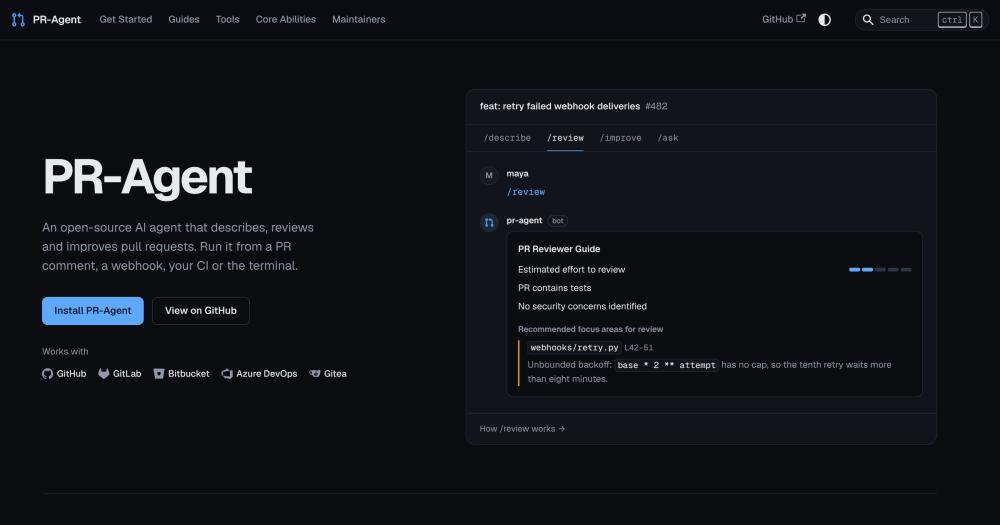
Analyzes a PR diff and produces a structured review with an estimated effort score, a list of key changes, a yes/no on whether tests are present, a security concern flag, and recommended focus areas with file and line references. Output appears as a comment on the PR, so it integrates with existing review workflows without changing how your team works.

/describe command

Rewrites the PR title and body from the diff, generating a walkthrough of changes grouped by file and type. Useful for PRs where the author submitted with a minimal description: the agent reads the actual code change and produces a human-readable summary, reducing the reviewer's first-pass orientation time.

/improve command

Scans the PR diff for code quality issues and suggests inline fixes as review comments. Each suggestion names the specific file and line and proposes a concrete code change, not a generic warning. The command runs in a single LLM call, so latency stays low even on larger diffs.

Multi-platform Git support

Works across GitHub, GitLab, Bitbucket, Azure DevOps, and Gitea. Each platform uses the same command set (/review, /describe, /improve, /ask), and each has a documented installation path: GitHub Action, GitLab webhook, Bitbucket app, or Azure DevOps pipeline step. Teams running their own GitLab instance can self-host PR-Agent alongside it.

LiteLLM-based model routing

Any LLM reachable through LiteLLM works as the backend: OpenAI GPT, Anthropic Claude, Google Gemini, DeepSeek, Mistral, Azure OpenAI, AWS Bedrock, Vertex AI, Databricks, OpenRouter, and Ollama for fully local inference. Switching models is a configuration change, not a code change.

strengths · trade-offs

Strengths and trade-offs#

Strengths

  • No per-seat or per-PR billingRunning PR-Agent on your own infrastructure means you pay only for LLM API calls at market rates, with no additional subscription. For teams with high PR volume, this is materially cheaper than CodeRabbit or Qodo Merge at their published per-seat prices.
  • Fully local inference with OllamaBecause PR-Agent routes through LiteLLM, you can point it at Ollama running on your own server and review PRs with no external API calls at all. For teams with strict data-residency requirements, Ollama integration means code never leaves your infrastructure and no external API key is required.
  • 14,800+ stars, community-ownedWith over 14,800 GitHub stars and 2,099 forks, PR-Agent has a large contributor base. Created by Qodo (formerly CodiumAI) and donated to the open-source community, it is now independently maintained under The-PR-Agent organization and in the process of being donated to an open-source foundation.
  • MIT license with no usage restrictionsMIT means you can run it in commercial production, modify the prompts, and fork the project without restriction. No copyleft, no resale prohibition, and no clauses that change if you scale past a usage threshold.

Trade-offs

  • -Requires your own LLM API keyUnlike managed services that bundle the LLM, PR-Agent needs you to supply an API key (OpenAI, Anthropic, etc.) or run your own model via Ollama. That means LLM API costs are yours to manage, and you are responsible for staying within rate limits, rotating keys, and handling provider outages.
  • -Community-maintained, no commercial SLAPR-Agent is a community project with no official commercial support tier. The 21 open issues on the repository are modest, but feature requests and bug reports depend on volunteer contributors. Teams that need a guaranteed response time should factor that in against paid alternatives.
  • -/help_docs temporarily disabledAs of v0.36.1, the /help_docs command is disabled pending a fix for a credential-exposure issue (#2445). Teams relying on in-PR documentation lookup will not have that feature until the fix ships.
versus alternatives

Pr Agent vs alternatives#

PR-Agent vs CodeRabbit

Both tools automate pull request review with AI, but they serve different infrastructure models. CodeRabbit is a managed SaaS product. You connect your GitHub or GitLab account, and reviews run on CodeRabbit's infrastructure using their hosted model. PR-Agent runs on your own servers using the LLM provider you choose.

FeaturePR-AgentCodeRabbit
LicenseMITProprietary
Self-hostingYesNo
LLM choiceAny via LiteLLM (OpenAI, Claude, Gemini, Ollama)Hosted model
PricingFree (LLM API costs only)Per-seat subscription
Git platformsGitHub, GitLab, Bitbucket, Azure DevOps, GiteaGitHub, GitLab, Bitbucket, Azure DevOps

PR-Agent wins when data privacy or cost control drives the decision. At high PR volume, LLM API costs are predictable and far below per-seat pricing. For teams where code must stay on-premises, Ollama integration means no external API calls.

CodeRabbit is worth considering when you want a zero-configuration managed product with no infrastructure to maintain. Its setup is a GitHub App install with no servers required; PR-Agent's GitHub Action setup takes more configuration but is straightforward from the README.

PR-Agent vs Qodo Merge

PR-Agent was originally created by Qodo (then CodiumAI) as an open source project. Qodo Merge is Qodo's separate commercial offering, now rebranded as Qodo 2.0, described in the README as providing a feature-rich, context-aware experience that is distinct from PR-Agent. The two share conceptual DNA but are independent products.

PR-Agent is the community-maintained open source path: MIT licensed, self-hosted, model-agnostic. Qodo Merge is the commercial path, hosted by Qodo, with enterprise integrations and paid support. Teams that started on PR-Agent and need enterprise features can evaluate Qodo Merge without switching command syntax.

PR-Agent vs Sourcery

Sourcery focuses on code quality improvement, suggesting refactors and style fixes inline. Its review functionality overlaps with PR-Agent's /improve command, but its scope is narrower. Sourcery is a managed product with per-seat pricing; PR-Agent is self-hosted and free to run beyond LLM API costs.

For teams primarily interested in automated code quality feedback, both tools reach the same end. PR-Agent is the stronger fit when the team also needs /describe and /ask, or when self-hosting and model choice are requirements.

install · quick start

Quick start#

bash
Install PR-Agent via pip to review pull requests from the command line.

```bash
pip install "pr-agent[github]"
```
tech stack · detected from GitHub

What it's built on#

Languages
Python
Frameworks
FastAPIReact
Infrastructure
AWS
frequently asked

FAQ#

Does PR-Agent work with GitLab, Bitbucket, and Azure DevOps, or only GitHub?

PR-Agent supports GitHub, GitLab, Bitbucket, Azure DevOps, and Gitea. Each platform has a documented installation path: GitHub gets a native Actions workflow, GitLab uses a webhook, Bitbucket has a dedicated app, and Azure DevOps uses a pipeline step. The same /review, /describe, /improve, and /ask commands work across all five platforms.

What LLM does PR-Agent use, and can I use my own model?

PR-Agent routes through LiteLLM, so it works with OpenAI GPT, Anthropic Claude, Google Gemini, DeepSeek, Mistral, Azure OpenAI, AWS Bedrock, Vertex AI, and Ollama. To use Ollama, configure PR-Agent to point at the local endpoint; no external API key is required, and code stays on your infrastructure. Switching providers is a configuration change, not a code change.

Is PR-Agent the same as Qodo Merge?

No. PR-Agent is the original open source project created by Qodo (formerly CodiumAI) and donated to the community. It is now maintained independently under the The-PR-Agent GitHub organization. Qodo Merge is Qodo's separate commercial product, Qodo 2.0, which is a hosted service with its own pricing. PR-Agent's README states: 'This project is not the Qodo free tier.'

How much does running PR-Agent cost?

PR-Agent itself is MIT-licensed and free to run. The main ongoing cost is LLM API usage. The README notes that each tool call (/review, /improve, /ask) is a single LLM call that takes roughly 30 seconds at low cost. For a team making dozens of PRs per day, the API bill is typically a few dollars per month depending on the model and PR size. Using Ollama eliminates API costs entirely.

Can PR-Agent run as a GitHub Action automatically on every pull request?

Yes. The recommended installation is a GitHub Actions workflow that triggers on the pull_request event types opened and synchronize. Add a .github/workflows/pr-agent.yml file with an OPENAI_KEY secret and the pr-agent action step, and reviews run automatically without any PR author action required.

also worth a look

Similar open-source tools#

no_human

Alternative toConductor

From ticket to reviewed pull request, on your machine.

  • 331 GitHub stars
  • MITLicence MIT

Code Server

Alternative toGitHub Codespaces

VS Code in the browser, self-hosted, with no per-seat pricing.

  • 79,767 GitHub stars
  • MITLicence MIT

Self Host

Alternative toEasypanel

CLI tool for 93 self-hosted apps with an agent-ready install workflow.

  • 1,501 GitHub stars
  • Apache-2.0Licence Apache-2.0

Zeroshot

Alternative toConductor

Enforced QA workflow engine for coding agents, MIT licensed

  • 2,096 GitHub stars
  • MITLicence MIT

Bifrost

Alternative toPortkey

Open-source AI gateway with 23+ providers, failover, and MCP support.

  • 9,291 GitHub stars
  • Apache-2.0Licence Apache-2.0

Duckle

Alternative toFivetran

Self-hosted ETL on DuckDB with 385 connectors and no per-row billing.

  • 1,548 GitHub stars
  • Apache-2.0Licence Apache-2.0
by category

Open source tools in these categories#

565

Developer Tools

REA (Reverse Engineer Anything), Skills for Real Engineers, superpowers
481

AI & Machine Learning

freeCodeCamp, REA (Reverse Engineer Anything), OpenClaw
116

DevOps & CI/CD

Nvm, Uptime Kuma, Netdata
Hostinger

Self-host Pr Agent on a Hostinger VPS

Keep it running 24/7, even when your laptop is off. A Hostinger VPS gives it a server of its own.

  1. 01

    Choose a plan

    Starts from $6.49/mo

  2. 02

    Apply

    Extra 10% off yearly plans

  3. 03

    Install Pr Agent

    On a server that stays on

  4. 04

    Start building

    Focus on the app, not the server

Deploy on Hostinger

Sponsors

Inbox Zero

Alternative toSuperhuman

AI email assistant that drafts replies and clears your inbox

  • 12,889 GitHub stars
  • AGPL-3.0Licence AGPL-3.0
  • #Email

rakazo

Alternative toGrok Bot

AI teammates you own: your keys, your model, your machine.

  • 7,028 GitHub stars
  • Apache-2.0Licence Apache-2.0
  • #AI Agents

SnitchFeed

Live monitoring on LinkedIn, X, Reddit & more. Agentic social listening for startups.

Marketing & Growth

Advertise your product

New open source projects by email

The projects we add and every new guide. Free, unsubscribe any time.

Find open source alternatives to paid software

/
  • Claude Code to OpenCode
  • Jira to Windshift
  • Notion to AppFlowy
  • Slack to Mattermost
  • Linear to GitLab
  • Wispr Flow to Handy
  • Arc to Zen Browser
  • CapCut to Concat
  • Grok Bot to rakazo
  • Superhuman to Inbox Zero
  • Airtable to AITable
  • Muse to OpenClaw
  • Railway to Coolify
  • GitHub Copilot to Cline
  • Datadog to Netdata
  • Confluence to Wiki.js
  • Microsoft Teams to Rocket.Chat
  • Firebase to Supabase
  • Pinecone to Qdrant
  • Zapier to n8n
  • 1Password to KeePassXC
  • Devin AI to OpenHands
  • Asana to Leantime
  • Contentful to Strapi