Open Source Alternatives
  • Alternatives
  • Categories
    Categories by size1,201 projects
    • Developer Tools620
    • AI & Machine Learning521
    • Business & Productivity293
    • Web Development215
    • Security & Monitoring180
    • Communication & Collaboration161
    • IT Management151
    • LLMOps & AI Tooling132
    • Cloud & Hosting129
    • Product & Project Management126
    Browse all 21 categoriesDesign & Creative, DevOps & CI/CD and 9 more
  • Blog
  • Advertise
SearchNotion, Slack, password manager.../
Submit
Open Source Alternatives
  • Alternatives
    • Developer Tools620
    • AI & Machine Learning521
    • Business & Productivity293
    • Web Development215
    • Security & Monitoring180
    • Communication & Collaboration161
    • Browse all 21 categories
  • Blog
  • Advertise
Submit your project

New open source projects by email

The projects we add and every new guide. Free, unsubscribe any time.

Open Source Alternatives LogoOpen Source Alternatives

Handpicked Open Source Alternatives to Paid Softwares

Add Open Source Alternatives as a preferred source on Google

Product

  • Categories
  • Tag
  • Advertise

Resources

  • Blog
  • Collection
  • Submit

Company

  • Privacy Policy
  • Terms of Service
  • Refund Policy
  • Sitemap

Alternatives

  • Claude Code
  • Jira
  • Notion
  • Slack
  • Linear
  • Wispr Flow
  • All alternatives
© 2026 Open Source Alternatives. All rights reserved.
Open SourceAlternatives
Home/Categories/Backend Development/Milvaion
icon of Milvaion

Milvaion

Open source alternative to Hangfire Pro

  • 81 stars
  • Apache-2.0
  • Active this week
  • Last commit today

Last verified Nov 11, 2026

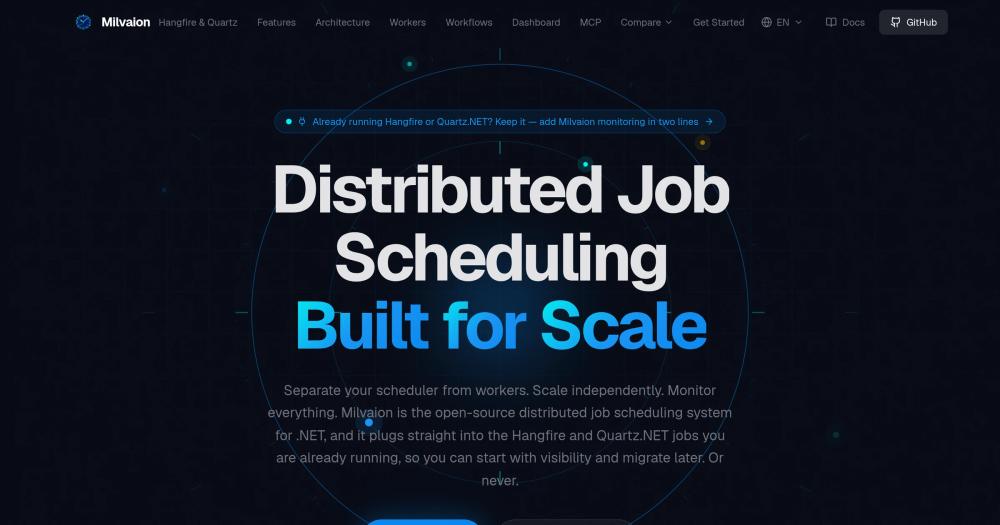
Orchestrate distributed .NET background jobs with a self-hosted unified dashboard, decoupled workers, and drop-in Hangfire monitoring.

Visit websiteGitHub81 starsDeploy on Hostinger
Image for Milvaion
TL;DR

Milvaion is a distributed job scheduling system for .NET 10 that separates scheduling logic from job execution, connecting the two via Redis and RabbitMQ. It offers an open source alternative to commercial .NET job frameworks like Hangfire Pro, providing a unified dashboard across every service in your estate rather than a per-application view, with PostgreSQL-stored execution history that persists beyond each library's retention window. Licensed under Apache 2.0 and self-hosted with Docker or Kubernetes, the stack scales horizontally by adding workers without touching the scheduler. Best for .NET teams managing background jobs across multiple microservices who need centralized observability and independent scaling of job execution.

Read the full breakdownHide the full breakdownWho it is for, how it works, trade-offs, the quick start and the FAQ
who it's for

Who Milvaion is for#

Platform engineers consolidating .NET job observability

When background jobs run across a dozen services, each with its own Hangfire dashboard, Milvaion's unified view gives platform teams a single place to check job health, review execution history, and configure alerts. The two-line drop-in integration for existing services means adoption does not require coordinating application changes across every development team.

Skip if:

Teams running a single .NET service with straightforward job requirements will find in-process Hangfire or Quartz.NET simpler to operate than a full distributed scheduler infrastructure.

Backend engineers building multi-step data pipelines in .NET

The DAG-based workflow engine lets backend engineers model complex job sequences with conditional branching and data passing between steps, without building their own orchestration layer. The visual builder in the dashboard makes it easy to inspect and modify pipeline structure without code changes.

Skip if:

Teams whose jobs are independent and not dependent on each other's outputs do not need the workflow engine; a standard scheduler handles that use case with less infrastructure.

DevOps teams running HTTP and SQL maintenance jobs on a schedule

The built-in HTTP Worker and SQL Worker run REST calls and database queries on a cron schedule with no code required. Teams maintaining scheduled API calls, nightly reports, or database cleanup procedures can configure these through the dashboard without writing or deploying custom job code.

Skip if:

If your scheduled jobs require complex branching or data transformations that the built-in workers cannot express, the same use case calls for a custom worker with the Milvaion SDK.

the problem

The problem it solves#

Background jobs in .NET microservices grow into a monitoring mess. When every service runs its own Hangfire or Quartz.NET instance, checking job health means opening a different dashboard per service, and history disappears when each library's retention window expires. Nobody has a single answer to "which jobs failed last night?" without paging through a dozen URLs.

The architectural problem runs deeper. When scheduling and execution run inside the same process, a long job blocks others from starting, a crashing job can take the scheduler down with it, and there is no way to give GPU-intensive jobs their own dedicated workers. Scaling job throughput means scaling the entire application, not just the execution tier. For teams operating at any real volume across multiple services, in-process schedulers become a ceiling.

how Milvaion solves it

How it solves it#

Scheduler-worker separation via RabbitMQ

The API server decides when and what runs; workers receive job messages from RabbitMQ and report status back. The two processes are fully independent: workers can be added, removed, or scaled horizontally without restarting the scheduler. Job-type routing lets you direct specific jobs to workers with the right hardware, such as dedicated workers for GPU or memory-intensive tasks.

Drop-in monitoring for Hangfire and Quartz.NET

If your services already run Hangfire or Quartz.NET, you can add Milvaion's unified dashboard with two lines of service registration code. Your existing scheduler keeps owning triggers, storage, and cron expressions; job code stays unchanged. Every Hangfire and Quartz.NET job appears in the dashboard as an external job, alongside any native Milvaion workers.

DAG-based workflow engine with visual builder

Chain multiple jobs into directed acyclic graphs with a drag-and-drop editor in the dashboard. Workflow nodes support conditional branching (true/false ports based on output or status), merge nodes that wait for all parallel branches, and data mappings that pass output fields from one step as input to the next. Failure strategies can stop the whole workflow on first failure or continue independent branches.

Four built-in workers requiring no job code

HTTP Worker calls REST endpoints on a schedule, SQL Worker runs database queries, Email Worker sends messages via SMTP, and Maintenance Worker handles Milvaion's own data cleanup and archival. All four run out of the box and are configured through the dashboard rather than written as application code.

Real-time dashboard with persistent execution history

The React dashboard uses SignalR for live updates on running jobs, worker heartbeats, and per-execution logs. Execution history stores in PostgreSQL, so it persists beyond each library's default retention window. OpenTelemetry support exports metrics and traces to external observability stacks, and technical logs can be forwarded to Seq.

strengths · trade-offs

Strengths and trade-offs#

Strengths

  • Adopt incrementally, keeping existing Hangfire job code intactTeams already on Hangfire or Quartz.NET can add Milvaion monitoring with two lines of service registration code, with no migration window and no changes to existing job code, triggers, or storage configuration. You can stop at the monitoring layer permanently or migrate individual jobs to Milvaion workers selectively over time.
  • Apache 2.0 license with no per-seat or per-job feesMilvaion is Apache 2.0 licensed, which allows use, modification, and distribution for any purpose, including commercial use, without licensing fees. Unlike paid commercial frameworks that charge per developer or per execution tier, running Milvaion on your infrastructure costs only the servers it runs on.
  • Independent scaling of workers and schedulerBecause execution is decoupled from scheduling, you can scale the worker pool horizontally for throughput without touching the API server. Job-type routing assigns specific job types to specialized worker instances, so a resource-intensive batch job does not compete for capacity with lightweight event-driven jobs.
  • MCP server for AI assistant access to job dataMilvaion exposes an MCP server that integrates with Claude Code, Cursor, or GitHub Copilot. More than forty tools cover reading job status and history, triggering runs, pausing jobs, and making edits, each gated by the same role-based permissions as the main REST API. A read-only API key gives an AI assistant full visibility with no ability to change anything.

Trade-offs

  • -Requires PostgreSQL, Redis, and RabbitMQ to runThe full Milvaion stack needs three external services alongside the application: PostgreSQL 16, Redis 7, and RabbitMQ 3.x. For teams running single-service .NET applications, this is a heavier infrastructure footprint than running Hangfire alone. Docker Compose covers local development, but production deployments need each service properly provisioned and monitored.
  • -.NET 10 required for all integrationsMilvaion is built on .NET 10. Teams whose services run on .NET 6, 7, or 8 would need to upgrade before adopting either the native worker SDK or the drop-in Hangfire and Quartz.NET monitoring integrations. This is a meaningful prerequisite for organizations with long-running LTS releases.
  • -Early-stage project with limited production track recordMilvaion was created in January 2026 and had 81 GitHub stars at the time of this listing. Teams that require a large ecosystem of community plugins, documented long-term production history, or extensive third-party integrations should evaluate maturity against those criteria before committing.
versus alternatives

Milvaion vs alternatives#

Milvaion vs Hangfire Pro

Milvaion and Hangfire Pro are both .NET background job frameworks, but they address different architectural concerns. Hangfire Pro is a commercial extension of open source Hangfire that adds advanced queue management, batches, continuations, and a polished in-process dashboard; it runs inside your application's process alongside your job code. Milvaion separates the scheduler from execution at the infrastructure level and provides one dashboard across every service in your environment.

FeatureMilvaionHangfire Pro
LicenseApache 2.0Proprietary
Self-hostingYes, Docker or KubernetesYes, runs inside your application
Dashboard scopeUnified, cross-servicePer application instance
Scheduler-worker separationYes, via RabbitMQNo, in-process execution
Workflow DAG engineYesNo (batches only)
Drop-in monitoring for existing HangfireYesn/a
.NET 10 requiredYesNo

Milvaion is the better choice when you need visibility across multiple services, independent scaling of job execution, DAG-based workflow orchestration, or the ability to route job types to specialized hardware. The overhead of maintaining Redis, RabbitMQ, and PostgreSQL makes it more infrastructure than a single-service application typically needs.

Hangfire Pro remains a sound choice for teams managing background jobs inside a single application or a small number of tightly coupled services. Its in-process model requires no external message broker, and its batch and continuation APIs cover most multi-step job patterns without a separate orchestration layer. For teams already committed to the Hangfire ecosystem and not requiring cross-service observability, Hangfire Pro is a lower-overhead path than adopting a full distributed scheduler.

install · quick start

Quick start#

bash
Deploy the Milvaion server stack locally with Docker Compose.

```bash
git clone https://github.com/Milvasoft/milvaion.git
cd milvaion
cp .env.example .env
docker compose up -d
```
tech stack · detected from GitHub

What it's built on#

Languages
C#JavaScript
Frameworks
React
Runtimes
.NET
frequently asked

FAQ#

Does Milvaion replace Hangfire or Quartz.NET, or work alongside them?

It works alongside them without requiring migration. Adding Milvaion monitoring to an existing Hangfire or Quartz.NET service takes two lines of service registration code; your existing job code, storage, and cron expressions stay unchanged. You can keep running Hangfire and Quartz.NET indefinitely and use Milvaion only for the unified dashboard and execution history. Migrating individual jobs to Milvaion native workers is optional and can happen selectively over time.

What infrastructure does self-hosting Milvaion require?

The stack needs PostgreSQL 16, Redis 7, RabbitMQ 3.x, and .NET 10 on the host. The quick start uses Docker Compose, which starts all services together from a single configuration file. For production, the documentation covers Docker and Kubernetes deployment patterns, horizontal scaling of workers, and reliability settings including retry backoff, dead-letter queues, and zombie detection for stuck jobs.

Is Milvaion free for commercial use?

Yes. Milvaion is Apache 2.0 licensed, which permits use, modification, and distribution for any purpose including commercial use with no licensing fees. You run it on your own infrastructure; the only costs are the servers the stack runs on.

Can Milvaion route jobs to specialized hardware like GPU workers?

Yes. Because workers are separate processes that connect via RabbitMQ, you can configure job-type routing to direct specific jobs to workers deployed on specialized hardware. A GPU-intensive machine learning job and a lightweight notification job can each have their own dedicated worker pool, scaled independently of the API server and each other.

How does Milvaion's MCP server work with AI coding assistants?

Milvaion exposes an HTTP MCP server at your deployment URL under /mcp. You add it to your AI assistant's MCP configuration with an API key. More than forty tools are available, covering reading job status and history, triggering runs, pausing jobs, and making edits, each gated by the same role-based permissions as the REST API. A read-only API key gives full visibility with no ability to change job configuration.

also worth a look

Similar open-source tools#

Bugsink

Alternative toSentry

Self-hosted error tracking, drop-in compatible with all Sentry SDKs.

  • 2,186 GitHub stars
  • CustomLicence PolyForm Shield License 1.0.0

Alchemy

Alternative toPulumi Cloud

Type-safe cloud infrastructure and app logic in one TypeScript program

  • 1,909 GitHub stars
  • Apache-2.0Licence Apache-2.0

Nvm

InDeveloper Tools

Switch Node.js versions per shell with a single bash command

  • 95,858 GitHub stars
  • MITLicence MIT

FckSignups

InCustomer Support

Open-source tools that work instantly, no signup required

  • 4,580 GitHub stars
  • GPL-3.0Licence GPL-3.0

DeepSeek TUI

Alternative toClaude Code

A coding agent that lives in your terminal.

  • 41,176 GitHub stars
  • MITLicence MIT

Encore

Alternative toAWS Amplify

Auto-generate infrastructure from your TypeScript or Go code

  • 12,704 GitHub stars
  • MPL-2.0Licence MPL-2.0
by category

Open source tools in these categories#

86

Backend Development

dify, graphify, Rust
124

DevOps & CI/CD

Nvm, Uptime Kuma, Netdata
620

Developer Tools

REA (Reverse Engineer Anything), Skills for Real Engineers, superpowers
Hostinger

Self-host Milvaion on a Hostinger VPS

Keep it running 24/7, even when your laptop is off. A Hostinger VPS gives it a server of its own.

  1. 01

    Choose a plan

    Starts from $6.49/mo

  2. 02

    Apply

    Extra 10% off yearly plans

  3. 03

    Install Milvaion

    On a server that stays on

  4. 04

    Start building

    Focus on the app, not the server

Deploy on Hostinger

Sponsors

Inbox Zero

Alternative toSuperhuman

AI email assistant that drafts replies and clears your inbox

  • 12,987 GitHub stars
  • AGPL-3.0Licence AGPL-3.0
  • #Email

rakazo

Alternative toGrok Bot

AI teammates you own: your keys, your model, your machine.

  • 7,869 GitHub stars
  • Apache-2.0Licence Apache-2.0
  • #AI Agents

SnitchFeed

Live monitoring on LinkedIn, X, Reddit & more. Agentic social listening for startups.

Marketing & Growth

Advertise your product

New open source projects by email

The projects we add and every new guide. Free, unsubscribe any time.

Find open source alternatives to paid software

/
  • Claude Code to OpenCode
  • Jira to Windshift
  • Notion to AppFlowy
  • Slack to Mattermost
  • Linear to GitLab
  • Wispr Flow to Handy
  • Arc to Zen Browser
  • CapCut to Concat
  • Grok Bot to rakazo
  • Superhuman to Inbox Zero
  • Airtable to AITable
  • Muse to OpenClaw
  • Railway to Coolify
  • GitHub Copilot to Cline
  • Datadog to Netdata
  • Confluence to Wiki.js
  • Microsoft Teams to Rocket.Chat
  • 1Password to KeePassXC
  • Firebase to Supabase
  • Pinecone to Qdrant
  • Zapier to n8n
  • Devin AI to OpenHands
  • Asana to Leantime
  • Contentful to Strapi