Open Source Alternatives
  • Alternatives
  • Categories
    Categories by size1,102 projects
    • Developer Tools555
    • AI & Machine Learning470
    • Business & Productivity268
    • Web Development208
    • Security & Monitoring171
    • Communication & Collaboration153
    • IT Management145
    • Cloud & Hosting127
    • LLMOps & AI Tooling122
    • Data & Analytics118
    Browse all 21 categoriesProduct & Project Management, DevOps & CI/CD and 9 more
  • Blog
  • Advertise
SearchNotion, Slack, password manager.../
Submit
Open Source Alternatives
  • Alternatives
    • Developer Tools555
    • AI & Machine Learning470
    • Business & Productivity268
    • Web Development208
    • Security & Monitoring171
    • Communication & Collaboration153
    • Browse all 21 categories
  • Blog
  • Advertise
Submit your project

New open source projects by email

The projects we add and every new guide. Free, unsubscribe any time.

Open Source Alternatives LogoOpen Source Alternatives

Handpicked Open Source Alternatives to Paid Softwares

Product

  • Categories
  • Tag
  • Advertise

Resources

  • Blog
  • Collection
  • Submit

Company

  • Privacy Policy
  • Terms of Service
  • Refund Policy
  • Sitemap

Alternatives

  • Claude Code
  • Jira
  • Notion
  • Slack
  • Linear
  • Wispr Flow
  • All alternatives
© 2026 Open Source Alternatives. All rights reserved.
Open SourceAlternatives
Home/Categories/Developer Tools/Bugsink
icon of Bugsink

Bugsink

Open source alternative to Sentry, Rollbar, Bugsnag, Honeybadger, Raygun and Airbrake

  • 2.2K stars
  • PolyForm Shield License 1.0.0
  • Active this week
  • Last commit today

Last verified Nov 5, 2026

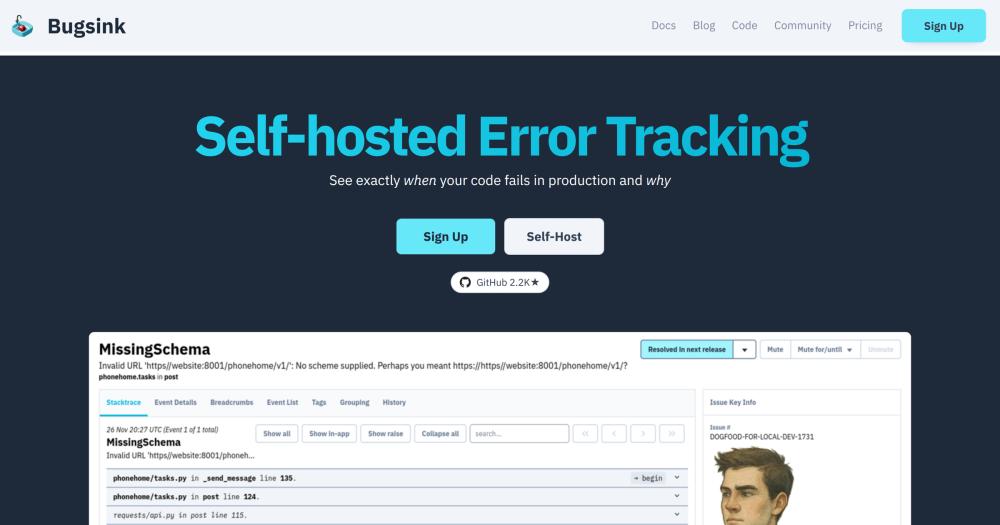
Track errors self-hosted, with full stacktraces, local variables, and drop-in Sentry SDK compatibility at predictable cost.

Visit websiteGitHub2.2K starsDeploy on Hostinger
image of Bugsink
TL;DR

Bugsink is a self-hosted error tracking tool that captures full stacktraces with local variable state at every exception. It replaces paid services like Sentry, Rollbar, and Bugsnag. Self-hosting means no per-event billing; your team handles millions of events at infrastructure cost only. Bugsink is compatible with all Sentry-compatible SDKs for Python, JavaScript, Go, Ruby, PHP, and more, so migrating means updating one DSN value. Best for backend teams facing event-volume billing or who need error data on infrastructure they control; licensed under PolyForm Shield 1.0.0, which permits self-hosting and internal commercial use.

Read the full breakdownHide the full breakdownWho it is for, how it works, trade-offs, the quick start and the FAQ
who it's for

Who Bugsink is for#

Backend teams already using Sentry SDKs

Teams instrumented with Sentry SDKs who want to reduce their monthly monitoring bill can migrate by changing a single DSN value. No instrumentation changes are needed. The full stacktrace and local variable capture remains identical to what Sentry provides.

Skip if:

Skip if your team has no existing Sentry SDK instrumentation and is evaluating error trackers from scratch. Bugsink's main advantage is a zero-friction migration path; starting fresh removes that edge.

Teams handling high event volumes

Development teams running services that generate a large number of exceptions, whether from traffic spikes, background jobs, or noisy error conditions, benefit most from a self-hosted model. Event-volume costs that grow linearly on hosted services become a fixed infrastructure cost instead.

Skip if:

Skip if your production error rate is low and your hosted error tracker plan is well below its tier limit. The cost argument is weakest when event volume is small.

GDPR-sensitive applications

Applications that handle EU user data and need to control where exception payloads and local variable captures are stored can self-host on their own infrastructure or use the managed EU-hosted plan. Exception data, which may include user context, stays within controlled boundaries.

Skip if:

Skip if data residency is not a concern and you prefer a fully managed service with no infrastructure overhead. Hosted Sentry and Bugsnag remain strong options for teams without compliance constraints.

Solo developers and small teams on a budget

A single Docker command gets Bugsink running locally. The self-hosted path has no licensing cost for internal use under PolyForm Shield, so small teams can track production errors without a recurring SaaS subscription.

Skip if:

Skip if you need built-in performance monitoring, tracing, or session replay in the same tool. Bugsink focuses on error and exception tracking; Sentry's full paid plan covers a wider observability surface.

the problem

The problem it solves#

Hosted error tracking charges by event volume. A backend service that throws exceptions during a traffic spike or a noisy logging period can generate events in large numbers with no corresponding limit on the monthly bill. Most hosted error trackers tier by error volume, so the more exceptions your production systems generate, the more you pay. Rollbar, Bugsnag, and Sentry all follow this model on their hosted plans.

The other issue is data residency. Exception payloads contain stacktraces, local variable values, and sometimes user context. Sending that data to a third-party cloud service adds a dependency outside the team's control and raises questions for GDPR-regulated deployments. Teams that need their error data to stay on their own infrastructure have no option on the major hosted services.

how Bugsink solves it

How it solves it#

Drop-in Sentry SDK compatibility

Accepts events from any Sentry-compatible SDK without code changes. Updating the DSN in your existing Sentry configuration is the entire migration. SDKs for Python, JavaScript, Go, Ruby, PHP, Java, and other languages all work out of the box.

Full stacktraces with local variable capture

Every exception includes the full call stack and the value of every local variable at each frame at the moment the error fired. This gives you the exact state of the application at the point of failure, not just where it crashed.

No per-event billing on self-hosted instances

Self-hosted Bugsink has no event-volume caps or per-event charges. You pay for the server, not for the number of exceptions. The product website states teams can cut a Sentry invoice by up to 80% on a managed Bugsink plan.

Single Docker command to get started

The quickest path is one docker run command with three environment variables: a secret key, a superuser credential, and a port. No external database is required to evaluate the tool; a Postgres database is added for production persistence.

Managed and self-hosted on the same codebase

Bugsink offers a managed plan hosted in EU infrastructure alongside the self-hosted option. Both run the same product, so teams can switch between managed and self-hosted without changing SDK configuration or losing event history.

strengths · trade-offs

Strengths and trade-offs#

Strengths

  • Identical SDK interface as SentryAny application already instrumented with a Sentry SDK can point at Bugsink by changing one DSN value. No library change, no code rewrite. This removes the main friction from migrating away from a hosted error tracking plan.
  • Event storage without volume capsUnlike Sentry's hosted plans, which cap error events by tier, a self-hosted Bugsink instance stores every event it receives at no incremental cost. Teams running high-throughput services or frequent exception bursts are not penalized.
  • GDPR-friendly data locationSelf-hosting keeps all exception data, stacktraces, and local variables on the team's own infrastructure. The managed Bugsink plan runs in EU data centers. Both options let teams control where error payloads, which may contain user context, are stored.
  • Active development since August 2024The repository reached its last push on November 4, 2026 and has 2,166 stars and 146 forks. Over 2,000 teams are using Bugsink weekly according to the product website, with community testimonials noting easy setup and ARM compatibility.

Trade-offs

  • -PolyForm Shield license restricts competitive useBugsink uses the PolyForm Shield 1.0.0 license, which permits self-hosting and internal commercial use but forbids building a product that competes with Bugsink or any product its affiliates offer using the software. Teams that want to build a hosted error tracking service on top of Bugsink cannot do so under this license.
  • -115 open issues at the time of reviewThe GitHub repository carried 115 open issues at the time this entry was written (from GitHub Issues API, pull requests excluded). For a project launched in August 2024, this indicates active use and ongoing development, but also suggests some rough edges that more mature tools have resolved.
  • -No performance monitoring or distributed tracingBugsink focuses on error and exception tracking. It does not include performance monitoring, distributed tracing, profiling, or session replay. Teams that need a full observability surface beyond error tracking will need to combine Bugsink with separate tools, or stay on a hosted platform like Sentry that bundles all of them.
versus alternatives

Bugsink vs alternatives#

Bugsink vs Sentry

Sentry is the leading hosted error tracker and the product Bugsink is most directly designed to replace. Both track exceptions, capture stacktraces, and support the same SDK ecosystem. The primary difference is deployment model and billing.

FeatureBugsinkSentry (hosted)
LicensePolyForm Shield 1.0.0Proprietary
Self-hostingYes, single Docker commandYes, heavy multi-service stack
SDK compatibilityAll Sentry SDKsNative
Event billingNone on self-hostedBy event volume
Data locationYour infrastructure or EU managedUS-hosted by default

Bugsink is the better choice for teams already using Sentry SDKs who want self-hosting with no event-volume billing, or who need error data on EU or on-premises infrastructure. Sentry is worth choosing when you need its broader observability suite: performance monitoring, distributed tracing, profiling, and session replay are all part of Sentry's paid plans but absent from Bugsink.

Bugsink vs Rollbar

Rollbar offers real-time error tracking with deploy tracking, error grouping, and integrations with Slack, PagerDuty, and GitHub. Like Sentry, it is a hosted-only service that bills by event volume.

FeatureBugsinkRollbar
LicensePolyForm Shield 1.0.0Proprietary
Self-hostingYesNo
SDK compatibilitySentry SDKsRollbar SDKs
Pricing modelInfrastructure cost onlyPer-event tiers

Bugsink is the better choice when self-hosting is required or Rollbar's per-event billing has become a cost concern. Rollbar is worth choosing when you are already on its SDK ecosystem and need its deploy-linked error grouping and integration features.

Bugsink vs Bugsnag

Bugsnag specializes in mobile and web crash reporting, with strong SDK coverage for iOS, Android, and browser JavaScript. It is a hosted service with no self-hosting option.

FeatureBugsinkBugsnag
LicensePolyForm Shield 1.0.0Proprietary
Self-hostingYesNo
SDK compatibilitySentry SDKsBugsnag SDKs
Mobile SDK focusLimitedStrong

Bugsink is the better choice for backend server-side error tracking where Sentry SDK coverage is sufficient and self-hosting or cost control is a priority. Bugsnag is worth choosing when mobile crash reporting, its session-based pricing model, or its native iOS and Android SDKs are requirements.

install · quick start

Quick start#

bash
Self-hosting runs via Docker; a Postgres database is recommended for production deployments.

```bash
docker pull bugsink/bugsink:latest

docker run \
  -e SECRET_KEY=PUT_AN_ACTUAL_RANDOM_SECRET_HERE_OF_AT_LEAST_50_CHARS \
  -e [email protected]:admin \
  -e PORT=8000 \
  -p 8000:8000 \
  bugsink/bugsink
```
tech stack · detected from GitHub

What it's built on#

Languages
JavaScriptPython
Frameworks
Django
frequently asked

FAQ#

Is Bugsink free to use?

Self-hosted Bugsink is free for internal use under the PolyForm Shield 1.0.0 license. The license permits self-hosting, running, modifying, and distributing the software for any purpose that does not compete with Bugsink's own products. A managed hosted plan is also available for teams that want Bugsink without the infrastructure overhead.

Does Bugsink work with Sentry SDKs?

Yes. Bugsink is designed as a drop-in replacement for Sentry's ingest endpoint. Any application using a Sentry SDK, including SDKs for Python, JavaScript, Go, Ruby, PHP, and more, connects to Bugsink by updating the DSN. No other code changes are required.

How do I install Bugsink?

The quickest path is a single docker run command. You set three environment variables: SECRET_KEY (at least 50 random characters), CREATE_SUPERUSER (email:password format), and PORT. Map the port and visit the login screen at http://localhost:8000. Detailed installation instructions, including production Postgres configuration, are on the Bugsink documentation site at https://www.bugsink.com/docs/installation/.

What does the PolyForm Shield license mean for self-hosters?

PolyForm Shield 1.0.0 permits you to self-host, run, modify, and distribute Bugsink for any purpose, including internal commercial team use. The restriction is that you cannot use Bugsink to build a product that competes with Bugsink or its affiliates. For the overwhelming majority of teams, running Bugsink for their own error tracking falls well within the license.

How does Bugsink compare to self-hosted Sentry?

Sentry also publishes a self-hosted version, but it requires a full Docker Compose stack with multiple services and significantly more infrastructure than a single container. Bugsink starts with a single docker run command and a Postgres database. Teams looking for a lighter self-hosted error tracker often choose Bugsink over Sentry's self-hosted option for lower operational overhead.

also worth a look

Similar open-source tools#

Sentry

Alternative toRollbar

Real-time error tracking with performance monitoring and traces

  • 2,218 GitHub stars
  • MITLicence MIT

Healthchecks

Alternative toCronitor

Ping-URL monitoring for cron jobs, tasks, and background services.

  • 10,498 GitHub stars
  • BSD-3-ClauseLicence BSD-3-Clause

Termix

Alternative toTermius

Self-hosted, plugin-based server manager with SSH and remote desktop.

  • 15,837 GitHub stars
  • Apache-2.0Licence Apache-2.0

Infisical

Alternative toHashiCorp Vault

Self-hosted secrets, certs, and privileged access in one platform.

  • 30,275 GitHub stars
  • MITLicence MIT

Code Server

Alternative toGitHub Codespaces

VS Code in the browser, self-hosted, with no per-seat pricing.

  • 79,767 GitHub stars
  • MITLicence MIT

Shannon

Alternative toXBOW

Autonomous AI pentester for web apps and APIs, AGPL-licensed

  • 51,212 GitHub stars
  • AGPL-3.0Licence AGPL-3.0
by category

Open source tools in these categories#

555

Developer Tools

REA (Reverse Engineer Anything), Skills for Real Engineers, superpowers
171

Security & Monitoring

RustDesk, REA (Reverse Engineer Anything), Uptime Kuma
114

DevOps & CI/CD

Nvm, Uptime Kuma, Netdata
80

Backend Development

dify, graphify, Rust
Hostinger

Self-host Bugsink on a Hostinger VPS

Keep it running 24/7, even when your laptop is off. A Hostinger VPS gives it a server of its own.

  1. 01

    Choose a plan

    Starts from $6.49/mo

  2. 02

    Apply

    Extra 10% off yearly plans

  3. 03

    Install Bugsink

    On a server that stays on

  4. 04

    Start building

    Focus on the app, not the server

Deploy on Hostinger

Sponsors

Inbox Zero

Alternative toSuperhuman

AI email assistant that drafts replies and clears your inbox

  • 12,889 GitHub stars
  • AGPL-3.0Licence AGPL-3.0
  • #Email

rakazo

Alternative toGrok Bot

AI teammates you own: your keys, your model, your machine.

  • 7,028 GitHub stars
  • Apache-2.0Licence Apache-2.0
  • #AI Agents

SnitchFeed

Live monitoring on LinkedIn, X, Reddit & more. Agentic social listening for startups.

Marketing & Growth

Advertise your product

New open source projects by email

The projects we add and every new guide. Free, unsubscribe any time.

Find open source alternatives to paid software

/
  • Claude Code to OpenCode
  • Jira to Windshift
  • Notion to AppFlowy
  • Slack to Mattermost
  • Linear to GitLab
  • Wispr Flow to Handy
  • Arc to Zen Browser
  • CapCut to Concat
  • Grok Bot to rakazo
  • Superhuman to Inbox Zero
  • Airtable to AITable
  • Muse to OpenClaw
  • Railway to Coolify
  • GitHub Copilot to Cline
  • Datadog to Netdata
  • Confluence to Wiki.js
  • Microsoft Teams to Rocket.Chat
  • Firebase to Supabase
  • Pinecone to Qdrant
  • Zapier to n8n
  • 1Password to KeePassXC
  • Devin AI to OpenHands
  • Asana to Leantime
  • Contentful to Strapi