Open Source Alternatives
  • Alternatives
  • Categories
    Categories by size948 projects
    • Developer Tools491
    • AI & Machine Learning423
    • Business & Productivity208
    • Web Development199
    • Security & Monitoring143
    • Communication & Collaboration129
    • IT Management129
    • Cloud & Hosting112
    • LLMOps & AI Tooling109
    • Data & Analytics108
    Browse all 21 categoriesDesign & Creative, Product & Project Management and 9 more
  • Blog
  • Advertise
SearchNotion, Slack, password manager.../
Submit
Open Source Alternatives
  • Alternatives
    • Developer Tools491
    • AI & Machine Learning423
    • Business & Productivity208
    • Web Development199
    • Security & Monitoring143
    • Communication & Collaboration129
    • Browse all 21 categories
  • Blog
  • Advertise
Submit your project

New open source projects by email

The projects we add and every new guide. Free, unsubscribe any time.

Open Source Alternatives LogoOpen Source Alternatives

Handpicked Open Source Alternatives to Paid Softwares

Product

  • Categories
  • Tag
  • Advertise

Resources

  • Blog
  • Collection
  • Submit

Company

  • Privacy Policy
  • Terms of Service
  • Refund Policy
  • Sitemap

Alternatives

  • Claude Code
  • Jira
  • Notion
  • Slack
  • Linear
  • Wispr Flow
  • All alternatives
© 2026 Open Source Alternatives. All rights reserved.
Open SourceAlternatives
Home/Categories/DevOps & CI/CD/Minimal
icon of Minimal

Minimal

Open source alternative to Chainguard Images, Docker Hardened Images and Minimus

  • 554 stars
  • MIT
  • Active this week
  • Last commit today

Last verified Oct 29, 2026

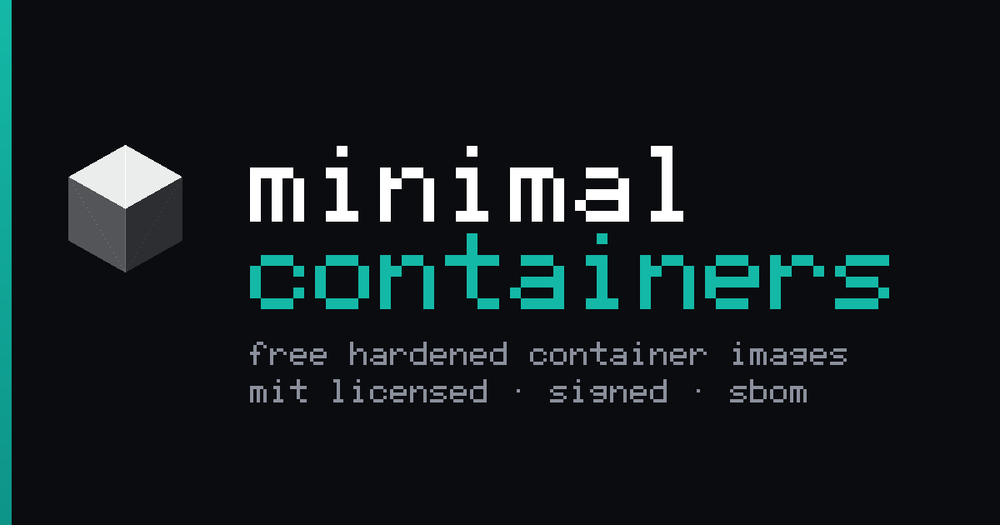
Deploy containers from 150 MIT-licensed, hardened base images. Cosign-signed, SBOM-attested, SLSA v1.0 provenance, rebuilt daily from Wolfi packages.

Visit websiteGitHub554 starsDeploy on Hostinger
image of Minimal
TL;DR

Minimal is a catalogue of 150 hardened container images, MIT-licensed and free for any use. It replaces paid commercial image services like Chainguard Images and Docker Hardened Images for teams that need cosign-signed, SBOM-attested base images without a subscription. Every image ships with SLSA v1.0 Build L2 provenance, is rebuilt daily from Wolfi packages, and is published to the GitHub Container Registry with no login required. Best for security-conscious engineering teams adopting supply-chain compliance, and for any project that currently pays for hardened images or runs unattested base images in production.

Read the full breakdownHide the full breakdownWho it is for, how it works, trade-offs, the quick start and the FAQ
who it's for

Who Minimal is for#

Security teams enforcing SLSA compliance on container builds

Every Minimal image ships SLSA v1.0 Build L2 provenance, a Cosign keyless signature, and an SPDX SBOM attached as in-toto attestations. You can verify the full chain from GitHub workflow to registry digest with a single gh attestation verify command before deployment, without building attestation infrastructure in-house.

Skip if:

Your compliance requirement specifies a vendor SLA, FedRAMP authorization, FIPS validation, or DISA STIG hardening; Minimal provides none of these programs.

Platform teams replacing unattested base images in CI pipelines

Replacing a common runtime base image (Python, Node.js, Nginx) means changing the FROM line and removing Dockerfile steps that install packages the Minimal image already includes. Daily rebuilds keep the base current with Wolfi package patches without a separate maintenance step on your side.

Skip if:

Your pipeline already pins images by SHA digest from a vendor that provides SLA-backed patching; the daily rebuild cadence is only an improvement over point-release base images, not over an already-hardened vendor image.

Developers building multi-stage Docker images

Minimal's -dev companion tags add a shell and toolchain to any production image, making them suitable as the build stage in a multi-stage Dockerfile. The shell-less production tag ships as the final stage, reducing attack surface without requiring a custom distroless base configuration.

Skip if:

Your application runtime is not among the 150 images in the catalogue. Check the full list at minimalcontainers.com before planning a migration.

the problem

The problem it solves#

Container images pulled from public registries carry known vulnerabilities by default. The official Python, Node.js, or Nginx images ship shell binaries and package managers that are unnecessary for most production workloads, run as root, and include packages that accumulate CVEs between releases. Rebuilding from scratch requires toolchain knowledge most teams don't have.

The deeper pain is verifiability. Without a cryptographic chain from source code to running image, a security audit cannot confirm that the image pulled in CI matches what the build system produced. Attestations like SBOM and SLSA provenance exist for this purpose, but generating them per image, signing them with Cosign, and publishing them to a transparency log is significant infrastructure work. Most teams skip it entirely and accept the compliance gap.

how Minimal solves it

How it solves it#

Daily rebuilds from Wolfi packages

Every image rebuilds on a 24-hour cycle against current Wolfi package versions. A CVE fix that lands upstream reaches a published tag within one day rather than waiting for a new upstream release. Each rebuild is rescanned with Grype and results are published on the Minimal site.

Cosign keyless signature on every tag

Every production tag is signed with Cosign's keyless workflow, pinned to a Rekor transparency log entry. Verifying the signature requires only the gh attestation verify command and the GitHub owner handle; no private key infrastructure to manage on your end.

SPDX SBOM and SLSA v1.0 Build L2 provenance

Each image ships an in-toto SPDX SBOM listing every package, version, and license included. The SLSA v1.0 Build Level 2 provenance attestation records the exact workflow, commit, and runner that built it, giving auditors a verifiable chain from source to registry digest.

Shell-less production images

Most images ship no /bin/sh, which removes the most common initial-access path in container escapes. The default user is UID 65532 (non-root). A -dev companion tag with a shell and toolchain is available for debugging and multi-stage builds, keeping the production attack surface minimal.

No-account pull from GHCR

All 150 images are published to the GitHub Container Registry as public packages. Anonymous docker pull from ghcr.io requires no login, no token, and does not count against Docker Hub's anonymous pull-rate limits. amd64 and arm64 architectures are both available on every image.

strengths · trade-offs

Strengths and trade-offs#

Strengths

  • MIT license with no paid tierAll 150 images are free for any use, including commercial production workloads, under the MIT license. There is no paid tier, no free-trial window, and no image withheld behind a subscription. The catalogue shown on the site is the complete catalogue.
  • Daily freshness vs. point-release base imagesMinimal rebuilds daily from Wolfi packages rather than on upstream release cycles, so CVE fixes appear in a pulled tag within 24 hours. Most public base images on Docker Hub stay at a pinned upstream release until the next major version. The rebuild cadence is documented and verifiable through the build badge and published CVE scan results.
  • Same provenance set as paid commercial imagesThe attestation set (Cosign signature, SPDX SBOM, SLSA v1.0 Build L2 provenance) that Chainguard and Docker Hardened Images supply on paid plans ships on every Minimal tag. The comparison pages publish head-to-head Grype scan results against a pinned vulnerability database for direct, verifiable comparison rather than marketing claims.

Trade-offs

  • -No vendor SLA or enterprise compliance programsMinimal has no support contract, vendor SLA, FedRAMP readiness, FIPS validation, or STIG hardening guides. Organizations with compliance requirements that mandate vendor-backed image support (FedRAMP High environments, DISA STIG) will need a commercial provider like Chainguard. The README states this directly: the signatures, SBOMs, and provenance help with verification and audits but do not replace those programs.
  • -Catalogue limited to 150 imagesThe catalogue covers common runtimes and servers (Python, Node.js, Go, Nginx, Postgres, Redis) but is significantly smaller than Chainguard's or Docker's commercial image libraries. If your application depends on a runtime not in the 150-image catalogue, you cannot use Minimal for that component.
  • -CVE scan results are informational, not a build gateA green build does not mean zero CVE findings. Grype scans run on every production image and results are published on the site, but findings do not block publication. Teams that require a zero-CVE gate before deploying must evaluate Grype output themselves rather than relying on the build status badge.
versus alternatives

Minimal vs alternatives#

Minimal vs Chainguard Images

Chainguard Images is the commercial leader in hardened, distroless container images, offering cosign signatures, SBOMs, and SLSA provenance across hundreds of images. Minimal covers the same attestation set across 150 common images at no cost.

FeatureMinimalChainguard Images
LicenseMITProprietary (free developer images available)
Paid tier requiredNoYes (production images)
Cosign signatureYesYes
SPDX SBOMYesYes
SLSA provenanceYes (Build L2)Yes
Rebuild cadenceDailyDaily
Catalogue size150 imagesHundreds
Vendor SLANoYes
FedRAMP / FIPS / STIGNoYes (select plans)

Minimal is the better choice when you need supply-chain attestations for common runtimes (Python, Node.js, Go, Nginx, Postgres, Redis) and do not require a vendor SLA or enterprise compliance programs. The MIT license means no per-seat or per-image fees regardless of workload scale.

Chainguard is worth the cost when your organization requires vendor-backed image support (FedRAMP High, DISA STIG), needs a runtime not in Minimal's 150-image catalogue, or needs contractual guarantees on patch response times.

Minimal vs Docker Hardened Images

Docker Hardened Images (DHI) are Docker's commercial offering of hardened base images with provenance attestations. Like Chainguard, DHI charges for production use.

FeatureMinimalDocker Hardened Images
LicenseMITProprietary
Paid tier requiredNoYes
Rebuild cadenceDailyRegular
RegistryGHCR (no pull limits)Docker Hub
AttestationsCosign, SPDX SBOM, SLSA v1.0 L2Cosign, SBOM, provenance

Minimal avoids Docker Hub's pull-rate limits entirely by publishing to the GitHub Container Registry. For CI pipelines that frequently exceed Docker Hub's anonymous pull limits, this is a tangible operational difference. DHI is the stronger choice when your organization already has a Docker subscription and needs support backed by Docker's enterprise contracts.
install · quick start

Quick start#

bash
Images are published to the GitHub Container Registry for direct docker pull.
```bash
docker pull ghcr.io/rtvkiz/minimal-python:latest
docker run --rm -p 8080:80 ghcr.io/rtvkiz/minimal-nginx:latest
```
tech stack · detected from GitHub

What it's built on#

Languages
JavaScriptTypeScript
Infrastructure
Docker
frequently asked

FAQ#

Are the Minimal container images really free for commercial use?

Yes. All 150 images are MIT-licensed and free for any use, including commercial production workloads. There is no paid tier, no free-trial period, and no image held behind a subscription. The MIT license permits use, modification, and redistribution with no restriction beyond preserving the copyright notice.

Do I need a Docker Hub account or login to pull Minimal images?

No. Images are published to the GitHub Container Registry (ghcr.io) as public packages. An anonymous docker pull requires no login, no token, and does not count against Docker Hub's anonymous pull-rate limits. No account of any kind is needed to pull or run the images.

How does Minimal compare to Chainguard Images or Docker Hardened Images?

All three supply cosign-signed, SBOM-attested base images with SLSA provenance. Minimal is MIT-licensed and free; Chainguard and Docker Hardened Images charge for production use. The trade-off is catalogue size (Minimal offers 150 images vs. hundreds from the commercial vendors) and the absence of a vendor SLA or enterprise compliance programs (FedRAMP, FIPS, STIG). The Minimal site publishes head-to-head Grype scan results for direct CVE comparison.

How do I verify a Minimal image's build provenance?

Run gh attestation verify oci://ghcr.io/rtvkiz/minimal-python:latest --owner rtvkiz using the GitHub CLI. This verifies the Cosign signature and SLSA provenance against the Rekor transparency log. The SPDX SBOM is also attached as an in-toto attestation on every published digest, listing every package, version, and license in the image.

What if I need to debug an image that has no shell?

Every production image has a -dev companion tag (for example, minimal-python:latest-dev) that adds a shell and a full toolchain. Use the -dev tag as the build stage in a multi-stage Dockerfile or for interactive debugging; ship the shell-less production tag as the final image to keep the attack surface low.

also worth a look

Similar open-source tools#

Keda

Alternative toKedify

Event-driven Kubernetes autoscaling with 70+ scalers and scale to zero

  • 10,674 GitHub stars
  • Apache-2.0Licence Apache-2.0

Container

Alternative toDocker Desktop

Linux containers as lightweight VMs, native to Apple silicon

  • 50,892 GitHub stars
  • Apache-2.0Licence Apache-2.0

Kamal

Alternative toFly.io

Zero-downtime Docker deploys to any server, no managed platform.

  • 14,692 GitHub stars
  • MITLicence MIT

CapRover

Alternative toHeroku

Self-hosted PaaS: deploys any language, automatic HTTPS, zero fees.

  • 15,194 GitHub stars
  • CustomLicence Apache-2.0 with additional terms

Dokploy

Alternative toHeroku

Self-hosted PaaS to deploy apps and databases across multiple servers

  • 38,089 GitHub stars
  • CustomLicence Apache-2.0 with proprietary enterprise directories

Unkey

Alternative toKong Konnect

Unified API keys, gateways, and observability for developers.

  • 5,480 GitHub stars
  • FSL-1.1-ALv2Licence FSL-1.1-ALv2
by category

Open source tools in these categories#

95

DevOps & CI/CD

Nvm, Uptime Kuma, Netdata
143

Security & Monitoring

REA (Reverse Engineer Anything), RustDesk, Uptime Kuma
491

Developer Tools

superpowers, REA (Reverse Engineer Anything), Skills for Real Engineers
112

Cloud & Hosting

dify, RuView, rtk
Hostinger

Self-host Minimal on a Hostinger VPS

Keep it running 24/7, even when your laptop is off. A Hostinger VPS gives it a server of its own.

  1. 01

    Choose a plan

    Starts from $6.49/mo

  2. 02

    Apply

    Extra 10% off yearly plans

  3. 03

    Install Minimal

    On a server that stays on

  4. 04

    Start building

    Focus on the app, not the server

Deploy on Hostinger

Sponsors

Inbox Zero

Alternative toSuperhuman

AI email assistant that drafts replies and clears your inbox

  • 12,826 GitHub stars
  • AGPL-3.0Licence AGPL-3.0
  • #Email

Omnara

Alternative toCClaude Managed Agents

Open-source agent deployment API. Self-host or use Omnara Cloud.

  • 3,296 GitHub stars
  • Apache-2.0Licence Apache-2.0
  • #AI Agents

rakazo

Alternative toGrok Bot

AI teammates you own: your keys, your model, your machine.

  • 5,914 GitHub stars
  • Apache-2.0Licence Apache-2.0
  • #AI Agents
Advertise your product

New open source projects by email

The projects we add and every new guide. Free, unsubscribe any time.

Find open source alternatives to paid software

/
  • Claude Code to OpenCode
  • Jira to Windshift
  • Notion to AppFlowy
  • Slack to Mattermost
  • Linear to GitLab
  • Wispr Flow to Handy
  • Arc to Zen Browser
  • CapCut to Concat
  • Grok Bot to rakazo
  • Superhuman to Inbox Zero
  • Airtable to AITable
  • Muse to OpenClaw
  • Railway to Coolify
  • GitHub Copilot to Cline
  • Datadog to Netdata
  • Microsoft Teams to Rocket.Chat
  • Confluence to Docmost
  • Pinecone to Qdrant
  • Zapier to n8n
  • Devin AI to OpenHands
  • Firebase to Supabase
  • 1Password to KeePassXC
  • Contentful to Strapi
  • Adobe Premiere Pro to Shotcut