Open Source Alternatives
  • Alternatives
  • Categories
    Categories by size1,114 projects
    • Developer Tools562
    • AI & Machine Learning478
    • Business & Productivity274
    • Web Development208
    • Security & Monitoring171
    • Communication & Collaboration153
    • IT Management145
    • Cloud & Hosting127
    • LLMOps & AI Tooling124
    • Data & Analytics118
    Browse all 21 categoriesProduct & Project Management, Design & Creative and 9 more
  • Blog
  • Advertise
SearchNotion, Slack, password manager.../
Submit
Open Source Alternatives
  • Alternatives
    • Developer Tools562
    • AI & Machine Learning478
    • Business & Productivity274
    • Web Development208
    • Security & Monitoring171
    • Communication & Collaboration153
    • Browse all 21 categories
  • Blog
  • Advertise
Submit your project

New open source projects by email

The projects we add and every new guide. Free, unsubscribe any time.

Open Source Alternatives LogoOpen Source Alternatives

Handpicked Open Source Alternatives to Paid Softwares

Product

  • Categories
  • Tag
  • Advertise

Resources

  • Blog
  • Collection
  • Submit

Company

  • Privacy Policy
  • Terms of Service
  • Refund Policy
  • Sitemap

Alternatives

  • Claude Code
  • Jira
  • Notion
  • Slack
  • Linear
  • Wispr Flow
  • All alternatives
© 2026 Open Source Alternatives. All rights reserved.
Open SourceAlternatives
Home/Categories/LLMOps & AI Tooling/Routerly
icon of Routerly

Routerly

Open source alternative to Portkey, Helicone, Bifrost and Kong AI Gateway

  • 107 stars
  • AGPL-3.0
  • Active this week
  • Last commit today

Last verified Nov 5, 2026

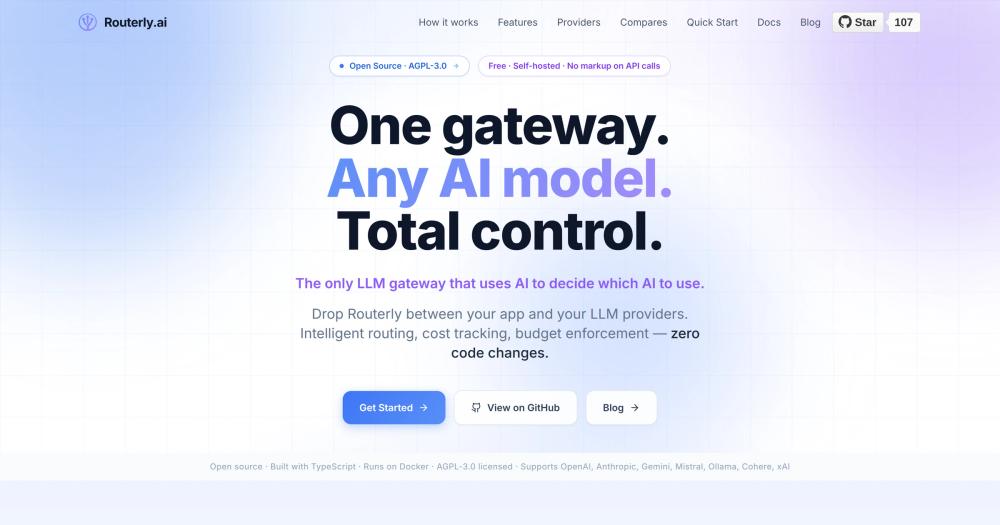
Run a self-hosted LLM gateway that routes requests across OpenAI, Anthropic, Gemini and Ollama with 11 composable policies and no database.

Visit websiteGitHub107 starsDeploy on Hostinger
Image for Routerly
TL;DR

Routerly is a self-hosted LLM gateway that routes requests across AI providers using 11 composable scoring policies, including an AI-powered policy that asks a language model to pick the best candidate for each prompt. It replaces paid services like Portkey and Helicone by keeping requests on your own infrastructure with built-in cost tracking, per-token pricing, and budget caps that block overspending before a call is made. Licensed under AGPL-3.0, it runs on Docker with no database required, making it accessible to individual developers and multi-tenant platform teams alike.

Read the full breakdownHide the full breakdownWho it is for, how it works, trade-offs, the quick start and the FAQ
who it's for

Who Routerly is for#

Platform engineers building multi-tenant AI products

Routerly's project isolation model assigns each tenant a router token with its own model list and monthly spend cap. The gateway enforces the cap before any request reaches a provider, so a single over-spending tenant cannot affect others. No application code changes are needed to onboard a new tenant.

Skip if:

If your tenants need dedicated server isolation rather than token-level isolation, running a separate Routerly instance per tenant may be more appropriate than sharing one deployment.

Developers evaluating or switching AI providers

Routing your app through Routerly means model changes happen in the dashboard, not in code. The A/B testing feature splits live traffic between two router configurations, so you can compare a cheaper model against the current one on real production requests and see cost, latency, and error rate side by side before committing.

Skip if:

If you use a single provider and have no plans to change models, running a gateway adds latency and infrastructure overhead with no benefit.

Teams centralizing access to Cursor, Open WebUI, or similar AI tools

Routerly accepts connections from any tool that speaks the OpenAI or Anthropic format. Configure Cursor, Open WebUI, LibreChat, or LangChain to point at Routerly instead of the provider directly, then apply guardrails, budget caps, and PII scrubbing at the gateway level for the whole team from one dashboard.

Skip if:

If your AI tools are SaaS-hosted and cannot be configured to use a custom API endpoint, local gateway routing will not reach their traffic.

Cost-conscious developers running local and cloud models together

Routerly can register both local Ollama models and cloud models in a single router. The built-in `cheap` routing profile sends simple requests to the free local model and falls through to a cloud model for complex ones. The dashboard cost breakdown shows how much each routing decision saves compared to always using the cloud path.

Skip if:

If you only need local model access without routing to cloud providers, running Ollama directly is simpler and has no overhead.

the problem

The problem it solves#

Applications that integrate AI providers directly absorb every reliability and cost risk of that choice. When a provider's API degrades, the application degrades with it. Pricing changes land on the bill with no warning. And actual AI spend only surfaces on the monthly invoice, not in per-call data that could inform routing decisions.

The harder challenge is cost optimization at the per-request level. Sending every request to the most capable model wastes spend on simple tasks; routing everything to the cheapest model hurts quality for complex ones. Most teams handle this with hand-written conditional logic that breaks every time a provider releases a new model, changes pricing, or adjusts their context limits.

how Routerly solves it

How it solves it#

11 Composable Routing Policies

Policy scoring runs on every request in parallel. The `cheapest` policy minimizes cost, `health` deprioritizes failing endpoints, `llm` calls a language model to pick the best candidate for the specific prompt, and `semantic-intent` classifies the request with embeddings. Any combination of policies stacks into one ranking per request, and a failed call automatically falls through to the next candidate.

Drop-in Compatibility with OpenAI and Anthropic Formats

Routerly implements the OpenAI (`/v1/chat/completions`, `/v1/responses`) and Anthropic (`/v1/messages`) wire formats with full streaming. Switching an existing application means changing one URL: no SDK changes, no code changes. AI tools and frameworks that speak either protocol, including Cursor, LangChain, Open WebUI, and the Anthropic SDK, connect by pointing at the Routerly address.

Budget Enforcement and Per-Token Cost Tracking

Every request is priced per token using built-in presets for GPT-4o, Claude, and Gemini, with custom pricing available for any model. Hard spend caps at the router or global level block over-budget requests before they reach the provider, with limits configurable per hour, day, week, or month.

No Database Required

Configuration lives in plain JSON files under `~/.routerly/`, with no Postgres, no Redis, and no migration steps. The gateway stores API keys encrypted and router tokens as SHA-256 hashes; a Docker volume holds the data directory. A single `docker run` command produces a fully operational gateway with no external services to provision.

Multi-Tenant Project Isolation

Each project gets a separate bearer token with its own model list, routing configuration, and budget limits. One instance of Routerly can serve multiple teams or tenants; there is no cross-project request or budget visibility. Per-project budget caps enforce spending at the router level before any call leaves your infrastructure.

8 Opt-in Token Optimizers

Eight token optimizers reduce prompt size before each call. `session-dedup` removes duplicate context from long sessions, `ccr` compresses redundant content, and `llmlingua-2` applies learned compression. Each optimizer is off by default and enabled per router, so you can run them on high-volume routes without affecting others.

strengths · trade-offs

Strengths and trade-offs#

Strengths

  • LLM-Powered RoutingThe `llm` and `semantic-intent` routing policies are unique among self-hosted gateways. Among the gateways in Routerly's README comparison table (LiteLLM, Bifrost, Portkey's OSS gateway), only Routerly documents an AI-powered routing policy that adapts decisions to the content of each request at runtime, accounting for prompt complexity and task type rather than just cost and latency signals.
  • No Infrastructure Dependencies Beyond DockerMost LLM proxy setups require Postgres for spend tracking and Redis for caching or rate limiting. Routerly stores everything in JSON files, which means a single `docker run` command produces a fully operational gateway with per-token billing, budget enforcement, and a web dashboard. No database to provision, no migration to run.
  • Native Anthropic Messages API FormatRouterly serves native Anthropic Messages API requests at `/v1/messages`, not through a translation layer. The Python and Node.js Anthropic SDKs connect by changing `base_url`; full streaming and tool_use responses are supported. This matters for teams using tools built on the Anthropic SDK, including Claude Code and OpenClaw, that cannot easily switch to the OpenAI format.
  • Transparent Per-Decision Routing TracesEvery routing decision records the policy scores that led to the choice and the model selected. The dashboard Playground lets you replay a request and inspect the full trace: which policies ran, what each scored, and which model won. This makes it straightforward to debug routing behavior and tune policy weights without reading logs.

Trade-offs

  • -AGPL-3.0 License Restricts Hosted ResaleYou can run Routerly for yourself, your team, or your clients on your own servers at no cost. If you modify the source and offer Routerly as a hosted service to others (a managed or cloud service), AGPL-3.0 requires publishing your modifications. Teams running it privately or as internal infrastructure are unaffected; this restriction only applies to reselling managed access to others.
  • -SSO Not Yet AvailableDashboard access uses local user accounts. OAuth 2.0, OIDC, and LDAP login are on the roadmap but not shipped as of v0.5.3. Teams whose security policies require SSO for new services will need to manage accounts manually or wait for that feature before deploying organization-wide.
  • -Early-Stage Project with a Growing EcosystemRouterly has 107 GitHub stars and 9 open issues as of November 2026. It is actively maintained (last push November 4, 2026) and ships a substantial feature set, but as a newer project it has a smaller ecosystem of community guides and third-party integrations compared to LiteLLM. API stability, documented upgrade paths, and production war stories are still accumulating.
versus alternatives

Routerly vs alternatives#

Routerly vs Portkey

Portkey provides an LLM gateway as a managed cloud service, with an MIT-licensed open source proxy for self-hosters and paid hosted or enterprise tiers for teams that want managed observability. Routerly is fully self-hosted, which means routing, cost tracking, and usage data stay on your own infrastructure rather than passing through a third-party service.

FeatureRouterlyPortkey
LicenseAGPL-3.0MIT (self-hosted proxy) / commercial (hosted/enterprise)
Self-hostedYesYes (proxy tier)
Routing policies11 composable policiesFallbacks, retries, weighted load balancing
LLM-powered routingYesNot documented
No database requiredYesn/a (managed service)
PII scrubbingYes (all tiers)Enterprise tier

Routerly is the right choice when routing decisions need to stay on your own servers and you want the full policy suite including LLM-powered routing. Portkey's paid tiers suit teams that want managed observability dashboards, shared team access, and support without running infrastructure.

Routerly vs Bifrost

Bifrost is an Apache-2.0 open source LLM gateway. Routerly's README comparison (verified October 2026 against each project's public documentation) shows both support native Anthropic API format and self-hosting. Bifrost does not document LLM-powered or intent-based routing, and its enterprise tier is required for some governance features that Routerly includes in the open tier.

FeatureRouterlyBifrost
LicenseAGPL-3.0Apache-2.0 (enterprise tier exists)
Native Anthropic APIYesYes (/anthropic)
LLM-powered routingYesNot documented
No database for core useYes (JSON files)Not verified
Web dashboardYesYes
GuardrailsYes (open tier)Enterprise tier

Routerly is the better fit when you need the full routing policy suite or guardrails without a commercial enterprise tier. Bifrost is worth evaluating if your project requires an Apache-2.0 license for open source compatibility and cannot use AGPL.


install · quick start

Quick start#

bash
Self-host Routerly on Docker with a persistent data volume.

```bash
docker run -d \
  --name routerly \
  -p 3000:3000 \
  -v routerly_data:/data \
  -e ROUTERLY_HOME=/data \
  --restart unless-stopped \
  inebrio/routerly:v0.5.3
```
tech stack · detected from GitHub

What it's built on#

Languages
JavaScriptTypeScript
Frameworks
React
frequently asked

FAQ#

Is Routerly free to use?

Yes. Routerly is AGPL-3.0 licensed and free to run on your own infrastructure. There is no paid tier or usage fee for self-hosting. If you modify the source and offer Routerly as a hosted service to others, AGPL-3.0 requires publishing those modifications; running it for yourself or your team, including commercially, has no such requirement.

Does Routerly work with the Anthropic SDK?

Yes. Routerly serves the Anthropic Messages API at /v1/messages, so the Python and Node.js Anthropic SDKs connect by changing base_url to the Routerly address. Full streaming and tool_use responses are supported. AI tools built on the Anthropic protocol, including Claude Code and OpenClaw, work by pointing their custom endpoint setting at the same address.

How does Routerly handle AI provider outages?

When a provider returns an error or times out, Routerly falls back to the next highest-scoring candidate model automatically. The health routing policy deprioritizes endpoints with recent errors, so a degraded provider is routed around on subsequent requests without manual intervention. Registering the same capability across multiple providers (OpenAI, Anthropic, Gemini) gives Routerly candidates to route to when one is down.

What data does Routerly store, and where?

Configuration and usage data live in JSON files in the ~/.routerly/ directory (or the Docker volume mounted at /data). API keys are stored encrypted; router tokens are stored as SHA-256 hashes; passwords use bcrypt. No data leaves your server unless you configure a notification channel like Slack or a webhook.

Does the `llm` routing policy add latency to every request?

Yes, when enabled, the llm policy makes an additional AI call to pick the model, adding the time of that call to each request. Teams sensitive to latency can disable it and use deterministic policies like cheapest, health, or capability instead. These run in-process with millisecond overhead. The llm policy is off by default and opt-in per router.

also worth a look

Similar open-source tools#

Nasiko

Alternative toPortkey

Self-hosted runtime for agent cost control, routing, and access policy

  • 11,681 GitHub stars
  • Apache-2.0Licence Apache-2.0

Bifrost

Alternative toPortkey

Open-source AI gateway with 23+ providers, failover, and MCP support.

  • 9,291 GitHub stars
  • Apache-2.0Licence Apache-2.0

Litellm

Alternative toPortkey

Self-hosted AI gateway for 100+ LLMs in OpenAI format

  • 62,626 GitHub stars
  • CustomLicence MIT with enterprise directory carve-out

OmniRoute

Alternative toOpenRouter

352-provider AI gateway with automatic fallback and token compression

  • 84,205 GitHub stars
  • MITLicence MIT

freellmapi

Alternative toOpenRouter

One OpenAI-compatible key for 635 free LLM endpoints

  • 47,600 GitHub stars
  • MITLicence MIT

sub2api

Alternative toOpenRouter

One API gateway for Claude, OpenAI, Gemini, and Grok subscriptions

  • 45,444 GitHub stars
  • LGPL-3.0Licence LGPL-3.0
by category

Open source tools in these categories#

124

LLMOps & AI Tooling

Hermes Agent, OpenCode, MarkItDown
481

AI & Machine Learning

freeCodeCamp, REA (Reverse Engineer Anything), OpenClaw
90

APIs & Integration

n8n, Firecrawl, iptv
565

Developer Tools

REA (Reverse Engineer Anything), Skills for Real Engineers, superpowers
Hostinger

Self-host Routerly on a Hostinger VPS

Keep it running 24/7, even when your laptop is off. A Hostinger VPS gives it a server of its own.

  1. 01

    Choose a plan

    Starts from $6.49/mo

  2. 02

    Apply

    Extra 10% off yearly plans

  3. 03

    Install Routerly

    On a server that stays on

  4. 04

    Start building

    Focus on the app, not the server

Deploy on Hostinger

Sponsors

Inbox Zero

Alternative toSuperhuman

AI email assistant that drafts replies and clears your inbox

  • 12,889 GitHub stars
  • AGPL-3.0Licence AGPL-3.0
  • #Email

rakazo

Alternative toGrok Bot

AI teammates you own: your keys, your model, your machine.

  • 7,028 GitHub stars
  • Apache-2.0Licence Apache-2.0
  • #AI Agents

SnitchFeed

Live monitoring on LinkedIn, X, Reddit & more. Agentic social listening for startups.

Marketing & Growth

Advertise your product

New open source projects by email

The projects we add and every new guide. Free, unsubscribe any time.

Find open source alternatives to paid software

/
  • Claude Code to OpenCode
  • Jira to Windshift
  • Notion to AppFlowy
  • Slack to Mattermost
  • Linear to GitLab
  • Wispr Flow to Handy
  • Arc to Zen Browser
  • CapCut to Concat
  • Grok Bot to rakazo
  • Superhuman to Inbox Zero
  • Airtable to AITable
  • Muse to OpenClaw
  • Railway to Coolify
  • GitHub Copilot to Cline
  • Datadog to Netdata
  • Confluence to Wiki.js
  • Microsoft Teams to Rocket.Chat
  • Firebase to Supabase
  • Pinecone to Qdrant
  • Zapier to n8n
  • 1Password to KeePassXC
  • Devin AI to OpenHands
  • Asana to Leantime
  • Contentful to Strapi