Open Source Alternatives
  • Alternatives
  • Categories
    Categories by size1,302 projects
    • Developer Tools673
    • AI & Machine Learning549
    • Business & Productivity311
    • Web Development219
    • Security & Monitoring198
    • Communication & Collaboration168
    • IT Management165
    • Design & Creative145
    • LLMOps & AI Tooling142
    • DevOps & CI/CD141
    Browse all 21 categoriesCloud & Hosting, Product & Project Management and 9 more
  • Blog
  • Advertise
SearchNotion, Slack, password manager.../
Submit
Open Source Alternatives
  • Alternatives
    • Developer Tools673
    • AI & Machine Learning549
    • Business & Productivity311
    • Web Development219
    • Security & Monitoring198
    • Communication & Collaboration168
    • Browse all 21 categories
  • Blog
  • Advertise
Submit your project

New open source projects by email

The projects we add and every new guide. Free, unsubscribe any time.

Open Source Alternatives LogoOpen Source Alternatives

Handpicked Open Source Alternatives to Paid Softwares

Add Open Source Alternatives as a preferred source on Google

Product

  • Categories
  • Tag
  • Advertise

Resources

  • Blog
  • Collection
  • Submit

Company

  • Privacy Policy
  • Terms of Service
  • Refund Policy
  • Sitemap

Alternatives

  • Claude Code
  • Jira
  • Notion
  • Slack
  • Linear
  • Wispr Flow
  • All alternatives
© 2026 Open Source Alternatives. All rights reserved.
Open SourceAlternatives
Home/Categories/AI & Machine Learning/Agentrun
icon of Agentrun

Agentrun

  • 1.2K stars
  • Apache-2.0
  • Active this week
  • Last commit today

Last verified Nov 18, 2026

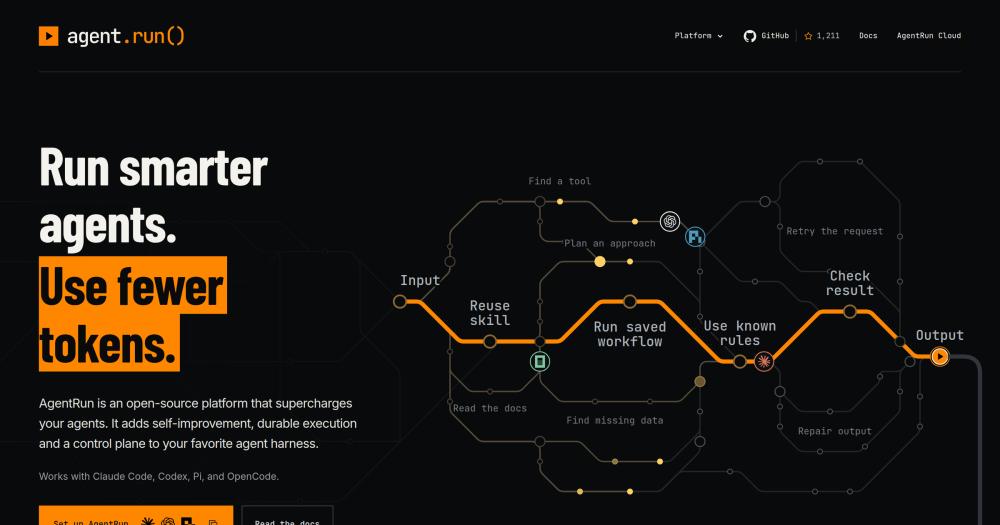
Run AI agents across Claude Code, Codex, Pi and OpenCode with self-learning, durable execution and a shared control plane. Apache-2.0, self-hosted.

Visit websiteGitHub1.2K starsDeploy on Hostinger
Image for Agentrun
TL;DR

Agentrun is an open source platform that sits around Claude Code, Codex, Pi, or OpenCode and makes agent runs cheaper and more durable. It adds a self-learning layer that turns repeated work into reusable skills, reducing token spend on jobs the agent already knows how to do. When a run stops mid-job, Agentrun recovers from saved state rather than restarting from scratch. The full platform is Apache-2.0 licensed and self-hostable; AgentRun Cloud offers a hosted option from the Grep team. Best for teams running agents on any of the four supported tools who are hitting token costs or losing work to interrupted runs.

Read the full breakdownHide the full breakdownWho it is for, how it works, trade-offs, the quick start and the FAQ
who it's for

Who Agentrun is for#

Teams running repetitive agent jobs with high token spend

A team running code reviews, compliance checks, or classification pipelines dozens of times a day pays for each run's planning from scratch. Agentrun's learning layer turns accepted procedures into reusable skills; a later run that starts from learned skills spends fewer tokens on the parts of the job it already knows.

Skip if:

If your agent jobs are one-off or highly varied, repeated steps are less likely to emerge and the learning layer adds reflection cost without proportionate savings.

Developers connecting an existing Claude Code or Codex setup

Agentrun can observe an existing Claude Code or Codex setup and show its activity and token usage in the console through an OpenTelemetry collector, without changing how the application starts the work. It can also start new jobs using your existing project, instructions, skills, and MCP tools. History import brings past conversations into the run log without re-executing them.

Skip if:

Observation mode does not automatically enable learning or import transcripts; it requires the agent to report activity through the collector. A live connection requires the server and connector from the same reviewed checkout.

Infrastructure teams self-hosting an agent platform

The full platform, including the console and learning infrastructure, is Apache-2.0 and self-hostable. Railway and Render are documented one-click targets in the README. Teams that need to keep agent conversations on their own infrastructure or use their own model API keys can run the whole stack without sending data to a cloud service.

Skip if:

AgentRun Cloud from the Grep team is an alternative for teams that want hosted access with runner choice and the full learning layer, without managing a server.

Developers building multi-step agent jobs that break mid-run

Durable execution stores every run's conversation, files, and completed tool results. After a crash or a deliberate stop, reopening the saved state continues the run from where it stopped. Finished tool calls are never re-executed; a write interrupted mid-call is marked as interrupted rather than retried.

Skip if:

If your agent jobs are short enough that restarting from scratch costs less than the recovery infrastructure, the durable execution layer adds complexity without proportionate value.

the problem

The problem it solves#

Agent runs are expensive partly because every run starts from scratch. An agent figuring out how to call an API, structure a request, or validate a result spends tokens doing work it did last time. Multiply that across dozens of daily runs on a code review job, a compliance check, or a data classification pipeline, and the cost compounds quickly. The Grep team's merchant classification case study shows the same job dropping from $0.89 to $0.12 per merchant once the agent handed what it learned to a cheaper model.

The second problem is fragility. A run that stops mid-task loses its context unless you built recovery into the calling code. For multi-step jobs involving files, external tools, and intermediate results, an interrupted run means restarting from zero and paying for that reasoning again. Teams running agents across multiple jobs also lack a single place to monitor costs, respond to approval requests, or see which runs need attention.

how Agentrun solves it

How it solves it#

Self-Learning Runs

When learning is enabled, the agent proposes notes, reusable skills, and workflow drafts at the end of each run. Agentrun grades them before committing anything, so low-quality proposals do not pollute later runs. Once a skill has served three runs, the agent is asked to draft a reusable workflow. Later runs can skip repeated planning and tool discovery, spending fewer tokens on work the agent already knows.

Durable Execution and Crash Recovery

Every run's conversation, files, and completed tool results are stored in one place. If the server stops mid-run, a new process reopens the saved state and the run continues. Finished steps are never re-executed. A tool write interrupted mid-call is marked as interrupted rather than retried, so callers can inspect the state before deciding whether to reconcile external actions.

Multi-Runner Control Plane

One API and one console cover agents running on Claude Code, Codex, Pi, or OpenCode. Define an agent once with its instructions, tools, and runner choice, then manage revisions, run history, approvals, and learning from the same interface. Switching from one agent tool to another does not require rebuilding the management layer.

Spend Caps and Approval Gates

Each run takes a cost cap in USD. When a run reaches its cap it pauses and reports the minimum needed to continue, instead of failing silently. Each tool can be set to always allow, always deny, or require approval before running. A call waiting for approval pauses the run on its page until you respond, so agents can run unattended without unlimited spend exposure.

TypeScript and Python Client SDKs

The TypeScript client (@parcha/agentrun-client, available on npm) and Python client (parcha-agentrun, available on PyPI) share the same API shape. Both read AGENTRUN_BASE_URL and AGENTRUN_API_KEY from the environment and work against any self-hosted or cloud deployment. The same client call starts a run, waits for it, responds to questions, and reads results.

Typed Workflow Authoring

Repeatable work that does not need a full agent loop can be written as a typed workflow: tool calls, model steps, and fast typed decisions (yes or no, pick one, a confidence score) that branch on the answer. A workflow runs under the agent's tool permissions and cost cap. Steps can call other workflows, fan out over a list in parallel, loop a bounded number of times, or hand off a hard case to an agent.

strengths · trade-offs

Strengths and trade-offs#

Strengths

  • Apache-2.0 with Full Platform IncludedThe learning layer, crash recovery, and console are all part of the open source release, not cloud-only features. Apache-2.0 means you can run it on your own infrastructure commercially with no licensing fees, modify it, and distribute it. The comparable managed services (Anthropic's managed agents, OpenAI's Agents API) provide none of their platform as self-hostable code.
  • Cross-Runner Support Through One APIClaude Code, Codex, Pi, and OpenCode are all supported through the same API. Teams running more than one agent tool do not need separate management layers. The product's self-published comparison table documents that Anthropic's managed offering supports Claude only, OpenAI's supports Codex only, and Google Cloud uses a custom integration.
  • Learning Proposals Require GradingProposals from an agent's end-of-run reflection go through code checks and a grader before being committed. A secret or hidden character anywhere in the answer drops the whole answer. A note sourced from a pasted email or a page the agent read is dropped. Only proposals that pass grading are committed to the agent's git-backed learning folder, reducing noise from low-quality reflections.
  • Production Case Studies with Measured ResultsThe GitHub repository documents two production results. After tuning on 30 PRs, a code review agent running on Agentrun caught 1.6x the bugs of a competing service and cost 18 cents per review. A merchant classification job dropped from $0.89 to $0.12 per merchant once the agent handed its learned procedures to a cheaper model. These are production workloads, not synthetic benchmarks.

Trade-offs

  • -New Project with 22 Open IssuesAgentrun was created in September 2026 and had 22 open GitHub issues as of November 2026. At that early stage, undocumented behavior and rough edges are more likely than in a mature project. The README notes that remote connections require the server and Python connector from a reviewed checkout, while the published observation-only CLI does not include the remote execution mode.
  • -Node 24.22.3 or Newer Required on macOS or LinuxThe local quickstart requires Node 24.22.3 or newer on macOS or Linux. The README documents no Windows native path. Teams on Windows or older Node versions need to reach for Docker or AgentRun Cloud. Docker sandboxes are available when Docker is running locally, but the server itself requires the documented Node version.
  • -Reflection and Grading Add Model Costs Per RunSelf-learning adds a reflection turn and a grading pass at the end of each run, both of which call models and add to the run's cost. The website notes that savings depend on how much work repeats and advises measuring total spend rather than assuming savings from the first run. Early runs on a new agent job may show no savings until the learning folder has accumulated enough accepted skills.
versus alternatives

Agentrun vs alternatives#

Agentrun vs Managed Agent Services

Agentrun is an open source self-hostable alternative to managed agent platforms like Anthropic's Claude Managed Agents, OpenAI's Agents API, and Google Cloud's Gemini Enterprise Agent Platform. Agentrun runs on your own server with your own model API keys; the managed services run on their providers' infrastructure with no self-hosting option.

FeatureAgentrunAnthropic Claude Managed AgentsOpenAI Agents API
LicenseApache-2.0ProprietaryProprietary
Self-hostableYesNoNo
Supported runnersClaude Code, Codex, Pi, OpenCodeClaude onlyCodex only
Self-learningBuilt-in, gradedNot documentedNot documented
Durable executionBuilt-in recoveryDurable sessionsDurable sessions
Pricing modelFree + infrastructureManaged service feesManaged service fees

Agentrun is the better choice for teams that need cost control at scale, cross-runner management, or the ability to keep agent conversations on their own infrastructure. The graded self-learning layer does not appear in Anthropic's or OpenAI's managed offerings.

The managed services from Anthropic and OpenAI are worth choosing when infrastructure management is not your team's concern, when you need enterprise SLAs and support, or when staying inside a single provider's ecosystem matters. Anthropic offers durable sessions; OpenAI offers parallel subagents in multi-agent workflows. Neither provides a cross-runner control plane or open source learning infrastructure.

AgentRun Cloud, the hosted option from the Grep team, is available for teams that want hosted access with runner choice and the full learning layer, without managing a server.
install · quick start

Quick start#

bash
Self-hosting starts the server locally on macOS or Linux (Node 24.22.3+); install the TypeScript or Python client SDK to call the API from your own applications.

```bash
npx @parcha/agentrun
npm i @parcha/agentrun-client
pip install parcha-agentrun
```
tech stack · detected from GitHub

What it's built on#

Languages
GoJavaJavaScriptPythonSwiftTypeScript
Frameworks
React
frequently asked

FAQ#

Is Agentrun open source?

Yes. The full platform, including the learning layer, crash recovery, and the console, is released under Apache-2.0 at https://github.com/Parcha-ai/agentrun. You can run it on your own infrastructure with your own model API keys, modify it, and use it commercially with no licensing fees. AgentRun Cloud is a separate hosted option from the Grep team and is not required to self-host.

Which agent runners does Agentrun support?

Agentrun supports Claude Code, Codex, Pi, and OpenCode. The agent definition specifies which runner to use; switching between them does not require changing how you manage or start runs. TypeScript and Python client SDKs are available on npm (@parcha/agentrun-client) and PyPI (parcha-agentrun).

How does the self-learning layer work?

When learning is enabled on an agent definition, the agent gets one extra turn at the end of each run to propose what it would keep: a note, a reusable skill, or a workflow draft. Agentrun runs code checks and a grader over every proposal. Items that pass are committed to the agent's own git folder. Later runs read the index of accepted notes and get learned skills alongside their instructions, so repeated planning steps can be skipped. The agent's Learning tab shows every kept item and the full log of changes.

What happens to a run that stops mid-job?

Agentrun stores the run's conversation, files, and completed tool results in one store. If the server stops or crashes, a new process reopens the saved state and the run continues from where it stopped. Finished steps are not re-executed. A tool write interrupted mid-call is marked as interrupted rather than retried, so callers can inspect the state before deciding whether to reconcile external actions. Cancelled runs cannot continue.

Can I use my existing Claude Code or Codex setup with Agentrun?

Yes. Agentrun can connect to an existing Claude Code or Codex setup and observe its activity through an OpenTelemetry collector. It can also start new jobs using your existing project, instructions, skills, MCP tools, and sign-in. History import brings past conversations into the run log without re-executing them. The connection is outbound from your machine to the Agentrun server; your native credentials stay on the source machine.

also worth a look

Similar open-source tools#

Hermes Agent

Featured

Alternative toGrok Bot

Self-hosted AI agent: persistent memory, multi-channel chat, model choice.

  • 263,992 GitHub stars
  • MITLicence MIT

Smolmaxxing

InAI & Machine Learning

Runs 16B LLMs on a TV box with 1 GB of RAM, offline.

  • 969 GitHub stars
  • MITLicence MIT

Ninfer

InAI & Machine Learning

Native C++/CUDA inference for Qwen3 and GLM models, self-hosted.

  • 3,356 GitHub stars
  • Apache-2.0Licence Apache-2.0

AutoRAG

Alternative toRagie AI

Local-first AI librarian for files, messengers, and cloud drives

  • 5,899 GitHub stars
  • Apache-2.0Licence Apache-2.0

SkillEvaluator

InAI & Machine Learning

Validation, deduplication, and live sandbox eval for AI agent skills.

  • 1,698 GitHub stars
  • Apache-2.0Licence Apache-2.0

Llama.cpp

Alternative toOpenAI API

C/C++ LLM inference engine with OpenAI-compatible API, no cloud.

  • 135,212 GitHub stars
  • MITLicence MIT
by category

Open source tools in these categories#

549

AI & Machine Learning

REA (Reverse Engineer Anything), freeCodeCamp, OpenClaw
142

LLMOps & AI Tooling

Hermes Agent, OpenCode, MarkItDown
673

Developer Tools

Skills for Real Engineers, REA (Reverse Engineer Anything), superpowers
Hostinger

Self-host Agentrun on a Hostinger VPS

Keep it running 24/7, even when your laptop is off. A Hostinger VPS gives it a server of its own.

  1. 01

    Choose a plan

    Starts from $6.49/mo

  2. 02

    Apply

    Extra 10% off yearly plans

  3. 03

    Install Agentrun

    On a server that stays on

  4. 04

    Start building

    Focus on the app, not the server

Deploy on Hostinger

Sponsors

Inbox Zero

Alternative toSuperhuman

AI email assistant that drafts replies and clears your inbox

  • 13,058 GitHub stars
  • AGPL-3.0Licence AGPL-3.0
  • #Email

rakazo

Alternative toGrok Bot

AI teammates you own: your keys, your model, your machine.

  • 8,913 GitHub stars
  • Apache-2.0Licence Apache-2.0
  • #AI Agents

SnitchFeed

Live monitoring on LinkedIn, X, Reddit & more. Agentic social listening for startups.

Marketing & Growth

Advertise your product

New open source projects by email

The projects we add and every new guide. Free, unsubscribe any time.

Find open source alternatives to paid software

/
  • Claude Code to OpenCode
  • Jira to Windshift
  • Notion to AppFlowy
  • Slack to Mattermost
  • Linear to GitLab
  • Wispr Flow to Handy
  • Arc to Zen Browser
  • CapCut to Concat
  • Grok Bot to rakazo
  • Superhuman to Inbox Zero
  • Discord to Stoat
  • Airtable to AITable
  • Datadog to SigNoz
  • Muse to OpenClaw
  • Railway to Coolify
  • GitHub Copilot to Cline
  • Confluence to Wiki.js
  • Microsoft Teams to Rocket.Chat
  • 1Password to KeePassXC
  • Firebase to Supabase
  • Pinecone to Qdrant
  • Zapier to n8n
  • Devin AI to OpenHands
  • Asana to Leantime