Smolmaxxing vs Cloud LLM APIs
When a device has too little RAM to run an LLM locally, most developers turn to a cloud API. Services like the OpenAI API give access to capable models over HTTP, billed per token, with no hardware requirements on the client side.
| Feature | Smolmaxxing | Cloud LLM API |
|---|
| License | MIT | Proprietary |
| Inference location | On-device | Remote server |
| Network required | Setup only | Every request |
| Per-token cost | None | Yes |
| Privacy | Prompts stay on-device | Data sent to provider |
| Model size on phone | Up to 80B MoE | Frontier models |
| Latency | Device-local | API round-trip |
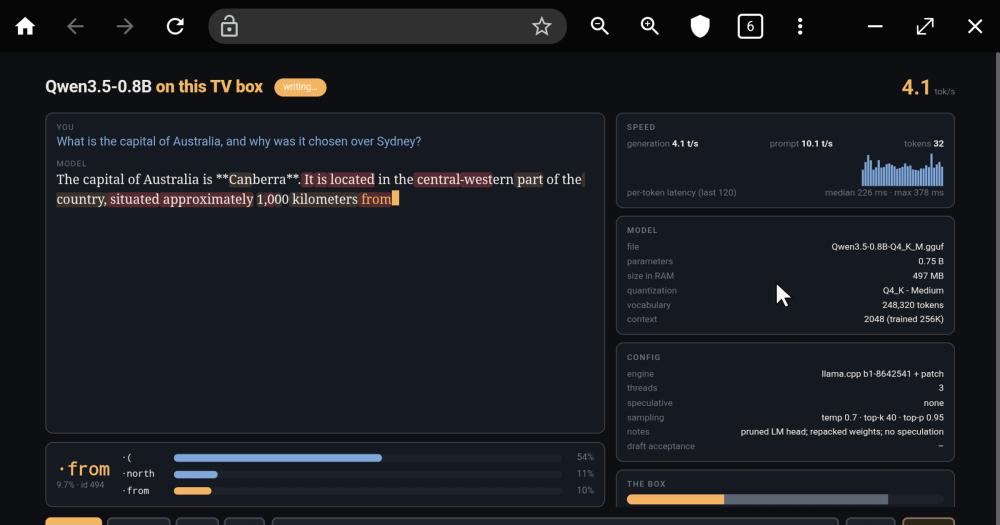
Smolmaxxing is the right path when offline operation is a requirement, when per-token API costs are a constraint at high volumes, or when data privacy demands that prompts never leave the device. A TV box running a 2B model at 7.7 tokens per second, or an iPad Air running a 16B model at 2.6 tokens per second, replace a cloud API for tasks where local output at acceptable speed is sufficient.
Cloud LLM APIs are still the better fit when response quality matters more than cost or privacy. A frontier model's reasoning and coding capability are beyond what any sub-100B model running on 1 to 3 GB of RAM can match. For tasks where the prompt needs frontier reasoning or broad world knowledge, local inference on constrained hardware is not the right trade. Smolmaxxing's niche is cases where local, offline output at a fraction of the cost is sufficient.