Open Source Alternatives
  • Alternatives
  • Categories
    Categories by size1,162 projects
    • Developer Tools597
    • AI & Machine Learning503
    • Business & Productivity281
    • Web Development211
    • Security & Monitoring174
    • Communication & Collaboration155
    • IT Management147
    • LLMOps & AI Tooling129
    • Cloud & Hosting128
    • Product & Project Management124
    Browse all 21 categoriesDesign & Creative, DevOps & CI/CD and 9 more
  • Blog
  • Advertise
SearchNotion, Slack, password manager.../
Submit
Open Source Alternatives
  • Alternatives
    • Developer Tools597
    • AI & Machine Learning503
    • Business & Productivity281
    • Web Development211
    • Security & Monitoring174
    • Communication & Collaboration155
    • Browse all 21 categories
  • Blog
  • Advertise
Submit your project

New open source projects by email

The projects we add and every new guide. Free, unsubscribe any time.

Open Source Alternatives LogoOpen Source Alternatives

Handpicked Open Source Alternatives to Paid Softwares

Add Open Source Alternatives as a preferred source on Google

Product

  • Categories
  • Tag
  • Advertise

Resources

  • Blog
  • Collection
  • Submit

Company

  • Privacy Policy
  • Terms of Service
  • Refund Policy
  • Sitemap

Alternatives

  • Claude Code
  • Jira
  • Notion
  • Slack
  • Linear
  • Wispr Flow
  • All alternatives
© 2026 Open Source Alternatives. All rights reserved.
Open SourceAlternatives
Home/Categories/Web Development/Angular
icon of Angular

Angular

  • 101.4K stars
  • MIT
  • Active this week
  • Last commit today

Last verified Nov 7, 2026

Build large-scale web apps in TypeScript with components, dependency injection, reactive signals, SSR, and first-party routing and form modules.

Visit websiteGitHub101.4K stars
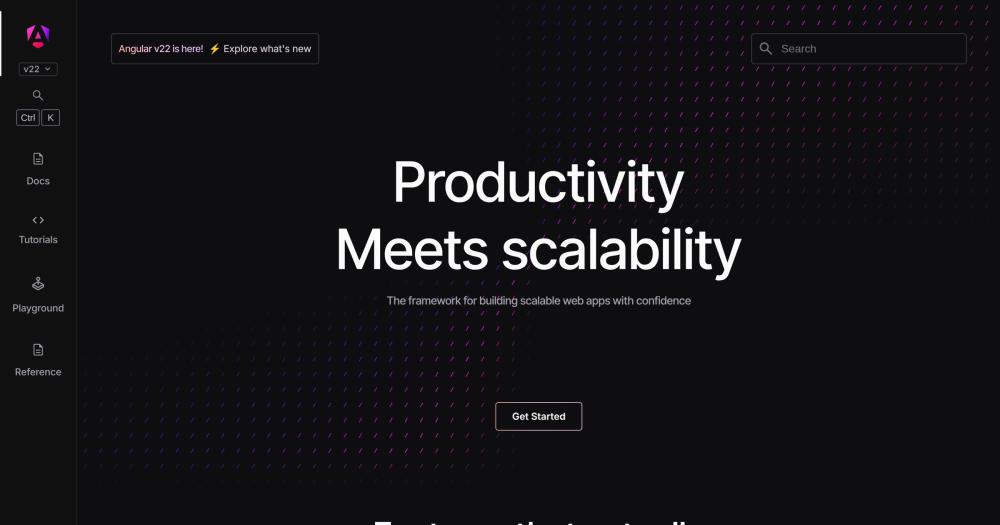
image of Angular
TL;DR

Angular is a TypeScript-based web development framework for building mobile and desktop web applications. It ships components, dependency injection, reactive Signals-based state management, server-side rendering, and first-party routing and form modules as an integrated package under the MIT license. With 101,371 GitHub stars and a last push in November 2026, it is one of the most widely deployed web frameworks. Best for enterprise teams and TypeScript developers building large SPAs, progressive web apps, and server-side rendered sites.

Read the full breakdownHide the full breakdownWho it is for, how it works, trade-offs, the quick start and the FAQ
who it's for

Who Angular is for#

Enterprise dev teams building internal dashboards

Angular's enforced conventions and dependency injection make it well-suited for large internal applications where multiple developers maintain the same codebase over years. The CLI's component generation and consistent module structure reduce the variation that accumulates in loosely structured codebases.

Skip if:

Your team is small (one to three developers) and the application is simple enough that framework conventions add overhead without returning consistency benefits.

TypeScript teams building progressive web apps

Angular includes official PWA support with service workers and app manifests documented in the CLI. Teams building offline-capable mobile-first applications can configure the PWA tooling from the standard project template without adding separate libraries.

Skip if:

Your PWA needs are minimal (simple offline caching only) and a lightweight service worker library would cover the requirement without a full framework.

Frontend engineers building SSR-rendered sites

Angular's server-side rendering with hydration lets teams ship fast initial page loads while keeping full client-side interactivity. The SSR mode is an official first-party module, so upgrades track the main framework release cycle rather than a separate third-party adapter's schedule.

Skip if:

Your SEO requirements are covered by static site generation and your pages do not need per-request server rendering.

Teams migrating off commercial enterprise frameworks

Organizations moving off commercial licensed JavaScript frameworks will find Angular's TypeScript component model a reasonable landing point. Angular Material provides a UI component library comparable to commercial component suites, and the official upgrade guide documents migration paths.

Skip if:

Your existing commercial framework integrates deeply with backend systems through specialized widgets or server-side data binding that Angular and Angular Material do not replicate.

the problem

The problem it solves#

Building large web applications without a consistent framework contract leads to teams using different libraries for routing, form handling, and state management, often chosen at different times with incompatible APIs. As codebases expand past a few hundred components, the lack of enforced structure slows onboarding and turns refactoring into a cross-team coordination problem.

Commercial enterprise JavaScript frameworks like Sencha ExtJS charge licensing fees for business use, adding a recurring cost that scales with team headcount. Assembling a custom stack of open source libraries shifts that cost to evaluation and maintenance work, requiring teams to track upgrades across multiple third-party dependencies instead of one versioned framework.

how Angular solves it

How it solves it#

TypeScript component architecture

Angular applications are structured as TypeScript components with decorators, templates, and a dependency injection system that handles service wiring automatically. Components are the building blocks for every view, with lifecycle hooks and two-way data binding built in.

Signals-based reactive state management

Angular Signals provide fine-grained reactivity for state updates. Signals let components subscribe to specific state changes, reducing unnecessary re-renders in large applications. The framework website describes this as 'fine-grained reactivity based on Angular Signals'.

First-party routing, forms, and HTTP modules

Angular ships routing, reactive forms, and an HTTP client as first-party modules versioned with the framework. Teams get a consistent API for navigation, form validation, and backend communication without selecting and aligning separate community libraries.

Server-side rendering with hydration

Angular supports server-side rendering with hydration, so the page becomes interactive without a full client re-render. SSR is documented as an official Angular guide and ships as a first-party package, with setup covered in the Angular CLI tools.

Angular CLI for scaffolding and builds

The Angular CLI handles project generation, component scaffolding, test running, and production builds. A new project scaffolds with one command and starts a development server immediately. The CLI also manages schematics for code generation across the project.

Deferrable Views and Control Flow

Deferrable Views let components and their dependencies load only when needed, reducing the initial JavaScript bundle size. Angular's Control Flow syntax manages conditional rendering and list iteration directly in templates without additional setup.

strengths · trade-offs

Strengths and trade-offs#

Strengths

  • MIT license with no per-developer costAngular is MIT-licensed, meaning any team can use it commercially without licensing fees. Unlike commercial enterprise JavaScript frameworks that charge per developer or per application, Angular costs nothing beyond hosting and infrastructure.
  • 101,000+ GitHub stars and active maintenanceWith 101,371 GitHub stars and 28,912 forks as of November 2026, Angular is one of the most widely adopted web frameworks in production. The last push was November 6, 2026. The project was created in 2014 and has sustained significant community engagement for over a decade.
  • Integrated platform with no stack assembly requiredRouting, forms, HTTP client, animations, and a component library (Angular Material) ship as first-party and officially supported modules. Teams do not need to audit and assemble third-party libraries for core web application requirements, reducing the ongoing maintenance burden.
  • Progressive web app and AI tooling includedAngular includes official tooling for progressive web apps, with PWA listed as a core GitHub topic for the repository. The framework also ships AI-forward resources and an Angular MCP for teams integrating AI development workflows into their projects.

Trade-offs

  • -Broad learning surface for new teamsAngular's platform includes TypeScript, decorators, components, services, dependency injection, the CLI, and multiple first-party modules including routing, forms, and HTTP. Teams new to this stack need to learn several interrelated systems before being fully productive. The official docs include in-browser tutorials and essentials guides, but the initial investment is higher than smaller, single-purpose frameworks.
  • -847 open GitHub issuesThe repository had 847 open issues as of November 7, 2026 (read from GitHub's issue search API). For a framework of this scale and usage, that count reflects active development with ongoing bug reports and feature discussions. Teams should review open issues relevant to their use case before committing to a new major version upgrade.
  • -Full framework overhead for simple sitesAngular is designed for scalable web applications with complex state, routing, and form requirements. For simple static landing pages or minimal-JavaScript content sites, the framework adds build complexity and bundle size that lighter tools do not. The setup overhead is justified by the platform's features only when the application actually needs them.
versus alternatives

Angular vs alternatives#

Angular vs Sencha ExtJS

Sencha ExtJS is a commercial enterprise JavaScript framework that requires licensing for business use. Angular replaces that licensing cost with an MIT-licensed framework that any team can use commercially at no charge. Both provide a component-based architecture and UI components, but Angular's component model matches contemporary TypeScript patterns, while ExtJS carries older class-based design patterns. Angular Material provides a UI component library comparable to commercial component suites at no cost.

Angular vs Commercial Enterprise Platforms

Commercial app development platforms charge subscription fees that scale with team size. Angular targets developers directly: it requires TypeScript and framework knowledge, and it gives developers full control over application architecture, component behavior, and backend integration. Teams that want to avoid vendor lock-in and have developers available to build a TypeScript codebase will find Angular a cost-effective replacement for commercial platforms.

Angular vs React and Vue

Angular, React, and Vue are all free and open source, so the comparison is about trade-offs in structure rather than cost. Angular provides routing, forms, HTTP client, and state management as first-party modules versioned together. React and Vue leave those choices to third-party libraries, which gives more flexibility but requires more decisions at the outset. Angular suits teams that want one integrated framework contract rather than curating a stack of community packages. React suits teams that want maximum flexibility and a larger pool of community components. Vue suits teams that want a gentler start with optional conventions.

install · quick start

Quick start#

bash
Install the Angular CLI globally via npm, then scaffold and serve a new project.
```bash
npm install -g @angular/cli
ng new my-project
cd my-project
ng serve
```
tech stack · detected from GitHub

What it's built on#

Languages
JavaScriptRustTypeScript
Frameworks
Angular
Tooling
esbuildRollup
frequently asked

FAQ#

Is Angular free to use for commercial projects?

Yes. Angular is released under the MIT license, which allows use, modification, and distribution for any purpose, including commercial applications, without licensing fees. The source code is at github.com/angular/angular.

Does Angular support server-side rendering?

Yes. Angular includes official server-side rendering support with hydration. The SSR module ships as a first-party Angular package. The Angular CLI can configure a new or existing project for SSR, and the official documentation at angular.dev covers setup and deployment options.

What is the difference between Angular and AngularJS?

AngularJS (Angular 1.x) is a legacy JavaScript framework that reached end-of-life and is no longer maintained. Angular (versions 2 and above) is a completely different TypeScript-based framework. The two share a name but have no shared codebase. The current GitHub repository at github.com/angular/angular was created in 2014 and targets TypeScript developers building modern web applications.

How do I install Angular and start a new project?

Install the Angular CLI globally with npm: npm install -g @angular/cli. Then run ng new [PROJECT NAME] to scaffold a new workspace, cd [PROJECT NAME] to enter it, and ng serve to start the development server. Full documentation is at angular.dev/tutorials/learn-angular.

Does Angular support progressive web apps?

Yes. Progressive web app support is an official Angular feature listed as a GitHub topic for the repository. The Angular CLI includes tooling for adding service workers and app manifests to an existing project. Angular's official documentation covers the PWA configuration.

also worth a look

Similar open-source tools#

Opensource UI

Alternative toTailwind UI

200+ copy-paste React and Next.js components, MIT licensed, no package

  • 818 GitHub stars
  • MITLicence MIT

Rust

InWeb Development

Systems language with memory safety and no garbage collector.

  • 121,092 GitHub stars
  • Apache-2.0Licence Apache-2.0

Rails

InWeb Development

Full-stack Ruby framework with built-in ORM, mailer, and WebSockets.

  • 59,026 GitHub stars
  • MITLicence MIT

BUI

InDeveloper Tools

Blender's widget system for Python, Rust, JavaScript and C apps

  • 1,385 GitHub stars
  • GPL-3.0Licence GPL-3.0

SDL

InDeveloper Tools

Cross-platform C library for audio, input, and graphics access.

  • 16,942 GitHub stars
  • ZlibLicence Zlib

Docmd

Alternative toMintlify

Markdown to website, search, and AI context files in one command.

  • 2,550 GitHub stars
  • MITLicence MIT
by category

Open source tools in these categories#

211

Web Development

freeCodeCamp, Skills for Real Engineers, superpowers
46

Web & App Development

Flutter, Rust, Angular
597

Developer Tools

REA (Reverse Engineer Anything), Skills for Real Engineers, superpowers

Sponsors

Inbox Zero

Alternative toSuperhuman

AI email assistant that drafts replies and clears your inbox

  • 12,915 GitHub stars
  • AGPL-3.0Licence AGPL-3.0
  • #Email

rakazo

Alternative toGrok Bot

AI teammates you own: your keys, your model, your machine.

  • 7,028 GitHub stars
  • Apache-2.0Licence Apache-2.0
  • #AI Agents

SnitchFeed

Live monitoring on LinkedIn, X, Reddit & more. Agentic social listening for startups.

Marketing & Growth

Advertise your product

New open source projects by email

The projects we add and every new guide. Free, unsubscribe any time.

Find open source alternatives to paid software

/
  • Claude Code to OpenCode
  • Jira to Windshift
  • Notion to AppFlowy
  • Slack to Mattermost
  • Linear to GitLab
  • Wispr Flow to Handy
  • Arc to Zen Browser
  • CapCut to Concat
  • Grok Bot to rakazo
  • Superhuman to Inbox Zero
  • Airtable to AITable
  • Muse to OpenClaw
  • Railway to Coolify
  • GitHub Copilot to Cline
  • Datadog to Netdata
  • Confluence to Wiki.js
  • Microsoft Teams to Rocket.Chat
  • Firebase to Supabase
  • Pinecone to Qdrant
  • Zapier to n8n
  • 1Password to KeePassXC
  • Devin AI to OpenHands
  • Asana to Leantime
  • Contentful to Strapi