Open Source Alternatives
  • Alternatives
  • Categories
    Categories by size1,046 projects
    • Developer Tools532
    • AI & Machine Learning460
    • Business & Productivity244
    • Web Development204
    • Security & Monitoring157
    • Communication & Collaboration141
    • IT Management139
    • Cloud & Hosting122
    • LLMOps & AI Tooling120
    • Data & Analytics113
    Browse all 21 categoriesDesign & Creative, Product & Project Management and 9 more
  • Blog
  • Advertise
SearchNotion, Slack, password manager.../
Submit
Open Source Alternatives
  • Alternatives
    • Developer Tools532
    • AI & Machine Learning460
    • Business & Productivity244
    • Web Development204
    • Security & Monitoring157
    • Communication & Collaboration141
    • Browse all 21 categories
  • Blog
  • Advertise
Submit your project

New open source projects by email

The projects we add and every new guide. Free, unsubscribe any time.

Open Source Alternatives LogoOpen Source Alternatives

Handpicked Open Source Alternatives to Paid Softwares

Product

  • Categories
  • Tag
  • Advertise

Resources

  • Blog
  • Collection
  • Submit

Company

  • Privacy Policy
  • Terms of Service
  • Refund Policy
  • Sitemap

Alternatives

  • Claude Code
  • Jira
  • Notion
  • Slack
  • Linear
  • Wispr Flow
  • All alternatives
© 2026 Open Source Alternatives. All rights reserved.
Open SourceAlternatives
Home/Categories/Security & Monitoring/Beszel
icon of Beszel

Beszel

Open source alternative to Datadog, New Relic, Better Stack and Site24x7

  • 26.8K stars
  • MIT
  • Active this week
  • Last commit 1 day ago

Last verified Nov 4, 2026

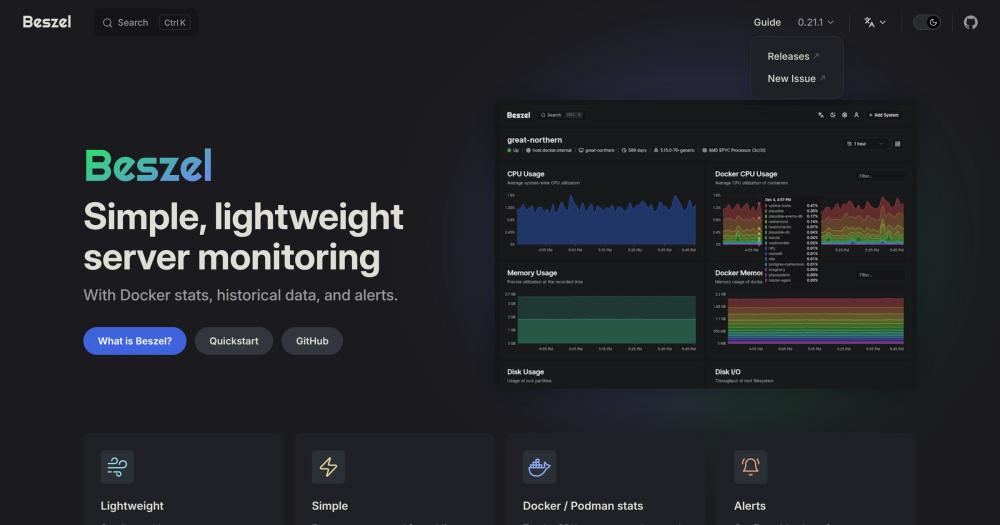
Monitor servers, Docker containers, and disk health in a self-hosted hub with historical data, configurable alerts, and multi-user support.

Visit websiteGitHub26.8K starsDeploy on Hostinger
image of Beszel
TL;DR

Beszel is a self-hosted server monitoring tool that tracks CPU, memory, disk I/O, network, Docker and Podman container stats, S.M.A.R.T. disk health, and GPU metrics across multiple machines from a single dashboard. It replaces paid services like Datadog and New Relic for teams that need basic server visibility without per-host fees or telemetry leaving their infrastructure. MIT licensed, built in Go, and deployable via Docker. Best for homelab operators, small DevOps teams, and developers who self-host their own servers.

Read the full breakdownHide the full breakdownWho it is for, how it works, trade-offs, the quick start and the FAQ
who it's for

Who Beszel is for#

Homelab operators monitoring multiple servers

Beszel is designed around this use case: one hub instance, multiple agent deployments across different machines, all tracked in a single dashboard with historical data. The Docker and S.M.A.R.T. features cover the typical homelab mix of containerized services and local storage.

Skip if:

If you need external uptime checks (testing availability from outside your network), Beszel does not cover that. It monitors from the server's own perspective, so a router or ISP outage affecting the whole homelab would take the monitoring offline too.

Small DevOps teams managing Docker-heavy infrastructure

Per-container CPU, memory, and network history lets small teams see which services are growing in resource use over time. The multi-user model grants each team member access to their relevant systems without shared credentials or full admin access.

Skip if:

Teams that need distributed tracing, application-level error tracking, or deployment correlation should evaluate a more complete observability stack. Beszel covers server health, not application behavior.

Developers running disk-heavy self-hosted services

The S.M.A.R.T. monitoring and ZFS pool health tracking makes Beszel useful for anyone running NAS devices, backup servers, or database servers where drive health directly affects service availability. Alerts on S.M.A.R.T. degradation give advance warning before a drive fails.

Skip if:

If the disks in question are managed by a cloud provider (EBS, persistent disks, managed NVMe), S.M.A.R.T. data is typically unavailable or unreliable from the guest OS. Beszel's disk health features apply to physical or directly attached storage.

the problem

The problem it solves#

Server monitoring tools designed for large-scale operations like Datadog and New Relic charge per-host fees that grow quickly across even modest fleet sizes, and they route all telemetry to their clouds. For teams running a few VPS instances, a homelab, or on-premises hardware, that tradeoff rarely makes sense: you pay for APM, distributed tracing, and log aggregation capabilities you do not use, while your performance data lives on someone else's infrastructure.

The alternative has traditionally been assembling your own stack. Prometheus collects metrics, Grafana visualizes them, and a collection of exporters bridges the two. That approach works but carries real setup overhead and ongoing maintenance. Teams that want persistent server health visibility without becoming full-time observability engineers need something in between.

how Beszel solves it

How it solves it#

Docker and Podman Container Monitoring

Tracks CPU, memory, and network usage history for each running container individually. Monitors both Docker and Podman, capturing per-container metrics rather than aggregate host-level totals. This lets you see which container is consuming resources and when usage patterns changed.

S.M.A.R.T. Disk Health Monitoring

Collects S.M.A.R.T. data from attached drives and sends alerts when disk health indicators degrade, including eMMC wear and end-of-life status and Linux mdraid array health via sysfs. Disk failures often precede data loss by days; early warning through the same dashboard reduces the chance of an unexpected failure.

GPU Metrics for Nvidia, AMD, and Intel

Reports GPU usage and power draw for all three major GPU vendors. Useful for servers running AI inference workloads, game servers, or video encoding where GPU saturation matters alongside CPU and memory.

Configurable Alerts with Multi-Service Notifications

Alerts are configurable for most tracked metrics, with support for many notification services. Set thresholds on CPU, memory, disk I/O, network, temperature, or container health and route notifications wherever your team already monitors.

Network Response Time and Interruption Tracking

Agents can monitor network response time and detect interruptions directly from each host, giving you visibility into connectivity issues from the server's perspective rather than relying solely on external uptime checks.

OAuth/OIDC and Multi-User Access Control

Supports many OAuth2 and OIDC providers for authentication, with password auth optional. Admins can share individual systems with specific users, so team members see only the servers relevant to them without sharing admin credentials.

strengths · trade-offs

Strengths and trade-offs#

Strengths

  • Minimal resource footprint on monitored hostsBeszel is built to be smaller and less resource-intensive than alternatives like Datadog agents or Prometheus exporters. The agent binary runs on the same machine it monitors without materially affecting the metrics it reports, which matters on low-memory VPS instances or embedded hardware.
  • MIT license with no per-host feesThe MIT license means you can run Beszel on your infrastructure at no cost with no licensing fees, no seat limits, and no restrictions on commercial use. Unlike Datadog's per-host-per-month billing, the total cost scales with your server costs, not with the monitoring vendor.
  • Automatic backups to disk or S3Beszel supports automatic backup of its PocketBase data store to local disk or any S3-compatible storage endpoint, with restore capability. This covers the standard homelab and small-team concern of not losing months of historical monitoring data to a disk failure on the hub server.
  • No external service dependencyAll data stays on your infrastructure. The hub stores historical metrics in PocketBase, agents communicate directly to the hub, and nothing is sent to an external cloud. For teams with privacy requirements or those monitoring air-gapped infrastructure, this is a hard requirement that commercial SaaS tools cannot meet.

Trade-offs

  • -257 open issues as of November 2026The project has 257 open issues (GitHub API count, pull requests excluded). For a tool created in mid-2024 with over 26,000 stars, that reflects rapid growth outpacing resolution bandwidth. The maintainer notes they respond when time permits; teams with critical production dependencies should review open issues relevant to their use case before adopting.
  • -No APM, distributed tracing, or log managementBeszel covers infrastructure-level metrics: CPU, memory, disk, network, Docker stats, and disk health. It does not provide distributed tracing, application performance monitoring, log aggregation, or synthetic uptime checks from external vantage points. Teams that need those capabilities alongside server metrics will need additional tooling.
  • -Primarily single-maintainer projectBeszel is primarily maintained by one developer. Active development is evident from the commit history with pushes in November 2026, but long-term sustainability depends on that individual or the project attracting additional core contributors. Teams evaluating it for critical infrastructure should factor this into their risk assessment.
versus alternatives

Beszel vs alternatives#

Beszel vs Datadog

Datadog is a full-featured observability service covering APM, distributed tracing, log management, synthetic monitoring, and infrastructure metrics, with per-host pricing and no self-hosting option. Beszel covers infrastructure-level server health metrics with self-hosting and no per-host fees.

FeatureBeszelDatadog
LicenseMITProprietary
Self-hostingYesNo
PricingFree (self-hosted)Paid, per host
Docker monitoringYesYes
Distributed tracingNoYes
Log managementNoYes

Beszel is the stronger fit when your needs are server health metrics and Docker container tracking across a small to medium fleet without per-host fees or external telemetry. Datadog is the better choice for teams that need distributed application tracing, log aggregation, synthetic uptime testing, or integration with a large application portfolio. Beszel does not replace Datadog's APM or the breadth of its integrations.

Beszel vs Better Stack

Better Stack combines uptime monitoring, incident management, and log management in a managed SaaS product. Beszel focuses on self-hosted server health metrics rather than external uptime checks or log aggregation.

FeatureBeszelBetter Stack
LicenseMITProprietary
Self-hostingYesNo
PricingFree (self-hosted)Free tier / paid plans
Uptime monitoringNoYes
Log managementNoYes

Beszel is the better fit when you need persistent server metrics, Docker stats, and disk health data on your own infrastructure without data leaving it. Better Stack is the better choice for teams that need external uptime checks (which require an observer outside your network), log forwarding, and on-call escalation paths. The two tools serve adjacent but different use cases and can run alongside each other.

install · quick start

Quick start#

bash
Self-hosting Beszel uses Docker to run the hub and a lightweight agent on each server to monitor.

```bash
docker run -d -p 8090:8090 henrygd/beszel
docker run -d henrygd/beszel-agent
```
tech stack · detected from GitHub

What it's built on#

Languages
GoTypeScript
Frameworks
React
frequently asked

FAQ#

Is Beszel free to use?

Yes. Beszel is MIT licensed and completely free to self-host. There is no paid tier, no per-host fee, and no feature gating. You run the hub and agents on your own infrastructure at no cost from the software side.

How do I install Beszel?

The recommended path is Docker: run the hub container, then deploy the lightweight agent on each server you want to monitor. The full setup guide is at beszel.dev and covers getting from zero to a working dashboard in a few minutes.

Does Beszel support Podman as well as Docker?

Yes. Beszel monitors both Docker and Podman containers, tracking per-container CPU, memory, and network usage for each.

How does Beszel compare to setting up Prometheus and Grafana?

Both approaches give you self-hosted server metrics, but with different tradeoffs. Prometheus plus Grafana is more flexible and covers many more data sources, but requires significant setup: dashboards to build, alert routing to configure, and a time-series database to manage. Beszel is a single-stack install with a built-in dashboard and opinionated defaults. The right choice depends on whether you need Prometheus's flexibility or Beszel's simpler footprint.

Can Beszel send alerts to Slack or other notification services?

Yes. Beszel supports configurable alerts for most tracked metrics, and the notification system supports many external services. The specific list of supported notification integrations is documented at beszel.dev.

also worth a look

Similar open-source tools#

Prometheus

Alternative toDatadog

Time series monitoring with a dimensional model and PromQL query language.

  • 66,940 GitHub stars
  • Apache-2.0Licence Apache-2.0

Sentry

Alternative toRollbar

Real-time error tracking with performance monitoring and traces

  • 2,218 GitHub stars
  • MITLicence MIT

ClawTrace

Alternative toLangSmith

Visualize agent execution trees and track token costs per step

  • 47 GitHub stars
  • Apache-2.0Licence Apache-2.0

Stakpak

Alternative toDatadog

Open source agent that automates app deployment and monitoring

  • 1,813 GitHub stars
  • Apache-2.0Licence Apache-2.0

OpenObserve

Alternative toDatadog

Self-hosted observability for logs, metrics, and traces

  • 22,655 GitHub stars
  • AGPL-3.0Licence AGPL-3.0

Coroot

Alternative toDatadog

Instant observability with no-code setup.

  • 7,998 GitHub stars
  • Apache-2.0Licence Apache-2.0
by category

Open source tools in these categories#

157

Security & Monitoring

REA (Reverse Engineer Anything), RustDesk, Uptime Kuma
105

DevOps & CI/CD

Nvm, Uptime Kuma, Netdata
139

IT Management

RustDesk, Immich, Stirling PDF
Hostinger

Self-host Beszel on a Hostinger VPS

Keep it running 24/7, even when your laptop is off. A Hostinger VPS gives it a server of its own.

  1. 01

    Choose a plan

    Starts from $6.49/mo

  2. 02

    Apply

    Extra 10% off yearly plans

  3. 03

    Install Beszel

    On a server that stays on

  4. 04

    Start building

    Focus on the app, not the server

Deploy on Hostinger

Sponsors

Inbox Zero

Alternative toSuperhuman

AI email assistant that drafts replies and clears your inbox

  • 12,889 GitHub stars
  • AGPL-3.0Licence AGPL-3.0
  • #Email

rakazo

Alternative toGrok Bot

AI teammates you own: your keys, your model, your machine.

  • 6,568 GitHub stars
  • Apache-2.0Licence Apache-2.0
  • #AI Agents

SnitchFeed

Live monitoring on LinkedIn, X, Reddit & more. Agentic social listening for startups.

Marketing & Growth

Advertise your product

New open source projects by email

The projects we add and every new guide. Free, unsubscribe any time.

Find open source alternatives to paid software

/
  • Claude Code to OpenCode
  • Jira to Windshift
  • Notion to AppFlowy
  • Slack to Mattermost
  • Linear to GitLab
  • Wispr Flow to Handy
  • Arc to Zen Browser
  • CapCut to Concat
  • Grok Bot to rakazo
  • Superhuman to Inbox Zero
  • Airtable to AITable
  • Muse to OpenClaw
  • Railway to Coolify
  • GitHub Copilot to Cline
  • Datadog to Netdata
  • Microsoft Teams to Rocket.Chat
  • Confluence to Docmost
  • Pinecone to Qdrant
  • Zapier to n8n
  • Devin AI to OpenHands
  • Firebase to Supabase
  • 1Password to KeePassXC
  • Contentful to Strapi
  • Adobe Premiere Pro to Shotcut