Open Source Alternatives
  • Alternatives
  • Categories
    Categories by size1,270 projects
    • Developer Tools652
    • AI & Machine Learning538
    • Business & Productivity306
    • Web Development217
    • Security & Monitoring198
    • Communication & Collaboration169
    • IT Management161
    • Design & Creative139
    • DevOps & CI/CD137
    • LLMOps & AI Tooling137
    Browse all 21 categoriesCloud & Hosting, Product & Project Management and 9 more
  • Blog
  • Advertise
SearchNotion, Slack, password manager.../
Submit
Open Source Alternatives
  • Alternatives
    • Developer Tools652
    • AI & Machine Learning538
    • Business & Productivity306
    • Web Development217
    • Security & Monitoring198
    • Communication & Collaboration169
    • Browse all 21 categories
  • Blog
  • Advertise
Submit your project

New open source projects by email

The projects we add and every new guide. Free, unsubscribe any time.

Open Source Alternatives LogoOpen Source Alternatives

Handpicked Open Source Alternatives to Paid Softwares

Add Open Source Alternatives as a preferred source on Google

Product

  • Categories
  • Tag
  • Advertise

Resources

  • Blog
  • Collection
  • Submit

Company

  • Privacy Policy
  • Terms of Service
  • Refund Policy
  • Sitemap

Alternatives

  • Claude Code
  • Jira
  • Notion
  • Slack
  • Linear
  • Wispr Flow
  • All alternatives
© 2026 Open Source Alternatives. All rights reserved.
Open SourceAlternatives
Home/Categories/Security & Monitoring/Claude-BugHunter
icon of Claude-BugHunter

Claude-BugHunter

  • 6.5K stars
  • MIT
  • Active this week
  • Last commit 1 day ago

Last verified Nov 16, 2026

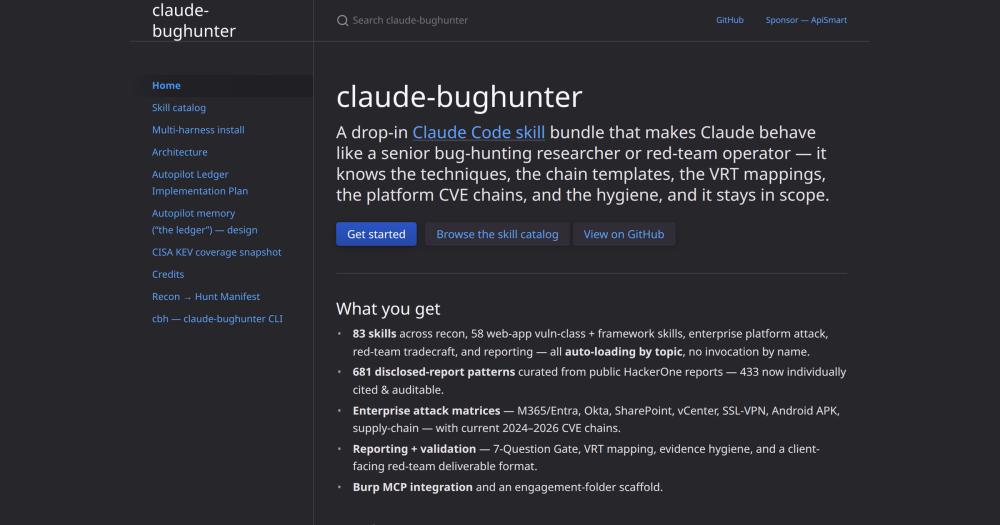
Run Claude Code as a senior bug-hunting researcher or red-team operator, with 83 auto-loading skills and 681 HackerOne-sourced patterns. MIT licensed.

Visit websiteGitHub6.5K stars
Image for Claude-BugHunter
TL;DR

Claude-BugHunter is a Claude Code skill bundle for authorized bug hunting and external red-team work. It ships 83 skills auto-loaded by topic, 681 HackerOne-sourced patterns across 24 vulnerability classes, enterprise platform attack matrices with current 2024-2026 CVE chains (M365/Entra, Okta, vCenter, SSL-VPN appliances), and a 7-Question Gate validation workflow. MIT licensed and free to run on your own machine; no server required. Best for bug bounty hunters, authorized pentesters, and external red teamers who want context from real disclosed reports rather than abstract checklists.

Read the full breakdownHide the full breakdownWho it is for, how it works, trade-offs, the quick start and the FAQ
who it's for

Who Claude-BugHunter is for#

Bug bounty hunters running in-scope HackerOne and Bugcrowd programs

The 58 hunt-* skills and 681 pattern corpus map directly to the vulnerability classes H1 and Bugcrowd pay on. VRT-aware severity output, OOS rebuttal blocks, and evidence-hygiene checks (cookies, PII redaction) address the submission-side gaps that hurt validity ratios on platforms with strict duplicate and severity thresholds.

Skip if:

You hunt primarily on platforms with custom severity models outside HackerOne or Bugcrowd VRT, such as crypto-focused bug bounty programs where the core risk framing differs significantly from web-app vulnerability classes.

External red teamers targeting internet-facing enterprise estate

The enterprise platform matrices (M365/Entra, Okta, vCenter, SSL-VPN appliances, SharePoint) carry current 2024-2026 CVE chains and post-credential escalation paths for AWS keys, JWTs, and GCP JSON credentials. The red-team report template produces 50 KB+ DOCX-compatible deliverables, not bug-bounty report stubs.

Skip if:

Your engagement scope includes internal Active Directory, lateral movement, or C2 tradecraft. The bundle deliberately excludes those phases; Impacket, NetExec, BloodHound, and Rubeus are outside its scope by design.

Security researchers and CTF players building portable workflows

The multi-agent install (--all flag) copies skills to Claude Code, OpenCode, Codex CLI, Hermes Agent, and Google AntiGravity simultaneously. Battle-tested on public training platforms including DVWA, OWASP Juice Shop, Hacker101, and testphp.vulnweb.com, so the skill behavior is validated before a first real target.

Skip if:

You need binary exploitation, kernel pwn, browser internals, or hardware security skills. These are out of scope for this bundle.

Developers auditing their own code for security defects

The 58 web-app vulnerability-class skills and the recon layer work on repos you own. Frame the engagement as a defensive review ('check this against the OWASP Top 10', 'secure refactor to remediate'), which fits the authorized-use model and reduces classifier friction on Anthropic's models without requiring CVP enrollment.

Skip if:

You need SAST or SCA tooling integrated into a CI/CD pipeline. This bundle operates interactively inside Claude Code, not as an automated scanner stage in a build system.

the problem

The problem it solves#

Generic AI assistants fail mid-engagement in security work. They produce plausible-sounding test cases without knowing which payloads bypass real-world filters, and they carry no context for how triagers on HackerOne or Bugcrowd actually evaluate reports. The pain compounds fast: a hypothesis drafted before validation means wasted hours and a hurt validity ratio; the wrong VRT severity mapping auto-downgrades a P3 finding to P4; screenshots get submitted with cookies and victim PII still visible.

External red-team engagements expose a second layer of gaps: no current CVE chains for enterprise targets (M365, Okta, vCenter, SSL-VPN appliances), no model for post-credential escalation when recon yields AWS keys or JWTs, and no client-facing report format that meets an enterprise deliverable standard. These are the specific gaps documented across real authorized engagements before the first line of this bundle was written.

how Claude-BugHunter solves it

How it solves it#

83 skills auto-loaded by topic

Covers recon and OSINT (5 skills), 58 web app vulnerability classes, enterprise platform attacks (M365/Entra, Okta, vCenter, SSL-VPN appliances), red-team tradecraft, and reporting. Describe what you are testing in plain English and the relevant skill loads without naming it; no manual invocation required.

681 disclosed-report patterns across 24 vulnerability classes

Curated from public HackerOne reports, 433 of them now individually cited and auditable. Each hunt-* skill includes per-class detection patterns, payload tables, bypass techniques, and chain templates sourced from real triager-validated findings, not abstract OWASP descriptions.

Enterprise platform attack matrices with current CVE chains

Covers M365 and Entra ID, Okta as an IdP, SharePoint on-prem (ToolShell and legacy SOAP), VMware vCenter and Workspace ONE, SSL-VPN appliances (Cisco, Fortinet, Citrix, Palo Alto, Pulse, SonicWall, F5), Android APK red-team, and cloud IAM post-credential escalation. Each matrix carries current 2024-2026 CVE chains.

7-Question Gate and VRT-aware reporting

The triage-validation skill fires before any submission: it checks whether the asset is in scope (Q3) and on the program's accepted-impact list (Q2). Report output maps severity using VRT defaults for HackerOne and Bugcrowd, with an OOS rebuttal block and evidence-hygiene checks (cookies, PII redaction) built in.

Multi-agent compatibility

Skills are plain SKILL.md files readable by Claude Code, OpenCode, OpenAI Codex CLI, Hermes Agent, and Google AntiGravity. The install script's --all flag detects installed agents and copies skills to each; --burp-mcp wires the Burp MCP server into every one. The cbh CLI installs standalone via pipx.

strengths · trade-offs

Strengths and trade-offs#

Strengths

  • MIT license with no server or subscription requiredThe entire bundle is MIT licensed; install it, fork it, modify it, or ship it into an internal toolkit without restriction. It runs inside Claude Code on the researcher's own machine, so there is no hosted service to pay for, no per-engagement fee, and no data leaving your control.
  • Patterns from 433 individually cited HackerOne reportsThe 681-pattern corpus is not synthesized from documentation: it is curated from public disclosed reports, with 433 now linked to their source. Each pattern carries the actual chain template a real triager paid for, not an OWASP checklist summary. That specificity is what separates evidence-backed hypothesis generation from guesswork.
  • Scope enforcement built into every skillThe triage-validation skill's 7-Question Gate fires on ambiguous targets; the bundle documents its own exclusions explicitly (no C2, no internal AD, no post-exploit) rather than leaving them implied. The /hunt scaffold states the engagement frame on its first turn, reducing classifier refusals on authorized offensive work.
  • Active project with 6,467 stars and 3 open issuesWith 6,467 GitHub stars, 972 forks, and the last push on 2026-11-15, the project is actively maintained. Only 3 open issues at time of writing. The v3 community expansion added 20+ framework and surface skills beyond the original 24 vulnerability classes.

Trade-offs

  • -Authorized offensive work requires Anthropic's Cyber Verification ProgramAnthropic's models apply real-time safeguards that block exploitation tooling by default, and the bundle cannot override them. Authorized pentesters and bug hunters need to enroll in Anthropic's free Cyber Verification Program (CVP) before the full skill set works as intended on live offensive tasks. On Opus 5, some higher-risk requests fall back to Opus 4.8 mid-session, which can be easy to miss in a long agentic run.
  • -External attack surface only; internal AD and post-exploit excludedInternal Active Directory attacks (BloodHound, Kerberoasting, DCSync, Pass-the-Hash, AD CS abuse), C2 frameworks (Cobalt Strike, Sliver), post-exploit persistence, AMSI bypass, iOS pentesting, binary exploitation, and kernel pwn are all explicitly out of scope by design. Teams running internal red-team engagements that include domain-takeover chains need separate tooling for those phases.
  • -Plugin install path lacks the hunt scaffolder and cbh CLIThe plugin route (the fastest install) loads all 83 skills and 15 slash commands namespaced under claude-bughunter:, but the engagement-folder scaffolder (/hunt engine) and cbh CLI are only available with the full clone install. Plugin users can add cbh standalone via pipx, but the hunt scaffolder requires the clone.
versus alternatives

Claude-BugHunter vs alternatives#

Claude-BugHunter vs Burp Suite Professional

Burp Suite Professional is the dominant paid tool in web application security: a mature proxy, active scanner, and extensibility framework from PortSwigger, priced at $499 a year per user (PortSwigger's price, read 2026-11-16). Claude-BugHunter is not a direct replacement; it ships Burp MCP wiring so the two work together.

FeatureClaude-BugHunterBurp Suite Professional
LicenseMITProprietary
Runs locallyYes (inside Claude Code)Yes
PricingFree$499 a year per user
Active proxy and traffic scannerNoYes
AI assistanceYes (skills loaded by topic, hypotheses from disclosed reports)Yes (Burp AI, built into Professional)
HackerOne/Bugcrowd pattern library681 curated patternsNone built in
Enterprise platform CVE chainsYes (M365, Okta, vCenter, VPN)No
VRT-aware reportingYesNo built-in
Burp MCP integrationYesn/a

For web application bug hunting, Burp Suite Pro remains the better choice for active scanning, traffic interception, and manual testing via Intruder and Repeater; those capabilities have no equivalent in this bundle. Claude-BugHunter handles the layers Burp does not: recon, hypothesis generation from real disclosed patterns, enterprise platform attacks, and structured VRT-aware reporting. The recommended workflow is both: Burp for proxying and scanning, Claude-BugHunter inside Claude Code for context, pattern matching, and report writing.

Claude-BugHunter vs Paid AI Security Platforms

Commercial AI security tools such as Snyk Code or Semgrep Pro are designed for continuous integration: they scan repositories or running services on a schedule and feed findings into a ticketing workflow. Claude-BugHunter is designed for interactive, authorized offensive work: a human researcher drives each engagement and skills load context on demand. The two categories serve different workflows and do not compete directly.

For teams choosing an AI layer to extend their offensive security work, Claude-BugHunter's MIT license and self-contained local deployment offer a cost-free path rather than adding a commercial AI security subscription on top of an existing toolchain.

install · quick start

Quick start#

bash
Install the bundle by cloning the repository and running the setup script for your platform.

```bash
git clone https://github.com/elementalsouls/Claude-BugHunter.git
cd Claude-BugHunter
bash scripts/install.sh
```
tech stack · detected from GitHub

What it's built on#

Languages
Python
frequently asked

FAQ#

Does Claude-BugHunter work without Anthropic's Cyber Verification Program?

It installs and runs without CVP, but Anthropic's real-time safeguards block exploitation tooling by default, so authorized offensive work (live bug bounty, pentest, red team) will hit refusals on certain tasks. CVP is free and application-based; it adjusts the safeguards for legitimate dual-use work. Mass data exfiltration and ransomware development stay prohibited and cannot be adjusted via CVP.

What is the difference between the plugin install and the copy install?

The plugin route (/plugin marketplace add elementalsouls/Claude-BugHunter inside Claude Code) loads all 83 skills and 15 slash commands namespaced under claude-bughunter: and updates when you bump the plugin version; no files are copied to ~/.claude/. The copy install (bash scripts/install.sh on macOS/Linux) copies skills and commands into ~/.claude/ and also installs the hunt engagement scaffolder and the cbh CLI. Plugin users can add cbh standalone via pipx install git+https://github.com/elementalsouls/Claude-BugHunter without a full clone.

Which bug bounty platforms does the reporting workflow support?

The reporting skills target HackerOne, Bugcrowd (VRT-aware), Intigriti, and Immunefi, plus a client-facing red-team deliverable format for enterprise engagements. The 7-Question Gate in triage-validation checks scope and program impact before any submission to guard against invalid or duplicate reports.

What enterprise targets do the attack matrices cover?

M365 and Entra ID, Okta as an IdP, SharePoint on-prem (ToolShell plus legacy SOAP), VMware vCenter and Workspace ONE, SSL-VPN appliances (Cisco, Fortinet, Citrix, Palo Alto, Pulse, SonicWall, F5), Android APK red-team, and cloud IAM post-credential escalation (AWS STS AssumeRole, IMDS chains, cross-account confused-deputy, GCP JSON keys). Each matrix carries current 2024-2026 CVE chains.

Does the bundle cover internal Active Directory attacks?

No. Internal AD attacks (BloodHound, Kerberoasting, DCSync, Pass-the-Hash, AD CS abuse, ntlmrelayx) are explicitly out of scope by design. The bundle covers the external attack surface only; handoff to internal red-team tooling (Impacket, NetExec, Rubeus, BloodHound) is intentionally outside its scope. The README notes that coverage for internal AD and post-exploit may come in a future update.

also worth a look

Similar open-source tools#

REA (Reverse Engineer Anything)

Featured

Alternative toRevEng.AI

AI-powered reverse engineering for binaries, apps, and assemblies.

  • 458,164 GitHub stars
  • MITLicence MIT

Codex Security

Alternative toSnyk

Find, validate, and fix code vulnerabilities via CLI, SDK, or Codex.

  • 13,549 GitHub stars
  • Apache-2.0Licence Apache-2.0

LiveReview

Alternative toCodeRabbit

Self-hosted AI code review with auto-approve and blast-radius scoring

  • 158 GitHub stars
  • CustomLicence Sustainable Use License (fair-code, modified)

Code Server

Alternative toGitHub Codespaces

VS Code in the browser, self-hosted, with no per-seat pricing.

  • 79,854 GitHub stars
  • MITLicence MIT

Sandchest

Alternative toSnyk

AI code security reviewer using abliterated, unrestricted models

  • 57 GitHub stars
  • AGPL-3.0Licence AGPL-3.0

Nasiko

Alternative toPortkey

Self-hosted runtime for agent cost control, routing, and access policy

  • 11,933 GitHub stars
  • Apache-2.0Licence Apache-2.0
by category

Open source tools in these categories#

198

Security & Monitoring

REA (Reverse Engineer Anything), RustDesk, Sherlock
538

AI & Machine Learning

freeCodeCamp, REA (Reverse Engineer Anything), OpenClaw

Sponsors

Inbox Zero

Alternative toSuperhuman

AI email assistant that drafts replies and clears your inbox

  • 13,025 GitHub stars
  • AGPL-3.0Licence AGPL-3.0
  • #Email

rakazo

Alternative toGrok Bot

AI teammates you own: your keys, your model, your machine.

  • 8,291 GitHub stars
  • Apache-2.0Licence Apache-2.0
  • #AI Agents

SnitchFeed

Live monitoring on LinkedIn, X, Reddit & more. Agentic social listening for startups.

Marketing & Growth

Advertise your product

New open source projects by email

The projects we add and every new guide. Free, unsubscribe any time.

Find open source alternatives to paid software

/
  • Claude Code to OpenCode
  • Jira to Windshift
  • Notion to AppFlowy
  • Slack to Mattermost
  • Linear to GitLab
  • Wispr Flow to Handy
  • Arc to Zen Browser
  • CapCut to Concat
  • Grok Bot to rakazo
  • Superhuman to Inbox Zero
  • Discord to Stoat
  • Airtable to AITable
  • Datadog to SigNoz
  • Muse to OpenClaw
  • Railway to Coolify
  • GitHub Copilot to Cline
  • Confluence to Wiki.js
  • Microsoft Teams to Rocket.Chat
  • 1Password to KeePassXC
  • Firebase to Supabase
  • Pinecone to Qdrant
  • Zapier to n8n
  • Devin AI to OpenHands
  • Asana to Leantime
  • Claude Code to OpenCode
  • Jira to Windshift
  • Notion to AppFlowy
  • Slack to Mattermost
  • Linear to GitLab
  • Wispr Flow to Handy
  • Arc to Zen Browser
  • CapCut to Concat
  • Grok Bot to rakazo
  • Superhuman to Inbox Zero
  • Discord to Stoat
  • Airtable to AITable
  • Datadog to SigNoz
  • Muse to OpenClaw
  • Railway to Coolify
  • GitHub Copilot to Cline
  • Confluence to Wiki.js
  • Microsoft Teams to Rocket.Chat
  • 1Password to KeePassXC
  • Firebase to Supabase
  • Pinecone to Qdrant
  • Zapier to n8n
  • Devin AI to OpenHands
  • Asana to Leantime