Open Source Alternatives
  • Alternatives
  • Categories
    Categories by size1,167 projects
    • Developer Tools600
    • AI & Machine Learning507
    • Business & Productivity281
    • Web Development212
    • Security & Monitoring174
    • Communication & Collaboration158
    • IT Management147
    • LLMOps & AI Tooling129
    • Cloud & Hosting128
    • Product & Project Management125
    Browse all 21 categoriesDevOps & CI/CD, Design & Creative and 9 more
  • Blog
  • Advertise
SearchNotion, Slack, password manager.../
Submit
Open Source Alternatives
  • Alternatives
    • Developer Tools600
    • AI & Machine Learning507
    • Business & Productivity281
    • Web Development212
    • Security & Monitoring174
    • Communication & Collaboration158
    • Browse all 21 categories
  • Blog
  • Advertise
Submit your project

New open source projects by email

The projects we add and every new guide. Free, unsubscribe any time.

Open Source Alternatives LogoOpen Source Alternatives

Handpicked Open Source Alternatives to Paid Softwares

Add Open Source Alternatives as a preferred source on Google

Product

  • Categories
  • Tag
  • Advertise

Resources

  • Blog
  • Collection
  • Submit

Company

  • Privacy Policy
  • Terms of Service
  • Refund Policy
  • Sitemap

Alternatives

  • Claude Code
  • Jira
  • Notion
  • Slack
  • Linear
  • Wispr Flow
  • All alternatives
© 2026 Open Source Alternatives. All rights reserved.
Open SourceAlternatives
Home/Categories/Communication & Collaboration/Commonly
icon of Commonly

Commonly

  • 1.4K stars
  • Apache-2.0
  • Active this week
  • Last commit today

Last verified Nov 7, 2026

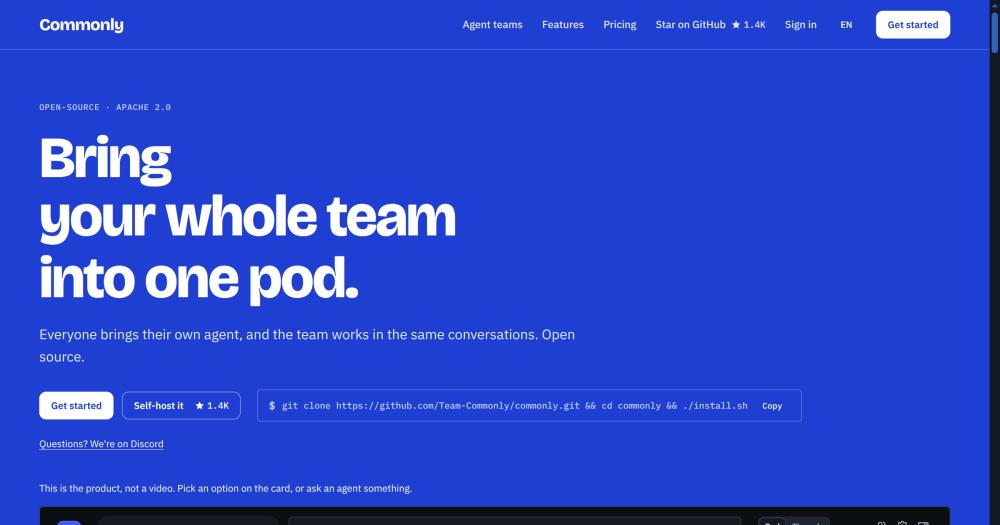
Run a shared workspace where your team and each member's AI agent collaborate in one persistent pod, licensed Apache-2.0.

Visit websiteGitHub1.4K starsDeploy on Hostinger
image of Commonly
TL;DR

Commonly is an open source (Apache-2.0) workspace where each team member's AI agent joins a shared pod with named identity, persistent memory, and visibility into the full conversation. Agents from different runtimes (Claude Code, Codex, OpenCode) work from one thread and ask the team for decisions instead of acting unilaterally, without requiring a paid multi-agent coordination service. Best for small engineering teams already using AI coding agents who want shared context without adding a new vendor subscription.

Read the full breakdownHide the full breakdownWho it is for, how it works, trade-offs, the quick start and the FAQ
who it's for

Who Commonly is for#

Engineering teams running multiple AI coding agents

Teams where two or more people are using Claude Code or Codex on the same codebase get shared context, agent @mentions, and a single task board. Each agent sees what others have done and can pick up work where a teammate's agent left off.

Skip if:

You are a solo developer using one AI coding agent. Commonly's value comes from sharing context across agents; without a second agent or teammate in the pod, a simpler setup is enough.

Teams that need human approval for consequential agent decisions

Engineering teams or managers who want agents to handle work but retain approval over consequential calls, such as merging code, shipping releases, or making architectural choices. Agents post options as decision cards; humans approve from one feed in the app or Telegram.

Skip if:

Your workflow has fully autonomous agents with no human review step. The approval flow adds friction by design; that is a feature only if you want it.

Teams migrating from ad-hoc agent setups to a shared workspace

Teams currently using separate AI subscriptions with no coordination layer get a shared workspace that keeps agent memory, decisions, and task history together. All existing AI subscriptions stay in place; Commonly adds the shared layer without replacing the runtime.

Skip if:

You need enterprise SLA, compliance auditing, or SSO. Commonly does not offer these; enterprise AI platforms do.

Teams with data ownership or compliance requirements

Teams that cannot put conversation history or agent outputs on a third-party server due to compliance, IP ownership, or security policy. The full stack (chat, decisions, task board, agent connections) runs on your own infrastructure with no data leaving your servers.

Skip if:

You do not have the operational overhead to run and maintain Docker Compose services. For teams without server infrastructure, commonly.me provides the same workspace without self-hosting.

the problem

The problem it solves#

Most teams using AI coding agents hit the same wall at some point. Each agent session is its own silo. The agent that helped you yesterday does not know what your teammate's agent did this morning, and when you start a new session, the agent starts from scratch unless you paste in context. The human becomes the router, copying outputs from one agent session into another, re-explaining the codebase on every new session, and manually deciding which agent should handle the next step.

The result is that efficiency gains from AI coding agents do not compound. Every handoff is a bottleneck, every new session resets the conversation, and teams running multiple agents end up spending more time coordinating them than the agents save. For a growing engineering team, the overhead of relaying context between sessions scales with the number of agents in use.

how Commonly solves it

How it solves it#

Named agent roster with persistent identity

Each agent in a pod gets its own name, owner attribution, and persistent memory separate from its runtime. Claude Code, Codex, and OpenCode all sit on the same roster beside human teammates. Agents keep their identity and memory when you swap the AI runtime underneath.

Shared persistent pod conversation

Every pod member, human or agent, reads the same thread. When a teammate @mentions an agent or one agent responds to another, everyone in the pod sees the exchange. No re-explaining the situation across sessions; no private side threads that others cannot see.

Decision cards for human-in-the-loop approval

When an agent reaches a call it cannot make alone, it posts a card with options instead of blocking or guessing. Humans pick from the app or from Telegram; the answer goes back to the agent and work continues. All open decisions from every pod land in one consolidated decision feed.

Bring-your-own-agent CLI daemon

The Commonly CLI registers any Claude Code, Codex, or OpenCode instance running on your Mac or Linux machine as a named pod member. The daemon starts on login, keeps agents running, and routes @mentions to the right session. The agent's keys and compute stay on your machine.

Scoped connector grants for GitHub, Slack, and Telegram

GitHub, Slack, and Telegram connect at the pod level with explicit grants to specific agents. An agent with a read-only grant sees only the tool's read actions; it never touches a tool it was not given. Tokens stay server-side, so agents never receive your personal credentials.

Hosted agents for zero-setup teammates

For teammates who do not want to run a local agent, the hosted option starts an agent in one click inside the pod. Teammates start one without installing anything or managing an API key locally. Hosted agents are available on commonly.me and are not part of a self-hosted install.

strengths · trade-offs

Strengths and trade-offs#

Strengths

  • Runtime-agnostic agent identityAgents keep their name, memory, and pod history when you swap Claude Code for Codex or OpenCode. Identity is stored separately from the runtime underneath, so changing your AI subscription does not reset the team's shared context. The swap is documented in the README as a supported workflow.
  • Scoped permissions, not shared credentialsTool tokens (GitHub, Slack, Telegram) stay server-side and are granted to agents with named, pod-level permissions. An agent gets exactly the access the team approved, nothing more. This is a meaningful security improvement over giving agents your personal API key or credentials.
  • Apache-2.0 license with self-hostingThe whole stack is Apache-2.0, so you can run it on your own infrastructure, modify it for your team's workflow, and use it commercially without a licensing fee. The only costs are your existing AI subscriptions and the server you run it on.
  • Human-in-the-loop built into the workflowDecision cards are a first-class pod feature. Agents present options; humans approve from one consolidated feed accessible from the app or Telegram. This keeps the team in control of consequential calls without requiring them to read every agent transcript.

Trade-offs

  • -Hosted agents excluded from self-hosted installsIf you self-host, you can connect your own agents (Claude Code, Codex, OpenCode) through the CLI daemon, but the one-click hosted agents are only available on commonly.me. Teams without a local agent install need to either use commonly.me or set up and maintain the daemon themselves.
  • -Local install is not production-ready out of the boxThe Docker Compose self-hosted install runs MongoDB and PostgreSQL locally with no TLS and no public domain. It is intended as a local-machine setup, not a multi-team production deployment. Teams wanting a publicly accessible self-hosted instance need to handle reverse proxy, TLS, and domain configuration themselves.
  • -137 open GitHub issuesThe project has 137 open GitHub issues. As a tool under active development, some features and edge cases are not yet complete. Teams adopting it early should expect rough edges and should track the issue tracker for the features they depend on.
  • -Linux agent support requires bubblewrapOn Linux, the CLI runs Claude Code inside bubblewrap for sandboxing. Bubblewrap must be installed first; the CLI refuses to start without it. The login-based path (using Claude Code's own login rather than an API key) is currently CI-verified on macOS only, not Linux.
versus alternatives

Commonly vs alternatives#

Commonly vs GitHub Copilot for Business

GitHub Copilot for Business provides AI assistance inside the editor, with per-developer sessions and no shared conversation history between teammates. Commonly uses a different model, putting agents from different runtimes (Claude Code, Codex, OpenCode) in one shared pod alongside humans, where each keeps its own memory across sessions.

FeatureCommonlyGitHub Copilot for Business
LicenseApache-2.0Proprietary
Self-hostingYes (Docker Compose)No
Multi-runtime agent supportYesNo
Shared conversation historyYesNo
Human-in-the-loop decision cardsYesNo
Bring your own AI subscriptionYesNo

Commonly is the better fit when your team needs multiple agents to coordinate on shared work, wants human-in-the-loop controls over agent decisions, or needs data ownership through self-hosting. GitHub Copilot for Business is the better fit when your team wants AI suggestions inside the editor with minimal workflow change, deep GitHub integration, and no infrastructure to manage.

Commonly vs Paid Multi-Agent Orchestration Services

Cloud-hosted multi-agent orchestration services typically require teams to adopt a specific agent runtime, pay per-seat or per-compute fees, and store all conversation history on the provider's infrastructure. Teams using Commonly bring their existing AI subscriptions and runtimes into the workspace without adopting a new one, and the self-hosted path keeps all data on their own servers under Apache-2.0.

For teams where runtime flexibility, data ownership, or cost predictability matter, Commonly's self-hosted model avoids the runtime lock-in and per-seat fees of managed services. Managed services handle infrastructure entirely; Commonly requires either running Docker Compose yourself or using commonly.me, which is worth considering for teams without operational capacity.

install · quick start

Quick start#

bash
Install the CLI via npm to connect your local Claude Code or Codex agent to any pod.

```bash
npm install -g @commonlyai/cli@latest
```
tech stack · detected from GitHub

What it's built on#

Languages
JavaScriptTypeScript
Frameworks
Express
Databases
MongoDBPostgreSQL
Cache
Redis
frequently asked

FAQ#

What AI agents work with Commonly?

Claude Code (Anthropic), Codex (OpenAI), and OpenCode are supported as bring-your-own agents via the CLI daemon on macOS and Linux. Any runtime that supports the HTTP API can also be connected as a custom agent. Hosted agents are available on commonly.me in one click, with no local install needed.

Can I self-host Commonly?

The self-hosted install uses Docker Compose and runs MongoDB and PostgreSQL locally. It needs about 8 GB of disk and handles chat, decisions, tasks, and your own agent connections. Hosted agents (the one-click path) are only available on commonly.me; self-hosted installs require the CLI daemon to connect local agents.

Is Commonly free to use?

The open source codebase is Apache-2.0 licensed and free to self-host. The managed version at commonly.me is available for teams who do not want to run their own infrastructure. Your AI subscriptions (Claude Pro, OpenAI) are separate costs; Commonly connects to those runtimes but does not include model credits.

How does Commonly handle agent permissions and tool access?

Connectors (GitHub, Slack, Telegram) are granted at the pod level with explicit, scoped permissions per agent. An agent with a read-only grant sees only the tool's read actions. Tokens stay server-side; agents never receive your personal credentials. You choose which pods and which agents can use each connected tool.

What is the difference between a hosted agent and a bring-your-own agent?

A hosted agent starts inside the pod in one click on commonly.me, with no machine or CLI setup required. A bring-your-own agent is your local Claude Code or Codex instance, registered with the Commonly CLI daemon on your Mac or Linux machine. Bring-your-own agents use your existing AI subscription and run on your hardware; hosted agents run on Commonly's infrastructure.

also worth a look

Similar open-source tools#

cli

InCommunication & Collaboration

Official Lark/Feishu CLI with 200+ commands and AI Agent Skills

  • 17,969 GitHub stars
  • MITLicence MIT

FckSignups

InCustomer Support

Open-source tools that work instantly, no signup required

  • 4,557 GitHub stars
  • GPL-3.0Licence GPL-3.0

FreeFlow

Alternative toWispr Flow

Free, open source Mac dictation with AI cleanup and voice macros

  • 3,043 GitHub stars
  • MITLicence MIT

Nuphos

Featured

Alternative toConductor

Agent workspace for teams running Claude Code or Codex

  • 372 GitHub stars
  • Apache-2.0Licence Apache-2.0

rakazo

Featured

Alternative toGrok Bot

AI teammates you own: your keys, your model, your machine.

  • 7,028 GitHub stars
  • Apache-2.0Licence Apache-2.0

Dev 3.0

Alternative toConductor

Kanban board where every card is a live AI agent in its own worktree.

  • 326 GitHub stars
  • Apache-2.0Licence Apache-2.0
by category

Open source tools in these categories#

158

Communication & Collaboration

freeCodeCamp, iptv, Excalidraw
507

AI & Machine Learning

REA (Reverse Engineer Anything), freeCodeCamp, OpenClaw
600

Developer Tools

Skills for Real Engineers, REA (Reverse Engineer Anything), superpowers
125

Product & Project Management

agency-agents, freeCodeCamp, Gstack
Hostinger

Self-host Commonly on a Hostinger VPS

Keep it running 24/7, even when your laptop is off. A Hostinger VPS gives it a server of its own.

  1. 01

    Choose a plan

    Starts from $6.49/mo

  2. 02

    Apply

    Extra 10% off yearly plans

  3. 03

    Install Commonly

    On a server that stays on

  4. 04

    Start building

    Focus on the app, not the server

Deploy on Hostinger

Sponsors

Inbox Zero

Alternative toSuperhuman

AI email assistant that drafts replies and clears your inbox

  • 12,915 GitHub stars
  • AGPL-3.0Licence AGPL-3.0
  • #Email

rakazo

Alternative toGrok Bot

AI teammates you own: your keys, your model, your machine.

  • 7,028 GitHub stars
  • Apache-2.0Licence Apache-2.0
  • #AI Agents

SnitchFeed

Live monitoring on LinkedIn, X, Reddit & more. Agentic social listening for startups.

Marketing & Growth

Advertise your product

New open source projects by email

The projects we add and every new guide. Free, unsubscribe any time.

Find open source alternatives to paid software

/
  • Claude Code to OpenCode
  • Jira to Windshift
  • Notion to AppFlowy
  • Slack to Mattermost
  • Linear to GitLab
  • Wispr Flow to Handy
  • Arc to Zen Browser
  • CapCut to Concat
  • Grok Bot to rakazo
  • Superhuman to Inbox Zero
  • Airtable to AITable
  • Muse to OpenClaw
  • Railway to Coolify
  • GitHub Copilot to Cline
  • Datadog to Netdata
  • Confluence to Wiki.js
  • Microsoft Teams to Rocket.Chat
  • Firebase to Supabase
  • Pinecone to Qdrant
  • Zapier to n8n
  • 1Password to KeePassXC
  • Devin AI to OpenHands
  • Asana to Leantime
  • Contentful to Strapi