Open Source Alternatives
  • Alternatives
  • Categories
    Categories by size1,139 projects
    • Developer Tools583
    • AI & Machine Learning498
    • Business & Productivity275
    • Web Development209
    • Security & Monitoring173
    • Communication & Collaboration154
    • IT Management146
    • Cloud & Hosting128
    • LLMOps & AI Tooling128
    • Product & Project Management122
    Browse all 21 categoriesDevOps & CI/CD, Data & Analytics and 9 more
  • Blog
  • Advertise
SearchNotion, Slack, password manager.../
Submit
Open Source Alternatives
  • Alternatives
    • Developer Tools583
    • AI & Machine Learning498
    • Business & Productivity275
    • Web Development209
    • Security & Monitoring173
    • Communication & Collaboration154
    • Browse all 21 categories
  • Blog
  • Advertise
Submit your project

New open source projects by email

The projects we add and every new guide. Free, unsubscribe any time.

Open Source Alternatives LogoOpen Source Alternatives

Handpicked Open Source Alternatives to Paid Softwares

Product

  • Categories
  • Tag
  • Advertise

Resources

  • Blog
  • Collection
  • Submit

Company

  • Privacy Policy
  • Terms of Service
  • Refund Policy
  • Sitemap

Alternatives

  • Claude Code
  • Jira
  • Notion
  • Slack
  • Linear
  • Wispr Flow
  • All alternatives
© 2026 Open Source Alternatives. All rights reserved.
Open SourceAlternatives
Home/Categories/Developer Tools/Dev 3.0
icon of Dev 3.0

Dev 3.0

Open source alternative to Conductor, crystl and KanBots

  • 326 stars
  • Apache-2.0
  • Active this week
  • Last commit today

Last verified Nov 5, 2026

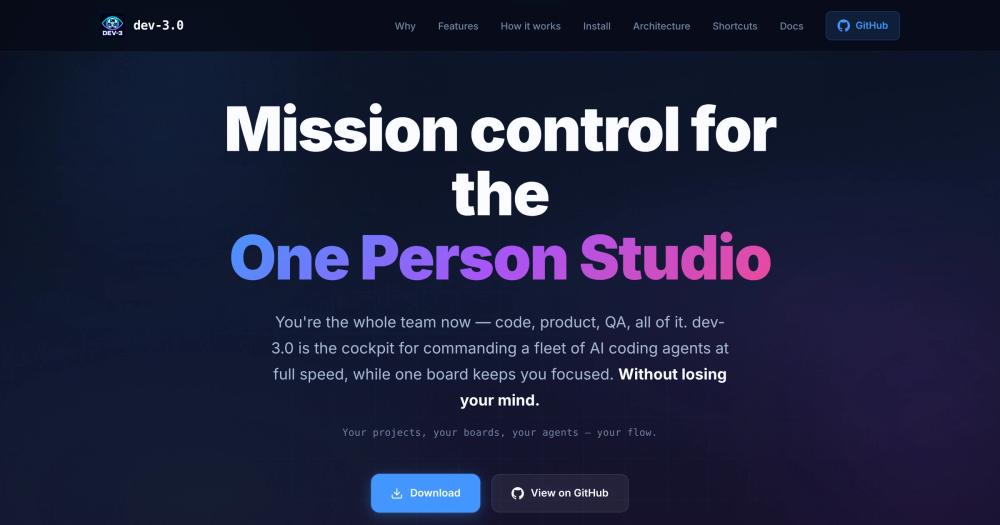
Orchestrate multiple AI coding agents in parallel across isolated git worktrees with a Kanban-first cockpit for the solo developer.

Visit websiteGitHub326 starsDeploy on Hostinger
image of Dev 3.0
TL;DR

Dev 3.0 is an open source orchestrator for running multiple AI coding agents in parallel across isolated git worktrees. It replaces paid multi-agent tools like Conductor, crystl, and KanBots with a Kanban board where each card is a real branch, a real terminal, and a real agent session. Apache 2.0 licensed, free to self-host, available as a native desktop app on macOS, Linux, and Windows. Best suited to solo developers who want to delegate code writing to Claude Code, Codex, Gemini CLI, or any terminal-based agent and keep track of a full fleet on one board.

Read the full breakdownHide the full breakdownWho it is for, how it works, trade-offs, the quick start and the FAQ
who it's for

Who Dev 3.0 is for#

Solo developers running parallel agent tasks

You are a one-person studio who wants to run several independent features or bug fixes simultaneously, each handled by a different agent. Dev 3.0 gives each task its own worktree and terminal, keeps the board up to date with agent status, and alerts you when any agent needs a decision.

Skip if:

You prefer to work on one task at a time and do not currently run more than one or two agent sessions simultaneously. The board's value scales with the number of parallel tasks.

Developers migrating off Conductor

Conductor reaches end of life on 2026-11-20. Dev 3.0 covers the core orchestration workflow (Kanban board, agent launch, worktree isolation) in an open source form with no migration cliff date.

Skip if:

You relied on Conductor-specific managed cloud features or team-sharing functionality that Dev 3.0 does not replicate.

Teams running headless agent fleets on a server

You run agents on a cloud VM or home server and want to monitor and direct them from any device. The headless mode (Linux CLI + browser UI over Cloudflare tunnel) covers the full board, all terminals, and live previews over a QR-accessible URL.

Skip if:

Your agents run on a machine you can physically sit in front of, and remote access adds complexity without benefit.

Developers evaluating multiple approaches in parallel

You want to run three different implementations of the same feature and compare the diffs before picking one. Dev 3.0's variant system runs the same task on multiple branches simultaneously, each in its own isolated worktree, so you can inspect all three approaches side by side before committing to one.

Skip if:

You already know the approach and have no need to compare competing implementations. Single-task linear workflows do not benefit from this feature.

the problem

The problem it solves#

Managing multiple AI coding agents manually is chaotic. When you run five or more agents across different terminals, branches, and repositories, switching between them takes minutes each time, and you constantly lose track of which agent is working on what. Without isolation between parallel workstreams, agents on the same codebase generate merge conflicts, and partial changes from one task bleed into another.

The harder problem is awareness. An agent stops and waits for your input, but you are buried in another terminal and miss the prompt entirely. By the time you notice, the agent has been idle for ten minutes. At scale, the cognitive overhead of managing the fleet becomes the bottleneck, not the speed of the agents themselves.

how Dev 3.0 solves it

How it solves it#

Git worktree per task

Full codebase isolation for every task on the board. Each new task creates its own git branch and worktree, so agents on the same repository physically cannot touch each other's files. Heavy directories like node_modules or .venv are copy-on-write cloned, so worktrees appear instantly with near-zero additional disk usage.

Live terminal preview on hover

Hover over any task card on the Kanban board and a live preview of that task's terminal appears without navigating away from the board. The preview updates in real time, every second, so you can check on ten agents at a glance without opening a single terminal window.

Multi-agent per task with split panes

Each task opens a real tmux terminal with preconfigured split panes. Run Claude Code, Codex, Gemini CLI, and opencode side by side in the same worktree for competing approaches, or one writing and one reviewing simultaneously. Session state persists through disconnects.

Terminal bell and badge alerting

When an agent sends a bell signal (asking a question or reporting a blocker), a red badge appears on its task card. The board includes a Has Questions column so tasks needing your input are never buried. No polling required; the card surface carries the status you actually need.

Headless remote access

Run the full app headless on any Linux server. One command (`dev3 remote`) starts the UI and prints a QR code plus URL served over a built-in Cloudflare tunnel. Scan from your phone or open in any browser: full board, live terminals, all previews, without the laptop in front of you.

Built-in code review with inline comments

The diff viewer shows the full branch diff with syntax highlighting, per-file read state, and inline comments on any line range. Completed comments export back into the agent's terminal as a prompt, closing the review loop without leaving the board. Markdown, Mermaid, and images render as a preview alongside the diff.

strengths · trade-offs

Strengths and trade-offs#

Strengths

  • Apache 2.0 with no seat pricingFree to self-host and use commercially. Unlike paid orchestration tools (crystl at $170/year, KanBots at $19/seat/month), Dev 3.0 has no recurring cost or per-seat model. You run it on your own infrastructure and own the fleet entirely.
  • Per-task git worktree isolationWorktrees give each task a physical copy of the working tree at its own commit, not just a separate terminal. Five agents can modify the same file without any of them seeing the other's changes until you explicitly merge. No staging tricks or manual branch management required.
  • Cross-platform: macOS, Linux, and WindowsNative desktop app on Apple Silicon and Intel Macs, headless CLI on any Linux box or cloud VM, and a Windows x64 build. The same Kanban board and agent sessions work from your laptop, a remote server, or your phone via the headless remote URL.
  • Active development as of late 2026326 GitHub stars, 42 forks, and a last push on 2026-11-05. The repo is not archived and shows active commit activity with 23 open issues, indicating a live project tracking real bugs and features rather than a stale or abandoned codebase.

Trade-offs

  • -Windows support is new and unsignedThe macOS Homebrew path is the most tested install. The official docs describe the Windows build as new and potentially rough, with an unsigned binary that requires two clicks past a SmartScreen warning on first launch. Users on Windows should expect the occasional rough edge.
  • -No hosted SaaS pathDev 3.0 has no managed cloud option: you download and run it yourself. For developers who want managed infrastructure, automatic updates, or a support contract, that is a gap the app does not fill. Updates require re-running the Homebrew upgrade command or downloading a new release.
  • -23 open GitHub issuesWith 23 open issues the project is active but not fully polished. Users running into edge cases should check the issue tracker before reporting; the volume suggests a codebase under active development rather than a stable-and-finished release.
  • -Individual focus without team governance featuresThe app optimizes for a single developer commanding their own fleet. Features like SSO, seat management, audit logs, and shared admin access are absent by design. Teams that need centralized access control or compliance tooling will need a different product.
versus alternatives

Dev 3.0 vs alternatives#

Dev 3.0 vs Conductor

Both Dev 3.0 and Conductor are parallel-agent orchestration tools designed for developers running multiple AI coding agents in parallel.

Conductor reaches end of life on 2026-11-20. Users currently on Conductor should begin planning their migration before that date. Dev 3.0 provides the same parallel-agent Kanban workflow as an open source, self-hosted tool at no cost.

Dev 3.0 vs crystl

crystl is a macOS-only Kanban tool for AI coding agents, available on the Guild plan at $170/year. Dev 3.0 covers the same board-and-agent workflow on macOS, Linux headless, and Windows x64, with no licensing cost.

FeatureDev 3.0crystl
LicenseApache 2.0Proprietary
PlatformsmacOS, Linux, WindowsmacOS only
PricingFree$170/year
Self-hostingYesNo

Dev 3.0 is the better fit for developers who work on Linux or Windows, prefer not to pay a yearly fee, or need to run agents on a headless server. crystl may still suit macOS users who want a fully managed native-app experience with no self-hosting requirement and prefer to pay for support and polish.

Dev 3.0 vs KanBots

KanBots is a cloud-based Kanban orchestration tool at $19/seat/month. Dev 3.0 offers the same board-and-agent workflow as a self-hosted, open source alternative.

FeatureDev 3.0KanBots
LicenseApache 2.0Proprietary
DeploymentSelf-hostedCloud
PricingFree$19/seat/month
Data locationYour infrastructureVendor cloud

Dev 3.0 is the better fit when data residency matters, when per-seat costs add up, or when you need agents running in an on-premises environment. KanBots may suit teams that prefer fully managed cloud infrastructure with no self-hosting overhead and are comfortable with the per-seat pricing model.

install · quick start

Quick start#

bash
Install Dev 3.0 on macOS or Linux with the official Homebrew tap; Windows users download from https://github.com/h0x91b/dev-3.0/releases/latest.

```bash
brew tap h0x91b/dev3
brew trust h0x91b/dev3
brew install --cask dev3
```
tech stack · detected from GitHub

What it's built on#

Languages
TypeScript
Frameworks
React
Runtimes
Bun
frequently asked

FAQ#

Does Dev 3.0 work with Claude Code, Codex, and Gemini CLI simultaneously?

Yes. Each task can run multiple agents side by side in split tmux panes inside the same git worktree. The app supports Claude Code, Codex CLI, Gemini CLI, opencode, Cursor Agent, and any other CLI-based tool. Claude Code and Codex additionally report their status back automatically through built-in hooks; other agents use an installed dev3 skill.

Does Dev 3.0 require a cloud account or subscription?

No. Dev 3.0 is Apache 2.0 licensed and free to self-host. There is no cloud backend, no subscription, and no seat pricing. You download the app, point it at a git repo, and run agents locally. Headless remote access uses a built-in Cloudflare tunnel, which is free for this use case.

How does Dev 3.0 prevent merge conflicts when multiple agents edit the same repo?

Each task on the board gets its own git worktree: a separate working tree at its own branch. Agents in different tasks cannot see each other's uncommitted changes, so there is no conflict until you decide to merge two tasks. The same repo can run five agents on five separate features with no cross-contamination.

Is Dev 3.0 an IDE?

No. The official docs are explicit: Dev 3.0 is not an IDE and will not become one. It is a cockpit for launching, monitoring, and reviewing agent work. It does not embed an editor; one click opens your real VS Code or Cursor when you need to read code, but the goal is for the agent to handle that. Git operations stay the agent's job too.

What platforms does Dev 3.0 run on?

macOS (Apple Silicon and Intel, via Homebrew cask or DMG), Linux (headless x64 and arm64 CLI with a browser-based UI), and Windows x64 (zip download, unsigned, described in the docs as new and potentially rough). The macOS Homebrew path is the most mature. Linux headless works on any cloud VM or server.

Looking for more

Other ways to replace Conductor, crystl and KanBots#

paperclip

Featuredfor Conductor

Self-hosted AI agent management with org charts and budgets

111,113 GitHub starsVisit

Orca

#1 in the Conductor guide

Drop-in Conductor replacement with 27 or more agents on macOS, Windows, and Linux under MIT

115,397 GitHub stars

T3 Code

#2 in the Conductor guide

MIT-licensed control plane for 6 or more agents with mobile and web clients and a large community

46,806 GitHub stars

Paseo

#3 in the Conductor guide

Daemon-based architecture for agents running on a VM or Docker host with full mobile parity

23,074 GitHub stars
All 52 Conductor alternatives12 open source Conductor alternatives, ranked
by category

Open source tools in these categories#

584

Developer Tools

REA (Reverse Engineer Anything), Skills for Real Engineers, superpowers
499

AI & Machine Learning

freeCodeCamp, REA (Reverse Engineer Anything), OpenClaw
123

Product & Project Management

agency-agents, freeCodeCamp, Gstack
Hostinger

Self-host Dev 3.0 on a Hostinger VPS

Keep it running 24/7, even when your laptop is off. A Hostinger VPS gives it a server of its own.

  1. 01

    Choose a plan

    Starts from $6.49/mo

  2. 02

    Apply

    Extra 10% off yearly plans

  3. 03

    Install Dev 3.0

    On a server that stays on

  4. 04

    Start building

    Focus on the app, not the server

Deploy on Hostinger

Sponsors

Inbox Zero

Alternative toSuperhuman

AI email assistant that drafts replies and clears your inbox

  • 12,915 GitHub stars
  • AGPL-3.0Licence AGPL-3.0
  • #Email

rakazo

Alternative toGrok Bot

AI teammates you own: your keys, your model, your machine.

  • 7,028 GitHub stars
  • Apache-2.0Licence Apache-2.0
  • #AI Agents

SnitchFeed

Live monitoring on LinkedIn, X, Reddit & more. Agentic social listening for startups.

Marketing & Growth

Advertise your product

New open source projects by email

The projects we add and every new guide. Free, unsubscribe any time.

Find open source alternatives to paid software

/
  • Claude Code to OpenCode
  • Jira to Windshift
  • Notion to AppFlowy
  • Slack to Mattermost
  • Linear to GitLab
  • Wispr Flow to Handy
  • Arc to Zen Browser
  • CapCut to Concat
  • Grok Bot to rakazo
  • Superhuman to Inbox Zero
  • Airtable to AITable
  • Muse to OpenClaw
  • Railway to Coolify
  • GitHub Copilot to Cline
  • Datadog to Netdata
  • Confluence to Wiki.js
  • Microsoft Teams to Rocket.Chat
  • Firebase to Supabase
  • Pinecone to Qdrant
  • Zapier to n8n
  • 1Password to KeePassXC
  • Devin AI to OpenHands
  • Asana to Leantime
  • Contentful to Strapi