Open Source Alternatives
  • Alternatives
  • Categories
    Categories by size1,302 projects
    • Developer Tools673
    • AI & Machine Learning549
    • Business & Productivity311
    • Web Development219
    • Security & Monitoring198
    • Communication & Collaboration168
    • IT Management165
    • Design & Creative145
    • LLMOps & AI Tooling142
    • DevOps & CI/CD141
    Browse all 21 categoriesCloud & Hosting, Product & Project Management and 9 more
  • Blog
  • Advertise
SearchNotion, Slack, password manager.../
Submit
Open Source Alternatives
  • Alternatives
    • Developer Tools673
    • AI & Machine Learning549
    • Business & Productivity311
    • Web Development219
    • Security & Monitoring198
    • Communication & Collaboration168
    • Browse all 21 categories
  • Blog
  • Advertise
Submit your project

New open source projects by email

The projects we add and every new guide. Free, unsubscribe any time.

Open Source Alternatives LogoOpen Source Alternatives

Handpicked Open Source Alternatives to Paid Softwares

Add Open Source Alternatives as a preferred source on Google

Product

  • Categories
  • Tag
  • Advertise

Resources

  • Blog
  • Collection
  • Submit

Company

  • Privacy Policy
  • Terms of Service
  • Refund Policy
  • Sitemap

Alternatives

  • Claude Code
  • Jira
  • Notion
  • Slack
  • Linear
  • Wispr Flow
  • All alternatives
© 2026 Open Source Alternatives. All rights reserved.
Open SourceAlternatives
Home/Categories/Backend Development/Dbos Transact Java
icon of Dbos Transact Java

Dbos Transact Java

Open source alternative to Temporal Cloud, AWS Step Functions and Orkes Conductor

  • 248 stars
  • MIT
  • Active this week
  • Last commit today

Last verified Nov 18, 2026

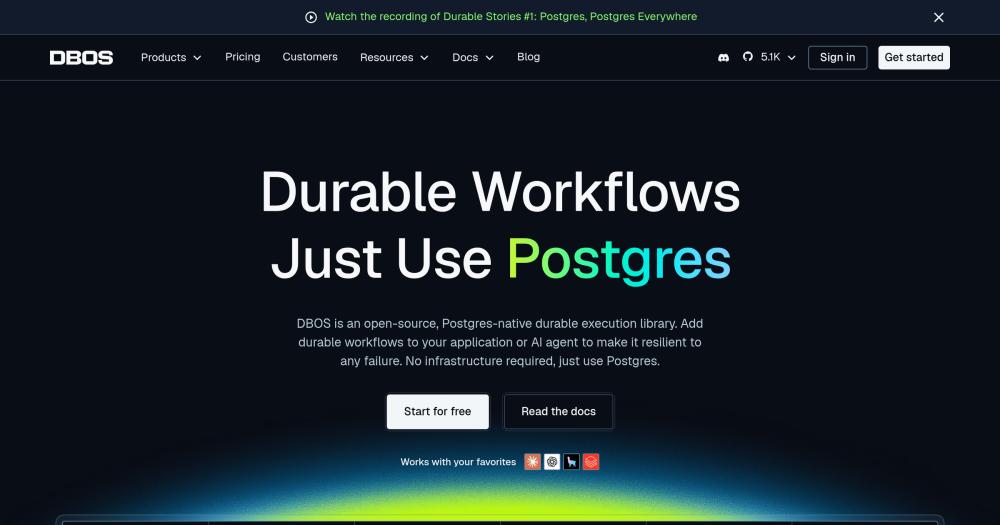
Run durable workflows and background jobs on Postgres in Java, without a separate orchestration server.

Visit websiteGitHub248 starsDeploy on Hostinger
image of Dbos Transact Java
TL;DR

Dbos Transact Java is an MIT-licensed library that adds durable workflow execution to Java applications using Postgres as the checkpoint store. It is an open source alternative to paid orchestration services like Temporal Cloud, AWS Step Functions, and Orkes Conductor, requiring no separate orchestration server or message broker. Workflows resume automatically from the last completed step after any failure, using the Postgres database your application already runs. Best for Java and Spring Boot teams building AI agents, payment flows, or data pipelines who want fault tolerance without new infrastructure overhead.

Read the full breakdownHide the full breakdownWho it is for, how it works, trade-offs and the FAQ
who it's for

Who Dbos Transact Java is for#

Java teams building AI agent pipelines

AI agent workflows involve sequential calls to LLM APIs, tools, and databases. DBOS checkpoints each step in Postgres, so an agent resumes from the last successful tool call after a failure without re-sending earlier API requests or duplicating side effects.

Skip if:

Your AI agent runs in Python. Use the separate Python DBOS Transact library for Python-based agent frameworks.

Backend engineers building payment workflows

Payment flows spanning order creation, inventory reservation, charge, and fulfillment need exactly-once guarantees across steps. DBOS workflow checkpoints ensure no step repeats after a crash, and the durable notification feature handles payment confirmation callbacks that arrive asynchronously.

Skip if:

Your payment processor already provides idempotency keys and retry logic covering your entire workflow. DBOS adds value when multi-step coordination across services is the reliability gap.

Spring Boot teams replacing a message broker with durable queues

Durable queues in DBOS fan out background tasks (document indexing, email sending, data synchronization) with per-queue concurrency limits and guaranteed completion, all backed by Postgres. No separate queue service or message broker is needed.

Skip if:

You need a persistent event bus that multiple independent services consume from. DBOS queues are designed for task orchestration within an application, not general-purpose event streaming between microservices.

the problem

The problem it solves#

Building reliable long-running workflows in Java means managing what happens when a process dies mid-execution. Payment flows spanning order creation, inventory reservation, charge, and fulfillment cannot safely repeat steps after a crash without corrupting data or double-charging customers. Data pipelines calling external APIs across dozens of steps cannot restart from scratch each time a network call fails. The standard approach is ad-hoc retry tables, database state flags, or an external message broker, each requiring custom bookkeeping that grows brittle as workflows gain more steps and conditional branches.

Adding an external orchestration server addresses the durability problem but shifts the pain to infrastructure. Teams using Temporal must rearchitect their Java code around Temporal workers and clients, deploy and operate a Temporal server, and route all workflow state through it. For teams that already run Postgres and want to stay close to their existing stack, the tradeoff between reliability and operational complexity is a genuine pain point.

how Dbos Transact Java solves it

How it solves it#

Durable Workflow Checkpoints

DBOS saves each completed step to Postgres as your workflow runs. If your process crashes or restarts, every in-progress workflow resumes from the last checkpoint without re-executing earlier steps. You register methods as workflows and wrap steps with DBOS.runStep(), and the library handles all checkpoint writes transactionally.

Postgres-Backed Durable Queues

Task queues let you fan out work to many concurrent tasks while controlling how many run at once per queue or per process. Queues support deduplication, timeouts, priority, and rate limiting, all backed by your Postgres database with no message broker required.

Scheduled Workflows with Cron Support

Annotate any workflow with @Scheduled and a cron expression to run it on an interval. DBOS guarantees the workflow executes exactly once per schedule window, even across restarts or redeploys, and supports creating schedules dynamically at runtime for per-user or per-entity scheduling patterns.

Durable Notifications and Human-in-the-Loop Pauses

Workflows pause and wait for an external signal using DBOS.recv(), resuming exactly once when the notification arrives. Durable sleep lets workflows wait for days or weeks across restarts. Use this for payment confirmation callbacks, approval flows, or any step that waits on an external event before continuing.

Asynchronous Background Workflow Execution

Start a workflow in the background with DBOS.startWorkflow() and receive a handle. Your application returns immediately while the workflow runs independently. Retrieve the result at any time with handle.getResult(), letting long-running jobs like data sync or batch processing run without blocking the caller.

strengths · trade-offs

Strengths and trade-offs#

Strengths

  • No Separate Orchestration ServerTemporal Cloud, AWS Step Functions, and Orkes Conductor all require an external service or cloud connection. DBOS uses Postgres, which your application likely already runs, so you get workflow durability without deploying or paying for an additional orchestration service.
  • MIT License with Full Data OwnershipMIT licensing means no usage restrictions for commercial applications. Workflow state is stored entirely in your Postgres instance under your control, with no data flowing to a third-party service. This matters for teams with compliance requirements or sensitive workflow data.
  • Library Integration without RearchitectingUnlike Temporal, which requires moving workflow logic to a Temporal worker and accessing it only through a Temporal client, DBOS adds durability to methods you already have. Annotate existing Java methods with @Workflow and wrap steps with DBOS.runStep(), and existing code becomes fault-tolerant.
  • Standard Postgres Tooling Applies to Workflow StateWorkflow checkpoints live in your Postgres database, so the same backup, monitoring, and GUI tools you already use apply to workflow state. There is no proprietary format or vendor-specific tool required to inspect or recover workflow data.

Trade-offs

  • -Java-Only SDK in This RepositoryDBOS Transact Java is specifically the Java SDK. The separate dbos-transact repository covers Python. Teams with multi-language codebases need both libraries, and cross-language workflow chaining is not built into the DBOS framework itself.
  • -Postgres Required as InfrastructureEvery deployment needs a Postgres database. Teams without an existing Postgres instance must provision one before getting started. PGlite is available for local development, but production use requires a standard Postgres server.
  • -Newer SDK with 32 Open IssuesThe Java SDK launched in June 2025 and had 32 open GitHub issues as of November 2026. It is production-usable with active development and regular commits, but the ecosystem of community examples and third-party guides is smaller than more established orchestration tools.
versus alternatives

Dbos Transact Java vs alternatives#

DBOS vs Temporal Cloud

Both DBOS Transact Java and Temporal Cloud provide durable execution, checkpointing steps and resuming from the last saved state after a failure. The key difference is where workflow state lives and how much infrastructure you operate.

FeatureDBOS Transact JavaTemporal Cloud
DeploymentLibrary inside your Java appExternal managed service
InfrastructureYour Postgres databaseTemporal's servers
LicenseMITProprietary managed service
Java setupAnnotate existing methodsRearchitect to workers and client
Data residencyYour Postgres instanceTemporal's cloud

DBOS is the better choice when you want workflow durability without connecting to an external service, when data residency matters for compliance, or when you want to avoid rearchitecting your code around Temporal workers. Temporal Cloud is worth considering when you need multi-language workflow support across Go, TypeScript, Python, and Java in one system, or its mature visual workflow history UI for debugging complex long-running workflows.

DBOS vs AWS Step Functions

AWS Step Functions defines workflows as state machines in Amazon States Language. DBOS uses annotated Java methods, keeping workflows as code rather than JSON definitions.

FeatureDBOS Transact JavaAWS Step Functions
DeploymentLibrary in Java appAWS managed service
Workflow definitionJava annotationsAmazon States Language
Infrastructure lock-inNoneAWS ecosystem
LicenseMITProprietary
Pricing modelFree self-hostedPer state transition

DBOS is better when you want workflows expressed as ordinary Java code, need to run outside AWS, or need to avoid per-state-transition pricing on high-throughput jobs. AWS Step Functions is worth considering when you need deep integration with other AWS services or a visual workflow designer for non-developers working in the AWS ecosystem.

DBOS vs Orkes Conductor

Orkes Conductor is an enterprise managed platform built on Netflix Conductor, specifically marketed to Java teams. Both tools target Java workflow orchestration, but Orkes is a managed service while DBOS runs as a library in your application.

FeatureDBOS Transact JavaOrkes Conductor
DeploymentLibrary in Java appManaged service on AWS
Data storageYour PostgresOrkes-managed servers
LicenseMITProprietary
Java SDKYesYes
Self-hosting pathLibrary and PostgresOpen-source Conductor available

DBOS is better for teams that want workflow state entirely under their control with no data leaving their infrastructure. Orkes Conductor suits teams that need a managed Conductor deployment with enterprise support and do not want to operate any workflow infrastructure themselves.

tech stack · detected from GitHub

What it's built on#

Languages
Java
Databases
PostgreSQL
frequently asked

FAQ#

Does DBOS Transact Java require a separate server or service to run?

No. DBOS is a library that runs inside your Java application. The only external dependency is a Postgres database. You do not need to deploy or connect to a separate orchestration server.

How does DBOS handle failures and restarts?

DBOS checkpoints each completed workflow step in Postgres. When your application restarts after a crash, in-progress workflows resume from the last checkpointed step without re-executing earlier work. The workflow code runs again from the beginning, but completed steps return their saved results from the database immediately without re-running.

Can DBOS Transact Java work with Spring Boot?

Yes. DBOS is a standard Java library that works with Spring Boot without modifying your framework setup. You register workflows, configure the Postgres connection, and DBOS handles durability through annotations.

What is the difference between DBOS and Temporal?

Both provide durable execution, but Temporal requires a separate orchestration server and rearchitecting your Java code around Temporal workers and a Temporal client. DBOS adds durability as a library inside your existing application, using Postgres for checkpoint storage. The README notes that DBOS avoids moving workflows to a worker or running a separate Temporal server.

Does DBOS store workflow data in a third-party service?

No. All workflow state, step results, queue entries, and notifications are stored in your own Postgres database. DBOS never sends your workflow data to an external service. DBOS Conductor, the optional management dashboard, can be self-hosted or used as a managed service, but neither path sends workflow state to a third party.

also worth a look

Similar open-source tools#

Temporal

Alternative toAWS Step Functions

Durable workflow orchestration for reliable, long-running apps

  • 24,443 GitHub stars
  • MITLicence MIT

Kestra

Alternative toGoogle Cloud Composer

Declarative workflow orchestration for data and DevOps teams

  • 30,241 GitHub stars
  • Apache-2.0Licence Apache-2.0

Duckle

Alternative toFivetran

Self-hosted ETL on DuckDB with 385 connectors and no per-row billing.

  • 1,573 GitHub stars
  • Apache-2.0Licence Apache-2.0

FckSignups

InCustomer Support

Open-source tools that work instantly, no signup required

  • 4,588 GitHub stars
  • GPL-3.0Licence GPL-3.0

code-graph-rag

Alternative toAugment AI

AI-powered codebase analysis with knowledge graphs

  • 5,376 GitHub stars
  • MITLicence MIT

Codewhale

Alternative toClaude Code

Open source terminal coding agent for any model, with approval gates.

  • 41,184 GitHub stars
  • MITLicence MIT
by category

Open source tools in these categories#

93

Backend Development

dify, graphify, Rust
673

Developer Tools

REA (Reverse Engineer Anything), Skills for Real Engineers, superpowers
549

AI & Machine Learning

freeCodeCamp, REA (Reverse Engineer Anything), OpenClaw
80

Databases & Storage

Immich, Supabase, Redis
141

DevOps & CI/CD

Nvm, Uptime Kuma, Netdata
Hostinger

Self-host Dbos Transact Java on a Hostinger VPS

Keep it running 24/7, even when your laptop is off. A Hostinger VPS gives it a server of its own.

  1. 01

    Choose a plan

    Starts from $6.49/mo

  2. 02

    Apply

    Extra 10% off yearly plans

  3. 03

    Install Dbos Transact Java

    On a server that stays on

  4. 04

    Start building

    Focus on the app, not the server

Deploy on Hostinger

Sponsors

Inbox Zero

Alternative toSuperhuman

AI email assistant that drafts replies and clears your inbox

  • 13,058 GitHub stars
  • AGPL-3.0Licence AGPL-3.0
  • #Email

rakazo

Alternative toGrok Bot

AI teammates you own: your keys, your model, your machine.

  • 8,913 GitHub stars
  • Apache-2.0Licence Apache-2.0
  • #AI Agents

SnitchFeed

Live monitoring on LinkedIn, X, Reddit & more. Agentic social listening for startups.

Marketing & Growth

Advertise your product

New open source projects by email

The projects we add and every new guide. Free, unsubscribe any time.

Find open source alternatives to paid software

/
  • Claude Code to OpenCode
  • Jira to Windshift
  • Notion to AppFlowy
  • Slack to Mattermost
  • Linear to GitLab
  • Wispr Flow to Handy
  • Arc to Zen Browser
  • CapCut to Concat
  • Grok Bot to rakazo
  • Superhuman to Inbox Zero
  • Discord to Stoat
  • Airtable to AITable
  • Datadog to SigNoz
  • Muse to OpenClaw
  • Railway to Coolify
  • GitHub Copilot to Cline
  • Confluence to Wiki.js
  • Microsoft Teams to Rocket.Chat
  • 1Password to KeePassXC
  • Firebase to Supabase
  • Pinecone to Qdrant
  • Zapier to n8n
  • Devin AI to OpenHands
  • Asana to Leantime