Open Source Alternatives
  • Alternatives
  • Categories
    Categories by size980 projects
    • Developer Tools505
    • AI & Machine Learning432
    • Business & Productivity220
    • Web Development202
    • Security & Monitoring148
    • IT Management133
    • Communication & Collaboration132
    • Cloud & Hosting116
    • LLMOps & AI Tooling111
    • Data & Analytics108
    Browse all 21 categoriesProduct & Project Management, Design & Creative and 9 more
  • Blog
  • Advertise
SearchNotion, Slack, password manager.../
Submit
Open Source Alternatives
  • Alternatives
    • Developer Tools505
    • AI & Machine Learning432
    • Business & Productivity220
    • Web Development202
    • Security & Monitoring148
    • IT Management133
    • Browse all 21 categories
  • Blog
  • Advertise
Submit your project

New open source projects by email

The projects we add and every new guide. Free, unsubscribe any time.

Open Source Alternatives LogoOpen Source Alternatives

Handpicked Open Source Alternatives to Paid Softwares

Product

  • Categories
  • Tag
  • Advertise

Resources

  • Blog
  • Collection
  • Submit

Company

  • Privacy Policy
  • Terms of Service
  • Refund Policy
  • Sitemap

Alternatives

  • Claude Code
  • Jira
  • Notion
  • Slack
  • Linear
  • Wispr Flow
  • All alternatives
© 2026 Open Source Alternatives. All rights reserved.
Open SourceAlternatives
Home/Categories/Developer Tools/ESP32-Bit-Pirate
icon of ESP32-Bit-Pirate

ESP32-Bit-Pirate

  • 6.3K stars
  • MIT
  • Active this week
  • Last commit 4 days ago

Last verified Oct 31, 2026

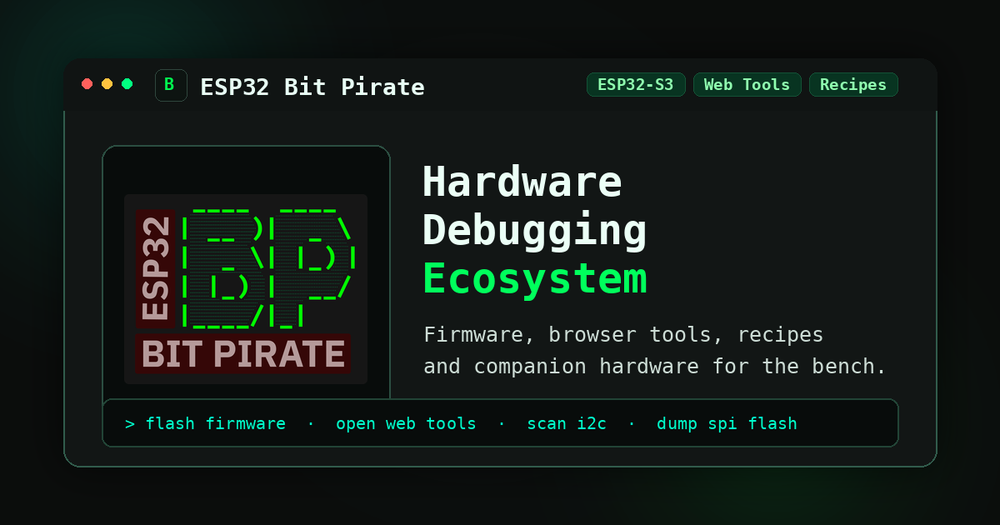
Build a multi-protocol hardware debugging bench on any ESP32-S3 board, with I2C, SPI, UART, Sub-GHz, RFID, JTAG, and 20+ protocols via browser-based tools.

Visit websiteGitHub6.3K stars
image of ESP32-Bit-Pirate
TL;DR

ESP32-Bit-Pirate is MIT-licensed firmware for ESP32-S3 boards that turns a €5-€60 device into a multi-protocol hardware debugging workbench, inspired by Bus Pirate. It replaces dedicated commercial debugging hardware for embedded development, firmware exploration, and hardware security research, with 20+ protocol modes covering I2C, SPI, UART, Sub-GHz, RFID, JTAG, and more. Access is through USB Serial, a browser-based Web CLI over Wi-Fi, or standalone mode on the M5 Cardputer. Best for embedded developers, electronics students, and security researchers who want a configurable, open alternative to commercial multi-tool hardware.

Read the full breakdownHide the full breakdownWho it is for, how it works, trade-offs, the quick start and the FAQ
who it's for

Who ESP32-Bit-Pirate is for#

Embedded developers debugging new hardware prototypes

The I2C scanner, SPI flash dumper, UART bridge, and JTAG mode cover the most common initial hardware bring-up tasks without writing a custom sketch or installing a full debug toolchain. Python scripting extends those tasks into repeatable test sequences for hardware revisions.

Skip if:

Your hardware bring-up requires JTAG debugging with breakpoint and variable inspection. The firmware's JTAG mode works via OpenOCD for scanning and SWD access, but it is not a replacement for a dedicated debug probe with IDE integration.

Hardware security researchers probing wireless protocols

Sub-GHz signal capture and replay, RFID reading, Bluetooth scanning, and Wi-Fi sniffing are available through the same firmware. A CC1101-equipped board covers Sub-GHz; the PN532 module adds NFC and RFID. The unified CLI keeps the workflow consistent across protocol types, and Python scripts can automate capture sequences.

Skip if:

Your work requires portable wireless analysis without a laptop or USB connection. The M5 Cardputer's standalone mode covers some fieldwork, but for fully pocket-carried operation a dedicated portable device may be more practical.

Electronics students learning serial protocols in a lab

The browser-based CLI means students can follow along from any laptop or tablet without installing drivers or a terminal application. The scan command identifies I2C devices on a bus, and the recipe library documents wiring and commands for common exercises. The Web Python Lab adds scripting practice without a local Python setup.

Skip if:

The course requires specific certified lab equipment. Some curricula are built around dedicated hardware with standardized connections; substituting a general-purpose firmware tool may introduce unexpected variables.

IoT developers auditing device communication buses

The UART auto-detection, I2C register dump, SPI flash read, and CAN bus sniff modes support the initial investigation steps when examining an unfamiliar IoT device. The Web Serial terminal provides a session log in the browser. Python scripts can automate multi-step sequences across multiple device connections.

Skip if:

The audit requires certified tooling for compliance documentation. Research firmware is not a certified audit instrument; formal security assessments typically require traceable, accredited tooling.

the problem

The problem it solves#

Hardware debugging and protocol analysis require multiple dedicated tools: a logic analyzer for wired buses, a serial adapter for UART, an RFID reader, a Sub-GHz sniffer, and a JTAG programmer. Stocking a bench with capable hardware for every protocol costs hundreds of dollars, and each tool comes with its own drivers and software. Switching between tools during a debugging session adds friction and breaks focus.

Commercial multi-tool devices exist but lock the user into a fixed hardware configuration; any feature not on the original spec requires a separate device purchase. For embedded developers iterating quickly on new hardware, students learning multiple protocols in a lab, and security researchers who need wireless and wired coverage in the same session, the lack of a unified, open, and affordable bench tool is a persistent friction point.

how ESP32-Bit-Pirate solves it

How it solves it#

20+ Protocol Modes in One Firmware

Supports wired buses (I2C, SPI, UART, 1-Wire, 2-Wire, CAN, JTAG, SWD), wireless protocols (Wi-Fi, Bluetooth, Sub-GHz, LoRa, RFID, RF24), and USB adapter modes in a single firmware image. Each protocol has its own CLI mode with commands for scanning, reading, writing, sniffing, and scripting. Switching between protocols requires only a mode command, not a hardware swap.

Browser-Based Web Serial Terminal

A browser-hosted Web Serial terminal connects to the device over USB without installing drivers or a terminal application. The same interface works on desktop, tablets, and mobile devices. A Wi-Fi Web CLI provides network-based access to the same CLI from any device on the local network, useful for headless bench setups or remote monitoring.

Python Scripting and Lab Automation

Python scripts control the firmware over serial for repeatable protocol tests, EEPROM dumps, GPIO automation, and scan reports. The browser-based Python Lab lets you write and run scripts without a local Python install. Useful for regression testing new hardware revisions, batch device provisioning, or automating signal captures across a lab session.

One-Click Web Flasher

The project ships a browser-based Web Flasher that writes the firmware to a connected board via WebSerial without requiring PlatformIO, esptool, or any local toolchain. Pick a supported board from the list, connect over USB, and flash in one step. The M5Stack M5Burner app also supports flashing for M5Stack boards.

Dock Hardware for Bus Pirate Adapter Compatibility

An optional Dock board for the ESP32-S3 DevKit accepts original Bus Pirate adapters and accessories. The Dock adds level logic adaptation from 1.8V to 5V for targets outside the ESP32's native 3.3V range. Teams with existing Bus Pirate adapter collections can reuse them without purchasing new probes.

Sub-GHz Signal Analysis and Replay

Using a CC1101 module, the firmware scans active Sub-GHz frequencies, records signals, and replays them. The Cardputer ADV and T-Embed CC1101 boards include CC1101 built-in; other boards attach it via direct wiring. Supported operations include frequency scanning, signal capture, and playback for testing wireless device responses.

strengths · trade-offs

Strengths and trade-offs#

Strengths

  • MIT License with No Use RestrictionsThe firmware is MIT licensed, which means it can be used in commercial products, modified without disclosure requirements, and deployed in any environment without licensing fees. Unlike GPL or AGPL licenses, MIT imposes no share-alike obligation, so hardware makers building products on ESP32-S3 can include the firmware without license compatibility concerns.
  • Hardware Cost from €5 to €60Compatible boards start at around €5 for basic ESP32-S3 DevKit boards and go up to €60 for feature-rich units like the T-Embed CC1101 Plus with built-in Sub-GHz, NFC, LoRa, and IR. The firmware runs on all supported boards with no feature differences between them, so users can start with a minimal board and upgrade hardware without changing their workflow.
  • No Desktop Software Required for Most WorkflowsThe Web Flasher installs the firmware from a browser. The Web Serial terminal provides CLI access from the same browser without additional drivers. The Python Lab runs scripts in the browser without a local Python install. Most common workflows complete entirely in the browser, reducing setup time for students, occasional users, and shared lab environments.
  • Active Development with Broad Board SupportThe repository reached 6,299 stars and 544 forks since its creation in July 2025, with the last commit in October 2026. The project supports 15+ named boards and extends to any ESP32-S3 with at least 4 MB of flash. Community supporters include M5Stack, Seeed Studio, Heltec Automation, and PCBWay.

Trade-offs

  • -GPIO Logic Fixed at 3.3VThe ESP32-S3 GPIO pins operate at 3.3V. Connecting targets that use different voltage levels (1.8V or 5V) without level-shifting hardware can damage the ESP32 or the target device. The optional Dock accessory adds level adaptation for 1.8V to 5V targets, but without the Dock, voltage mismatch is a real risk for users debugging mixed-voltage boards.
  • -Wireless Modes Require External Modules on Basic BoardsSub-GHz and RFID support require a CC1101 or PN532 module wired to the board's GPIO pins. LoRa requires an SX1262 module. Boards like the T-Embed CC1101 and Cardputer ADV include these modules built-in, but basic DevKit boards need external wiring. The pin mapping varies by board, and incorrect wiring can cause failures that are not always obvious from the error output.
  • -Pin Mapping Varies Across BoardsThe firmware uses default pin mapping for each supported board, but the mapping may not match an unsupported or custom board. Users flashing the firmware on a board not in the official list need to verify the GPIO assignments before wiring targets, and some configurations require modifying the firmware source. The wiki documents the default pin maps for each official board.
  • -30 Open Issues as of October 2026The issue tracker lists 30 open issues. The project is under active development, so some features or board combinations may have unresolved bugs or incomplete documentation. Check the issue tracker before deploying in a production testing environment where stability is critical.
versus alternatives

ESP32-Bit-Pirate vs alternatives#

ESP32-Bit-Pirate vs Flipper Zero

Flipper Zero is a commercial multi-tool device targeting hardware hackers and security researchers, with Sub-GHz, NFC, RFID, IR, and Bluetooth in a fixed hardware package. ESP32-Bit-Pirate runs on off-the-shelf ESP32-S3 boards and covers a wider wired protocol set alongside similar wireless capabilities.

| Feature | ESP32-Bit-Pirate | Flipper Zero | |---------|-----------------|______________| | Hardware | Off-the-shelf ESP32-S3 boards (€5-€60) | Fixed commercial device | | Wired buses | I2C, SPI, UART, JTAG, CAN, 1-Wire, 3-Wire | GPIO header, limited modes | | Wireless | Sub-GHz, LoRa, BLE, Wi-Fi, RFID | Sub-GHz, NFC, RFID, IR, BLE | | Python scripting | Yes (Web Python Lab) | No | | Browser CLI | Yes | No |

ESP32-Bit-Pirate is the better choice when you need deep wired bus debugging alongside wireless protocol work, or when Python scripting is needed for automated test sequences. Flipper Zero suits users who want a polished, carry-ready consumer device with a larger commercial accessory market and no board assembly required.

ESP32-Bit-Pirate vs Bus Pirate

Bus Pirate is the open source hardware project that directly inspired ESP32-Bit-Pirate. Both share a unified CLI for serial bus interaction; the key differences are wireless protocol coverage and browser-based tooling.

FeatureESP32-Bit-PirateBus Pirate
LicenseMIT (firmware)Open source hardware
Wireless protocolsSub-GHz, LoRa, BLE, Wi-Fi, RFIDWired buses only
Browser toolsWeb Flasher, Web Serial terminal, Python LabNone
Adapter compatibilityDock accepts original Bus Pirate adaptersOwn adapter ecosystem

ESP32-Bit-Pirate extends the Bus Pirate concept with wireless protocols and browser-based tooling at a lower hardware cost for new setups. Teams with existing Bus Pirate adapter collections can reuse them via the Dock accessory, treating ESP32-Bit-Pirate as a wireless-capable upgrade rather than a full replacement. For strictly wired protocol work where hardware interoperability with the Bus Pirate adapter ecosystem is the priority, Bus Pirate hardware remains a valid choice.

install · quick start

Quick start#

bash
Flash the firmware to any supported ESP32-S3 board in one click using the Web Flasher, or download a pre-built binary from GitHub Releases: https://github.com/geo-tp/ESP32-Bit-Pirate/releases/latest
tech stack · detected from GitHub

What it's built on#

Languages
CC++Python
frequently asked

FAQ#

Which ESP32-S3 boards are compatible with ESP32-Bit-Pirate?

The firmware officially supports 15+ named boards including the ESP32-S3 DevKit variants, M5 Cardputer, M5 AtomS3 Lite, M5 StampS3, M5 Stick S3, LILYGO T-Display, T-Embed, T-Embed CC1101, Heltec WiFi LoRa 32 V4, Heltec Vision Master T190, Seeed Studio XIAO S3, Waveshare ESP32-S3-GEEK, and the Unexpected Maker ProS3. Any ESP32-S3 board with at least 4 MB of flash can run the DevKit or SuperMini build, though the default pin mapping may not match your board's layout.

Does using ESP32-Bit-Pirate require installing desktop software?

No. The Web Flasher installs the firmware from a browser window using WebSerial, without needing PlatformIO, esptool, or a local toolchain. Once flashed, the firmware is accessible through a browser-based Web Serial terminal, the Wi-Fi Web CLI, or a standard serial terminal app. Most common workflows complete entirely in the browser, though PlatformIO is available for developers who want to build from source or add custom commands.

Can I automate protocol scans and tests with scripts?

Yes. The firmware supports Python automation over serial, using Bus Pirate-style bytecode instructions or custom Python scripts. The browser-based Python Lab lets you write and run scripts without a local Python install. Scripts can automate I2C scans, SPI flash dumps, GPIO state reads, LED animations, data logging, and other repeatable tasks. The scripts repository is maintained separately from the main firmware.

What voltage logic levels does the firmware support?

The ESP32-S3 GPIO pins operate at 3.3V logic. Connecting targets at other voltage levels directly to the GPIO pins can damage the ESP32 or the target device. The optional Dock accessory adds level adaptation for targets using 1.8V to 5V logic. For boards without the Dock, verify the target voltage before connecting and use external level shifters when needed.

How does ESP32-Bit-Pirate compare to the original Bus Pirate?

ESP32-Bit-Pirate is explicitly inspired by Bus Pirate and extends its concept with wireless protocols (Sub-GHz, LoRa, BLE, Wi-Fi, RFID) that Bus Pirate hardware does not cover, and with browser-based tooling that requires no desktop application. A Dock accessory makes the firmware compatible with original Bus Pirate adapters, so existing adapter collections can be reused with ESP32-Bit-Pirate.

also worth a look

Similar open-source tools#

REA (Reverse Engineer Anything)

Featured

Alternative toRevEng.AI

AI-powered reverse engineering for binaries, apps, and assemblies.

  • 407,266 GitHub stars
  • MITLicence MIT

Minimal

Alternative toChainguard Images

150 hardened container images, MIT-licensed, signed and rebuilt daily

  • 554 GitHub stars
  • MITLicence MIT

Crossfyre Toolchain

InSecurity & Monitoring

Five-engine security testing toolchain for the terminal

  • 256 GitHub stars
  • Apache-2.0Licence Apache-2.0

Oya Browser

Alternative toBrowserbase

Records portal tasks once; replays with no model and no bot detection

  • 351 GitHub stars
  • CustomLicence Sustainable Use License 1.0

FlClash

Alternative toShadowrocket

Ad-free Clash Meta proxy client for Android and desktop, GPL-3.0.

  • 59,899 GitHub stars
  • GPL-3.0Licence GPL-3.0

Promptfoo

Alternative toBraintrust

Automated LLM evals, red teaming, and AI vulnerability scanning.

  • 26,565 GitHub stars
  • MITLicence MIT
by category

Open source tools in these categories#

505

Developer Tools

REA (Reverse Engineer Anything), superpowers, Skills for Real Engineers
148

Security & Monitoring

RustDesk, REA (Reverse Engineer Anything), Uptime Kuma

Sponsors

Inbox Zero

Alternative toSuperhuman

AI email assistant that drafts replies and clears your inbox

  • 12,855 GitHub stars
  • AGPL-3.0Licence AGPL-3.0
  • #Email

Omnara

Alternative toCClaude Managed Agents

Open-source agent deployment API. Self-host or use Omnara Cloud.

  • 3,325 GitHub stars
  • Apache-2.0Licence Apache-2.0
  • #AI Agents

rakazo

Alternative toGrok Bot

AI teammates you own: your keys, your model, your machine.

  • 6,242 GitHub stars
  • Apache-2.0Licence Apache-2.0
  • #AI Agents
Advertise your product

New open source projects by email

The projects we add and every new guide. Free, unsubscribe any time.

Find open source alternatives to paid software

/
  • Claude Code to OpenCode
  • Jira to Windshift
  • Notion to AppFlowy
  • Slack to Mattermost
  • Linear to GitLab
  • Wispr Flow to Handy
  • Arc to Zen Browser
  • CapCut to Concat
  • Grok Bot to rakazo
  • Superhuman to Inbox Zero
  • Airtable to AITable
  • Muse to OpenClaw
  • Railway to Coolify
  • GitHub Copilot to Cline
  • Datadog to Netdata
  • Microsoft Teams to Rocket.Chat
  • Confluence to Docmost
  • Pinecone to Qdrant
  • Zapier to n8n
  • Devin AI to OpenHands
  • Firebase to Supabase
  • 1Password to KeePassXC
  • Contentful to Strapi
  • Adobe Premiere Pro to Shotcut