Open Source Alternatives
  • Alternatives
  • Categories
    Categories by size1,093 projects
    • Developer Tools550
    • AI & Machine Learning470
    • Business & Productivity263
    • Web Development206
    • Security & Monitoring169
    • Communication & Collaboration151
    • IT Management144
    • Cloud & Hosting127
    • LLMOps & AI Tooling122
    • Data & Analytics117
    Browse all 21 categoriesProduct & Project Management, DevOps & CI/CD and 9 more
  • Blog
  • Advertise
SearchNotion, Slack, password manager.../
Submit
Open Source Alternatives
  • Alternatives
    • Developer Tools550
    • AI & Machine Learning470
    • Business & Productivity263
    • Web Development206
    • Security & Monitoring169
    • Communication & Collaboration151
    • Browse all 21 categories
  • Blog
  • Advertise
Submit your project

New open source projects by email

The projects we add and every new guide. Free, unsubscribe any time.

Open Source Alternatives LogoOpen Source Alternatives

Handpicked Open Source Alternatives to Paid Softwares

Product

  • Categories
  • Tag
  • Advertise

Resources

  • Blog
  • Collection
  • Submit

Company

  • Privacy Policy
  • Terms of Service
  • Refund Policy
  • Sitemap

Alternatives

  • Claude Code
  • Jira
  • Notion
  • Slack
  • Linear
  • Wispr Flow
  • All alternatives
© 2026 Open Source Alternatives. All rights reserved.
Open SourceAlternatives
Home/Categories/Customer Support/Fider
icon of Fider

Fider

Open source alternative to Canny, UserVoice, Featurebase, Nolt and Aha! Ideas

  • 4.6K stars
  • AGPL-3.0
  • Active this week
  • Last commit today

Last verified Nov 5, 2026

Manage user feedback and feature requests on a self-hosted voting board where customers drive your product roadmap.

Visit websiteGitHub4.6K starsDeploy on Hostinger
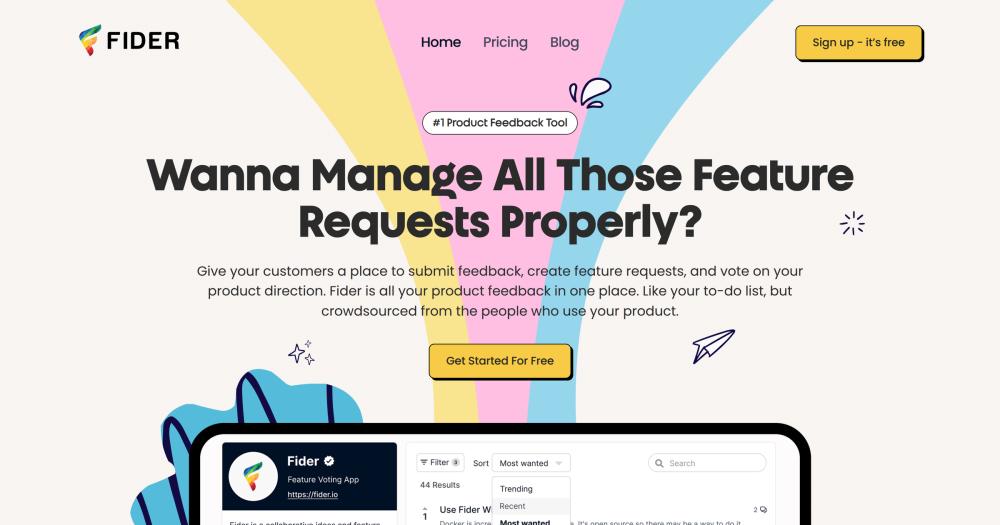
Image for Fider
TL;DR

Fider is an open source feedback portal where users submit feature requests, vote on each other's ideas, and follow updates as requests are acted on. It replaces paid feedback management tools like Canny and UserVoice, with self-hosting on your own infrastructure as the free option and a managed cloud Pro tier at $25/month. AGPL-3.0 licensed. Best for product managers and customer success teams at SaaS companies, mobile app developers, and game studios who want to close the feedback loop without per-seat pricing or third-party data custody.

Read the full breakdownHide the full breakdownWho it is for, how it works, trade-offs and the FAQ
who it's for

Who Fider is for#

Product managers at SaaS companies

Gather feature requests from active users, let the vote count reveal real priorities, and close the loop with status updates as requests move through your roadmap. Fider replaces ad-hoc email collection or a kanban board that only your team can see.

Skip if:

Skip if your roadmap decisions are driven primarily by enterprise client contracts rather than user votes: a feedback board adds limited value when a handful of large accounts set direction.

Mobile app and game developers

The Fider website identifies mobile app companies and game developers as target users. A public voting board lets your player or user community feel heard between releases, surfaces which pain points and feature gaps matter most, and reduces support volume from repeated requests.

Skip if:

Skip if you are pre-launch with no user base yet: a feedback board needs an active community to generate meaningful signal.

Customer success teams running internal feedback boards

Internal teams can use Fider to collect and prioritize ideas from staff rather than external users. The same voting and status workflow applies: team members submit ideas, vote, and see status updates as requests are addressed. The board can be kept private.

Skip if:

Skip if you need threaded task assignment or approval workflows alongside feedback collection: Fider is a voting board, not a task manager.

the problem

The problem it solves#

Product teams receive feedback from multiple directions at once: users email support, comment in app stores, post in community forums, and open support tickets. Without a single place to collect and weigh these ideas, teams end up guessing what to build next. The highest-volume requests get lost in email threads, and quieter but high-value feedback never surfaces at all.

The harder problem is prioritization. Any team can collect feedback; figuring out which requests represent a real need for the most users, versus a vocal few, requires visibility across the whole request pool. Spreadsheets and kanban boards can track requests, but they give users no ownership and no way to signal what matters most.

how Fider solves it

How it solves it#

Voting board for feature requests

Users submit ideas directly to your Fider board and vote on what matters most to them. The vote count surfaces your highest-priority requests without manual filtering through emails or spreadsheets. Each request gets its own discussion thread where users add context and teams can respond.

Per-request discussion threads

Every feature request on the board has its own comment thread, so users can elaborate on their need, ask questions, and follow the conversation. Teams post status updates directly in the thread, and users who voted receive notifications when the status changes.

Status updates with voter notifications

Mark requests as planned, in progress, complete, or declined. Voters receive a notification when the status changes, closing the feedback loop without any additional manual outreach. This keeps users informed and reduces repeat submissions for the same feature.

Multi-language interface

Fider ships with multi-language support so your feedback board works for international user bases without a separate localized setup. The official website lists multiple languages as part of the base feature set available to all users.

Cloud or self-hosted deployment

Teams can run Fider as a managed cloud service maintained by the Fider team, or self-host it on their own servers at no cost. The self-hosted path is documented at docs.fider.io/self-hosted. The managed cloud option removes the need to manage updates and patches.

strengths · trade-offs

Strengths and trade-offs#

Strengths

  • Free forever when self-hostedThe self-hosted version of Fider is AGPL-3.0 licensed and costs nothing to run on your own infrastructure. Unlike paid feedback tools with per-seat or per-user pricing, the core voting and feedback functionality has no usage caps on the self-hosted path.
  • Active, long-running projectFider has been in continuous development since January 2017, with 4,600 GitHub stars and 876 forks. The last commit landed on November 4, 2026, indicating active maintenance. With 29 open issues, the backlog is manageable for a project of this size.
  • Focused scope: feedback and votingFider covers the core feedback collection and prioritization flow without bundling project management, roadmapping, or CRM features you may not need. Teams that want a dedicated tool for this specific job, rather than a module inside a larger product, benefit from that focus.
  • Affordable Pro plan for managed hostingThe managed cloud Pro plan adds content moderation and SEO indexing at $25 per month, as documented on the product website. Teams can run the self-hosted free tier indefinitely and upgrade only if the managed service's advanced features become necessary.

Trade-offs

  • -AGPL-3.0 restricts redistribution as a managed serviceAGPL-3.0 permits running Fider for internal use or for your own users at no cost. If you modify Fider and offer it as a hosted service to paying customers, AGPL-3.0 requires you to publish the source of your changes. Teams building a managed feedback product on top of Fider need to review this restriction before proceeding.
  • -250-item cap on the free cloud tierThe free managed cloud tier has a fair-use limit of 250 feedback items, as documented on the product website. High-volume boards that exceed this limit need the Pro plan at $25/month or a self-hosted setup.
  • -No built-in roadmap or project managementFider handles feedback collection and voting but does not include roadmap views, sprint planning, or task tracking. Teams that want feedback and project management in one tool will need to integrate Fider with a separate system or choose a broader commercial platform.
versus alternatives

Fider vs alternatives#

Fider vs Canny

Canny is a commercial feedback tool with a free tier capped at tracked users and paid plans for teams needing integrations, automations, and custom domains. Fider covers the same core loop: collect requests, let users vote, update status. The key difference is the deployment model.

FeatureFiderCanny
LicenseAGPL-3.0Proprietary
Self-hostingYesNo
Voting boardYesYes
Discussion threadsYesYes
PricingFree (self-hosted) / $25/mo (Pro cloud)Freemium / paid plans

Fider is the better choice when data ownership, self-hosting, or cost control matter. Canny is worth considering when you need its native integrations with project management tools or automated changelog features, and you prefer a fully managed service with no infrastructure responsibility.

Fider vs UserVoice

UserVoice targets enterprise product teams with multi-board setups, NPS surveys, and CRM integrations. Fider focuses on the feedback-and-voting flow without the administrative overhead of an enterprise platform, which is an advantage for smaller teams with straightforward needs.

FeatureFiderUserVoice
LicenseAGPL-3.0Proprietary
Self-hostingYesNo
PricingFree (self-hosted) / $25/mo (Pro cloud)Enterprise pricing
Multi-languageYesYes
NPS surveysNoYes

Fider wins on cost and data control for teams that only need a feedback board. UserVoice is the stronger option for enterprise teams who need built-in NPS, CRM sync, or multi-product board management under one contract.

tech stack · detected from GitHub

What it's built on#

Languages
GoJavaScriptTypeScript
Frameworks
React
Tooling
esbuildWebpack
frequently asked

FAQ#

Is Fider free to self-host?

Yes. The self-hosted path is AGPL-3.0 licensed and costs nothing to run on your own servers. You manage your own updates and have no usage limits beyond what your infrastructure supports. The managed cloud service has a free tier capped at 250 feedback items and a Pro tier at $25 per month.

How does Fider compare to Canny?

Both collect feature requests and let users vote on priorities. Canny is a proprietary, fully managed service with paid plans. Fider adds a self-hosted, free path under AGPL-3.0, so teams with data ownership requirements or tight budgets have an option Canny does not offer. Canny's strength is its native integrations with project management and changelog tools; Fider's is cost and data control.

What does the AGPL-3.0 license mean for my team?

For most self-hosting use cases, AGPL-3.0 is permissive: you can run Fider internally or for your own users without restriction and without publishing your source code. The share-alike clause applies only if you distribute or offer a modified version of Fider as a hosted service to external customers. Internal deployments and standard self-hosting are unaffected.

Can Fider be used for internal team feedback rather than customer feedback?

Yes. The official Fider website notes that Fider works for internal teams collecting and organizing ideas from staff. The same voting board and status workflow applies: team members submit ideas, vote, and see status updates as requests are addressed. The board can be set to private to keep it internal.

also worth a look

Similar open-source tools#

knowledge-work-plugins

InCustomer Support

Open source AI plugins for knowledge workers in Claude

  • 34,713 GitHub stars
  • Apache-2.0Licence Apache-2.0

FckSignups

InCustomer Support

Open-source tools that work instantly, no signup required

  • 4,539 GitHub stars
  • GPL-3.0Licence GPL-3.0

rakazo

Featured

Alternative toGrok Bot

AI teammates you own: your keys, your model, your machine.

  • 7,028 GitHub stars
  • Apache-2.0Licence Apache-2.0

paperclip

Featured

Alternative toGrok Bot

Self-hosted AI agent management with org charts and budgets

  • 111,113 GitHub stars
  • MITLicence MIT

Vikunja

Alternative toTodoist

Self-hosted task manager with list, Kanban, Gantt, and table views

  • 5,963 GitHub stars
  • AGPL-3.0Licence AGPL-3.0

Redmine

Alternative toJira

Self-hosted project tracker with Gantt charts, wikis, and SCM links.

  • 6,070 GitHub stars
  • GPL-2.0-or-laterLicence GPL-2.0-or-later
by category

Open source tools in these categories#

32

Customer Support

agency-agents, iptv, Twenty
117

Product & Project Management

freeCodeCamp, agency-agents, Gstack
263

Business & Productivity

OpenClaw, Excalidraw, RustDesk
Hostinger

Self-host Fider on a Hostinger VPS

Keep it running 24/7, even when your laptop is off. A Hostinger VPS gives it a server of its own.

  1. 01

    Choose a plan

    Starts from $6.49/mo

  2. 02

    Apply

    Extra 10% off yearly plans

  3. 03

    Install Fider

    On a server that stays on

  4. 04

    Start building

    Focus on the app, not the server

Deploy on Hostinger

Sponsors

Inbox Zero

Alternative toSuperhuman

AI email assistant that drafts replies and clears your inbox

  • 12,889 GitHub stars
  • AGPL-3.0Licence AGPL-3.0
  • #Email

rakazo

Alternative toGrok Bot

AI teammates you own: your keys, your model, your machine.

  • 7,028 GitHub stars
  • Apache-2.0Licence Apache-2.0
  • #AI Agents

SnitchFeed

Live monitoring on LinkedIn, X, Reddit & more. Agentic social listening for startups.

Marketing & Growth

Advertise your product

New open source projects by email

The projects we add and every new guide. Free, unsubscribe any time.

Find open source alternatives to paid software

/
  • Claude Code to OpenCode
  • Jira to Windshift
  • Notion to AppFlowy
  • Slack to Mattermost
  • Linear to GitLab
  • Wispr Flow to Handy
  • Arc to Zen Browser
  • CapCut to Concat
  • Grok Bot to rakazo
  • Superhuman to Inbox Zero
  • Airtable to AITable
  • Muse to OpenClaw
  • Railway to Coolify
  • GitHub Copilot to Cline
  • Datadog to Netdata
  • Confluence to Wiki.js
  • Microsoft Teams to Rocket.Chat
  • Firebase to Supabase
  • Pinecone to Qdrant
  • Zapier to n8n
  • 1Password to KeePassXC
  • Devin AI to OpenHands
  • Asana to Leantime
  • Contentful to Strapi