Open Source Alternatives
  • Alternatives
  • Categories
    Categories by size1,088 projects
    • Developer Tools549
    • AI & Machine Learning470
    • Business & Productivity259
    • Web Development206
    • Security & Monitoring169
    • Communication & Collaboration148
    • IT Management144
    • Cloud & Hosting127
    • LLMOps & AI Tooling122
    • Data & Analytics117
    Browse all 21 categoriesProduct & Project Management, DevOps & CI/CD and 9 more
  • Blog
  • Advertise
SearchNotion, Slack, password manager.../
Submit
Open Source Alternatives
  • Alternatives
    • Developer Tools549
    • AI & Machine Learning470
    • Business & Productivity259
    • Web Development206
    • Security & Monitoring169
    • Communication & Collaboration148
    • Browse all 21 categories
  • Blog
  • Advertise
Submit your project

New open source projects by email

The projects we add and every new guide. Free, unsubscribe any time.

Open Source Alternatives LogoOpen Source Alternatives

Handpicked Open Source Alternatives to Paid Softwares

Product

  • Categories
  • Tag
  • Advertise

Resources

  • Blog
  • Collection
  • Submit

Company

  • Privacy Policy
  • Terms of Service
  • Refund Policy
  • Sitemap

Alternatives

  • Claude Code
  • Jira
  • Notion
  • Slack
  • Linear
  • Wispr Flow
  • All alternatives
© 2026 Open Source Alternatives. All rights reserved.
Open SourceAlternatives
Home/Categories/Product & Project Management/Redmine
icon of Redmine

Redmine

Open source alternative to Jira, YouTrack and Linear

  • 6.1K stars
  • GPL-2.0-or-later
  • Active this week
  • Last commit today

Last verified Nov 5, 2026

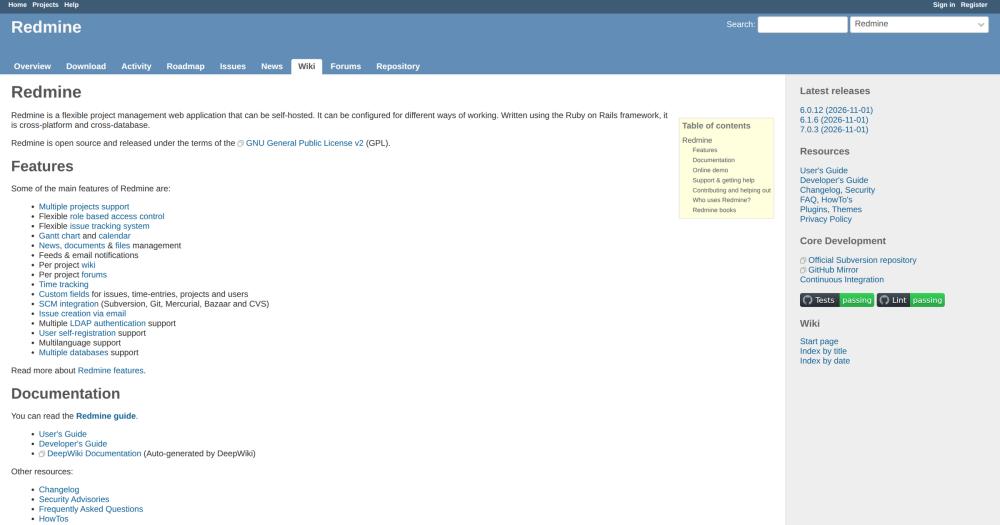
Manage projects, issues, and wikis in a self-hosted Ruby on Rails web app with Gantt charts, SCM integration, and role-based access control.

Visit websiteGitHub6.1K starsDeploy on Hostinger
Image for Redmine
TL;DR

Redmine is a self-hosted project management web application built with Ruby on Rails, used by development teams to track issues, manage projects with Gantt charts, and link directly to source code repositories. It replaces paid tools like Jira, YouTrack, and Linear at no per-seat licensing cost, running entirely on your own infrastructure. Licensed under GPL-2.0-or-later, it supports MySQL, PostgreSQL, and SQLite databases. Best for engineering teams that need issue tracking, time tracking, wiki documentation, and SCM integration in one place.

Read the full breakdownHide the full breakdownWho it is for, how it works, trade-offs and the FAQ
who it's for

Who Redmine is for#

Engineering teams replacing Jira on a fixed infrastructure budget

Development teams that need issue tracking, project milestones, and SCM browsing without per-seat costs get the core Jira feature set on hardware they own. The SCM integration works with existing Git or Subversion repositories, and role-based access control handles permission structures for teams of any size.

Skip if:

Skip if your team has no server infrastructure and no one to maintain a Ruby environment. Jira Cloud or Linear are lower-maintenance choices when administrative overhead matters more than cost.

Organizations with LDAP or Active Directory authentication requirements

Redmine's built-in LDAP support lets teams authenticate against an existing directory service without additional middleware. Role-based access control maps to organizational roles, and user self-registration can be disabled for stricter access management. Multiple LDAP sources are supported for organizations with complex directory structures.

Skip if:

Skip if your team authenticates through SAML or OAuth only. Redmine's built-in authentication is LDAP-based; SAML and OAuth support require a plugin.

Teams running internal Git or Subversion repositories

Redmine connects directly to Git, Subversion, Mercurial, Bazaar, and CVS repositories on the same server or over the network. Developers can browse commits, view diffs, and reference issues in commit messages without leaving the project tracker or setting up a separate integration service.

Skip if:

Skip if your repositories are hosted on GitHub or GitLab. Redmine's SCM integration targets server-hosted repositories; connecting to hosted platform repositories requires additional configuration.

Development teams managing multiple separate projects

Redmine's multi-project structure lets teams run separate issue trackers, wikis, and forums for each project while sharing user accounts and cross-project reporting. Teams can segment work without maintaining separate instances, and role-based access control gives each project its own permission set.

Skip if:

Skip if you need a unified backlog that spans all projects as a single queue. Each project in Redmine maintains its own separate issue tracker; cross-project views show aggregated summaries rather than a fully unified queue.

the problem

The problem it solves#

Per-seat pricing from tools like Jira and Linear scales with team growth, making project management licensing a line item that expands as headcount does. Vendor lock-in compounds this: issues, attachments, wikis, and time logs live in proprietary storage, and migrating everything before switching tools is itself a project.

For teams running Git or Subversion repositories internally, there is a separate problem. Getting commit history linked to issue trackers on hosted services often requires paying for premium tiers or setting up marketplace integrations. Teams with their own code repositories have no clean path to connect version control history to their issue list without additional cost or complexity.

how Redmine solves it

How it solves it#

SCM integration across Git, SVN, Mercurial, Bazaar, and CVS

Browse repository commits, diffs, and file history directly from the Redmine interface without leaving your project tracker. Commits reference issue numbers and appear in the issue timeline. This native integration covers Git, Subversion, Mercurial, Bazaar, and CVS, and runs against repositories on the same server or over the network.

Flexible issue tracking with custom fields

Track bugs, features, and tasks with configurable issue types, custom fields, priorities, and status workflows. Each issue supports file attachments, comments, and time logging. Custom fields extend to time-entries, projects, and users, so teams can capture whatever metadata their process requires without add-ons.

Gantt chart and calendar view

Visualize project timelines on a Gantt chart showing issue start dates, due dates, and progress. The calendar view overlays issues and milestones across a monthly grid. Both views are built in and require no additional configuration or plugins.

Per-project wikis and forums

Every project in Redmine gets its own wiki and threaded forum. The wiki stores structured documentation, process notes, and decision records. Forums provide discussion space separate from the issue tracker, keeping conversation history inside the project context rather than in an external chat tool.

LDAP authentication and multilanguage interface

Connect to existing LDAP or Active Directory directories with the built-in LDAP authentication support. Multiple LDAP sources are supported, and user self-registration can be enabled or restricted to administrator-approved accounts. The interface ships in multiple languages, making it usable for international teams without additional configuration.

strengths · trade-offs

Strengths and trade-offs#

Strengths

  • No per-seat licensing on self-hosted deploymentsRedmine is GPL-2.0-or-later: free to run on your own infrastructure with no user count limit. A team growing from 10 to 100 engineers pays no additional license cost. This directly replaces the per-seat subscription model of Jira and YouTrack with a fixed server expense.
  • Native SCM integration with five version control systemsGit, Subversion, Mercurial, Bazaar, and CVS connect to Redmine natively, without marketplace add-ons or separate integrations. Commit browsing, diff viewing, and issue-to-commit linking are built in. Teams that already run internal repositories get this connection without additional cost or tooling.
  • Active maintenance with concurrent stable and security releasesThree release series shipped simultaneously in November 2026: 7.0.3, 6.1.6, and 6.0.12, all released on November 1, 2026. The project has maintained production releases since 2006. Concurrent release series mean teams running older versions still receive security patches without being forced to upgrade major versions.
  • Enterprise authentication built inMultiple LDAP authentication sources, role-based access control, and multilanguage support are included without additional configuration or add-ons. Teams with an existing LDAP or Active Directory directory service can authenticate directly against it. These capabilities are part of the base installation.

Trade-offs

  • -Ruby on Rails environment required for deploymentRedmine runs on Ruby on Rails, so deploying it requires installing and configuring a Ruby environment, Bundler, and a compatible database server. This involves more setup work than tools with an official Docker image that starts in one command. Teams without Ruby expertise on staff should budget time for initial configuration and future upgrades when Ruby or Rails versions change.
  • -Primary development repository is on Subversion, not GitHubThe official Redmine source is at svn.redmine.org; the GitHub presence at github.com/redmine/redmine is a read-only mirror. Teams that want to track upstream changes through GitHub notifications, contribute patches via pull request, or use GitHub-native CI integrations will need to work with the SVN repository directly.
versus alternatives

Redmine vs alternatives#

Redmine vs Jira

Jira is Atlassian's hosted issue tracker targeting software development teams. Redmine covers the same core surface: issue tracking, project milestones, Gantt charts, and direct SCM integration, with the key difference that Redmine is GPL-licensed and self-hosted.

FeatureRedmineJira
LicenseGPL-2.0-or-laterProprietary
Self-hostingYesPaid enterprise tier
SCM integrationNative (Git, SVN, Mercurial)Via marketplace add-ons
PricingFree to self-hostPer-seat subscription

Redmine is the better choice when your team has server infrastructure, needs native SCM integration without marketplace add-ons, and wants to avoid subscription costs that scale with headcount. Jira is worth considering for teams that want a fully managed cloud service with no server administration overhead, or organizations already committed to the Atlassian toolchain.

Redmine vs YouTrack

YouTrack is JetBrains' project tracker with a free tier for small teams and paid plans as headcount grows. Redmine covers the same issue-tracking and project-management scope with no user count ceiling on the self-hosted path.

FeatureRedmineYouTrack
LicenseGPL-2.0-or-laterProprietary
Self-hostingYesYes (InCloud or on-premises)
Free user limitUnlimited (self-hosted)Limited free tier
SCM integrationNativeVia integrations

YouTrack is a reasonable fit for teams that want a modern agile interface and do not mind the proprietary license. Redmine is the better fit when avoiding per-seat costs at any team size matters more, or when native multi-VCS integration is required without paying for integrations.

Redmine vs Linear

Linear is a cloud-only project management tool designed for fast-moving product teams, with no self-hosted path. Redmine offers full data ownership and self-hosted deployment for teams where data residency or cost constraints rule out a cloud-only service.

FeatureRedmineLinear
LicenseGPL-2.0-or-laterProprietary
Self-hostingYesNo
PricingFree to self-hostPer-seat subscription

Teams that need all project data on their own infrastructure should choose Redmine. Linear remains the better fit for small, fast-moving product teams that prioritize a modern interface and are comfortable with a cloud-only service with no self-hosting path.

tech stack · detected from GitHub

What it's built on#

Languages
JavaScriptRuby
Frameworks
Rails
Databases
MySQLPostgreSQLSQLite
frequently asked

FAQ#

What databases does Redmine support?

Redmine supports MySQL, PostgreSQL, and SQLite. PostgreSQL is the common production choice for teams that need concurrent access and performance at scale. SQLite works for small installs or local testing. The database is configured during initial setup and the application runs across all three without code changes.

Does Redmine integrate with Git?

Yes. Redmine connects directly to Git repositories, along with Subversion, Mercurial, Bazaar, and CVS. Once configured, the interface displays commit history, file browsing, and diffs within each project. Commit messages that reference issue numbers link back to the relevant issue automatically.

What license is Redmine under, and can it be used commercially?

Redmine is released under the GNU General Public License v2 or later (GPL-2.0-or-later), an OSI-approved open source license. Running Redmine on your own infrastructure for internal commercial team use is fully permitted at no licensing cost. If you modify Redmine and distribute it or run it as a managed hosted service for external customers, GPL requires providing the modified source code under the same license.

Can Redmine handle multiple projects in a single installation?

Yes. A single Redmine installation supports multiple projects, each with its own issue tracker, wiki, forum, and repository. User accounts are shared across projects, and role-based access control lets administrators assign different permissions per user per project. Cross-project reports aggregate activity across the full installation.

Does Redmine support email notifications and email-based issue creation?

Yes on both. Redmine sends email notifications for issue updates, wiki changes, and other project activity. It also supports creating issues by sending email to a configured address, covering cases where team members or external reporters prefer email over the web interface.

Looking for more

Other ways to replace Jira, YouTrack and Linear#

OpenProject

#2 in the Jira guide

Full project planning suite with work packages, Gantt charts, roadmaps and Scrum backlogs in the Community edition

16,986 GitHub stars

Plane

#3 in the Jira guide

Modern Linear-style tracker with cycles, modules and burndown in the AGPL-3.0 Community edition

61,974 GitHub stars

Taiga

#4 in the Jira guide

Focused Scrum and Kanban tracker with native sprints, burndown, epics and configurable issue types in the open-source edition

385 GitHub stars

Leantime

#5 in the Jira guide

Task and sprint tracker designed for non-project-managers, with OIDC and LDAP in the AGPL-3.0 core

11,961 GitHub stars
All 17 Jira alternatives10 open source Jira alternatives, ranked
by category

Open source tools in these categories#

116

Product & Project Management

freeCodeCamp, agency-agents, Gstack
259

Business & Productivity

OpenClaw, Excalidraw, RustDesk
549

Developer Tools

REA (Reverse Engineer Anything), Skills for Real Engineers, superpowers
Hostinger

Self-host Redmine on a Hostinger VPS

Keep it running 24/7, even when your laptop is off. A Hostinger VPS gives it a server of its own.

  1. 01

    Choose a plan

    Starts from $6.49/mo

  2. 02

    Apply

    Extra 10% off yearly plans

  3. 03

    Install Redmine

    On a server that stays on

  4. 04

    Start building

    Focus on the app, not the server

Deploy on Hostinger

Sponsors

Inbox Zero

Alternative toSuperhuman

AI email assistant that drafts replies and clears your inbox

  • 12,889 GitHub stars
  • AGPL-3.0Licence AGPL-3.0
  • #Email

rakazo

Alternative toGrok Bot

AI teammates you own: your keys, your model, your machine.

  • 6,568 GitHub stars
  • Apache-2.0Licence Apache-2.0
  • #AI Agents

SnitchFeed

Live monitoring on LinkedIn, X, Reddit & more. Agentic social listening for startups.

Marketing & Growth

Advertise your product

New open source projects by email

The projects we add and every new guide. Free, unsubscribe any time.

Find open source alternatives to paid software

/
  • Claude Code to OpenCode
  • Jira to Windshift
  • Notion to AppFlowy
  • Slack to Mattermost
  • Linear to GitLab
  • Wispr Flow to Handy
  • Arc to Zen Browser
  • CapCut to Concat
  • Grok Bot to rakazo
  • Superhuman to Inbox Zero
  • Airtable to AITable
  • Muse to OpenClaw
  • Railway to Coolify
  • GitHub Copilot to Cline
  • Datadog to Netdata
  • Confluence to Wiki.js
  • Microsoft Teams to Rocket.Chat
  • Firebase to Supabase
  • Pinecone to Qdrant
  • Zapier to n8n
  • 1Password to KeePassXC
  • Devin AI to OpenHands
  • Contentful to Strapi
  • Adobe Premiere Pro to Shotcut