Open Source Alternatives
  • Alternatives
  • Categories
    Categories by size1,302 projects
    • Developer Tools673
    • AI & Machine Learning549
    • Business & Productivity311
    • Web Development219
    • Security & Monitoring198
    • Communication & Collaboration168
    • IT Management165
    • Design & Creative145
    • LLMOps & AI Tooling142
    • DevOps & CI/CD141
    Browse all 21 categoriesCloud & Hosting, Product & Project Management and 9 more
  • Blog
  • Advertise
SearchNotion, Slack, password manager.../
Submit
Open Source Alternatives
  • Alternatives
    • Developer Tools673
    • AI & Machine Learning549
    • Business & Productivity311
    • Web Development219
    • Security & Monitoring198
    • Communication & Collaboration168
    • Browse all 21 categories
  • Blog
  • Advertise
Submit your project

New open source projects by email

The projects we add and every new guide. Free, unsubscribe any time.

Open Source Alternatives LogoOpen Source Alternatives

Handpicked Open Source Alternatives to Paid Softwares

Add Open Source Alternatives as a preferred source on Google

Product

  • Categories
  • Tag
  • Advertise

Resources

  • Blog
  • Collection
  • Submit

Company

  • Privacy Policy
  • Terms of Service
  • Refund Policy
  • Sitemap

Alternatives

  • Claude Code
  • Jira
  • Notion
  • Slack
  • Linear
  • Wispr Flow
  • All alternatives
© 2026 Open Source Alternatives. All rights reserved.
Open SourceAlternatives
Home/Categories/Data & Analytics/Iceberg
icon of Iceberg

Iceberg

Open source alternative to Databricks and Dremio

  • 9.4K stars
  • Apache-2.0
  • Active this week
  • Last commit today

Last verified Nov 18, 2026

Build analytics tables for data lakes that Spark, Trino, Flink, Presto, Hive, and Impala can safely read and write without engine coordination overhead.

Visit websiteGitHub9.4K starsDeploy on Hostinger
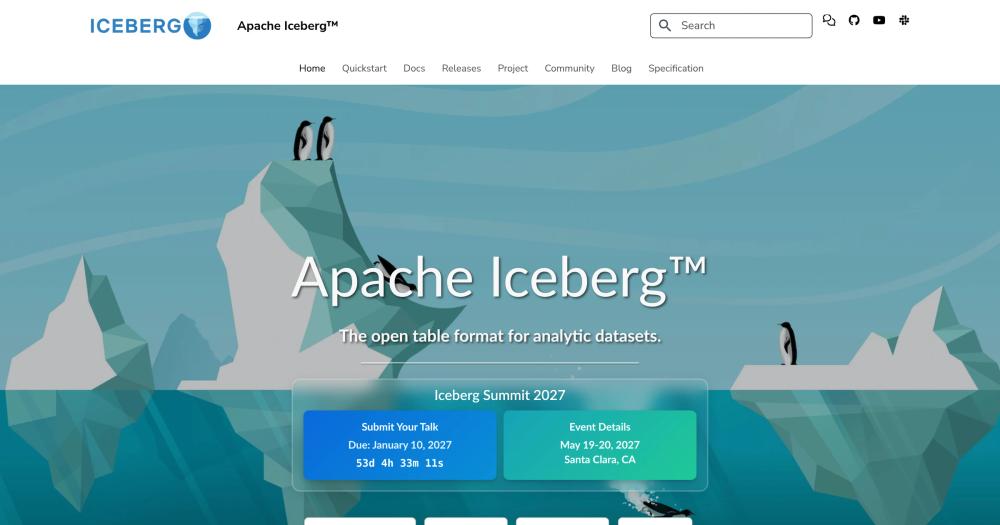
Image for Iceberg
TL;DR

Iceberg Apache Iceberg is an open table format for large analytic datasets, bringing SQL-like table reliability and concurrent multi-engine access to data lakes. It enables Spark, Trino, Flink, Presto, Hive, and Impala to safely read from and write to the same tables simultaneously, without coordinating through a single proprietary system. Licensed Apache-2.0, with the reference implementation in Java and additional libraries in Python (PyIceberg), Go, Rust, and C++. Best for data engineering teams building multi-engine analytics pipelines on cloud object storage without committing to a managed lakehouse vendor.

Read the full breakdownHide the full breakdownWho it is for, how it works, trade-offs, the quick start and the FAQ
who it's for

Who Iceberg is for#

Data engineering teams running multiple query engines

Teams that use Spark for batch ETL and Trino or Presto for interactive ad-hoc queries can point both engines at the same Iceberg tables without data duplication or synchronization overhead. The snapshot model gives each engine a consistent view without requiring write serialization.

Skip if:

Skip if your analytics environment runs a single query engine end-to-end. The multi-engine coordination Iceberg provides adds operational complexity; a simpler storage format may be a better fit for a single-engine pipeline.

Organizations moving off managed lakehouse services

Teams migrating from Databricks or Dremio to self-managed infrastructure can adopt Iceberg tables as their storage format and choose query engines independently. The Apache-2.0 license and multi-engine compatibility make Iceberg a neutral foundation for a vendor-independent data infrastructure.

Skip if:

Skip if your team lacks the engineering capacity to run and operate your own cluster infrastructure and catalog service. Managed lakehouse platforms handle these operational concerns as part of their service.

Teams extending Hive-based data warehouses

The iceberg-hive-metastore module integrates Iceberg tables into existing Hive setups backed by the Hive Metastore Thrift client, letting teams add new Iceberg tables alongside existing Hive tables without replacing the catalog layer.

Skip if:

Skip if you are starting fresh with no existing Hive infrastructure. This integration is most valuable for existing Hive-based environments; new greenfield setups benefit from evaluating catalog options without the Hive constraint.

the problem

The problem it solves#

Large-scale analytics on cloud object storage creates a concurrency challenge. When Spark, Trino, Flink, Presto, Hive, and Impala each read files directly from storage with no shared protocol, running multiple engines against the same dataset means accepting that different engines may read inconsistent views of the data. The standard workaround is to serialize all writes through a single system, which eliminates the multi-engine flexibility that makes a data lake attractive.

Building data pipelines around one query engine means that engine owns the storage format. Teams that want both Spark for batch processing and Trino for interactive queries against the same tables must either keep them synchronized manually, run separate copies of the data, or find a format both engines understand natively.

how Iceberg solves it

How it solves it#

Concurrent multi-engine table access

Spark, Trino, Flink, Presto, Hive, and Impala can safely read from and write to the same Iceberg tables simultaneously. Each engine reads a consistent snapshot of the data, so concurrent writes from one engine do not corrupt reads from another.

Parquet, ORC, and Arrow file format support

Optional modules back Iceberg tables with Parquet files, ORC files, or Arrow in-memory format. Teams choose the storage format that fits their query engine's performance characteristics without changing the table interface that all engines use.

Native Spark DataSource V2 integration

The iceberg-spark module implements Spark's DataSource V2 API for reading and writing Iceberg tables from Spark jobs. Shaded runtime jars are available to avoid dependency conflicts when running alongside other Spark libraries, with submodules for each Spark version.

Apache Flink and Hive engine integrations

iceberg-flink provides classes for integrating Iceberg tables with Apache Flink streaming jobs, with a shaded iceberg-flink-runtime jar available. The iceberg-mr module adds an InputFormat and supporting classes for reading Iceberg tables from Apache Hive's MapReduce layer.

Cross-language implementations

The Java library in this repository is the reference implementation for the Iceberg specification. Additional implementations are maintained under the Apache Software Foundation for Go (iceberg-go), Python (PyIceberg), Rust (iceberg-rust), and C++ (iceberg-cpp), covering the same specification across language environments.

strengths · trade-offs

Strengths and trade-offs#

Strengths

  • Apache-2.0 license with no commercial restrictionsApache-2.0 permits commercial use, modification, distribution, and private use without requiring source disclosure. Teams run Iceberg in production and distribute applications built on it without licensing fees or obligations to publish changes.
  • Engine-neutral storage layerIceberg tables are not owned by any single query engine. The same table is accessible to Spark, Trino, Flink, Presto, Hive, and Impala concurrently, so teams add or switch engines without migrating data or changing the storage format.
  • Active Apache Foundation developmentWith 9,443 GitHub stars, 3,697 forks, and active commits through November 2026, Iceberg is under sustained development at the Apache Software Foundation. The community communicates through a dev mailing list and an Apache Iceberg Slack workspace.
  • Reference implementation plus multi-language librariesThe Java core library is the authoritative reference for the Iceberg specification. Apache-maintained implementations also exist for Python, Go, Rust, and C++, so teams interact with Iceberg tables from their preferred language without requiring a JVM in every environment.

Trade-offs

  • -Format library requiring existing query infrastructureIceberg is a table format specification and library, not a standalone server or query engine. Using it requires integrating the library into an existing Spark, Flink, or Hive cluster and managing a catalog service separately. Teams without an existing data infrastructure need to provision compute, storage, and catalog components before Iceberg adds value.
  • -465 open issues on GitHubThe project tracks 465 open issues as of November 2026. Active projects at this scale commonly carry a backlog of open items; reviewing open issues relevant to your use case before adopting for a production deployment is worth doing.
  • -Source build requires Gradle and Java 17 or 21Contributing to or building from source requires Gradle with Java 17 or Java 21. Tests also require Docker to run. Teams consuming the library as a Maven or Gradle dependency do not build from source, but contributors and teams running customized builds need this toolchain set up.
versus alternatives

Iceberg vs alternatives#

Apache Iceberg vs Databricks

Databricks is a unified analytics platform for data engineering, data science, and AI, offering a managed lakehouse architecture with integrated compute, storage, and ML workflows. For teams building inside the Databricks ecosystem, the managed service handles query optimization, catalog management, and enterprise support under one billing relationship.

Apache Iceberg takes a narrower scope: it is a table format and specification only, without managed compute or catalog services. Teams that run Iceberg directly choose their own query engines (Spark, Trino, Flink, Presto, or Hive), their own catalog backend, and their own storage layer independently. Organizations with existing cloud infrastructure and the capacity to operate their own clusters avoid managed-service pricing while keeping full control over their data pipeline.

Apache Iceberg vs Dremio

Dremio is a commercial cloud data lakehouse platform built natively around Apache Iceberg with a managed Polaris catalog, now part of SAP. The layers differ: Dremio provides a managed query layer, catalog management, and cloud operations on top of Iceberg tables. Teams using Dremio still store data in Iceberg format; teams running Iceberg without Dremio skip the managed layer entirely.

The operational difference is about what your team manages. Dremio handles catalog state, caching, and query acceleration as a subscription service. Running Iceberg without Dremio means providing those yourself: a catalog backend such as Hive Metastore, your own cluster infrastructure for query engines, and your own operational tooling. For data engineering teams with strong infrastructure expertise, the direct Iceberg path avoids the Dremio subscription while staying within the same open table format ecosystem.

Which to Choose

Pick Databricks when your team needs a fully managed analytics platform with integrated ML workflows, collaborative notebooks, and enterprise support, and you are comfortable with managed compute pricing and vendor dependency at the storage layer. Pick Dremio when you want Iceberg tables with a managed catalog and query acceleration service and are prepared to adopt a commercial platform now part of SAP. Run Apache Iceberg directly when you operate your own query infrastructure, want to stay vendor-neutral at the storage layer, and have the engineering capacity to manage your own catalog, cluster, and operations.

install · quick start

Quick start#

bash
Install PyIceberg to read and write Iceberg tables from Python without a JVM or Spark cluster dependency.
```bash
pip install pyiceberg
```
tech stack · detected from GitHub

What it's built on#

Languages
JavaScala
frequently asked

FAQ#

What is Apache Iceberg and what is it used for?

Apache Iceberg is an open table format for large analytic datasets. It defines how metadata, snapshots, and data files are organized so multiple query engines can read and write the same table safely at the same time. It is used to build data lakehouse storage layers on object stores or HDFS, and integrates with engines including Spark, Trino, Flink, Presto, Hive, and Impala.

What query engines does Apache Iceberg support?

The Iceberg repository ships integration modules for Spark (DataSource V2 API), Apache Flink, and Apache Hive (MapReduce InputFormat). Trino, Presto, and Impala include their own Iceberg connectors. See the Multi-Engine Support page at iceberg.apache.org for compatibility details per engine version.

Can I use Apache Iceberg without a JVM or Spark cluster?

Yes. PyIceberg is a Python implementation of the Iceberg specification maintained under the Apache Software Foundation at github.com/apache/iceberg-python. It reads and writes Iceberg tables without requiring a JVM or a Spark installation. Additional implementations exist in Go, Rust, and C++ for other language environments.

What license does Apache Iceberg use?

Apache Iceberg is licensed under the Apache License 2.0. This permits commercial use, modification, distribution, and private use without requiring source disclosure or licensing fees. There are no additional commercial terms or hosting restrictions.

How is the Java reference implementation built?

The Java reference implementation is built with Gradle and requires Java 17 or Java 21. Running the full test suite also requires Docker. The project tracks issues on GitHub and accepts contributions as pull requests. Community discussions happen on the dev mailing list at [email protected] and in the Apache Iceberg Slack workspace.

also worth a look

Similar open-source tools#

Renart

Alternative todbt Cloud

SQL and Python pipelines, notebooks, and dashboards in Git

  • 96 GitHub stars
  • Apache-2.0Licence Apache-2.0

marin

Alternative toDatabricks

Open lab for training foundation models together

  • 4,120 GitHub stars
  • Apache-2.0Licence Apache-2.0

open-notebook

Alternative toNotebookLM

Self-host private AI research notebooks

  • 42,025 GitHub stars
  • MITLicence MIT

CocoIndex

Alternative toLlamaIndex

Incremental data framework for AI agents.

  • 11,902 GitHub stars
  • Apache-2.0Licence Apache-2.0

Ollama

Alternative toLM Studio

Run large language models locally on Mac, Linux, or Windows

  • 187,392 GitHub stars
  • MITLicence MIT

Unsloth

Alternative toTogether AI

Train LLMs locally without code using a browser-based interface

  • 79,632 GitHub stars
  • Apache-2.0Licence Apache-2.0
by category

Open source tools in these categories#

124

Data & Analytics

Firecrawl, ragflow, Worldmonitor
80

Databases & Storage

Immich, Supabase, Redis
93

Backend Development

dify, graphify, Rust
Hostinger

Self-host Iceberg on a Hostinger VPS

Keep it running 24/7, even when your laptop is off. A Hostinger VPS gives it a server of its own.

  1. 01

    Choose a plan

    Starts from $6.49/mo

  2. 02

    Apply

    Extra 10% off yearly plans

  3. 03

    Install Iceberg

    On a server that stays on

  4. 04

    Start building

    Focus on the app, not the server

Deploy on Hostinger

Sponsors

Inbox Zero

Alternative toSuperhuman

AI email assistant that drafts replies and clears your inbox

  • 13,058 GitHub stars
  • AGPL-3.0Licence AGPL-3.0
  • #Email

rakazo

Alternative toGrok Bot

AI teammates you own: your keys, your model, your machine.

  • 8,913 GitHub stars
  • Apache-2.0Licence Apache-2.0
  • #AI Agents

SnitchFeed

Live monitoring on LinkedIn, X, Reddit & more. Agentic social listening for startups.

Marketing & Growth

Advertise your product

New open source projects by email

The projects we add and every new guide. Free, unsubscribe any time.

Find open source alternatives to paid software

/
  • Claude Code to OpenCode
  • Jira to Windshift
  • Notion to AppFlowy
  • Slack to Mattermost
  • Linear to GitLab
  • Wispr Flow to Handy
  • Arc to Zen Browser
  • CapCut to Concat
  • Grok Bot to rakazo
  • Superhuman to Inbox Zero
  • Discord to Stoat
  • Airtable to AITable
  • Datadog to SigNoz
  • Muse to OpenClaw
  • Railway to Coolify
  • GitHub Copilot to Cline
  • Confluence to Wiki.js
  • Microsoft Teams to Rocket.Chat
  • 1Password to KeePassXC
  • Firebase to Supabase
  • Pinecone to Qdrant
  • Zapier to n8n
  • Devin AI to OpenHands
  • Asana to Leantime
  • Claude Code to OpenCode
  • Jira to Windshift
  • Notion to AppFlowy
  • Slack to Mattermost
  • Linear to GitLab
  • Wispr Flow to Handy
  • Arc to Zen Browser
  • CapCut to Concat
  • Grok Bot to rakazo
  • Superhuman to Inbox Zero
  • Discord to Stoat
  • Airtable to AITable
  • Datadog to SigNoz
  • Muse to OpenClaw
  • Railway to Coolify
  • GitHub Copilot to Cline
  • Confluence to Wiki.js
  • Microsoft Teams to Rocket.Chat
  • 1Password to KeePassXC
  • Firebase to Supabase
  • Pinecone to Qdrant
  • Zapier to n8n
  • Devin AI to OpenHands
  • Asana to Leantime