

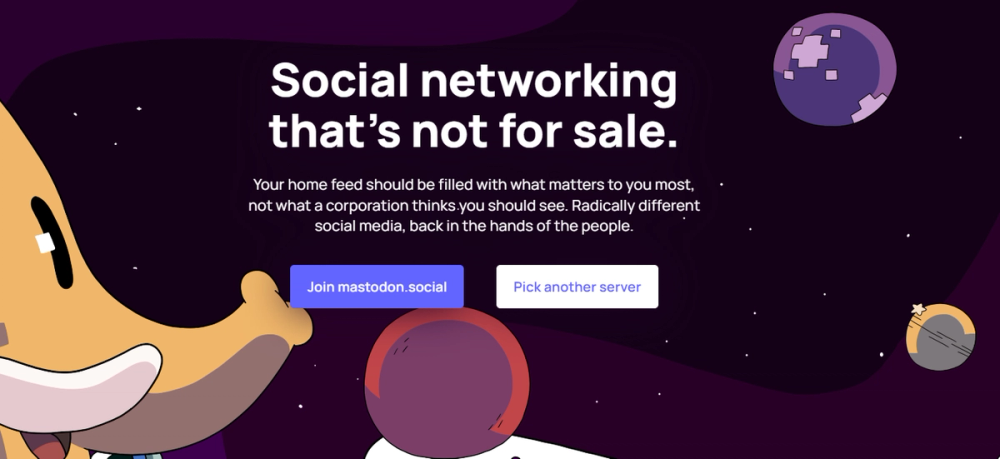
Who Mastodon is for#
Communities leaving centralized social platforms
Run a social space with your own moderation rules while remaining connected to other ActivityPub servers.
Skip if:
You need immediate access to the largest mainstream social graph.
Organizations publishing official updates
Own the server, handle, and moderation policy for public posts instead of depending on a proprietary platform account.
Skip if:
Your team cannot maintain a public-facing community service.
The problem it solves#
Centralized social platforms can change ranking, moderation, API access, and identity rules without community consent. Organizations and communities that rely on public conversation need a way to own moderation policy, user relationships, and long-term access to their social graph.
How it solves it#
ActivityPub federation
Mastodon servers interoperate with the broader Fediverse, letting users on separate servers follow and interact with one another.
Chronological social timelines
The README highlights real-time chronological timeline updates, media attachments, and standard social posting flows.
Moderation and safety controls
Private posts, locked accounts, content warnings, and server-level moderation tools help communities set their own norms.
Strengths and trade-offs#
Strengths
- Community-owned social infrastructureMastodon lets an organization run its own social server while still participating in a wider network through open standards.
- No single platform gatekeeperUnlike X or Threads, identity and moderation can live with the server operator rather than one company.
Trade-offs
- -Moderation is operational workRunning a Mastodon server means handling abuse reports, federation decisions, upgrades, and policy enforcement.
- -Network effects vary by communityMastodon works best when your audience already understands or accepts Fediverse identity and discovery patterns.
Mastodon vs alternatives#
Mastodon vs X Mastodon is the better choice when a community wants ownership over moderation, identity, and data access. X remains stronger for mainstream reach and centralized discovery. For public communities, nonprofits, publishers, and technical groups that care about open standards, Mastodon trades convenience for control.
What it's built on#
- Languages
- JavaScriptRubyTypeScript
- Frameworks
- ExpressRailsReact
- Databases
- PostgreSQL
- Infrastructure
- Docker
- Cache
- Redis
FAQ#
Can Mastodon replace Twitter or X?
Mastodon can replace X for communities that value federation, chronological feeds, and self-governance. It will not reproduce the same centralized network effects.
Can I self-host Mastodon?
Yes. Mastodon is built for self-hosted servers, but production hosting requires moderation, storage, email, background jobs, and upgrade planning.
What protocol does Mastodon use?
Mastodon uses ActivityPub, which allows federation with other compatible Fediverse software.
Similar open-source tools#

Discourse
Open source forum and community platform, self-hosted

FckSignups
Open-source tools that work instantly, no signup required

Mailflare
Self-hosted email inbox for custom domains on Cloudflare

ownCloud

Galae Email
Self-hosted email server stack forked from Mailcow

OpenCloud
File sync for organizations with data sovereignty and S3 storage