Open Source Alternatives
  • Alternatives
  • Categories
    Categories by size1,111 projects
    • Developer Tools559
    • AI & Machine Learning475
    • Business & Productivity273
    • Web Development208
    • Security & Monitoring171
    • Communication & Collaboration153
    • IT Management145
    • Cloud & Hosting127
    • LLMOps & AI Tooling123
    • Data & Analytics118
    Browse all 21 categoriesProduct & Project Management, DevOps & CI/CD and 9 more
  • Blog
  • Advertise
SearchNotion, Slack, password manager.../
Submit
Open Source Alternatives
  • Alternatives
    • Developer Tools559
    • AI & Machine Learning475
    • Business & Productivity273
    • Web Development208
    • Security & Monitoring171
    • Communication & Collaboration153
    • Browse all 21 categories
  • Blog
  • Advertise
Submit your project

New open source projects by email

The projects we add and every new guide. Free, unsubscribe any time.

Open Source Alternatives LogoOpen Source Alternatives

Handpicked Open Source Alternatives to Paid Softwares

Product

  • Categories
  • Tag
  • Advertise

Resources

  • Blog
  • Collection
  • Submit

Company

  • Privacy Policy
  • Terms of Service
  • Refund Policy
  • Sitemap

Alternatives

  • Claude Code
  • Jira
  • Notion
  • Slack
  • Linear
  • Wispr Flow
  • All alternatives
© 2026 Open Source Alternatives. All rights reserved.
Open SourceAlternatives
Home/Categories/AI & Machine Learning/Desearch MCP
icon of Mcp Desearch

Desearch MCP

  • 1 stars
  • MIT
  • Active this week
  • Last commit today

Last verified Nov 5, 2026

Search the web, X, and social platforms from AI agents via a hosted MCP endpoint with people search and company enrichment.

Visit websiteGitHub1 stars
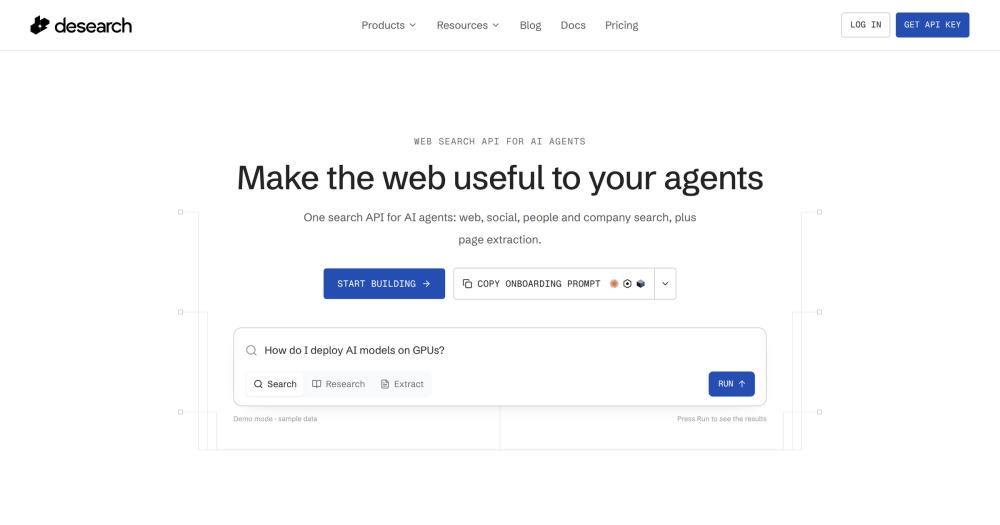
image of Mcp Desearch
TL;DR

Desearch MCP is a hosted Model Context Protocol server that exposes 39 tools for web search, X/Twitter data, social media lookups, people search, and company enrichment to AI agents via a single HTTP endpoint. It replaces the need to wire together multiple paid search and data APIs by consolidating web, social, and lead intelligence tools under one MIT-licensed server. Available as a hosted HTTP endpoint or a local npm package. Best for AI engineers and agent developers building pipelines that cross web research, social monitoring, and B2B lead qualification.

Read the full breakdownHide the full breakdownWho it is for, how it works, trade-offs, the quick start and the FAQ
who it's for

Who Desearch MCP is for#

AI engineers building multi-source research agents

Agents that need to combine web search, social monitoring, and company research in one workflow can call web-search, x-search, and company-search from the same MCP server without managing separate SDKs or API keys. The ai-search tool returns a synthesized answer plus source links for queries where a summary is more useful than raw results.

Skip if:

The workflow only needs web search; a simpler single-purpose search API will be cheaper and have fewer moving parts.

B2B sales or marketing teams using agent pipelines

The people-search and company-search tools find leads matching a plain-language description and return public contact data, LinkedIn profiles, and verified emails. Combined with company-enrich for domains already in a CRM, this covers a standard outbound research loop without leaving the agent context.

Skip if:

The team needs deep CRM integration or compliance-grade data sourcing; Desearch MCP provides public data only, with no opt-out or consent framework.

Social media analysts using agent workflows

X trends by WOEID, subreddit post feeds, TikTok hashtag data, and Instagram profile posts are all available as MCP tools. An agent can pull cross-platform signals in a single session and return a consolidated digest without the user managing five separate browser tabs or API sessions.

Skip if:

High-volume social data scraping is the primary goal; per-call costs and rate limits may make a dedicated scraping tool more cost-effective at scale.

the problem

The problem it solves#

Building capable AI agents today requires pulling data from multiple sources: web search for current information, social platforms for signals and trends, and people or company data for lead research. Each source typically means a separate API subscription with its own authentication scheme, schema, rate limits, and pricing model. Teams end up maintaining five or six integrations to cover the data surface a single agent workflow needs.

The harder problem is that most search APIs designed for AI agents cover only web search. Social media data, X/Twitter posts and trends, people search across LinkedIn, TikTok, and YouTube, and company enrichment with contact details are separate products entirely, often requiring enterprise contracts and manual stitching.

how Desearch MCP solves it

How it solves it#

AI Search with web and X/Twitter synthesis

The ai-search tool queries both web and X/Twitter and returns a synthesized summary alongside source links. The result_type parameter switches between a full summary with links (LINKS_WITH_FINAL_SUMMARY) and a links-only response (ONLY_LINKS). Tools are set by short ids such as web and twitter; the default is both. Useful for agents that need a combined signal rather than raw list results.

X/Twitter data tools

More than ten X-specific tools cover post search, user timelines, reply trees, retweeter lists, and trending topics. The x-search tool filters by language, verified status, date range (start_date, end_date), and engagement thresholds (min_likes, min_retweets). X trends returns topics by WOEID; x-posts-by-user pulls a user's posts with an optional keyword filter.

Async people search across four platforms

The people-search tool starts a background job that finds people matching a plain-language description on X, YouTube, LinkedIn, or TikTok. Each result carries handle, audience size, score, and publicly listed contact details. Searches can be paused, resumed within seven days, or cancelled; the reservation settles to what it delivered. Status polling returns completion reason and unverified criteria per person.

Company search and domain enrichment

Company Search finds businesses matching a description and collects their public contact data, including verified emails and LinkedIn profiles of key leaders. Company Enrich takes domains you already have and returns the same data. Both run as async jobs with pause, resume, and cancel controls. The require filter narrows results to companies with an email, phone, LinkedIn, or specific role data present.

Social media data across six platforms

Individual tools cover public TikTok, Facebook, Instagram, YouTube, Reddit, and Threads data. Actions include search, profile reads, post data, comment threads, and channel or subreddit listings. YouTube covers video search, transcripts, and channel video listings. Reddit supports subreddit posts with sort and timeframe filters. Threads covers post search, user search, and profile posts.

Page extraction over Streamable HTTP

The extract tool reads any public URL as text, markdown, or HTML, with a js flag for JavaScript-rendered pages and a full_page option for complete visible text. The server runs at mcp.desearch.ai over Streamable HTTP, so no local Docker or Node.js process is required. Discovery without an API key returns the tool list; tool calls need Authorization: <key> in the header.

strengths · trade-offs

Strengths and trade-offs#

Strengths

  • 39 tools over one HTTP connectionVersion 0.8.0 exposes 39 tools in a single MCP server, covering web search, AI search, X/Twitter, TikTok, Facebook, Instagram, YouTube, Reddit, Threads, people search, and company enrichment. Setting up one HTTP connection gives an agent access to all of them, rather than integrating a separate client library for each data source.
  • MIT licensed with a local npm install pathThe MIT license allows free use, modification, and commercial deployment without restriction. Teams that prefer local execution can run the server with `npx -y desearch-mcp-server@latest` instead of the hosted endpoint, keeping the MCP call overhead on their own infrastructure. No enterprise contract is required.
  • Async search jobs with pause and resumePeople Search and Company Search run as background jobs that can be paused, resumed within seven days, or cancelled with settlement to what was delivered. This model fits agent workflows where a search may take one to five minutes; the agent polls status rather than blocking on a synchronous call. Idempotency keys prevent duplicate charges on retries.

Trade-offs

  • -API key required; search and lead tools are paidEvery tool call except initialize and tools/list requires a Desearch API key from console.desearch.ai. People Search and Company Search are billed per person or company delivered, with a minimum of one when any results are delivered. Web and AI search also consume credits. Teams running high-volume or frequent searches will incur ongoing costs beyond the self-hosted npm package.
  • -Very early project with limited communityThe GitHub repository has 1 star and 1 fork as of this writing, with 2 open issues. The project is active (last pushed November 2026) but has not yet built a broad contributor base or a community issue tracker. Documentation on pricing, rate limits, and quotas lives on the Desearch platform, not in the open source repository.
  • -All tool calls reach the hosted Desearch backendThe 39-tool surface relies on the Desearch platform being available at mcp.desearch.ai. While the npm package runs a local stdio server, that package also calls the hosted Desearch API for search and data operations; there is no fully self-contained local deployment. Agent availability depends on Desearch platform uptime.
versus alternatives

Desearch MCP vs alternatives#

Desearch MCP vs Tavily

Tavily is a paid web search API built specifically for AI agents. Compared to Tavily, Desearch MCP adds X/Twitter data, social platform lookups across six networks, and async people and company search to the web search base.

FeatureDesearch MCPTavily
LicenseMITProprietary
Local installnpm package availableNo
Web searchYesYes
X/Twitter toolsYesNo
People SearchYes (billed per result)No
Company SearchYes (billed per result)No
Social media toolsYes (TikTok, YouTube, Reddit, Threads, Facebook, Instagram)No

Desearch MCP is the better fit when an agent needs to cross web search and social or lead intelligence in one session. Tavily is worth considering when web-only search results with a mature, well-documented API are the priority and broader data coverage is not needed.

Desearch MCP vs Exa

Exa is a paid semantic search API focused on web content quality and relevance for LLM applications. Compared to Exa, Desearch MCP offers a wider tool surface that includes social media data and lead intelligence, while Exa focuses on the semantic quality of web search results.

FeatureDesearch MCPExa
LicenseMITProprietary
Local installnpm package availableNo
Search typeWeb + social + lead dataSemantic web search
Social media toolsYesNo
People/Company SearchYesNo

Desearch MCP suits agents that need a broad data surface in one integration. Exa is the better fit when semantic relevance for web search queries is the primary criterion and social data is not needed.

install · quick start

Quick start#

bash
Create an API key in the Desearch console, then install the local stdio server with npm and set the key:

```bash
npm install -g desearch-mcp-server
export DESEARCH_API_KEY=<your-key>
```

Or connect a client to the hosted endpoint at https://mcp.desearch.ai/mcp with an `Authorization` header carrying the key.
tech stack · detected from GitHub

What it's built on#

Languages
JavaScriptPythonTypeScript
Cache
Redis
frequently asked

FAQ#

Does Desearch MCP require an API key?

Discovery calls (initialize and tools/list) work without an API key, but every tool call requires one from console.desearch.ai. Web search, AI search, page extraction, and X tools consume search credits; People Search and Company Search are billed per result delivered, with pricing listed at desearch.ai/pricing.

Can I run Desearch MCP without the hosted endpoint?

Yes: npx -y desearch-mcp-server@latest runs a local stdio MCP server with the DESEARCH_API_KEY environment variable. This keeps the MCP transport local, but the tool calls still reach the Desearch API backend for search and data operations; there is no fully offline deployment. Clients that prefer stdio over HTTP can use this path.

How do I add Desearch MCP to Claude Code?

In Claude Code, run the claude mcp add command with the hosted HTTP transport, the endpoint URL (https://mcp.desearch.ai/mcp), and your Desearch API key in the Authorization header. After reloading the MCP session, the Desearch server and its tools appear in the tool list. The docs at desearch.ai/docs/guide/sdk/mcp include configuration examples for Cursor, VS Code, and other MCP clients.

What is People Search and how is it billed?

People Search is an async background job that finds people matching a plain-language description on X, YouTube, LinkedIn, or TikTok. It reserves a cost based on count times the per-person rate when the job starts and settles to what it delivered. Searches typically finish in one to five minutes. You can pause, resume within seven days, or cancel at any time; a cancelled search settles to what it found before cancellation.

Which social platforms does Desearch MCP cover?

The server includes tools for X/Twitter, TikTok, Facebook, Instagram, YouTube, Reddit, and Threads. Coverage includes search, profiles, post data, comment threads, and in some cases transcripts or channel listings. The tool catalog is live; check your client's tools/list for the current inventory, as Desearch updates it without necessarily changing the version number.

also worth a look

Similar open-source tools#

Agent Reach

Featured

Alternative toFirecrawl

Give any AI agent internet access, free and local

  • 108,787 GitHub stars
  • MITLicence MIT

LibreTranslate

Alternative toDeepL Pro

Self-hosted, offline-capable machine translation API.

  • 17,276 GitHub stars
  • AGPL-3.0Licence AGPL-3.0

Pyannote Audio

Alternative toAssemblyAI

Speaker diarization library for Python, pretrained PyTorch pipelines.

  • 10,752 GitHub stars
  • MITLicence MIT

Pomerado

Alternative toSkyvern

Build website MCP integrations from natural language, no API required.

  • 1,552 GitHub stars
  • MITLicence MIT

Openspline

Alternative toHeyGen LiveAvatar

Talking-avatar SDK for voice AI agents, MIT-licensed, Python and Node.

  • 334 GitHub stars
  • MITLicence MIT

Marker

Alternative toUnstructured.io

Convert documents to clean markdown and JSON with open source AI.

  • 40,748 GitHub stars
  • Apache-2.0Licence Apache-2.0
by category

Open source tools in these categories#

476

AI & Machine Learning

freeCodeCamp, REA (Reverse Engineer Anything), OpenClaw
89

APIs & Integration

n8n, Firecrawl, iptv
560

Developer Tools

REA (Reverse Engineer Anything), Skills for Real Engineers, superpowers

Sponsors

Inbox Zero

Alternative toSuperhuman

AI email assistant that drafts replies and clears your inbox

  • 12,889 GitHub stars
  • AGPL-3.0Licence AGPL-3.0
  • #Email

rakazo

Alternative toGrok Bot

AI teammates you own: your keys, your model, your machine.

  • 7,028 GitHub stars
  • Apache-2.0Licence Apache-2.0
  • #AI Agents

SnitchFeed

Live monitoring on LinkedIn, X, Reddit & more. Agentic social listening for startups.

Marketing & Growth

Advertise your product

New open source projects by email

The projects we add and every new guide. Free, unsubscribe any time.

Find open source alternatives to paid software

/
  • Claude Code to OpenCode
  • Jira to Windshift
  • Notion to AppFlowy
  • Slack to Mattermost
  • Linear to GitLab
  • Wispr Flow to Handy
  • Arc to Zen Browser
  • CapCut to Concat
  • Grok Bot to rakazo
  • Superhuman to Inbox Zero
  • Airtable to AITable
  • Muse to OpenClaw
  • Railway to Coolify
  • GitHub Copilot to Cline
  • Datadog to Netdata
  • Confluence to Wiki.js
  • Microsoft Teams to Rocket.Chat
  • Firebase to Supabase
  • Pinecone to Qdrant
  • Zapier to n8n
  • 1Password to KeePassXC
  • Devin AI to OpenHands
  • Asana to Leantime
  • Contentful to Strapi