Open Source Alternatives
  • Alternatives
  • Categories
    Categories by size1,039 projects
    • Developer Tools530
    • AI & Machine Learning459
    • Business & Productivity241
    • Web Development204
    • Security & Monitoring155
    • Communication & Collaboration140
    • IT Management137
    • Cloud & Hosting122
    • LLMOps & AI Tooling120
    • Data & Analytics112
    Browse all 21 categoriesDesign & Creative, Product & Project Management and 9 more
  • Blog
  • Advertise
SearchNotion, Slack, password manager.../
Submit
Open Source Alternatives
  • Alternatives
    • Developer Tools530
    • AI & Machine Learning459
    • Business & Productivity241
    • Web Development204
    • Security & Monitoring155
    • Communication & Collaboration140
    • Browse all 21 categories
  • Blog
  • Advertise
Submit your project

New open source projects by email

The projects we add and every new guide. Free, unsubscribe any time.

Open Source Alternatives LogoOpen Source Alternatives

Handpicked Open Source Alternatives to Paid Softwares

Product

  • Categories
  • Tag
  • Advertise

Resources

  • Blog
  • Collection
  • Submit

Company

  • Privacy Policy
  • Terms of Service
  • Refund Policy
  • Sitemap

Alternatives

  • Claude Code
  • Jira
  • Notion
  • Slack
  • Linear
  • Wispr Flow
  • All alternatives
© 2026 Open Source Alternatives. All rights reserved.
Open SourceAlternatives
Home/Categories/Business & Productivity/Monica
icon of Monica

Monica

Open source alternative to Clay, Dex, UpHabit and Covve

  • 25.7K stars
  • AGPL-3.0
  • Active this week
  • Last commit 6 days ago

Last verified Nov 4, 2026

Manage your relationships with friends and family in a self-hosted PRM that logs contacts, notes, activities, and reminders. Free under AGPL-3.0.

Visit websiteGitHub25.7K starsDeploy on Hostinger
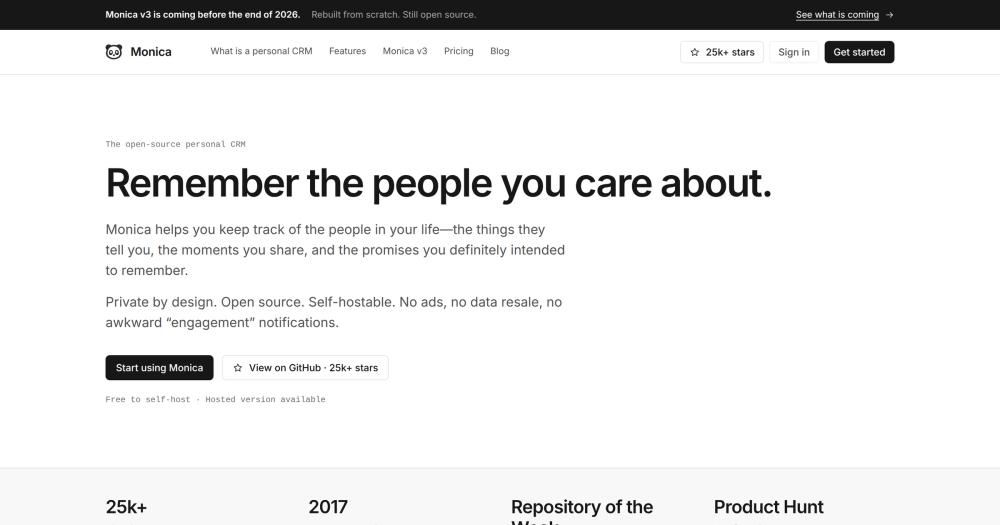
Image for Monica
TL;DR

Monica is an open source personal relationship management (PRM) system for documenting friendships and family relationships. It replaces paid tools like Clay and Dex for anyone whose goal is personal rather than professional networking, with self-hosting free under AGPL-3.0. The main branch is a beta of Monica v3, a full rewrite the maker says is due before the end of 2026 (monicahq.com); the stable version for self-hosting is the 4.x branch. Best for individuals who want a private, structured record of the people they care about.

Read the full breakdownHide the full breakdownWho it is for, how it works, trade-offs and the FAQ
who it's for

Who Monica is for#

People building a private record of personal relationships

Monica gives you one place to store everything you know about the people you care about: notes from conversations, birthdays, how you met, what their kids are named, and how they are doing. The records stay on your server when self-hosted.

Skip if:

You need professional contact enrichment, AI-driven networking insights, or integrations with business tools. Monica is not built for professional networking or career contact management.

People who have difficulty retaining personal details

Monica lets you record details about people that might be hard to retain naturally and surfaces reminders so you are not relying on memory for dates or follow-ups. The README explicitly names users with Asperger syndrome, Alzheimer's disease, and introverts as people who have found it valuable.

Skip if:

You need a lightweight mobile contacts app. Monica is a web application requiring self-hosting or a paid account; it is not a simple phone contacts replacement.

Developers who want an auditable personal data store

Running Monica on your own server means your relationship data stays entirely under your control. The AGPL-3.0 license makes the source auditable. The project commits to never tracking users and never running ads.

Skip if:

You prefer a managed service with no server maintenance. Monica's optional paid hosted plan at monicahq.com covers that need without requiring you to run your own server.

the problem

The problem it solves#

Most people track personal relationships through memory, scattered app notes, and reminders set when they happen to think of them. The problem is that memory is unreliable for the details that make relationships feel real: when someone's birthday is, what they told you last time you spoke, what their kids' names are, what struggles they are going through. Over time, the gap between what you know and what you remember widens.

Paid personal CRM tools like Clay, Dex, UpHabit, and Covve fill part of this gap, but they are hosted services with subscription fees. For people who want private, structured records of the people they care about, with no subscription and no third-party data handling, those paid options are not the answer.

how Monica solves it

How it solves it#

Contact records with relationship mapping

Track each contact's name, birthday, address, contact methods, and how you met them. Monica also lets you define relationships between contacts, so you can record that two friends know each other or that someone is a sibling of another contact in your vault.

Notes and activity logs

Attach notes to any contact and log activities to build a running record of what you discussed, what happened, and when. Notes are date-stamped and tied to the contact, making it straightforward to recall what was said six months ago.

Reminders and birthday tracking

Set reminders on any contact for dates, follow-ups, or recurring events. Birthday reminders are automatic: Monica tracks them from the birthday field and surfaces them before the date, so you do not need to remember to check.

Personal diary with day ratings

Monica includes a personal diary separate from contact records, with the ability to record how your day went. This sits alongside contact data so you can connect a good day with a conversation that made it that way, without mixing the two records.

Multiple vaults and 27 language support

Contacts are organized into vaults, letting you separate different groups (family, friends, colleagues) and optionally share a vault with another user. The interface is translated into 27 languages, covering international deployments.

Labels and custom activity types

Organize contacts with labels and define your own activity types so the records fit how you think about your relationships, not a preset structure imposed by the tool. Custom genders are also configurable.

strengths · trade-offs

Strengths and trade-offs#

Strengths

  • Privacy by default with no trackingMonica runs no ads, does not track users, and explicitly commits to never scanning user data. Self-hosting on your own infrastructure means your relationship records never leave your server. The README states this as a core design principle.
  • Free self-hosting under AGPL-3.0The AGPL-3.0 license means anyone can run Monica on their own server at no cost. Unlike paid tools like Clay and UpHabit, running Monica yourself has no subscription cost beyond the server itself.
  • Covers personal details paid tools skipMonica records pet names, how you met someone, custom activity types, a personal diary, and document uploads alongside contact records. These personal details are outside the scope of professional CRM tools, which focus on business relationships and networking.
  • Active project with 25,700 GitHub starsThe repo has 25,700 GitHub stars, was created in 2017, and was last updated in October 2026. The project is in active development with Monica v3, a full rewrite the maker says is due before the end of 2026 (monicahq.com), currently in beta on the main branch alongside the stable 4.x release.

Trade-offs

  • -Main branch is a beta rewriteThe main branch is Monica v3 in active development, a full rewrite the maker says is due before the end of 2026 (monicahq.com). The stable version is the 4.x branch. Users deploying from the main branch should expect rough edges; the 4.x branch is the production-ready path.
  • -725 open issues as of November 2026The issue tracker shows 725 open issues (excluding pull requests) as of November 2026. This is consistent with active use and feature requests, but also indicates known bugs and unimplemented features that have not yet been addressed.
  • -No built-in AI features, by designMonica has no AI integrations: it does not guess, enrich contacts, or suggest follow-ups. The README describes it as operating purely on explicit instructions. Users who want AI-driven contact enrichment or automated networking insights should consider Clay or Dex instead.
versus alternatives

Monica vs alternatives#

Monica vs Clay

Clay is the highest-profile paid alternative in Monica's category. Both tools help you track people you know, but they differ on hosting, cost, and openness. Monica is open source and self-hosted; Clay is a proprietary hosted service.

FeatureMonicaClay
LicenseAGPL-3.0Proprietary
HostingSelf-hosted or hosted planHosted service
PricingFree self-hosted / paid hostedPaid subscription

Monica is the better choice when you want personal relationship records on your own server: diary entries, notes, birthday reminders, pet names, and activity logs, all self-hosted at no cost. Clay is worth considering for users who prefer a fully managed service and are willing to pay a monthly subscription.

Monica vs Dex

Dex is a hosted personal CRM listed among Monica's paid alternatives. Like Clay, it is proprietary with no open source or self-hosting option. Monica's AGPL-3.0 license and self-hosting path make it the better fit for users who want full data control.

FeatureMonicaDex
LicenseAGPL-3.0Proprietary
HostingSelf-hosted or hosted planHosted service
PricingFree self-hosted / paid hostedPaid subscription

Dex may suit users who prefer a fully managed service with no server setup. Monica's optional paid hosted plan at monicahq.com covers that use case for those who prefer Monica's personal relationship model.

Monica vs UpHabit and Covve

UpHabit and Covve are both proprietary hosted personal CRM tools. Neither offers an open source or self-hosted path. Monica's self-hosted tier is free and keeps your data on your own server. UpHabit and Covve suit users who want a managed mobile-first experience; Monica's paid hosted plan at monicahq.com serves the same convenience need for users who want Monica's breadth of personal relationship features.

tech stack · detected from GitHub

What it's built on#

Languages
PHP
Frameworks
LaravelVue
frequently asked

FAQ#

Is Monica free to use?

Self-hosting Monica is free under the AGPL-3.0 license; you run it on your own server at no cost. An optional paid hosted plan is available at monicahq.com for those who prefer not to manage their own infrastructure. The README does not indicate any feature restrictions between self-hosted and hosted.

What is the difference between Monica and a business CRM?

Monica is a PRM (personal relationship manager), not a sales CRM. It is designed for tracking personal relationships with friends and family, not leads, pipelines, or business contacts. It records notes, activities, birthdays, diary entries, and personal details rather than deals or revenue metrics.

Which version of Monica should I deploy?

The 4.x branch is the stable release for self-hosting. The main branch is Monica v3, a full rewrite the maker says is due before the end of 2026 (monicahq.com); the README marks it as a beta. For a production self-hosted deployment, use the 4.x branch from https://github.com/monicahq/monica/tree/4.x.

What does the AGPL-3.0 license mean for self-hosters?

AGPL-3.0 is an OSI-approved open source license. Running Monica on your own server for private use, including internal team or household use, is fully permitted at no cost. The restriction applies only if you run a modified version of Monica as a service for third parties: you must then distribute your modifications under the same license.

Does Monica track or sell user data?

No. The README explicitly states Monica will never track users and will never be ad-supported. Self-hosting means your data stays on your own server. The project's design principles commit to transparency and to not doing anything with user data beyond what the user asks for.

also worth a look

Similar open-source tools#

Inbox Zero

Featured

Alternative toSuperhuman

AI email assistant that drafts replies and clears your inbox

  • 12,889 GitHub stars
  • AGPL-3.0Licence AGPL-3.0

Orbit Workspace

Alternative toLinear

Self-hosted team workspace: tasks, docs and chat in one binary.

  • 76 GitHub stars
  • Apache-2.0Licence Apache-2.0

TwinDesk

Alternative toSynergy

One mouse and keyboard for Mac, Windows, Linux and Android. No cloud.

  • 3,258 GitHub stars
  • GPL-3.0Licence GPL-3.0

Alexandrie

Alternative toNotion

Self-hosted knowledge base with offline sync, Kanban, and OIDC/SSO

  • 3,824 GitHub stars
  • MITLicence MIT

FreshRSS

Alternative toFeedly

Self-hosted RSS aggregator for news, podcasts, and video channels.

  • 16,495 GitHub stars
  • AGPL-3.0Licence AGPL-3.0

All In One

Alternative toDropbox

Full Nextcloud stack managed by one Docker container with auto-TLS.

  • 10,780 GitHub stars
  • AGPL-3.0Licence AGPL-3.0
by category

Open source tools in these categories#

241

Business & Productivity

OpenClaw, Excalidraw, RustDesk
140

Communication & Collaboration

freeCodeCamp, iptv, Excalidraw
Hostinger

Self-host Monica on a Hostinger VPS

Keep it running 24/7, even when your laptop is off. A Hostinger VPS gives it a server of its own.

  1. 01

    Choose a plan

    Starts from $6.49/mo

  2. 02

    Apply

    Extra 10% off yearly plans

  3. 03

    Install Monica

    On a server that stays on

  4. 04

    Start building

    Focus on the app, not the server

Deploy on Hostinger

Sponsors

Inbox Zero

Alternative toSuperhuman

AI email assistant that drafts replies and clears your inbox

  • 12,889 GitHub stars
  • AGPL-3.0Licence AGPL-3.0
  • #Email

rakazo

Alternative toGrok Bot

AI teammates you own: your keys, your model, your machine.

  • 6,568 GitHub stars
  • Apache-2.0Licence Apache-2.0
  • #AI Agents

SnitchFeed

Live monitoring on LinkedIn, X, Reddit & more. Agentic social listening for startups.

Marketing & Growth

Advertise your product

New open source projects by email

The projects we add and every new guide. Free, unsubscribe any time.

Find open source alternatives to paid software

/
  • Claude Code to OpenCode
  • Jira to Windshift
  • Notion to AppFlowy
  • Slack to Mattermost
  • Linear to GitLab
  • Wispr Flow to Handy
  • Arc to Zen Browser
  • CapCut to Concat
  • Grok Bot to rakazo
  • Superhuman to Inbox Zero
  • Airtable to AITable
  • Muse to OpenClaw
  • Railway to Coolify
  • GitHub Copilot to Cline
  • Datadog to Netdata
  • Microsoft Teams to Rocket.Chat
  • Confluence to Docmost
  • Pinecone to Qdrant
  • Zapier to n8n
  • Devin AI to OpenHands
  • Firebase to Supabase
  • 1Password to KeePassXC
  • Contentful to Strapi
  • Adobe Premiere Pro to Shotcut