

Who nodus is for#
Graduate researchers building a literature corpus
Nodus turns a Zotero collection or local PDF folder into a knowledge graph of claims, methods and findings, each linked to the exact page it came from. Deep Research surfaces a topic's findings, limitations and open questions as a saved report. The writing workshop produces drafts with citation links that open the source in one click.
Skip if:
Skip if the research workflow centers on quick PDF annotation and citation export with no interest in a structured knowledge layer. A simpler reference manager handles that task with less setup.
Teaching academics managing courses and assessment
The teaching vault covers academic year planning, timetables, course materials, gradebooks with reusable rubrics and exam building. AI generates teaching content, question banks and rubric structures without sending student names, grades or answers to a model. Non-numeric gradebook states (absent, pending) handle situations binary scores do not fit.
Skip if:
Skip if the primary need is a learning management system with assignment submission, group collaboration and institutional SSO integration. Nodus is not an LMS replacement.
Researchers who need a fully offline AI workflow
All AI features in Nodus work through Ollama or LM Studio, so the full research workflow including semantic search, Deep Research reports and writing copilots runs without sending documents to an external API. Researchers who handle sensitive, embargoed or unpublished material can keep the entire pipeline on their local machine.
Skip if:
Skip if cloud AI tools are already integrated into the workflow and offline operation is not a requirement. The setup cost of running a local model may not be worth it if data privacy is not a concern.
Historians and genealogists working with primary sources
The genealogy vault reconstructs family histories across a tree, timeline and map with GEDCOM import and export, each event tied to documentary evidence. The primary sources vault handles archival documents with OCR, transcription and provenance layers that keep what the document says separate from what the researcher infers.
Skip if:
Skip if the goal is sharing genealogical trees with public platforms like Ancestry or FamilySearch. Nodus does not connect to those services.
The problem it solves#
Academic research typically fragments across separate workflows: one tool for reference management, another for note-taking and a third for writing. The result is that the connection between a cited passage and the idea built from it lives only in the researcher's memory. When a bibliography grows to hundreds of papers, reconstructing why a particular argument relies on a particular source becomes a real problem.
Commercial reference managers like ReadCube Papers and Paperpile address the bibliographic half of this work but do not connect sources to the ideas they support. Researchers who want that connection typically maintain a separate note-taking system, which creates its own gap: the notes reference the sources but no machine-readable link runs back from a note to the passage it was drawn from.
How it solves it#
Evidence-anchored knowledge graph
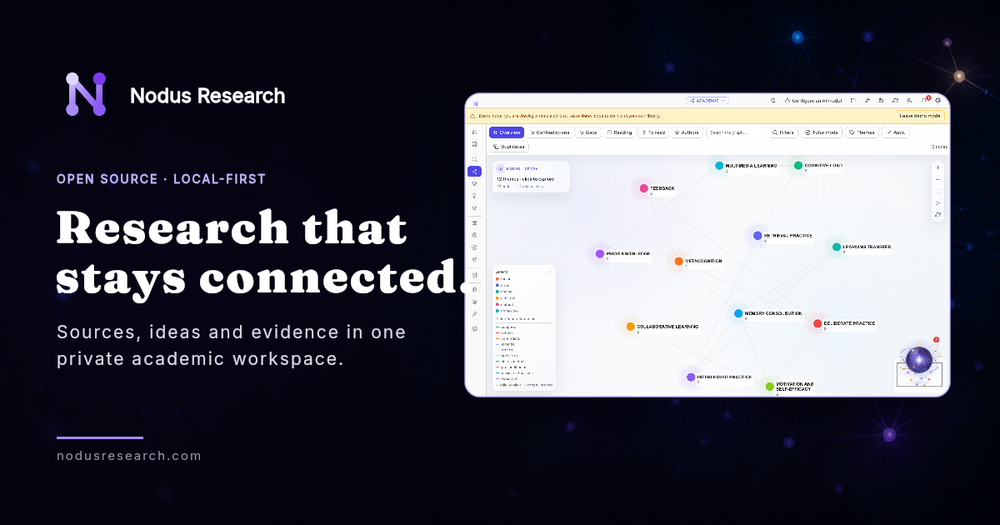
The academic vault links every note and idea to the exact passage and page that backs it up. Reading a corpus produces a connected graph of claims, findings and methods rather than a flat pile of annotations. Semantic search works across languages and surfaces debates, contradictions and research gaps from within the corpus you build.
Zotero integration and standalone Zotero plugin
Connect an existing Zotero library in read-only mode and build analytic and writing work on top of it without replacing your reference management workflow. A standalone Zotero plugin (XPI, supporting Zotero 9 and 10) brings Nodus semantic search into Zotero itself, indexing PDF, EPUB and HTML attachments for cross-attachment search grounded in exact passages.
Offline AI with local model support
AI features run through an API key of your choice or entirely offline via Ollama or LM Studio. Deep Research generates topic reports from your documents. Writing copilots for Word and LibreOffice produce drafts with verifiable citations. An MCP server is built in for tool-calling from external AI clients. Student grades and rosters never reach any model in the teaching vault.
Nine focused workspace vaults
Nodus organises work into nine vault types: academic (knowledge graph and writing workshop), teaching (course planning, gradebooks and rubrics), study (question banks, spaced review and flashcards from your materials), databases (typed tables with correlations, chi-square and regression analysis over actual rows), genealogy, primary sources, worldbuilding, testimony and prosopography. Each vault includes a demo mode with sample content.
Document toolkit built into every vault
The Nodus Toolkit converts files between formats, redacts and watermarks documents locally (Nodus Protect never sends content to an AI provider), translates text and Zotero attachments while preserving DOCX and EPUB layout, presents PDFs with a presenter view and speaker notes, and handles difficult OCR scans page by page before accepting them into a vault.
Strengths and trade-offs#
Strengths
- No accounts, subscriptions or telemetryNodus is free to download and run with no registration and no usage tracking. Vaults and search indexes stay on the local device. Encrypted auto-backups go to a folder the user chooses. The AGPL-3.0 license makes the source code publicly available, auditable and forkable without licensing fees.
- Works alongside Zotero without replacing itThe read-only Zotero connector preserves the existing Zotero database and collection hierarchy intact. The standalone Zotero plugin brings Nodus semantic search into the Zotero interface, so researchers who have built a Zotero library over years can add a knowledge-graph layer without migrating their data or changing their reference management workflow.
- Cross-platform desktop with no server setupInstalls from a single binary on macOS (Apple silicon and Intel), Windows 10 and 11, and Ubuntu/Debian, with an AppImage for other Linux distributions. No server to configure, no port forwarding, no external database. The optional Nodus Server (Docker-based, experimental) is for teams who want to share a vault, not a prerequisite for individual use.
- Full AI pipeline runs offlineOllama and LM Studio integration means the entire AI layer, including semantic search, Deep Research reports and writing copilots, runs without sending documents to an external API. Researchers who handle sensitive or unpublished material can keep the full pipeline on the local machine. An MCP server is built in for tool-calling from Claude, ChatGPT and other AI clients.
Trade-offs
- -Early project with a small contributor communityNodus was created in June 2026 and has 141 GitHub stars and 7 open issues at the time of writing. Feature gaps and rough edges are more likely in a tool this new than in established reference management tools with years of active use and larger contributor bases. The Zotero plugin and Nodus Server are both areas still under active development.
- -No automatic cloud sync without a self-hosted serverLocal-first storage means Nodus does not sync across devices automatically. The optional Nodus Server lets teams share vault content, but it is marked experimental and requires running Docker on a server. Researchers who move frequently between machines and need automatic multi-device sync without managing their own infrastructure will find this a genuine limitation compared to cloud-based reference managers.
- -AGPL-3.0 restricts commercial redistribution as a hosted serviceIndividuals and institutions can run Nodus locally for research, teaching and study with no restriction. If you run a modified version of Nodus as a managed service for paying customers, the AGPL-3.0 requires publishing your modifications. Personal use, internal institutional use and research use are unrestricted by the license terms.
nodus vs alternatives#
Nodus vs ReadCube Papers
ReadCube Papers is a commercial, cloud-based reference manager. Both Nodus and ReadCube Papers help researchers organize academic sources and read papers, but they differ in storage model, pricing and the depth of knowledge structuring available.
| Feature | Nodus | ReadCube Papers |
|---|---|---|
| License | AGPL-3.0 (free) | Proprietary (subscription) |
| Storage | Local device | Cloud |
| Knowledge graph | Yes | No |
| Offline AI | Yes (Ollama/LM Studio) | No |
Nodus suits researchers who want a knowledge-graph layer linking sources to ideas, full local storage and offline AI. ReadCube Papers suits those who prefer a cloud-based reading and annotation experience with no local setup. The choice comes down to whether source organization or source analysis is the primary need.
Nodus vs Paperpile
Paperpile is a cloud-based reference manager with subscription pricing. Both tools handle academic source organization, but Nodus adds a knowledge graph and local-first storage that Paperpile does not offer.
| Feature | Nodus | Paperpile |
|---|---|---|
| License | AGPL-3.0 (free) | Proprietary (subscription) |
| Storage | Local device | Cloud |
| Knowledge graph | Yes | No |
| Offline AI | Yes (Ollama/LM Studio) | No |
Paperpile is worth choosing when cloud sync across devices and a minimal-friction reference management workflow are the priority. Nodus suits researchers who want local data ownership, offline capability and a structured knowledge layer that maps how sources connect to the ideas they support.
Quick start#
Install Nodus on Ubuntu or Debian by downloading the DEB package from the latest GitHub release.
```bash
curl -LO https://github.com/Drakonis96/nodus/releases/latest/download/Nodus-linux-amd64.deb
sudo apt install ./Nodus-linux-amd64.deb
```What it's built on#
- Languages
- JavaScriptTypeScript
- Frameworks
- React
- Tooling
- esbuild
FAQ#
Is Nodus free to use?
Yes. Nodus is free to download and run with no accounts, subscriptions or usage limits. The AGPL-3.0 license makes the source code publicly available. AI features use your own API key or run locally via Ollama or LM Studio at no cost beyond the underlying hardware or API provider.
Does Nodus replace Zotero?
No. Nodus connects to an existing Zotero library in read-only mode and builds knowledge-graph and writing work on top of it without modifying or replacing the Zotero database. A standalone Zotero plugin also brings Nodus semantic search into the Zotero interface itself. Researchers keep their existing Zotero workflow and add Nodus alongside it.
Can I use Nodus without an internet connection?
Yes. All vaults and search indexes are stored locally. AI runs fully offline through Ollama or LM Studio, or with an API key when you choose to use one. The only network activity is what you initiate. There are no telemetry calls and no background sync.
What platforms does Nodus run on?
Nodus provides installers for macOS (Apple silicon and Intel), Windows 10 and 11, Ubuntu and Debian (DEB package), and other Linux distributions (AppImage). No server configuration is required: download the installer and open it to begin. A Zotero plugin (XPI) supports Zotero 9 and 10.
How is Nodus different from ReadCube Papers or Paperpile?
ReadCube Papers and Paperpile are commercial, cloud-based reference managers with subscription pricing. Nodus stores everything locally, runs AI offline, and adds a knowledge-graph layer that links ideas to their exact source passages, which paid reference managers do not offer. The trade-off is less polished PDF annotation and no automatic cloud sync without running the optional Nodus Server.
Similar open-source tools#

God's Eye View
Real-time global intelligence on a 3D globe

paperclip
Self-hosted AI agent management with org charts and budgets

OpenCode
OpenCode is an open-source AI coding agent that assists developers in

Claude-Red
78 offensive security skills for Claude, drop-in and MIT licensed

worktrunk
Git worktree management for parallel AI agents

pentagi
Autonomous AI agents for hands-free penetration testing