Open Source Alternatives
  • Alternatives
  • Categories
    Categories by size1,108 projects
    • Developer Tools558
    • AI & Machine Learning472
    • Business & Productivity271
    • Web Development208
    • Security & Monitoring171
    • Communication & Collaboration153
    • IT Management145
    • Cloud & Hosting127
    • LLMOps & AI Tooling123
    • Data & Analytics118
    Browse all 21 categoriesProduct & Project Management, DevOps & CI/CD and 9 more
  • Blog
  • Advertise
SearchNotion, Slack, password manager.../
Submit
Open Source Alternatives
  • Alternatives
    • Developer Tools558
    • AI & Machine Learning472
    • Business & Productivity271
    • Web Development208
    • Security & Monitoring171
    • Communication & Collaboration153
    • Browse all 21 categories
  • Blog
  • Advertise
Submit your project

New open source projects by email

The projects we add and every new guide. Free, unsubscribe any time.

Open Source Alternatives LogoOpen Source Alternatives

Handpicked Open Source Alternatives to Paid Softwares

Product

  • Categories
  • Tag
  • Advertise

Resources

  • Blog
  • Collection
  • Submit

Company

  • Privacy Policy
  • Terms of Service
  • Refund Policy
  • Sitemap

Alternatives

  • Claude Code
  • Jira
  • Notion
  • Slack
  • Linear
  • Wispr Flow
  • All alternatives
© 2026 Open Source Alternatives. All rights reserved.
Open SourceAlternatives
Home/Categories/Communication & Collaboration/Once Campfire
icon of Once Campfire

Once Campfire

Open source alternative to Slack, Basecamp, Google Chat and Twist

  • 4.8K stars
  • MIT
  • Active this week
  • Last commit today

Last verified Nov 5, 2026

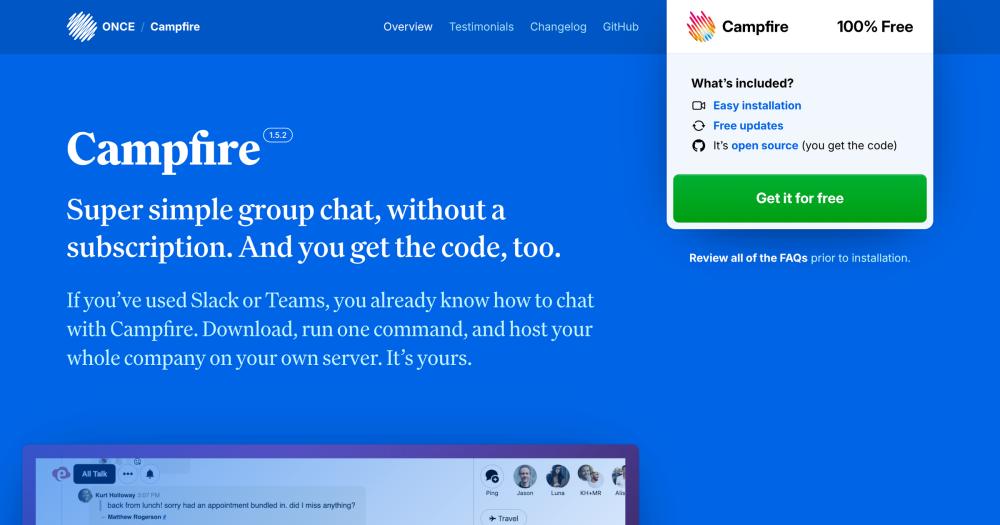
Run a self-hosted group chat for your team on your own server, MIT-licensed, with no subscription fees or recurring charges.

Visit websiteGitHub4.8K starsDeploy on Hostinger
image of Once Campfire
TL;DR

Once Campfire Campfire is a self-hosted group chat tool from 37signals, released under the MIT license. It replaces paid subscription services like Slack and Basecamp with a one-time server install, with no per-seat fees, no recurring charges, and full data ownership. The ONCE CLI installs it in one command on any Linux server or cloud provider. Best for small and medium teams that want to cut subscription costs, and for security-conscious organizations that need message history on their own infrastructure.

Read the full breakdownHide the full breakdownWho it is for, how it works, trade-offs, the quick start and the FAQ
who it's for

Who Once Campfire is for#

Teams switching from Slack or Basecamp

If your team uses Slack or Basecamp and wants to cut recurring costs, Campfire covers the core chat workflows: rooms, direct messages, search, file sharing, and mobile access. The switch requires a server and someone to run one command.

Skip if:

Teams that depend on Slack's app directory (GitHub, Jira, Salesforce integrations) or Basecamp's project management features (to-dos, check-ins, file storage, schedules) will find Campfire cannot replace those workflow automations.

Security and compliance teams needing on-premises chat

Campfire runs on your own infrastructure with all data stored locally. It supports air-gapped networks with no outside internet access, making it viable for regulated industries, government environments, and organizations with strict data residency requirements.

Skip if:

Teams that need built-in audit logs, e-discovery, or enterprise compliance certifications (SOC 2, HIPAA) will need to evaluate whether they can build those controls around a self-hosted MIT codebase.

Developers studying a production-grade Rails codebase

Campfire ships the full Ruby on Rails source code under the MIT license. The codebase includes reference implementations in Django, Laravel, Express, Elixir, Go, Rust, and C, each benchmarked against each other. It is a learning resource for teams building web applications or studying different language runtime performance.

Skip if:

Teams looking for reliable chat with minimal maintenance overhead will find the codebase focus is a poor fit. If you just want chat running and nothing to modify, pick a managed option.

the problem

The problem it solves#

Team chat tools should not charge every month forever. Slack's per-seat billing adds up fast. A 20-person team pays several hundred dollars a month; a 100-person team can pay thousands. Basecamp bundles chat into its project management subscription, tying communication costs to to-dos, file storage, and timelines that teams using a separate project tool do not need. Neither service lets you export and self-host your own conversation history.

The harder challenge is lock-in. All past messages, files, and search history live on vendor servers. If pricing changes, the service goes down, or the product shifts direction, teams have no path to their own data. Organizations in regulated industries or high-security environments often cannot use cloud-hosted services at all, leaving them with no viable option among the major commercial platforms.

how Once Campfire solves it

How it solves it#

ONCE CLI single-command install

Campfire installs on any Linux server with one curl command. The ONCE CLI handles the full setup, including initial configuration, SSL, and automatic daily updates. No separate orchestration tools or manual Docker configuration needed.

Multi-room chat with access controls

Create rooms for teams, projects, or topics and control who has access. Rooms display unreads at a glance, with private rooms limited to invited members and open rooms accessible to everyone in the organization.

Direct messages and @mentions

Every team member gets a direct messaging inbox alongside room access. @mentions notify specific people in any room. Previous searches are saved to the sidebar for quick access, and Web Push notifications work on desktop and mobile.

Mobile access via PWA

Campfire runs in the mobile browser as a Progressive Web App that can be added to a home screen and delivers push notification badges, matching native app behavior. No App Store distribution required.

HTTP API for chatbot integrations

Campfire exposes a simple HTTP API for sending and receiving messages and attachments. Teams can build internal bots and automations without a third-party integration marketplace. The API is documented in the GitHub repository.

Air-gapped and offline-capable deployment

Campfire runs on networks with no outside internet access, making it suitable for research facilities, secure government environments, and other high-security deployments where cloud-hosted services are not an option.

strengths · trade-offs

Strengths and trade-offs#

Strengths

  • MIT license with full source codeThe entire Campfire codebase is MIT-licensed and published on GitHub. Teams can fork it, modify it, and ship their own version commercially with no restrictions beyond attribution. Unlike proprietary chat services, the license does not expire or change with pricing tiers.
  • No subscription or per-seat billingOne install on your own server covers your entire organization. There are no recurring fees, no per-seat pricing tiers, and no contracts. The only ongoing cost is the server.
  • Single-container deployment at any scaleThe Docker image bundles the web app, background jobs, caching, file serving, and SSL into one container. A 2 GB server handles 250 concurrent users; the same architecture scales to 64 GB for 10,000 users, with no additional services to wire up.
  • Multiple language implementations availableBeyond the Rails (Ruby) reference implementation, Campfire has verified, shared-test implementations in Django, Laravel, Express, Elixir, Go, Rust, and C. Teams that prefer a different language runtime can run the same application with its own performance characteristics.

Trade-offs

  • -No native iOS or Android appsCampfire delivers mobile access as a Progressive Web App. It runs in the mobile browser and can be added to the home screen for push notifications and icon badges. Teams that require a dedicated App Store app will not find one, and the PWA does not support offline mode.
  • -No data import from Slack or BasecampCampfire does not support importing message history from Slack, Basecamp, or other chat services at this time. Past conversations, files, and search history stay in the old system. Teams switching to Campfire start with an empty history.
  • -Single-machine deployment onlyThe Docker image is designed for a single-machine deployment with no built-in clustering or high-availability configuration. Teams that need geographic redundancy or zero-downtime failover must build that layer themselves or accept the limitations of a single server.
versus alternatives

Once Campfire vs alternatives#

Campfire vs Slack

Both are web-based team chat with rooms, direct messages, file attachments, and mobile access. The key difference is pricing model: Slack charges per active user each month, while Campfire is a self-hosted install with no ongoing subscription.

FeatureCampfireSlack
LicenseMITProprietary
PricingFree (self-hosted)Per-seat subscription
Self-hostingYesNo
MobilePWANative apps (iOS/Android)
App integrationsHTTP APIExtensive marketplace
Data locationYour serverSlack's cloud

Campfire is the better choice when your team wants to eliminate recurring messaging costs and does not depend on Slack's integration marketplace. It covers basic chat without the complexity Slack has added over the years, and your message history stays on your own infrastructure. Slack is worth considering when native iOS/Android apps are required, or when your workflows depend on first-party integrations with Jira, Salesforce, GitHub, or similar services that Campfire's HTTP API cannot replicate without custom development.

Campfire vs Basecamp

Campfire and Basecamp are both from 37signals. Basecamp is a full project management and team communication platform; Campfire is a standalone group chat application. Where Basecamp bundles messaging alongside to-dos, file storage, schedules, and check-ins under a subscription, Campfire is chat only, free to self-host, and MIT-licensed.

FeatureCampfireBasecamp
LicenseMITProprietary
PricingFree (self-hosted)Per-team subscription
Self-hostingYesNo
ScopeChat onlyChat, tasks, files, schedules
Data locationYour serverBasecamp's cloud
MobilePWANative apps (iOS/Android)

Campfire is the right choice for teams that need only self-hosted chat and want to avoid a broader project management subscription. Teams already paying for Basecamp get messaging as part of the bundle; running Campfire alongside it only makes sense when on-premises message storage or data ownership is a hard requirement. Teams that rely on Basecamp's project management features (to-dos, check-ins, file storage, milestones) will not find them in Campfire.

install · quick start

Quick start#

bash
Install Campfire on your server by first setting up the ONCE CLI, then deploying Campfire.

```bash
curl https://get.once.com | sh
once deploy ghcr.io/basecamp/once-campfire --host chat.example.com
```
tech stack · detected from GitHub

What it's built on#

Languages
JavaScriptRuby
Frameworks
Rails
Databases
SQLite
Cache
Redis
frequently asked

FAQ#

How much does Campfire cost?

Campfire is free. The software is MIT-licensed and hosted on GitHub. You need a server to run it, which you pay for separately. The ONCE CLI and all future updates are provided at no charge by 37signals.

Can we import our message history from Slack or Basecamp?

No. Campfire does not support data import from Slack, Basecamp, or other chat services at this time. Switching to Campfire means starting fresh. Past message history stays in the old system unless you export and archive it separately before switching.

Does Campfire have native iOS and Android apps?

No native apps are published to the App Store or Google Play. Campfire is a Progressive Web App: it runs in the mobile browser and can be installed on the home screen for push notifications and icon badges. For most team chat use cases the PWA behaves like a native app, but it does not support offline mode.

How does Campfire handle software updates?

Each Campfire instance pings 37signals' server once a day to check for updates. When one is available, it downloads and installs automatically. Automatic updates can be disabled if you prefer to manage them manually.

Can Campfire run on a network with no internet access?

Yes. Since Campfire runs on your own server and the application itself does not require a connection to outside services, it works on air-gapped networks. This makes it suitable for research facilities, government environments, and other high-security deployments where cloud-hosted services are not permitted.

Looking for more

Other ways to replace Slack, Basecamp, Google Chat and Twist#

Buzz

Featuredfor Slack

Self-hosted team chat where people and AI agents work together

36,728 GitHub starsVisit

Mattermost

#1 in the Slack guide

Closest drop-in Slack replacement for self-hosted teams

39,524 GitHub stars

Rocket.Chat

#2 in the Slack guide

Teams needing internal chat and customer omnichannel in one tool

46,371 GitHub stars

Zulip

#3 in the Slack guide

Async-first teams that need organized, low-noise conversations

26,171 GitHub stars
All 18 Slack alternatives8 open source Slack alternatives, ranked
by category

Open source tools in these categories#

153

Communication & Collaboration

freeCodeCamp, iptv, Excalidraw
271

Business & Productivity

OpenClaw, Excalidraw, RustDesk
Hostinger

Self-host Once Campfire on a Hostinger VPS

Keep it running 24/7, even when your laptop is off. A Hostinger VPS gives it a server of its own.

  1. 01

    Choose a plan

    Starts from $6.49/mo

  2. 02

    Apply

    Extra 10% off yearly plans

  3. 03

    Install Once Campfire

    On a server that stays on

  4. 04

    Start building

    Focus on the app, not the server

Deploy on Hostinger

Sponsors

Inbox Zero

Alternative toSuperhuman

AI email assistant that drafts replies and clears your inbox

  • 12,889 GitHub stars
  • AGPL-3.0Licence AGPL-3.0
  • #Email

rakazo

Alternative toGrok Bot

AI teammates you own: your keys, your model, your machine.

  • 7,028 GitHub stars
  • Apache-2.0Licence Apache-2.0
  • #AI Agents

SnitchFeed

Live monitoring on LinkedIn, X, Reddit & more. Agentic social listening for startups.

Marketing & Growth

Advertise your product

New open source projects by email

The projects we add and every new guide. Free, unsubscribe any time.

Find open source alternatives to paid software

/
  • Claude Code to OpenCode
  • Jira to Windshift
  • Notion to AppFlowy
  • Slack to Mattermost
  • Linear to GitLab
  • Wispr Flow to Handy
  • Arc to Zen Browser
  • CapCut to Concat
  • Grok Bot to rakazo
  • Superhuman to Inbox Zero
  • Airtable to AITable
  • Muse to OpenClaw
  • Railway to Coolify
  • GitHub Copilot to Cline
  • Datadog to Netdata
  • Confluence to Wiki.js
  • Microsoft Teams to Rocket.Chat
  • Firebase to Supabase
  • Pinecone to Qdrant
  • Zapier to n8n
  • 1Password to KeePassXC
  • Devin AI to OpenHands
  • Asana to Leantime
  • Contentful to Strapi