Open Source Alternatives
  • Alternatives
  • Categories
    Categories by size1,108 projects
    • Developer Tools558
    • AI & Machine Learning472
    • Business & Productivity271
    • Web Development208
    • Security & Monitoring171
    • Communication & Collaboration153
    • IT Management145
    • Cloud & Hosting127
    • LLMOps & AI Tooling123
    • Data & Analytics118
    Browse all 21 categoriesProduct & Project Management, DevOps & CI/CD and 9 more
  • Blog
  • Advertise
SearchNotion, Slack, password manager.../
Submit
Open Source Alternatives
  • Alternatives
    • Developer Tools558
    • AI & Machine Learning472
    • Business & Productivity271
    • Web Development208
    • Security & Monitoring171
    • Communication & Collaboration153
    • Browse all 21 categories
  • Blog
  • Advertise
Submit your project

New open source projects by email

The projects we add and every new guide. Free, unsubscribe any time.

Open Source Alternatives LogoOpen Source Alternatives

Handpicked Open Source Alternatives to Paid Softwares

Product

  • Categories
  • Tag
  • Advertise

Resources

  • Blog
  • Collection
  • Submit

Company

  • Privacy Policy
  • Terms of Service
  • Refund Policy
  • Sitemap

Alternatives

  • Claude Code
  • Jira
  • Notion
  • Slack
  • Linear
  • Wispr Flow
  • All alternatives
© 2026 Open Source Alternatives. All rights reserved.
Open SourceAlternatives
Home/Categories/No-Code & Low-Code/OpnForm
icon of OpnForm

OpnForm

Open source alternative to Typeform, Jotform, Tally, Fillout, Paperform, Cognito Forms, Gravity Forms and Formstack

  • 4K stars
  • AGPL-3.0
  • Active this week
  • Last commit today

Last verified Nov 5, 2026

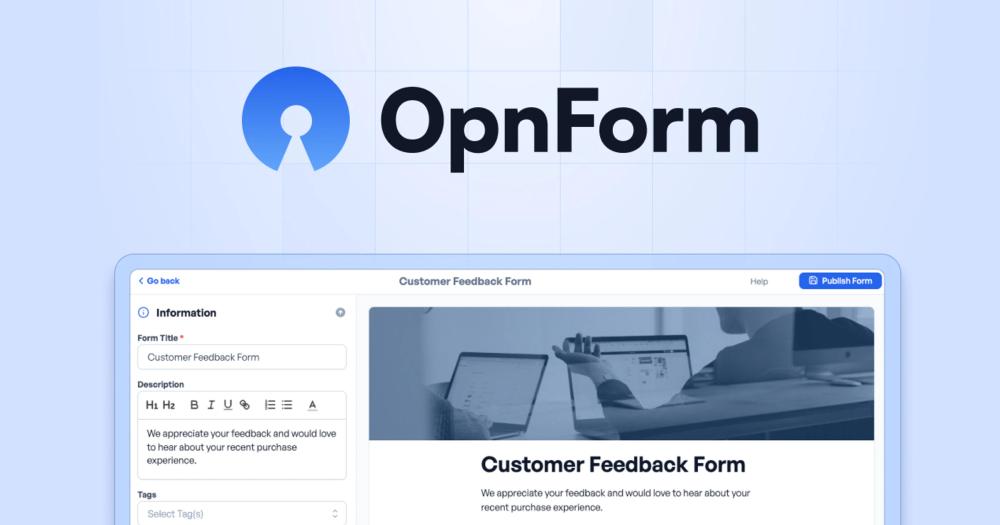
Build self-hosted online forms with unlimited submissions, conditional logic, and multi-page layouts under the AGPL-3.0 license.

Visit websiteGitHub4K starsDeploy on Hostinger
image of OpnForm
TL;DR

OpnForm is a no-code form builder that removes response caps and subscription lock-in from commercial form tools. It replaces Typeform, Jotform, and similar paid services with an AGPL-3.0 self-hosted option that supports unlimited forms and submissions even on the free cloud tier. The form editor supports conditional logic, multi-step layouts, file uploads, Stripe payment collection, and native integrations with Slack, Google Sheets, and Zapier. Best for small-to-midsize teams that need data ownership, EU hosting for GDPR compliance, or workflow automation without per-response fees.

Read the full breakdownHide the full breakdownWho it is for, how it works, trade-offs, the quick start and the FAQ
who it's for

Who OpnForm is for#

SaaS teams building onboarding and feedback forms

OpnForm's conditional logic and answer piping let teams build multi-step onboarding flows that adapt to each user's answers. Webhook and Zapier integrations push completed submissions directly into CRM or project management tools without custom backend code.

Skip if:

Teams needing forms deeply embedded in a React or Vue application with fully custom-designed field components. OpnForm provides embeds and an API, but the form renderer is its own UI; custom-component form libraries are a better fit for that use case.

Privacy-first organizations with GDPR requirements

Self-hosted deployment keeps all form responses on the organization's own servers, with no third-party data processing. The EU cloud option provides data residency for teams that cannot self-host. Combined with 2FA and submission audit logs (enterprise edition), this covers common compliance requirements.

Skip if:

Teams operating under compliance regimes that require audited third-party certification such as SOC 2 Type II on the form provider. OpnForm's SOC 2 compliance is noted as underway, not yet completed at time of writing.

Developers building form-driven data pipelines

The REST API exposes form submission retrieval, creation, and management. The MCP server integration lets AI agents create form drafts via OAuth. Webhooks forward each submission to any HTTP endpoint in real time, covering the standard pattern of form-in, database or workflow out.

Skip if:

Developers building forms where complex client-side validation, offline support, or deeply custom field types are required. OpnForm's field set is broad but fixed; custom field types require forking the codebase.

Small businesses replacing Typeform to remove response caps

Typeform's Basic plan limits responses to 100 per month at $39/month (typeform.com/pricing, November 2026). OpnForm's free cloud plan removes that cap, with no per-response charges at any volume. The form editor supports the same conversational multi-step layout Typeform offers, so migrating existing forms requires minimal redesign.

Skip if:

Teams that depend on Typeform's native HubSpot, Salesforce, or Intercom integrations. OpnForm offers Zapier and webhook coverage for these but does not provide direct native integrations with every CRM Typeform supports.

the problem

The problem it solves#

Most form tools cap submissions by plan tier. Typeform's Basic plan ($39/month) allows 100 responses per month; the Business plan at $129/month raises this to 10,000 (typeform.com/pricing, November 2026). Jotform's Bronze plan ($39/month) allows 1,000 monthly submissions; the Gold plan at $129/month allows 10,000 (jotform.com/pricing, November 2026). Both platforms lock features like conditional logic and file uploads behind higher pricing brackets.

Teams building contact forms for a growing product, survey flows for user research, or onboarding sequences for new customers end up paying for plan upgrades the moment they gain traction. Data also sits on the vendor's servers, with no export path that keeps the full submission history portable. Teams subject to GDPR or internal data policies have limited options when their form data lives on US-based commercial platforms with no self-hosting path.

how OpnForm solves it

How it solves it#

No-Code Form Builder with Drag-and-Drop Editor

Design forms by dragging in fields including text, date, URL, file uploads, signatures, and payment blocks. Forms support single-page and multi-step layouts, with Typeform-style conversational flow or classic stacked designs. Themes, brand colors, and custom fonts are available on paid plans.

Conditional Logic and Answer Piping

Show or hide fields based on prior answers, redirect to different pages on submit, and pipe earlier responses into later questions. Computed fields and hidden fields support pre-filling from URL parameters, letting forms adapt to each respondent without additional code.

Native Integrations with Slack, Zapier, and Stripe

Send form submissions directly to Slack and Discord channels, sync responses to Google Sheets, trigger Zapier workflows, and collect payments through Stripe. A REST API and webhook support connect OpnForm to any service not covered by the native integrations.

AI-Assisted Form Creation and MCP Server

An AI mode helps draft form questions and structure from a text prompt. The MCP server lets AI agents create and preview private form drafts without requiring a login, with OAuth adding workspace-aware form management, submission search, and export for authenticated use cases.

Self-Hosted or EU-Hosted Deployment

Deploy on your own infrastructure using Docker and a Postgres database. Teams that need EU data residency for GDPR compliance can use OpnForm's EU-based cloud hosting option instead. Both paths deliver the same form builder without response limits.

Form Analytics and PDF Template Mapping

Track view counts and completion rates per form through built-in analytics. PDF template fields allow mapping form responses to fillable PDF layouts for document generation. Submissions are searchable, exportable to spreadsheets, and display file attachments inline.

strengths · trade-offs

Strengths and trade-offs#

Strengths

  • Unlimited Submissions on the Free Cloud TierUnlike Typeform and Jotform, OpnForm's free cloud plan does not cap the number of responses a form can receive. Teams collecting survey data, running lead generation campaigns, or gathering feedback do not face forced plan upgrades when submission volumes grow.
  • AGPL-3.0 Core with Auditable Source CodeThe core application is published under AGPL-3.0 on GitHub (3,985 stars, active development as of November 2026). The license grants full freedom to run, modify, and deploy the application for internal use. Source-offer obligations apply only to network deployments of modified versions offered to external users.
  • EU Hosting and GDPR-Friendly ArchitectureOrganizations subject to GDPR or data residency requirements can use OpnForm's EU-based cloud option. Self-hosted deployments keep all submission data on the operator's own servers. The enterprise edition adds SSO, SAML, 2FA support, and form-level audit logs for compliance reporting.
  • Active Development with Low Issue CountThe repository records consistent commit activity, with the last push on November 4, 2026. Only 16 open issues (pull requests excluded) indicates a well-maintained issue tracker relative to 3,985 stars and 580 forks. Security dependency audits run weekly through Dependabot across PHP, Node, and GitHub Actions.

Trade-offs

  • -Enterprise Features Require a Commercial LicenseSSO, SAML, white-labeling, priority support, and advanced audit log features are part of the OpnForm Enterprise edition, which requires a paid subscription for production use. Development and testing copies of the enterprise features are free. Organizations that need these features cannot access them under the AGPL-3.0 core alone.
  • -AGPL-3.0 Source-Offer Obligation for Modified Network DeploymentsRunning a modified version of OpnForm as a network service (for example, as a hosted form product offered to others) triggers the AGPL-3.0 source-offer requirement: modified source must be made available to users of that service. Teams running OpnForm internally for their own staff and customers are not affected by this obligation.
  • -Self-Hosting Requires Multiple ServicesA production self-hosted deployment involves a PHP/Laravel API container, a Nuxt client, and a Postgres database composed together. Teams expecting a single-container install will need to follow the official deployment guide at docs.opnform.com/deployment rather than a one-line Docker command.
versus alternatives

OpnForm vs alternatives#

OpnForm vs Typeform

Both tools offer conversational multi-step form experiences, but they differ on data ownership and pricing model. Typeform is a commercial platform with no self-hosting option; OpnForm is AGPL-3.0 licensed with both cloud and self-hosted deployment.

FeatureOpnFormTypeform
LicenseAGPL-3.0 (core)Proprietary
Self-hostingYesNo
Response limitUnlimited100/month on Basic ($39/mo)
Conditional logicYesYes (paid plans)
Payment collectionStripe (native)Stripe (native)
AI form creationYesYes
Custom domainYes (paid)Yes (paid)

OpnForm is the better choice when response volume matters. Typeform's Basic plan caps responses at 100 per month ($39/month), Plus at 1,000 ($79/month), and Business at 10,000 ($129/month) (typeform.com/pricing, November 2026). OpnForm's free cloud plan has no response cap. Teams self-hosting OpnForm keep all submission data on their own servers.

Typeform remains the better fit when deep integrations with HubSpot, Salesforce, or Intercom are a hard requirement. Typeform's native integration library is larger than OpnForm's, though OpnForm covers most of the same targets through Zapier. Typeform also has a longer track record and a larger existing user community.

OpnForm vs Jotform

Jotform covers a broader set of form types including payment forms, approval workflows, and document signing. OpnForm focuses on data collection forms with automation integrations. The key difference is the deployment model: Jotform is cloud-only and commercial; OpnForm is self-hostable under AGPL-3.0.

FeatureOpnFormJotform
LicenseAGPL-3.0 (core)Proprietary
Self-hostingYesNo
Response limitUnlimited100/month on Starter (free)
Conditional logicYesYes
Payment collectionStripeStripe, PayPal, 30+ gateways
White-labelingEnterprise tierYes (paid plans)
Form analyticsYesYes

OpnForm is a better fit for teams that need unlimited free submissions or data residency that Jotform's US-based cloud cannot provide. Jotform's free Starter plan allows 100 monthly submissions; paid Bronze starts at $39/month for 1,000 submissions, and Gold at $129/month for 10,000 (jotform.com/pricing, November 2026). For organizations with strict GDPR requirements, OpnForm's EU cloud or self-hosted path is a practical option where Jotform's cloud is not.

Jotform has a significantly larger template library and supports more payment gateways (30+ versus Stripe only) compared to OpnForm. Teams running complex approval workflows or document generation pipelines at scale will find Jotform's feature set broader. The tradeoff is vendor lock-in and no self-hosting path.

install · quick start

Quick start#

bash
Self-hosting uses Docker with a Postgres database; the full docker-compose configuration is in the official deployment guide.

```bash
docker pull jhumanj/opnform-api
```
tech stack · detected from GitHub

What it's built on#

Languages
JavaScriptPHPPythonTypeScript
Frameworks
LaravelNuxtVue
Tooling
esbuild
frequently asked

FAQ#

Is OpnForm free to self-host?

Yes. The core application is AGPL-3.0 licensed, which allows self-hosting at no cost, including internal commercial and team use. Running the core on your own servers for your organization is unrestricted. The only obligation is a source-offer requirement if you run a modified version as a service others access over a network. Enterprise features under api/app/Enterprise/ require a commercial OpnForm Enterprise subscription for production use; development and testing copies are free.

What is the difference between the AGPL-3.0 core and the Enterprise license?

The core form builder is AGPL-3.0: you can self-host, modify, and run it for your organization at no cost. The Enterprise edition covers advanced features such as SSO, SAML, white-labeling, priority support, and form audit logs. Those features live under api/app/Enterprise/ and require a paid OpnForm Enterprise subscription for production use; development and testing copies are free.

Can OpnForm collect payments inside a form?

Yes. OpnForm integrates with Stripe for payment collection. A payment block can be added to any form to charge the respondent before or after submission. Stripe connection is configured in the integrations settings.

How does OpnForm handle file uploads in submissions?

File upload fields are supported out of the box. Uploaded files are stored as references in the submission and are accessible via signed, time-limited download URLs. When a file field is prefilled in the form editor, a copy is made for each submission rather than sharing a single upload. Files can be exported with the submission data.

Does OpnForm support embedding forms on a website?

Yes. Forms can be embedded on any website using a standard script embed, shared via a direct link, added to Notion pages, or distributed with a QR code for offline collection. Custom domains are supported, letting the form URL match your brand. All embed types deliver the same unlimited-submission experience.

also worth a look

Similar open-source tools#

HeyForm

Alternative toTypeform

Open source form builder with conversational UI

  • 9,063 GitHub stars
  • AGPL-3.0Licence AGPL-3.0

LimeSurvey

Alternative toSurveyMonkey

Open source survey platform for complex questionnaires

  • 3,787 GitHub stars
  • GPL-2.0Licence GPL-2.0

FckSignups

InCustomer Support

Open-source tools that work instantly, no signup required

  • 4,539 GitHub stars
  • GPL-3.0Licence GPL-3.0

OpenCompany

Alternative toMicrosoft Copilot Studio

Self-hosted AI agent canvas for every business function

  • 1,058 GitHub stars
  • MITLicence MIT

WordPress

Alternative toWix

Open source CMS with a block editor, 60,000+ plugins, and 40% market share.

  • 21,523 GitHub stars
  • GPL-2.0Licence GPL-2.0

Ycode

Alternative toWebflow

Open source visual website builder with no-code CMS

  • 336 GitHub stars
  • MITLicence MIT
by category

Open source tools in these categories#

40

No-Code & Low-Code

n8n, dify, Langflow
271

Business & Productivity

OpenClaw, Excalidraw, RustDesk
208

Web Development

freeCodeCamp, Skills for Real Engineers, superpowers
Hostinger

Self-host OpnForm on a Hostinger VPS

Keep it running 24/7, even when your laptop is off. A Hostinger VPS gives it a server of its own.

  1. 01

    Choose a plan

    Starts from $6.49/mo

  2. 02

    Apply

    Extra 10% off yearly plans

  3. 03

    Install OpnForm

    On a server that stays on

  4. 04

    Start building

    Focus on the app, not the server

Deploy on Hostinger

Sponsors

Inbox Zero

Alternative toSuperhuman

AI email assistant that drafts replies and clears your inbox

  • 12,889 GitHub stars
  • AGPL-3.0Licence AGPL-3.0
  • #Email

rakazo

Alternative toGrok Bot

AI teammates you own: your keys, your model, your machine.

  • 7,028 GitHub stars
  • Apache-2.0Licence Apache-2.0
  • #AI Agents

SnitchFeed

Live monitoring on LinkedIn, X, Reddit & more. Agentic social listening for startups.

Marketing & Growth

Advertise your product

New open source projects by email

The projects we add and every new guide. Free, unsubscribe any time.

Find open source alternatives to paid software

/
  • Claude Code to OpenCode
  • Jira to Windshift
  • Notion to AppFlowy
  • Slack to Mattermost
  • Linear to GitLab
  • Wispr Flow to Handy
  • Arc to Zen Browser
  • CapCut to Concat
  • Grok Bot to rakazo
  • Superhuman to Inbox Zero
  • Airtable to AITable
  • Muse to OpenClaw
  • Railway to Coolify
  • GitHub Copilot to Cline
  • Datadog to Netdata
  • Confluence to Wiki.js
  • Microsoft Teams to Rocket.Chat
  • Firebase to Supabase
  • Pinecone to Qdrant
  • Zapier to n8n
  • 1Password to KeePassXC
  • Devin AI to OpenHands
  • Asana to Leantime
  • Contentful to Strapi