Open Source Alternatives
  • Alternatives
  • Categories
    Categories by size1,012 projects
    • Developer Tools517
    • AI & Machine Learning447
    • Business & Productivity232
    • Web Development203
    • Security & Monitoring150
    • Communication & Collaboration138
    • IT Management135
    • Cloud & Hosting119
    • LLMOps & AI Tooling116
    • Data & Analytics111
    Browse all 21 categoriesProduct & Project Management, Design & Creative and 9 more
  • Blog
  • Advertise
SearchNotion, Slack, password manager.../
Submit
Open Source Alternatives
  • Alternatives
    • Developer Tools517
    • AI & Machine Learning447
    • Business & Productivity232
    • Web Development203
    • Security & Monitoring150
    • Communication & Collaboration138
    • Browse all 21 categories
  • Blog
  • Advertise
Submit your project

New open source projects by email

The projects we add and every new guide. Free, unsubscribe any time.

Open Source Alternatives LogoOpen Source Alternatives

Handpicked Open Source Alternatives to Paid Softwares

Product

  • Categories
  • Tag
  • Advertise

Resources

  • Blog
  • Collection
  • Submit

Company

  • Privacy Policy
  • Terms of Service
  • Refund Policy
  • Sitemap

Alternatives

  • Claude Code
  • Jira
  • Notion
  • Slack
  • Linear
  • Wispr Flow
  • All alternatives
© 2026 Open Source Alternatives. All rights reserved.
Open SourceAlternatives
Home/Categories/Data & Analytics/Virling
icon of Virling

Virling

Open source alternative to Cometly

  • 2 stars
  • AGPL-3.0
  • Active this week
  • Last commit today

Last verified Nov 1, 2026

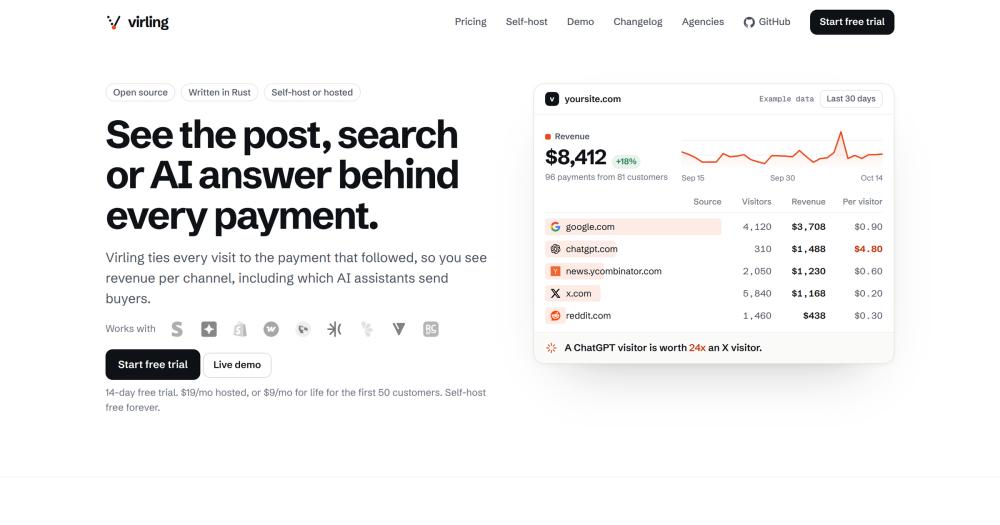
Track revenue per marketing channel with a single Rust binary; ties each Stripe, Paddle, or Polar payment to the visit that brought it.

Visit websiteGitHub2 starsDeploy on Hostinger
image of Virling
TL;DR

Virling is an open-source revenue attribution tool that joins each payment to the visit before it, showing revenue and revenue per visitor by channel, referrer, and campaign. It replaces paid platforms like Cometly by running as a single Rust binary with embedded storage, connecting to Stripe, Polar, and Dodo Payments with read-only keys. Self-hosting is free under AGPL-3.0 and runs without an external database. Best for SaaS founders and indie hackers who want to know which channel brings paying customers.

Read the full breakdownHide the full breakdownWho it is for, how it works, trade-offs, the quick start and the FAQ
who it's for

Who Virling is for#

SaaS founders tracking Stripe revenue by channel

Virling reads Stripe with a read-only key, runs a 90-day backfill, and polls every minute. The dashboard shows which traffic source is worth the most per visitor, which is the number a founder needs to decide where to spend time posting or advertising. Payment journeys are clickable.

Skip if:

If your primary goal is funnel analysis, session replay, or A/B testing rather than channel-level revenue attribution, a general-purpose product analytics tool covers more ground.

Indie hackers wanting self-hosted attribution with no subscription

One Docker command stands up the full tool with no Postgres or Redis. Data stays on your server, there is no monthly subscription for self-hosters, and the AGPL-3.0 license allows personal and commercial use. The install guide is at docs.virling.com.

Skip if:

If your payment processor is not in the supported list (Stripe, Polar, Dodo Payments, LemonSqueezy, Creem, RevenueCat, Paddle, Shopify, WooCommerce), the payment attribution side will not connect.

Agencies reporting channel attribution to clients

One Virling account handles all client sites. A branded weekly email report goes to each client every Monday showing which channels brought paying customers. The agency view gives a multi-site dashboard.

Skip if:

If clients need granular funnel analysis, multi-touch attribution across paid ad platforms, or session replay, Virling's channel-level revenue view does not cover those needs.

Teams using AI assistants for revenue reporting

Virling ships an MCP server and a CLI, so any assistant with MCP access can query revenue data. Hosted Virling is listed in the Claude directory, and the MCP server installs as a Claude Code plugin. You can ask which channel brought the most revenue last month without opening a dashboard.

Skip if:

If your team does not use AI assistants for reporting, this feature adds no value; the web dashboard covers the same data.

the problem

The problem it solves#

Standard web analytics count pageviews and sessions, but they cannot know which visit led to a payment. You can see that your X post brought 500 visitors, but not whether any of them bought. The number that matters, revenue per channel, stays hidden behind a join that most analytics tools never make.

Building this yourself means logging visitor IDs into your payment provider at checkout, storing them alongside payments, and writing the join query. For a solo founder or a small team, that is weeks of engineering to build and maintain. Existing hosted attribution tools that do it are subscription services with no self-hosting path, and your payment data stays on their servers.

how Virling solves it

How it solves it#

Revenue per channel and per visitor

Connects each payment to the visit before it using a visitor ID passed through checkout. The dashboard shows revenue, revenue per visitor, and conversion rate for every channel, referrer, page, country, and UTM campaign. The last non-direct channel gets the credit by default; you can switch to first touch and set the lookback window to 30, 60, 90, or 365 days.

Single binary with no external database

Ships as one Rust binary with embedded DuckDB for events and SQLite for settings. No Postgres, ClickHouse, or Redis is required. Runs on Linux x86_64, arm64, macOS, or Docker. A backup is copying one folder.

Payment provider integrations with read-only keys

Connects to Stripe, Paddle, Shopify, WooCommerce, Dodo Payments, Polar, LemonSqueezy, Creem, and RevenueCat. Stripe, Polar, and Dodo Payments use restricted, read-only API keys. LemonSqueezy, Creem, and RevenueCat add a webhook. Virling never creates, modifies, or refunds payments.

AI assistant visibility tracking

Every week Virling asks ChatGPT, Claude, Perplexity, and Gemini the questions your buyers ask, with web search on, and records whether they name your product, where you rank, and which pages they cite. Included on paid hosted plans; self-hosting uses your own API keys.

Agency multi-site reporting with custom branding

One account manages all client sites. A weekly email report goes to each client under your brand every Monday, showing which channels brought paying customers. An optional public dashboard is available per site.

Tracked short links for post and campaign revenue

Tag each post, newsletter, or campaign with a Virling link. The dashboard shows how much revenue that specific link earned, so you can compare individual posts or campaigns by actual money generated rather than click count.

strengths · trade-offs

Strengths and trade-offs#

Strengths

  • No database server requiredDuckDB stores events and SQLite stores settings, both embedded in the binary. This removes the setup work and ongoing cost of running a Postgres or ClickHouse instance, which nearly every competing attribution tool requires.
  • Cookieless mode for consent-banner-free sitesA daily-rotating salted hash replaces the first-party cookie for sites that need no consent banner. Events and channel data still collect; the tradeoff is that new payments cannot be linked to visits, landing as Unattributed. Visitor IPs are never stored in any mode.
  • Read-only payment integrationsStripe, Polar, and Dodo Payments connect with restricted, read-only API keys. Virling cannot create, change, or refund anything. LemonSqueezy keys cannot be restricted to read-only at the provider level, but Virling itself only reads.
  • MCP server and CLI for AI-assisted revenue queriesVirling ships an MCP server and a virling query CLI. Any AI assistant with MCP access can query revenue data directly, and hosted Virling is listed in the Claude directory. Revenue attribution becomes a data source for your AI tooling, not a separate dashboard to open.

Trade-offs

  • -Early development: 24 open issues, breaking changes expectedThe README flags this as early development and warns to expect breaking changes until a stable release. The project was created in October 2026 and has 24 open issues. Self-hosters who follow updates should read release notes before upgrading.
  • -AGPL-3.0 restricts running a hosted service on modified codeYou can self-host Virling for your own SaaS, your team, or client work without restriction, including internal commercial use. If you modify the code and run the modified version as a hosted service for outside users, AGPL-3.0 requires sharing those changes. Offering a white-label hosted Virling service is not permitted without satisfying that requirement.
  • -Cookieless mode breaks payment-to-visit linkingWhen you enable cookieless mode, payments still count toward revenue totals but cannot be linked to the visit that preceded them. They land as Unattributed in the dashboard. Attribution quality is lower whenever the first-party cookie is absent.
versus alternatives

Virling vs alternatives#

Virling vs Cometly

Both tools attribute revenue to marketing channels, but they differ in deployment model and license. Virling is open source under AGPL-3.0 and self-hostable; Cometly is a proprietary hosted platform.

FeatureVirlingCometly
LicenseAGPL-3.0Proprietary
Self-hostingYes, free foreverNo
Source codePublic on GitHubClosed
Data residencyYour serverHosted cloud

Virling is the better fit when data ownership, no subscription fees, and self-hosted deployment are the priorities. It connects to Stripe, Polar, Dodo Payments, and several other payment providers with read-only keys, and runs on a single Docker command with no external database. The AGPL-3.0 license permits self-hosting for personal and commercial use, including client work.

Cometly is worth considering for teams that need a fully managed service with no server administration. As a hosted platform, it handles updates, uptime, and infrastructure on your behalf. Virling is in early development, with breaking changes expected until a stable release, so teams that require production stability today may prefer a managed option while Virling matures.

install · quick start

Quick start#

bash
Self-hosting uses Docker with embedded DuckDB and SQLite storage.

```bash
docker run -d --name virling -p 8080:8080 -v virling-data:/data \
  -e VIRLING_BASE_URL=https://stats.example.com \
  ghcr.io/virling/virling:latest serve --app
docker exec virling virling add-site yourdomain.com --owner [email protected]
```
tech stack · detected from GitHub

What it's built on#

Languages
JavaScriptRust
frequently asked

FAQ#

Is Virling free to self-host?

Yes. The self-hosted path is free forever under AGPL-3.0. You run the binary on your own server and keep all your data with no recurring fees. The hosted plan at app.virling.com starts with a 14-day free trial at $19 per month.

Does Virling store visitor IP addresses?

No. The README states that visitor IPs are never stored. The tracking script assigns a first-party visitor ID (or a daily-rotating salted hash in cookieless mode) without recording the IP.

What payment providers does Virling support?

Stripe, Paddle, Shopify, WooCommerce, Dodo Payments, Polar, LemonSqueezy, Creem, and RevenueCat. Stripe, Polar, and Dodo Payments connect with read-only keys and include a 90-day backfill. LemonSqueezy, Creem, and RevenueCat add a webhook for payment events.

What does the AGPL-3.0 license permit for self-hosters?

You can self-host Virling for your own SaaS, your team, or client work without restriction, including internal commercial use. If you modify the code and run the modified version as a hosted service for outside users, AGPL-3.0 requires sharing those changes. Running it for your own products is fully permitted.

Is Virling production-ready?

The README flags it as early development and warns to expect breaking changes until a stable release. The project was created in October 2026 and has 24 open issues. Releases run on your own server today and the hosted trial is available, but operators should treat it as beta-quality and read release notes before upgrading.

also worth a look

Similar open-source tools#

Minilytics

Alternative toDDataFast

Revenue-first analytics for indie makers, self-hosted on Cloudflare

  • 778 GitHub stars
  • MITLicence MIT

Google Maps Scraper

Alternative toOutscraper

Google Maps lead extractor with batch keywords and CSV export

  • MITLicence MIT

openpanel

Alternative toMixpanel

Open-source analytics with funnels, replay, and self-hosting

  • 7,227 GitHub stars
  • AGPL-3.0Licence AGPL-3.0

MiroFish

InAI & Machine Learning

Multi-agent simulation engine that predicts real-world outcomes

  • 82,811 GitHub stars
  • AGPL-3.0Licence AGPL-3.0

FckSignups

InCustomer Support

Open-source tools that work instantly, no signup required

  • 4,531 GitHub stars
  • GPL-3.0Licence GPL-3.0

treg

Alternative toComposio

One token for 2,600+ agent tools across 47 providers

  • 6,499 GitHub stars
by category

Open source tools in these categories#

111

Data & Analytics

Firecrawl, ragflow, Worldmonitor
61

Marketing & Growth

agency-agents, MoneyPrinterTurbo, MiroFish
Hostinger

Self-host Virling on a Hostinger VPS

Keep it running 24/7, even when your laptop is off. A Hostinger VPS gives it a server of its own.

  1. 01

    Choose a plan

    Starts from $6.49/mo

  2. 02

    Apply

    Extra 10% off yearly plans

  3. 03

    Install Virling

    On a server that stays on

  4. 04

    Start building

    Focus on the app, not the server

Deploy on Hostinger

Sponsors

Inbox Zero

Alternative toSuperhuman

AI email assistant that drafts replies and clears your inbox

  • 12,855 GitHub stars
  • AGPL-3.0Licence AGPL-3.0
  • #Email

rakazo

Alternative toGrok Bot

AI teammates you own: your keys, your model, your machine.

  • 6,242 GitHub stars
  • Apache-2.0Licence Apache-2.0
  • #AI Agents

SnitchFeed

Live monitoring on LinkedIn, X, Reddit & more. Agentic social listening for startups.

Marketing & Growth

Advertise your product

New open source projects by email

The projects we add and every new guide. Free, unsubscribe any time.

Find open source alternatives to paid software

/
  • Claude Code to OpenCode
  • Jira to Windshift
  • Notion to AppFlowy
  • Slack to Mattermost
  • Linear to GitLab
  • Wispr Flow to Handy
  • Arc to Zen Browser
  • CapCut to Concat
  • Grok Bot to rakazo
  • Superhuman to Inbox Zero
  • Airtable to AITable
  • Muse to OpenClaw
  • Railway to Coolify
  • GitHub Copilot to Cline
  • Datadog to Netdata
  • Microsoft Teams to Rocket.Chat
  • Confluence to Docmost
  • Pinecone to Qdrant
  • Zapier to n8n
  • Devin AI to OpenHands
  • Firebase to Supabase
  • 1Password to KeePassXC
  • Contentful to Strapi
  • Adobe Premiere Pro to Shotcut