Open Source Alternatives
  • Alternatives
  • Categories
    Categories by size1,167 projects
    • Developer Tools600
    • AI & Machine Learning507
    • Business & Productivity281
    • Web Development212
    • Security & Monitoring174
    • Communication & Collaboration158
    • IT Management147
    • LLMOps & AI Tooling129
    • Cloud & Hosting128
    • Product & Project Management125
    Browse all 21 categoriesDevOps & CI/CD, Design & Creative and 9 more
  • Blog
  • Advertise
SearchNotion, Slack, password manager.../
Submit
Open Source Alternatives
  • Alternatives
    • Developer Tools600
    • AI & Machine Learning507
    • Business & Productivity281
    • Web Development212
    • Security & Monitoring174
    • Communication & Collaboration158
    • Browse all 21 categories
  • Blog
  • Advertise
Submit your project

New open source projects by email

The projects we add and every new guide. Free, unsubscribe any time.

Open Source Alternatives LogoOpen Source Alternatives

Handpicked Open Source Alternatives to Paid Softwares

Add Open Source Alternatives as a preferred source on Google

Product

  • Categories
  • Tag
  • Advertise

Resources

  • Blog
  • Collection
  • Submit

Company

  • Privacy Policy
  • Terms of Service
  • Refund Policy
  • Sitemap

Alternatives

  • Claude Code
  • Jira
  • Notion
  • Slack
  • Linear
  • Wispr Flow
  • All alternatives
© 2026 Open Source Alternatives. All rights reserved.
Open SourceAlternatives
Home/Categories/AI & Machine Learning/Voxos
icon of Voxos

Voxos

Open source alternative to Vapi, Retell AI and Bland AI

  • 2 stars
  • MIT
  • Active this week
  • Last commit today

Last verified Nov 7, 2026

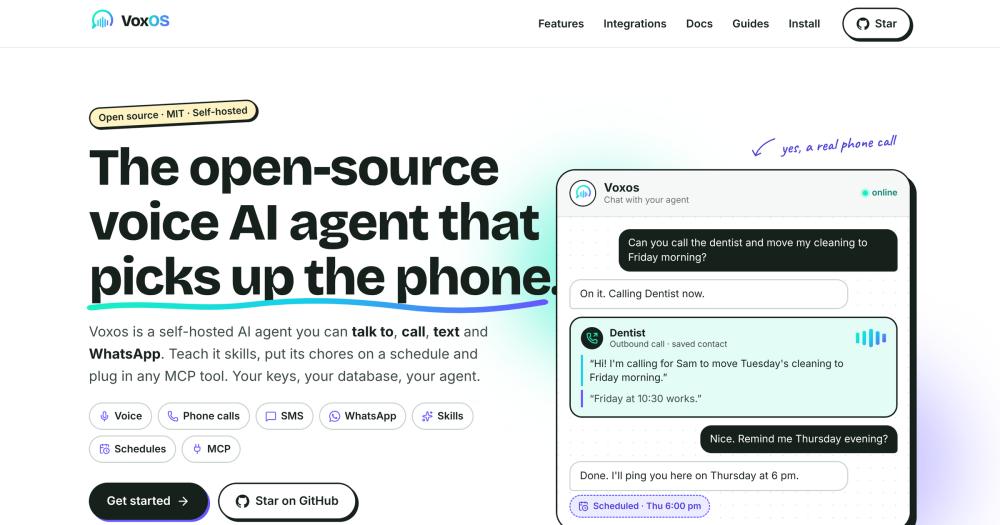
Run a self-hosted AI agent that handles phone calls, SMS, WhatsApp and web chat with memory, skills, schedules and MCP tools.

Visit websiteGitHub2 starsDeploy on Hostinger
image of Voxos
TL;DR

Voxos is an MIT-licensed, self-hosted backend for voice-first AI agents that handles phone calls, SMS, WhatsApp, and web chat through one unified agent. It replaces hosted voice automation platforms like Vapi, Retell AI, and Bland AI, charging no platform fees and storing provider keys only in your own encrypted database. Voice sessions run on OpenAI Realtime, Google Gemini Live, or xAI Grok through LiveKit; text chat supports any OpenAI-compatible endpoint including local models like Ollama. Best for developers and small teams who want a personal or internal agent with persistent memory, skills, schedules, and MCP tools across multiple channels.

Read the full breakdownHide the full breakdownWho it is for, how it works, trade-offs, the quick start and the FAQ
who it's for

Who Voxos is for#

Developers building a personal AI assistant

Voxos gives a developer a single agent that picks up phone calls, replies to texts, reads WhatsApp, and runs MCP tools like GitHub, Google Calendar, and Gmail. Skills encode repeating workflows once; schedules run them on a timer. The Docker Compose stack runs on a home server or a small VPS.

Skip if:

You need a managed service with guaranteed uptime SLAs and no server administration. Voxos requires you to provision and maintain the backend infrastructure.

Small teams sharing an internal agent deployment

Postgres row-level security and per-user encrypted credentials mean multiple people can share one Voxos server without accessing each other's data. Each user gets their own agents, memories, and tool grants. Teams can run shared skills from a curated catalog while keeping personal contact and calendar data isolated.

Skip if:

Your team needs an enterprise voice platform for high-volume customer-facing calls or a managed contact center. Voxos is built for internal agent use, not for call center automation at scale.

Builders integrating MCP tools into a voice workflow

Voxos is one of few open source agents that connects realtime voice to MCP servers. A builder can wire GitHub, Linear, Notion, Sentry, or any custom MCP server to a voice-capable agent that answers phone calls and responds to texts about the same project context.

Skip if:

Your MCP use case is text-only. If you do not need voice or phone call integration, a lighter agent framework without the LiveKit and telephony stack is simpler to operate.

Privacy-focused users running a local text agent

Text chat can point at any OpenAI-compatible local model (Ollama, LM Studio, vLLM, llama.cpp), so the conversation never leaves your machine. The web console and Flutter app connect to your own server, and your keys and memories stay in your own Postgres instance.

Skip if:

You also need local realtime voice. Voice sessions require OpenAI Realtime, Gemini Live, or xAI Grok, which send audio to an external API.

the problem

The problem it solves#

Hosted voice AI platforms charge per-minute fees that add up fast. A single voice agent handling phone calls and SMS on a platform like Vapi or Retell AI can cost hundreds of dollars a month once usage scales, and the meter never stops. Your API keys live on the platform's servers, your call data flows through their infrastructure, and switching to a different model or adding a new tool integration requires their cooperation.

The deeper challenge is scope. Voice automation platforms are built for calls. The person who actually wants to call a dentist, text a friend, check a WhatsApp group, or run a weekly calendar review needs four separate tools and no way to share context between them. Memory, schedules, and the ability to carry work across conversations are either missing or locked behind additional paid services.

how Voxos solves it

How it solves it#

Multi-channel voice and messaging

One agent handles real-time voice in the web console, inbound and outbound phone calls via Twilio or Telnyx, two-way SMS, and WhatsApp direct and group messages. Context carries across all channels. Start a conversation on a phone call and continue it in a text without losing agent state or memory.

LiveKit real-time voice with OpenAI, Gemini, and xAI

Voice sessions run over LiveKit using OpenAI Realtime, Google Gemini Live, or xAI Grok voice models. The LiveKit worker starts per-project on demand, retains briefly for burst reuse, and shuts down cleanly. Transcripts are saved with chat history. A Flutter iOS and Android app provides one-tap voice calls connecting to your own Voxos server.

Skills and scheduled tasks

Skills are reusable playbooks the agent finds and follows, editable by the user; suggested edits wait for approval before they take effect. Schedules are one-off or repeating tasks that post results back to the originating chat. Both persist across sessions so the agent carries work from one conversation to the next.

MCP tool integration

Voxos connects to remote MCP servers over Streamable HTTP or SSE, handling OAuth, bearer, and API-key auth. Each agent gets only the tools explicitly granted; the model never picks whose data it touches. The built-in catalog covers GitHub, Linear, Notion, Gmail, Google Calendar, Google Drive, Brave Search, and Browserless.

Local and self-hosted model support for text

Text chat can point at any OpenAI-compatible endpoint, including Ollama, LM Studio, vLLM, or llama.cpp on the same machine or network. Realtime voice still requires a hosted provider (OpenAI, Gemini, or xAI), but the text path is fully air-gappable for self-hosted deployments that need data isolation.

Per-user encrypted credentials and row-level security

Provider keys and tokens are encrypted per user with AES-GCM for local development and AWS or Google Cloud KMS envelope encryption for production deployments. Postgres row-level security partitions every user's agents, chats, memories, and tool grants. Agents only get the tools they have been explicitly granted.

strengths · trade-offs

Strengths and trade-offs#

Strengths

  • MIT license with no platform feeThe backend is MIT licensed, so you run it on your own infrastructure without licensing fees and use it commercially without restriction. Unlike Vapi or Retell AI, which bill per-minute for managed service, you pay your phone provider, voice model provider, and server host directly. No subscription meter.
  • Multi-channel with shared agent stateVoice, phone calls, SMS, WhatsApp, and web chat all reach the same agent with the same memory, skills, and tool access. This is a structural difference from voice-only platforms: a single session can start on a phone call and continue in a text without losing context.
  • Data ownership and per-user encryptionKeys and tokens are encrypted per user before storage, with AES-GCM for local development and AWS or Google Cloud KMS envelope encryption for production. Postgres row-level security isolates each user's data at the database layer. For teams running Voxos on shared infrastructure, one user's data is inaccessible to another's queries.
  • Self-hosting on Docker Compose or Kubernetes`make up` starts the entire stack (FastAPI, LiveKit, Postgres with pgvector, and workers) in one command on a laptop or VM. A Helm chart deploys the database and application as separate Kubernetes releases for production. Both paths are documented in the repository.

Trade-offs

  • -Very new project with minimal communityThe repository was created in October 2026 and has 2 GitHub stars. There is no community forum, extension marketplace, or production case studies. Early adopters will find the codebase moving fast and documentation still expanding.
  • -Realtime voice requires a hosted providerOpenAI Realtime, Google Gemini Live, and xAI Grok are the only supported voice models. There is no local realtime voice option; every voice session sends audio to an external API. Text chat supports local models (Ollama, LM Studio, vLLM), but voice is unavoidably tied to a cloud provider.
  • -Firebase required for authenticationSign-in is Firebase bearer auth. Running Voxos requires a Firebase project; there is no built-in username/password auth or alternative identity provider support as of the current release. For deployments that cannot use Firebase, authentication is a blocker.
  • -Not suited for high-volume outbound callingThe product FAQ explicitly states it is not built for bulk dialing campaigns. It is designed for one-to-one or small-group personal agent use, not enterprise call center automation at scale. Bland AI or a dedicated outbound dialer is a better fit for high-volume campaigns.
versus alternatives

Voxos vs alternatives#

Voxos vs Vapi

Both tools enable AI voice agents for phone calls, but they serve different deployment models and scope. Vapi is a managed hosted platform optimized for voice agent development; Voxos is a self-hosted open source backend that covers voice, SMS, WhatsApp, and web chat in one agent.

FeatureVoxosVapi
LicenseMITProprietary
DeploymentSelf-hostedManaged cloud
Pricing modelNo platform feePer-minute billing
ChannelsVoice, calls, SMS, WhatsApp, chatPrimarily voice/phone
MemoryBuilt-in durable memoryVia custom integrations
MCP toolsNative supportVia custom integrations

Voxos is the better choice when you need data ownership, want to avoid per-minute fees, or require SMS, WhatsApp, and chat alongside voice calls in one agent. Vapi is worth considering when you need a mature managed platform with enterprise SLAs, a large ecosystem of voice providers, and no server administration overhead.

Voxos vs Retell AI

Retell AI is built for ultra-low-latency, human-sounding phone voice agents. Voxos uses LiveKit for real-time voice and prioritizes multi-channel coverage and self-hosted control over voice latency optimization.

FeatureVoxosRetell AI
LicenseMITProprietary
DeploymentSelf-hostedManaged cloud
Voice focusGeneral realtime voiceLow-latency optimized
ChannelsVoice, calls, SMS, WhatsApp, chatVoice/phone focused
Local model supportText chat onlyNo

Voxos is the better choice when multi-channel capability (SMS, WhatsApp, MCP tools) matters more than optimized call latency, or when sending call data to a third-party platform is not acceptable. Retell AI is worth considering when you need the lowest possible voice latency for customer-facing phone agents with professional-grade voice quality and no infrastructure to manage.

Voxos vs Bland AI

Bland AI is built for enterprise-grade, high-volume outbound calling campaigns with custom LLM workflows. Voxos is not built for bulk dialing at scale; its own FAQ states this directly.

FeatureVoxosBland AI
LicenseMITProprietary
Primary use casePersonal/internal agentHigh-volume outbound calls
DeploymentSelf-hostedManaged cloud
ChannelsMulti-channelPhone focused
ScalePersonal to small teamEnterprise call center

Voxos is the better choice for personal assistants, internal team agents, and developers who need MCP tool integration across voice and messaging channels. Bland AI is the better choice for enterprise call centers running high-volume outbound campaigns, compliance-heavy environments, or scenarios requiring thousands of automated calls per day.


install · quick start

Quick start#

bash
Self-hosting uses Docker Compose with Postgres, pgvector, and LiveKit workers.
```bash
git clone https://github.com/s-block/voxos.git
cd voxos
make env
make up
```
tech stack · detected from GitHub

What it's built on#

Languages
DartPythonTypeScript
Frameworks
FastAPIReact
frequently asked

FAQ#

Is Voxos free to use?

Yes. The code is MIT licensed and you run it on your own infrastructure. You pay your phone provider for numbers and minutes, your voice model provider for usage, and whoever hosts your server. There is no platform fee from Voxos itself.

Is Voxos an open source alternative to Vapi or Retell AI?

Yes, if you want a self-hosted agent rather than a hosted call platform. Voxos is MIT licensed, charges no platform fee, and covers voice, phone calls, SMS, WhatsApp, chat, memory, and MCP tools. It is not built for bulk dialing campaigns, and realtime voice still runs on OpenAI, Gemini, or xAI.

Which AI models does Voxos support?

Realtime voice runs on OpenAI Realtime, Google Gemini Live, and xAI Grok voice models through LiveKit. Text chat supports OpenAI, xAI, and any OpenAI-compatible endpoint, including Ollama, LM Studio, vLLM, and llama.cpp for fully local text conversations. Hume, ElevenLabs, and Mistral credential storage exists in the current code but their voice worker adapters are not yet complete.

What do I need to run Voxos?

Docker with Docker Compose, a Firebase project for sign-in, and API keys for the providers you want to use. Running make up starts the FastAPI backend, LiveKit, Postgres with pgvector, and the durable run workers. A Helm chart covers Kubernetes deployments for production.

Can Voxos handle inbound and outbound phone calls?

Yes. Connect a Twilio or Telnyx phone number and your agent answers inbound calls through LiveKit. For outbound, the agent calls your saved contacts with a stated goal; caller access is configured per contact. The same number handles two-way SMS, so text replies come back to the same agent.

also worth a look

Similar open-source tools#

dograh

Alternative toVapi

Open source voice agent builder with telephony and BYOK AI support

  • 6,027 GitHub stars
  • BSD-2-ClauseLicence BSD-2-Clause

LiveKit

Alternative toTwilio

Real-time voice and video infrastructure on open source WebRTC

  • 15,087 GitHub stars
  • Apache-2.0Licence Apache-2.0

FckSignups

InCustomer Support

Open-source tools that work instantly, no signup required

  • 4,557 GitHub stars
  • GPL-3.0Licence GPL-3.0

Nuphos

Featured

Alternative toConductor

Agent workspace for teams running Claude Code or Codex

  • 372 GitHub stars
  • Apache-2.0Licence Apache-2.0

Inbox Zero

Featured

Alternative toSuperhuman

AI email assistant that drafts replies and clears your inbox

  • 12,915 GitHub stars
  • AGPL-3.0Licence AGPL-3.0

Commonly

InCommunication & Collaboration

Bring your AI agents into one shared team workspace, self-hosted.

  • 1,391 GitHub stars
  • Apache-2.0Licence Apache-2.0
by category

Open source tools in these categories#

507

AI & Machine Learning

freeCodeCamp, REA (Reverse Engineer Anything), OpenClaw
158

Communication & Collaboration

iptv, freeCodeCamp, Excalidraw
84

Backend Development

dify, graphify, Rust
Hostinger

Self-host Voxos on a Hostinger VPS

Keep it running 24/7, even when your laptop is off. A Hostinger VPS gives it a server of its own.

  1. 01

    Choose a plan

    Starts from $6.49/mo

  2. 02

    Apply

    Extra 10% off yearly plans

  3. 03

    Install Voxos

    On a server that stays on

  4. 04

    Start building

    Focus on the app, not the server

Deploy on Hostinger

Sponsors

Inbox Zero

Alternative toSuperhuman

AI email assistant that drafts replies and clears your inbox

  • 12,915 GitHub stars
  • AGPL-3.0Licence AGPL-3.0
  • #Email

rakazo

Alternative toGrok Bot

AI teammates you own: your keys, your model, your machine.

  • 7,028 GitHub stars
  • Apache-2.0Licence Apache-2.0
  • #AI Agents

SnitchFeed

Live monitoring on LinkedIn, X, Reddit & more. Agentic social listening for startups.

Marketing & Growth

Advertise your product

New open source projects by email

The projects we add and every new guide. Free, unsubscribe any time.

Find open source alternatives to paid software

/
  • Claude Code to OpenCode
  • Jira to Windshift
  • Notion to AppFlowy
  • Slack to Mattermost
  • Linear to GitLab
  • Wispr Flow to Handy
  • Arc to Zen Browser
  • CapCut to Concat
  • Grok Bot to rakazo
  • Superhuman to Inbox Zero
  • Airtable to AITable
  • Muse to OpenClaw
  • Railway to Coolify
  • GitHub Copilot to Cline
  • Datadog to Netdata
  • Confluence to Wiki.js
  • Microsoft Teams to Rocket.Chat
  • Firebase to Supabase
  • Pinecone to Qdrant
  • Zapier to n8n
  • 1Password to KeePassXC
  • Devin AI to OpenHands
  • Asana to Leantime
  • Contentful to Strapi