Open Source Alternatives
  • Alternatives
  • Categories
    Categories by size1,317 projects
    • Developer Tools679
    • AI & Machine Learning551
    • Business & Productivity317
    • Web Development219
    • Security & Monitoring200
    • Communication & Collaboration171
    • IT Management166
    • Design & Creative148
    • DevOps & CI/CD143
    • LLMOps & AI Tooling142
    Browse all 21 categoriesCloud & Hosting, Product & Project Management and 9 more
  • Blog
  • Advertise
SearchNotion, Slack, password manager.../
Submit
Open Source Alternatives
  • Alternatives
    • Developer Tools679
    • AI & Machine Learning551
    • Business & Productivity317
    • Web Development219
    • Security & Monitoring200
    • Communication & Collaboration171
    • Browse all 21 categories
  • Blog
  • Advertise
Submit your project

New open source projects by email

The projects we add and every new guide. Free, unsubscribe any time.

Open Source Alternatives LogoOpen Source Alternatives

Handpicked Open Source Alternatives to Paid Softwares

Add Open Source Alternatives as a preferred source on Google

Product

  • Categories
  • Tag
  • Advertise

Resources

  • Blog
  • Collection
  • Submit

Company

  • Privacy Policy
  • Terms of Service
  • Refund Policy
  • Sitemap

Alternatives

  • Claude Code
  • Jira
  • Notion
  • Slack
  • Linear
  • Wispr Flow
  • All alternatives
© 2026 Open Source Alternatives. All rights reserved.
Open SourceAlternatives
Home/Categories/Marketing & Growth/AgentSDR
icon of AgentSDR

AgentSDR

Open source alternative to Reply.io, 11x.ai and Clay

  • 94 stars
  • MIT
  • Active this week
  • Last commit today

Last verified Nov 21, 2026

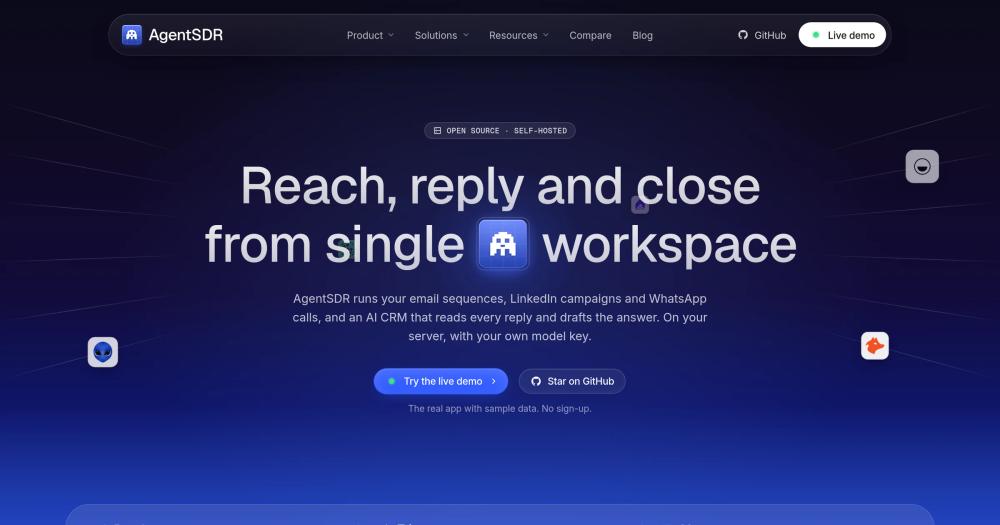
Run email, LinkedIn, and WhatsApp outreach from one self-hosted workspace, with an AI CRM that reads every reply and drafts responses.

Visit websiteGitHub94 starsDeploy on Hostinger
image of AgentSDR
TL;DR

AgentSDR is an MIT-licensed open source AI SDR that combines email, LinkedIn, and WhatsApp outreach into one self-hosted workspace, backed by one PostgreSQL database. It replaces Reply.io and 11x.ai for teams that want multichannel outbound without per-seat pricing and with leads staying on their own servers. The AI CRM reads every inbound reply, classifies it, and drafts a response grounded in your knowledge base; a person approves before anything sends. Best for B2B sales teams doing enough outreach volume that commercial platform costs are a decision factor.

Read the full breakdownHide the full breakdownWho it is for, how it works, trade-offs, the quick start and the FAQ
who it's for

Who AgentSDR is for#

B2B founders running their own outbound

A founder with a targeted prospect list who needs email, LinkedIn, and occasional WhatsApp touches can run the full outreach stack from one deployment without paying for separate sequencing, LinkedIn automation, and CRM tools. The AI drafts replies so the founder spends time approving and editing rather than writing from scratch.

Skip if:

You need a managed service with no server maintenance. AgentSDR requires Docker on a server and ongoing management of Google Workspace, Unipile, and OpenRouter integrations.

Sales teams consolidating a multi-tool outbound stack

Teams currently paying separately for a sequencer, LinkedIn tool, enrichment service, and CRM can consolidate into one deployment. The enrichment tables with 15 providers replace a standalone enrichment subscription, and the AI CRM handles reply classification that would otherwise require manual triage by a rep.

Skip if:

Your team uses Microsoft 365 for email. AgentSDR's email channel is Google Workspace only, with no other provider support planned yet.

Teams with data residency or privacy requirements

Leads, emails, LinkedIn conversations, and call recordings never leave your own servers. Organizations in regulated industries or with contractual data residency requirements can self-host AgentSDR and keep all prospect data within their own infrastructure, with no data passing through a managed SDR service.

Skip if:

You need a fully hosted service with no infrastructure management. AgentSDR requires operating a Postgres database and managing integrations in the app settings.

Developers building a custom outreach workflow

AgentSDR is a TypeScript Next.js application on Postgres with the codebase documented in an architecture guide. Adding a new enrichment column type, a custom channel integration, or a webhook to a downstream CRM is ordinary application work. The repo accepts issues and pull requests, and the CI suite covers typecheck, lint, and tests on PostgreSQL 16, 17, and 18.

Skip if:

You need a no-code tool your sales team can configure without engineering support. AgentSDR's customization is at the code level.

the problem

The problem it solves#

Running multichannel outbound sales means stitching together at least six separate tools: a lead database, an enrichment service, an email sequencer, a LinkedIn automation tool, a dialer, and a CRM. Each has its own seats, its own billing, and its own copy of your leads, so a reply on LinkedIn sits in a different inbox from an email reply, and the CRM only knows about it if someone manually updates it.

The cost adds up fast. At typical commercial pricing for email sequencing, LinkedIn automation, CRM, and enrichment, a small sales team can easily spend several thousand dollars a month per rep before the first reply comes back. And even after paying for all of it, every reply still lands in a different tool, requiring manual triage before anyone can respond.

how AgentSDR solves it

How it solves it#

Three-channel outreach in one workspace

Runs email sequences from your own Google Workspace mailboxes, LinkedIn invites and follow-up messages via Unipile across multiple accounts, and WhatsApp message campaigns and recorded calls via a Chrome extension. All three channels share one lead database, so a reply on any channel lands in the same CRM queue with the same context.

AI CRM with grounded reply drafts

Every inbound reply is classified into one of four categories: interested, customer, not interested, or other. The AI drafts a reply drawn from your knowledge base and queues it for a person to approve. Low-confidence classifications are held for review; the AI can move a lead forward in the pipeline when confident, but never sends a reply on its own by default.

Built-in enrichment tables with 15 providers

Tables add columns to your lead database by calling Apollo, Hunter, Lusha, Findymail, and 11 more enrichment providers row by row. Columns can also run AI prompts on your OpenRouter key, make HTTP calls to any API, or pull from other columns. A table can generate a campaign directly, keeping enrichment and outreach in one workflow without a separate tool.

Per-mailbox sending limits and automatic pooling

Each Google Workspace mailbox has its own daily cap (30 by default), sending window, and signature. Multiple campaigns share a pool of mailboxes assigned round-robin. Bounce suppression, one-click unsubscribe, and spin text for personalization are built in, so sending volume scales without manual inbox management.

WhatsApp call recording and transcription

A Chrome extension dials leads inside WhatsApp Web and records both sides of the call. The recording goes to your Cloudflare R2 bucket and your chosen model on OpenRouter transcribes it, writing the transcript into the lead's record. Calls that go unanswered are automatically retried after 1, 2, and 4 days. Messages sync with a 24-hour warm-up for new numbers and a limit of 25 new chats per day per number.

Bring-your-own AI key, model pinned per call

Every AI step, including reply classification, draft generation, call transcription, and enrichment table columns, runs on your own OpenRouter key. Each call is pinned to the model you chose, with fallbacks disabled, so your data only goes to the provider you selected. No AI usage is billed by AgentSDR itself.

strengths · trade-offs

Strengths and trade-offs#

Strengths

  • MIT license with no seat fees or contact feesAgentSDR is MIT licensed. You run it on your own server and pay only for compute and your provider accounts (Google Workspace, Unipile, OpenRouter). There are no per-seat charges, no per-contact fees, and no AgentSDR subscription tier. For teams doing high-volume outbound the cost difference versus commercial platforms can be substantial.
  • Lead data stays on your own serversLeads, conversations, and call recordings live in the Postgres database and Cloudflare R2 bucket you operate, not on AgentSDR's servers, because there is no hosted AgentSDR service. Integration credentials are encrypted per organization with AES-256-GCM and are verified with a live API call before being saved.
  • Multi-organization support in one deploymentOne AgentSDR deployment can host multiple organizations, each with its own leads, inboxes, and connected accounts, fully isolated from the others. A sales agency or team with separate brand identities can run all of them from one server without paying for multiple instances.
  • No Redis, no queue server, no separate workerThe application is one Next.js process backed by one PostgreSQL database. Background jobs and scheduled outreach run inside the application process itself. There is no Redis to operate, no message queue, and no separate worker that can fall out of sync, making the deployment footprint small enough to run on a basic VPS.

Trade-offs

  • -LinkedIn and WhatsApp require a paid Unipile accountLinkedIn campaigns and WhatsApp messaging run through Unipile, a third-party API service. This adds an external dependency and a Unipile subscription to the operating cost. The benefit is that your LinkedIn account connects through Unipile's official API path rather than a browser automation layer, but it is not a free addition to the stack.
  • -Email outreach requires Google WorkspaceEmail sequences send from Google Workspace mailboxes connected via a service account with domain-wide delegation. Other email providers are not supported yet. Teams using Microsoft 365 or a hosted SMTP provider cannot use the email channel without also adding a Google Workspace account.
  • -WhatsApp calling depends on WhatsApp Web's English interfaceThe call recording feature relies on a Chrome extension that dials inside WhatsApp Web. It requires the English interface and does not work via the WhatsApp Business API, so it is limited to personal or business accounts connected through WhatsApp Web. Teams relying on the WhatsApp Business API cannot use this feature.
  • -New project with limited production track recordThe repository was created in October 2026 and has 94 stars and 0 open issues. The absence of open issues on a new project more often reflects early adoption than exceptional stability. Teams with complex requirements or high-uptime needs should review the community discussions before committing.
versus alternatives

AgentSDR vs alternatives#

AgentSDR vs Reply.io

Reply.io is an AI-powered sales engagement platform with an AI agent that handles email sequences, LinkedIn outreach, and automated reply management. Both tools automate multichannel outbound; the main differences are hosting model, data ownership, and pricing structure.

FeatureAgentSDRReply.io
LicenseMIT (open source)Proprietary
Self-hostingYesNo
Email outreachYes (Google Workspace)Yes
LinkedIn automationYes (via Unipile)Yes
AI reply draftsYes, human approvesVaries by plan
PricingServer and provider costsPer-seat subscription

AgentSDR is the better fit when you need leads and conversations to stay on your own servers, want to avoid per-seat fees at scale. Reply.io is worth considering when you want a fully managed service with no server or integration management, or when your team lacks the capacity to operate a self-hosted deployment.

AgentSDR vs 11x.ai

11x.ai is a fully autonomous AI SDR that handles email and LinkedIn prospecting and outreach end-to-end without human involvement. AgentSDR is designed around human approval of AI drafts rather than autonomous outbound.

FeatureAgentSDR11x.ai
LicenseMIT (open source)Proprietary
Self-hostingYesNo
Human approval requiredYes (drafts wait for review)Minimal (autonomous)
Enrichment tablesYes (15 providers)Managed
Data ownershipYour serversVendor's servers

AgentSDR fits better when your team wants to review and approve replies before they go out, needs data to stay on your own servers. 11x.ai is worth considering when you want a fully autonomous outbound agent with no deployment or management work and are comfortable with the AI handling prospect communications independently.

AgentSDR vs Clay

Clay is a data enrichment and automation platform for building targeted lead lists with data from many providers. Its overlap with AgentSDR is in the enrichment tables feature; Its focus is the data layer rather than sending, and it connects to the sequencing tools teams already use.

FeatureAgentSDRClay
LicenseMIT (open source)Proprietary
Lead enrichmentYes (15 providers, AI columns)Yes (many more providers)
Built-in outreach sequencesYesNot its focus
Built-in AI CRMYesNot its focus

AgentSDR fits better when you want enrichment and outreach in one deployment without integrating a separate sequencing tool. Clay is the stronger choice when enrichment depth matters most, when you need more than 15 data providers, or when you already have a preferred sequencing tool and need a best-in-class data layer rather than a full outreach stack.

install · quick start

Quick start#

bash
Deploy AgentSDR with Docker Compose; PostgreSQL and the application run in the same Compose stack.

```bash
mkdir agentsdr && cd agentsdr
curl -O https://raw.githubusercontent.com/Kandid-ai/AgentSDR/main/docker-compose.yml
docker compose up -d
```
tech stack · detected from GitHub

What it's built on#

Languages
JavaScriptTypeScript
Frameworks
Next.jsReact
Databases
PostgreSQL
Infrastructure
AWS
frequently asked

FAQ#

Is AgentSDR free to use?

Yes. AgentSDR is MIT licensed and free to run on your own infrastructure. There are no seat fees, tier limits, or per-contact charges from AgentSDR itself. What you pay for is your server, a Unipile account for LinkedIn and WhatsApp, your Google Workspace mailboxes, and your OpenRouter AI usage. For teams doing high-volume outbound the total cost can be significantly lower than commercial platforms, depending on model usage and team size.

What do I need to deploy AgentSDR?

A machine that runs Docker and PostgreSQL 16 or newer (the Docker Compose file includes Postgres). Copy the example environment file, set a database connection string, an auth secret, and an encryption key, then run docker compose up -d. The setup page creates your admin account and organization on first visit. The documentation covers VPS deployment via Dokploy, production hardening, and running from source with Bun 1.2 and PostgreSQL 16.

Does the AI send replies automatically?

No, by default. Every AI-drafted reply waits in the action required queue until a person sends it, edited or as written. The AI can move a lead forward in the pipeline when it is confident in its classification; a backward move, a low-confidence call, and every new customer classification are held for a person. Auto-send for a specific sequence can be enabled explicitly in the sequence settings, but it is off by default.

Does AgentSDR support multiple team members?

Yes. Everyone signs in with their own account and you invite teammates as owners, admins, or members. One deployment can host multiple organizations, each fully isolated with its own leads, connected accounts, and inboxes. A sales agency running outreach for several clients can keep them separate on one server without additional instances.

Which AI models work with AgentSDR?

Any model on OpenRouter, including Claude, GPT-4o, Llama, and others, using your own OpenRouter API key. Each AI call is pinned to the model you chose with fallbacks disabled, so your data only goes to the provider you selected. Reply classification, draft generation, call transcription, and enrichment table columns all use this same path.

also worth a look

Similar open-source tools#

Monica

Alternative toClay

Self-hosted personal relationship manager for friends and family.

  • 25,808 GitHub stars
  • AGPL-3.0Licence AGPL-3.0

Orkas

InAI & Machine Learning

Local-first desktop AI team: 16 agents, MIT, models of your choice.

  • 9,457 GitHub stars
  • MITLicence MIT

MiroFish

InAI & Machine Learning

Multi-agent simulation engine that predicts real-world outcomes

  • 85,831 GitHub stars
  • AGPL-3.0Licence AGPL-3.0

DeskcommCRM

Alternative toHubSpot Sales Hub

AI agents for WhatsApp sales, fully audited, no per-user pricing

  • 5,500 GitHub stars
  • MITLicence MIT

FckSignups

InCustomer Support

Open-source tools that work instantly, no signup required

  • 4,597 GitHub stars
  • GPL-3.0Licence GPL-3.0

Comp AI CRM

Alternative toAttio

Open source agentic CRM with a durable research agent

  • 12,196 GitHub stars
  • MITLicence MIT
by category

Open source tools in these categories#

78

Marketing & Growth

agency-agents, MoneyPrinterTurbo, MiroFish
318

Business & Productivity

OpenClaw, Excalidraw, RustDesk
552

AI & Machine Learning

REA (Reverse Engineer Anything), freeCodeCamp, OpenClaw
Hostinger

Self-host AgentSDR on a Hostinger VPS

Keep it running 24/7, even when your laptop is off. A Hostinger VPS gives it a server of its own.

  1. 01

    Choose a plan

    Starts from $6.49/mo

  2. 02

    Apply

    Extra 10% off yearly plans

  3. 03

    Install AgentSDR

    On a server that stays on

  4. 04

    Start building

    Focus on the app, not the server

Deploy on Hostinger

Sponsors

SnitchFeed

Live monitoring on LinkedIn, X, Reddit & more. Agentic social listening for startups.

Marketing & Growth

Windshift

Alternative toJira

Self-hosted work management for teams leaving Jira

  • 460 GitHub stars
  • AGPL-3.0Licence AGPL-3.0

Nuphos

Alternative toConductor

Agent workspace for teams running Claude Code or Codex

  • 707 GitHub stars
  • Apache-2.0Licence Apache-2.0
  • #AI Agents
Advertise your product

New open source projects by email

The projects we add and every new guide. Free, unsubscribe any time.

Find open source alternatives to paid software

/
  • Claude Code to OpenCode
  • Jira to Windshift
  • Notion to AppFlowy
  • Slack to Mattermost
  • Linear to GitLab
  • Wispr Flow to Handy
  • Arc to Zen Browser
  • CapCut to Concat
  • Grok Bot to rakazo
  • Superhuman to Inbox Zero
  • Discord to Stoat
  • Airtable to AITable
  • Datadog to SigNoz
  • Muse to OpenClaw
  • Railway to Coolify
  • GitHub Copilot to Cline
  • Confluence to Wiki.js
  • Microsoft Teams to Rocket.Chat
  • 1Password to KeePassXC
  • Firebase to Supabase
  • Pinecone to Qdrant
  • Zapier to n8n
  • Devin AI to OpenHands
  • Adobe Premiere Pro to Shotcut