Open Source Alternatives
  • Alternatives
  • Categories
    Categories by size1,196 projects
    • Developer Tools617
    • AI & Machine Learning520
    • Business & Productivity290
    • Web Development215
    • Security & Monitoring180
    • Communication & Collaboration159
    • IT Management151
    • LLMOps & AI Tooling132
    • Cloud & Hosting129
    • Product & Project Management126
    Browse all 21 categoriesDesign & Creative, DevOps & CI/CD and 9 more
  • Blog
  • Advertise
SearchNotion, Slack, password manager.../
Submit
Open Source Alternatives
  • Alternatives
    • Developer Tools617
    • AI & Machine Learning520
    • Business & Productivity290
    • Web Development215
    • Security & Monitoring180
    • Communication & Collaboration159
    • Browse all 21 categories
  • Blog
  • Advertise
Submit your project

New open source projects by email

The projects we add and every new guide. Free, unsubscribe any time.

Open Source Alternatives LogoOpen Source Alternatives

Handpicked Open Source Alternatives to Paid Softwares

Add Open Source Alternatives as a preferred source on Google

Product

  • Categories
  • Tag
  • Advertise

Resources

  • Blog
  • Collection
  • Submit

Company

  • Privacy Policy
  • Terms of Service
  • Refund Policy
  • Sitemap

Alternatives

  • Claude Code
  • Jira
  • Notion
  • Slack
  • Linear
  • Wispr Flow
  • All alternatives
© 2026 Open Source Alternatives. All rights reserved.
Open SourceAlternatives
Home/Categories/Web Development/Ant Design Vue
icon of Ant Design Vue

Ant Design Vue

Open source alternative to Kendo UI for Vue, Syncfusion Essential UI Kit for Vue, DevExtreme and Webix

  • 21.7K stars
  • MIT
  • Active this week
  • Last commit 2 days ago

Last verified Nov 10, 2026

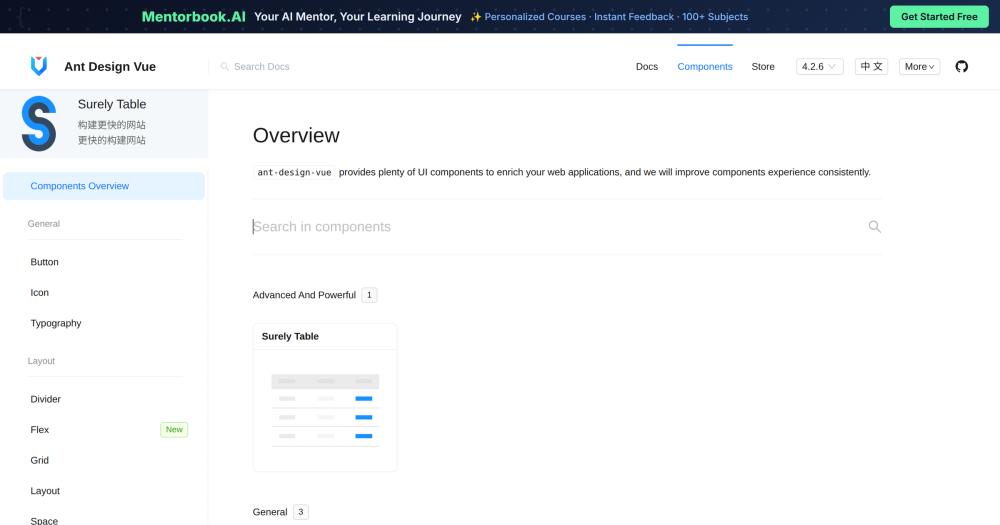
Build enterprise Vue.js applications with the Ant Design component library, supporting Vue 2 and Vue 3, server-side rendering, and Electron.

Visit websiteGitHub21.7K stars
Image for Ant Design Vue
TL;DR

Ant Design Vue is an MIT-licensed component library that ports the Ant Design design system from React to Vue.js, targeting enterprise applications and internal admin tools. It replaces commercial Vue component suites like Kendo UI for Vue and Syncfusion Essential UI Kit for Vue at no licensing cost. The library supports both Vue 2 and Vue 3, server-side rendering, and Electron desktop applications. Best for Vue.js teams building data-heavy dashboards and admin interfaces where design consistency is a priority.

Read the full breakdownHide the full breakdownWho it is for, how it works, trade-offs, the quick start and the FAQ
who it's for

Who Ant Design Vue is for#

Vue.js teams building enterprise admin interfaces

Teams building internal dashboards, data tables, and form-heavy administrative tools in Vue.js get a complete component set that covers the common enterprise UI patterns without assembling pieces from multiple libraries. The design system is production-ready and covers data grids, navigation, modals, and notifications in one package.

Skip if:

Skip if your project is a consumer-facing mobile app. The library targets desktop enterprise UIs, and its components assume a pointer-based interface rather than touch-optimized interactions.

Organizations using Ant Design (React) and Vue in the same product

When a product runs both Vue and React codebases, using Ant Design Vue on the Vue side keeps the visual language consistent across both frameworks without coordinating a separate design system. The same design tokens and component patterns cover both stacks, reducing cross-team coordination overhead.

Skip if:

Skip if the React side already uses a different design system. Ant Design Vue's value here is specifically the shared visual foundation with Ant Design (React); a cross-framework mismatch negates that advantage.

Teams migrating from Ant Design (React) to Vue.js

Teams porting a React codebase to Vue.js can migrate component by component using Ant Design Vue, since the component APIs mirror each other closely. The same design tokens and prop conventions reduce the learning gap, and the shared design resources mean both frameworks render identical interfaces during the transition period.

Skip if:

Skip if the migration is a full rewrite rather than an incremental port. A full rewrite is an opportunity to evaluate whether Ant Design is the right fit for the new stack.

Electron desktop application developers using Vue

Teams building desktop applications in Electron can use Ant Design Vue for the UI layer, keeping the same component set across their web and desktop builds. The library works inside Electron without additional configuration, covering the full range of enterprise UI patterns the desktop app needs.

Skip if:

Skip if the desktop application needs native platform controls or a native-feeling interface. Ant Design Vue provides web-rendered components following the Ant Design visual language, which may feel out of place in applications targeting OS-native aesthetics.

the problem

The problem it solves#

Building consistent enterprise UIs in Vue.js requires more than picking components off npm. Teams assembling component libraries from individual packages face a consistent challenge: reconciling different design languages, inconsistent APIs, and components that break each other's spacing or styling as they are updated independently. The result is visual drift and hidden maintenance overhead that compounds over time.

Commercial alternatives address the design consistency challenge, but they introduce a different pain: proprietary licensing tied to per-developer or per-project fees, support contracts negotiated through sales cycles, and APIs that make switching away expensive once a codebase commits to them. Teams running both Vue and React in the same product face an extra challenge: each framework typically runs a separate design system, which means interfaces built in Vue and React within the same application look different even when they should be identical.

how Ant Design Vue solves it

How it solves it#

Vue 2 and Vue 3 compatibility

The library runs on both Vue 2 and Vue 3 with the same component API, so teams can adopt it without first completing a framework upgrade. Organizations mid-migration from Vue 2 to Vue 3 can use a single component library across both versions during the transition, reducing the number of parallel dependencies to manage.

Server-side rendering support

Renders components on the server out of the box, without custom hydration wiring. This covers Nuxt.js and other SSR setups, and matters for enterprise applications that serve public-facing pages alongside internal dashboards: pages render fully before they reach the browser.

Shared design language with Ant Design (React)

Uses the same design tokens, spacing system, and component patterns as the React-native Ant Design library. Vue and React teams working in the same product ship interfaces with the same visual grammar without coordinating a separate design system for each framework.

Electron desktop application support

Runs in Electron out of the box, so teams building desktop applications can use the same component library for both their web and desktop interfaces. No separate UI kit is needed for the desktop tier, and the README lists Electron alongside modern browsers in its environment support table.

Nuxt.js integration module

The @ant-design-vue/nuxt package integrates the library into Nuxt projects with minimal configuration. It handles SSR and SSG use cases natively, covering the most common Vue full-stack setup without manual plugin wiring.

VSCode developer tooling

The ant-design-vue-helper extension for Visual Studio Code provides component name completion and prop hints while writing Vue templates, reducing time spent reading documentation during development. Available from the Visual Studio Marketplace.

strengths · trade-offs

Strengths and trade-offs#

Strengths

  • MIT license with no per-developer or per-deployment feesThe library is MIT licensed under three copyright holders (the vueComponent contributors, Alipay, and Anthony Fu). MIT licensing permits unrestricted commercial use at any team size with no seat counts, sales negotiation, or licensing audits. Compared to commercial alternatives like Kendo UI for Vue or Syncfusion Essential UI Kit for Vue, which bundle per-developer licensing, the cost difference compounds at team scale.
  • 21,700+ stars and active maintenance since 2017The repository has 21,709 stars and 3,886 forks. First created in September 2017, with the last push in November 2026, the project shows nine years of continuous development. The 108 open issues and CI-tested build pipeline reflect ongoing contributor attention across its lifespan.
  • Design parity with the Ant Design (React) ecosystemThe Vue port tracks the same design tokens, component behavior, and visual patterns as Ant Design (React). Teams running Vue and React in the same product work from one visual foundation, keeping interfaces aligned without maintaining separate design systems. Organizations already using Ant Design (React) can extend to Vue with no visual inconsistency.
  • Broad deployment target coverageCovers modern browsers (Edge, Firefox, Chrome, Safari, Opera), server-side rendering environments, and Electron desktop builds from a single package. The v1.x line also supported IE9 with polyfills, giving a track record across a wide range of deployment targets. This is documented directly in the README's environment support table.

Trade-offs

  • -Desktop-first design, not optimized for mobile interfacesThe README describes the library as an enterprise-class UI design system for desktop applications. Teams building mobile-first consumer interfaces will find the component set oriented around desktop patterns: data tables, complex forms, and administrative layouts rather than touch-optimized navigation. A mobile-first Vue library is a better fit for those use cases.
  • -108 open issuesThe repository carries 108 open issues (pull requests excluded, as of November 2026). For a library of this scope and usage level, that count signals active use and active bug reporting. Teams adopting it for production should monitor the issue tracker for regressions affecting components they rely on.
  • -Design decisions follow Ant Design (React) upstreamThe Vue port tracks the React-native Ant Design, which means design decisions, visual changes, and API evolution happen upstream in the React project first. Teams that want to diverge from the Ant Design aesthetic, or that need a component library with an independent visual direction, will face friction. The library is not built for significant visual customization.
versus alternatives

Ant Design Vue vs alternatives#

Ant Design Vue vs Kendo UI for Vue

Kendo UI for Vue is Progress Telerik's commercial Vue component library with 100+ UI components, enterprise data grids, charts, and full support contracts. Ant Design Vue covers the same enterprise UI patterns under MIT licensing with no per-developer or per-deployment fees.

FeatureAnt Design VueKendo UI for Vue
LicenseMITProprietary
CostFree (self-hosted)Subscription
Vue 2 supportYesYes
Vue 3 supportYesYes
SSR supportYesYes
Electron supportYesNot documented in README
Support contractCommunityCommercial (SLA available)

Ant Design Vue is the better choice when cost and licensing freedom are the priority. MIT licensing means no seat counts, no sales negotiation, and no licensing audits at any team size. Kendo UI for Vue is worth considering when teams need guaranteed enterprise support, SLA-backed response times, and direct access to Telerik engineers. The support contract is what justifies the subscription cost.

Ant Design Vue vs DevExtreme

DevExtreme is a commercial JavaScript UI component suite covering Angular, React, Vue, and jQuery with 80+ components, data visualization, and enterprise data grid tooling. It targets teams building complex data-heavy web applications across multiple frameworks.

FeatureAnt Design VueDevExtreme
LicenseMITProprietary
CostFree (self-hosted)Subscription
Framework scopeVue onlyAngular, React, Vue, jQuery
Design systemAnt DesignDevExtreme theme
SSR supportYesYes
Electron supportYesYes

Ant Design Vue is the better choice for Vue-only projects where MIT licensing and design consistency with the Ant Design ecosystem are the priorities. DevExtreme is worth considering when a team needs one component library to cover multiple JavaScript frameworks from a single subscription, or when the specific DevExtreme data grid capabilities are the deciding factor.

install · quick start

Quick start#

bash
Install via npm into any Vue 2 or Vue 3 project.
```bash
npm install ant-design-vue --save
```
tech stack · detected from GitHub

What it's built on#

Languages
JavaScriptTypeScript
Frameworks
ReactVue
Tooling
esbuildWebpack
frequently asked

FAQ#

Is Ant Design Vue free for commercial use?

Yes. The library is MIT licensed under three copyright holders (the vueComponent contributors, Alipay, and Anthony Fu). MIT licensing permits use, modification, and distribution in commercial applications without restriction, provided the license notices are retained in copies of the library code. There are no per-developer fees or usage restrictions.

Does Ant Design Vue work with both Vue 2 and Vue 3?

Yes. The library supports both Vue 2 and Vue 3. The README lists both versions in the environment support section. Teams can adopt the library on either version without waiting for a full framework migration. Check the official documentation at antdv.com for version-specific installation and configuration notes, as some ecosystem packages target one version specifically.

Can I use Ant Design Vue with Nuxt.js?

Yes. The @ant-design-vue/nuxt package integrates the library into Nuxt projects. It handles server-side rendering and static generation out of the box. Install it as a Nuxt module alongside the main ant-design-vue package and register it in your Nuxt configuration. This integration is listed in the library's official ecosystem table in the README.

Is Ant Design Vue suitable for mobile applications?

It is primarily designed for desktop enterprise UIs. The README describes it as an enterprise-class UI design system for desktop applications. Teams building mobile-first consumer applications will find the component set oriented around desktop patterns. For mobile Vue.js applications, a dedicated mobile-first component library is typically a better fit.

How does Ant Design Vue relate to Ant Design (React)?

Ant Design Vue is a Vue.js port of Ant Design, Alibaba's design system originally built for React. The two libraries share the same design tokens, visual language, and many component API conventions, as documented in the README. Vue and React teams working in the same product can use both libraries to ship visually consistent interfaces across frameworks without maintaining separate design systems.

also worth a look

Similar open-source tools#

material-ui

Alternative toKendoReact

Open source React components for Google's Material Design

  • 99,300 GitHub stars
  • MITLicence MIT

Angular

InWeb Development

TypeScript web framework with signals, SSR, and first-party modules

  • 101,465 GitHub stars
  • MITLicence MIT

Opensource UI

Alternative toTailwind UI

200+ copy-paste React and Next.js components, MIT licensed, no package

  • 829 GitHub stars
  • MITLicence MIT

Rust

InWeb Development

Systems language with memory safety and no garbage collector.

  • 121,626 GitHub stars
  • Apache-2.0Licence Apache-2.0

Rockxy

Alternative toProxyman

Open-source HTTP/HTTPS debugger for macOS apps, devices, and AI APIs

  • 1,466 GitHub stars
  • AGPL-3.0Licence AGPL-3.0

Astryx

Alternative toMUI X

Agent-ready React design system with 150+ accessible components.

  • 14,538 GitHub stars
  • MITLicence MIT
by category

Open source tools in these categories#

215

Web Development

freeCodeCamp, Skills for Real Engineers, superpowers
47

Web & App Development

Flutter, Rust, Angular
617

Developer Tools

REA (Reverse Engineer Anything), Skills for Real Engineers, superpowers

Sponsors

Inbox Zero

Alternative toSuperhuman

AI email assistant that drafts replies and clears your inbox

  • 12,942 GitHub stars
  • AGPL-3.0Licence AGPL-3.0
  • #Email

rakazo

Alternative toGrok Bot

AI teammates you own: your keys, your model, your machine.

  • 7,478 GitHub stars
  • Apache-2.0Licence Apache-2.0
  • #AI Agents

SnitchFeed

Live monitoring on LinkedIn, X, Reddit & more. Agentic social listening for startups.

Marketing & Growth

Advertise your product

New open source projects by email

The projects we add and every new guide. Free, unsubscribe any time.

Find open source alternatives to paid software

/
  • Claude Code to OpenCode
  • Jira to Windshift
  • Notion to AppFlowy
  • Slack to Mattermost
  • Linear to GitLab
  • Wispr Flow to Handy
  • Arc to Zen Browser
  • CapCut to Concat
  • Grok Bot to rakazo
  • Superhuman to Inbox Zero
  • Airtable to AITable
  • Muse to OpenClaw
  • Railway to Coolify
  • GitHub Copilot to Cline
  • Datadog to Netdata
  • Confluence to Wiki.js
  • Microsoft Teams to Rocket.Chat
  • 1Password to KeePassXC
  • Firebase to Supabase
  • Pinecone to Qdrant
  • Zapier to n8n
  • Devin AI to OpenHands
  • Asana to Leantime
  • Contentful to Strapi