Open Source Alternatives
  • Alternatives
  • Categories
    Categories by size1,173 projects
    • Developer Tools603
    • AI & Machine Learning510
    • Business & Productivity281
    • Web Development213
    • Security & Monitoring175
    • Communication & Collaboration158
    • IT Management149
    • LLMOps & AI Tooling130
    • Cloud & Hosting129
    • Product & Project Management125
    Browse all 21 categoriesDesign & Creative, DevOps & CI/CD and 9 more
  • Blog
  • Advertise
SearchNotion, Slack, password manager.../
Submit
Open Source Alternatives
  • Alternatives
    • Developer Tools603
    • AI & Machine Learning510
    • Business & Productivity281
    • Web Development213
    • Security & Monitoring175
    • Communication & Collaboration158
    • Browse all 21 categories
  • Blog
  • Advertise
Submit your project

New open source projects by email

The projects we add and every new guide. Free, unsubscribe any time.

Open Source Alternatives LogoOpen Source Alternatives

Handpicked Open Source Alternatives to Paid Softwares

Add Open Source Alternatives as a preferred source on Google

Product

  • Categories
  • Tag
  • Advertise

Resources

  • Blog
  • Collection
  • Submit

Company

  • Privacy Policy
  • Terms of Service
  • Refund Policy
  • Sitemap

Alternatives

  • Claude Code
  • Jira
  • Notion
  • Slack
  • Linear
  • Wispr Flow
  • All alternatives
© 2026 Open Source Alternatives. All rights reserved.
Open SourceAlternatives
Home/Categories/Design & Creative/Astryx
icon of Astryx

Astryx

Open source alternative to MUI X and KendoReact

  • 14.5K stars
  • MIT
  • Active this week
  • Last commit today

Last verified Nov 8, 2026

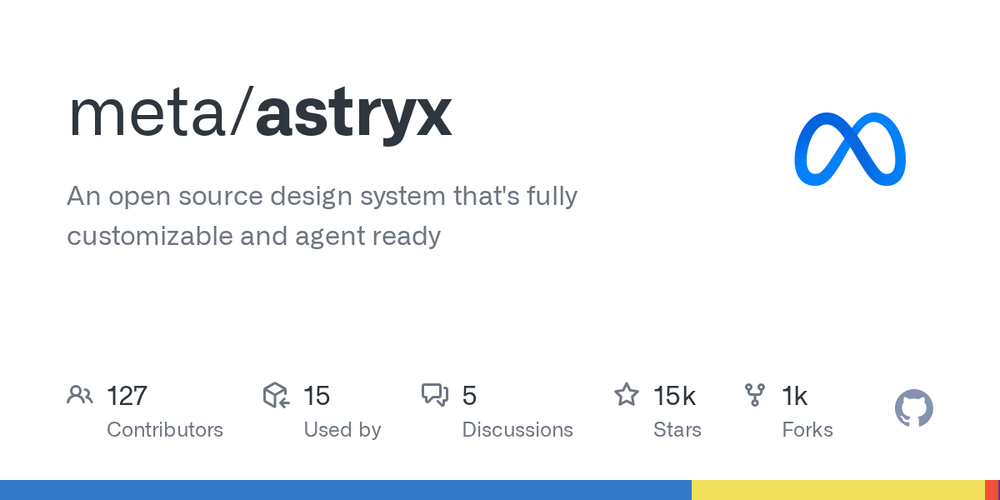
Build accessible React UIs with 150+ components, brand-level theming, and a CLI designed for both developers and AI coding agents.

Visit websiteGitHub14.5K stars
image of Astryx
TL;DR

Astryx is an open source React design system from Meta, built on React 19 and StyleX, shipping 150+ accessible components, seven ready-made themes, and a CLI built for both human developers and AI coding agents. It replaces paid tools like MUI X and KendoReact for teams that want MIT-licensed components with no subscription cost and a design system built for AI-agent workflows. MIT licensed; consumed as npm packages with no server infrastructure required. Currently in beta. Best for product teams on React 19 building accessible, branded UIs where AI-assisted development is part of the workflow.

Read the full breakdownHide the full breakdownWho it is for, how it works, trade-offs, the quick start and the FAQ
who it's for

Who Astryx is for#

Product teams building branded React 19 apps

Astryx ships seven themes and a theming system built on CSS custom property overrides, so a team can apply a custom brand without forking components. The 150+ accessible components cover most UI needs from foundations to complex patterns, and the MIT license means no subscription required.

Skip if:

Your codebase is on React 17 or React 18 and an upgrade is not planned. Astryx requires React 19 and there is no compatibility shim for older versions.

Teams integrating AI coding agents into frontend workflows

The CLI and API are designed so an AI coding agent and a human developer reach the same documentation and use the same commands. If your team uses AI coding tools and wants consistent component usage between human and agent contributions, Astryx was designed for that workflow.

Skip if:

You do not use AI coding agents and need a mature, stable component API today. KendoReact or MUI X offers larger stable component sets with enterprise support contracts.

Open source projects adopting a design system at zero cost

MIT licensed with no per-seat fees, Astryx is a viable component foundation for open source projects, internal tools, and startups that cannot absorb a component library subscription. The seven ready-made themes let a project look polished without custom design work.

Skip if:

You need a component library that has been stable and battle-tested at large external scale for years. Astryx's beta status means the API is still evolving.

the problem

The problem it solves#

Building and maintaining a consistent design system across a large React codebase is expensive. Teams that start with a third-party component library eventually need deep theming: a component that renders fine out of the box needs a brand color, custom radius, or a different density, and most libraries make those changes without wrapping or forking the source nearly impossible. Wrapping creates a maintenance layer you now own; forking creates version drift that never stops accumulating.

The problem grows once AI coding agents join the workflow. An API not designed for agents produces inconsistent outputs: the agent reaches for props that exist, misses composition patterns documented only in the reference, and builds differently than the developer working next to it. The result is review cycles that catch agent-generated code rather than approve it, which defeats the purpose of the tool.

how Astryx solves it

How it solves it#

150+ Accessible Components

Pre-built UI components covering foundations, interactive elements, and patterns, all with full TypeScript support. Each component follows the same prop and composition conventions, so once you learn a few the rest behave predictably. The library includes ready-to-ship templates for common page patterns.

Brand-Level Theming with CSS Custom Properties

Themes are sets of CSS custom property overrides, not wrapper components or forked source. A designer can restyle every component to match a custom brand without touching component code. Seven ready-made themes are included: neutral, butter, chocolate, matcha, stone, gothic, and y2k.

Agent-Ready CLI

The @astryxdesign/cli package documents components, generates scaffolding, and runs codemods. It can be installed globally so an AI coding agent and a developer reach the same component documentation with the same commands. Add a package.json script to avoid path errors when agents invoke it directly.

Swizzle: Component Source Ejection

When a component's public API is not enough, swizzle ejects its full source into your project. You own the code from that point, can modify anything, and lose only automatic upstream updates for that specific component. It removes the need to fork the whole library for one deep customization.

No Styling Lock-In

Astryx uses StyleX internally to author its component styles, but consuming projects are not required to adopt StyleX. Override component appearance with Tailwind utility classes, CSS modules, or plain CSS through the standard className prop. No build plugin or PostCSS config is needed to get started.

strengths · trade-offs

Strengths and trade-offs#

Strengths

  • MIT License with No Per-Seat CostThe full component library is MIT licensed. Unlike MUI X's paid grid and advanced components or KendoReact's subscription pricing, every Astryx component is free to use in commercial projects with no seat count or license fee.
  • API and Docs Designed for Humans and Agents TogetherThe API, documentation, and CLI were designed so both human developers and AI coding agents use the same tooling and reach the same documentation. The stated design principle is that every change that makes Astryx easier for AI also makes it easier for people, reducing inconsistency between human-authored and agent-authored code.
  • Meta-Scale Internal Track RecordAstryx grew inside Meta over eight years and powers 13,000+ internal apps as of its open source release. The design conventions and component lifecycle were shaped by real product teams at scale before the library was published, giving it production depth unusual for a beta-stage open source project.
  • Open Component InternalsComponents expose their building blocks directly rather than locking them behind a closed top-level API. The swizzle mechanism lets you eject full component source when you need to go deeper, and the contributing wiki documents API conventions, design conventions, and the component lifecycle for contributors.

Trade-offs

  • -Currently in BetaAstryx is explicitly in beta, meaning the API may carry breaking changes between releases. Teams that need a stable component API for a large production codebase should evaluate the beta maturity before committing. The MIT license means you can pin and fork, but upstream breaking changes still require migration work.
  • -Requires React 19 or LaterAstryx requires React 19 as a peer dependency. Projects on React 17 or React 18 cannot use it without upgrading their React version first. This is a hard requirement, not a recommendation, and limits adoption in codebases where upgrading React is not feasible.
  • -322 Open Issues as a Beta ProjectThe repository carries 322 open issues. As a beta-stage project opened to external contributors, this is expected, but it reflects an early-stage support surface. Teams that need a commercial support contract should consider MUI X or KendoReact instead.
versus alternatives

Astryx vs alternatives#

Astryx vs MUI X

Astryx and MUI X both serve React component library needs, but target different purchase situations. MUI X is a paid extension of the Material UI ecosystem, adding a data grid, date/time pickers, charts, and tree view that Material UI's free tier omits. Astryx is an MIT-licensed full design system with no paid tier.

FeatureAstryxMUI X
LicenseMITCommercial (subscription)
Component count150+ (beta)Advanced components beyond MUI core
ThemingCSS custom properties, 7 themesMUI theming system
AI-agent toolingBuilt-in CLI and docsNot a stated design goal
StatusBetaStable

Astryx is the better choice for teams that want MIT-licensed components across the full set and a design system built for AI-agent workflows. MUI X is the better choice for teams that need stable, production-proven advanced components, particularly data grids and charts, with a commercial support option. MUI X's strength is in advanced data display components that Astryx does not yet ship in a stable release.

Astryx vs KendoReact

KendoReact is a commercial component library of 120+ components for business applications, with professional support contracts. It targets enterprise teams building data-heavy UIs. Astryx is a free, MIT-licensed design system with an emphasis on accessibility, theming, and AI-agent compatibility.

FeatureAstryxKendoReact
LicenseMITCommercial (subscription)
Component count150+ (beta)120+ (stable)
SupportCommunity, Discord, GitHubProfessional support contracts
AI-agent toolingCLI and API designed for agentsNot a stated design goal
StatusBetaStable

Astryx is the better choice for teams that want MIT-licensed components and an AI-agent-compatible API without a subscription cost. KendoReact is the better choice for enterprise teams that need a stable, commercially supported library with professional support SLAs. KendoReact's value is the support layer and mature API stability that a beta-stage library cannot yet provide.

install · quick start

Quick start#

bash
Install Astryx and its peer dependencies using npm, pnpm, or yarn.
```bash
npm install @astryxdesign/core @astryxdesign/theme-neutral @stylexjs/stylex
npm install -D @astryxdesign/cli
```
tech stack · detected from GitHub

What it's built on#

Languages
JavaScriptSwiftTypeScript
Frameworks
Next.jsReact
Tooling
esbuild
frequently asked

FAQ#

Is Astryx production-ready?

Astryx is currently in beta, so the API may include breaking changes. Meta uses it internally to power 13,000+ apps, but the external release is still beta-stage. Teams with low tolerance for API churn should wait for a stable release or be prepared to pin versions and absorb migration work.

Does Astryx require StyleX in my project?

No. Astryx uses StyleX internally to author its component styles, but consumers do not need to adopt StyleX. You can override component appearance using Tailwind utility classes, CSS modules, or plain CSS through the standard className prop. No build plugin or PostCSS config is required.

What React version does Astryx require?

React 19 or later is required. Both react and react-dom are peer dependencies of @astryxdesign/core. Projects on React 17 or React 18 cannot use Astryx without upgrading their React version first.

How does the CLI help AI coding agents?

The @astryxdesign/cli package documents components, generates scaffolding, and handles codemods. It can be installed globally so an AI coding agent and a developer invoke the same commands and reach the same component documentation. The stated design goal is that people and agents build the same way from the same reference.

Can I use Astryx in a commercial project?

Yes. Astryx is MIT licensed, so you can use it in commercial projects, modify it, and distribute it without paying licensing fees. Beyond the standard MIT attribution requirement, there are no seat restrictions or subscription costs.

also worth a look

Similar open-source tools#

material-ui

Alternative toKendoReact

Open source React components for Google's Material Design

  • 99,301 GitHub stars
  • MITLicence MIT

Opensource UI

Alternative toTailwind UI

200+ copy-paste React and Next.js components, MIT licensed, no package

  • 829 GitHub stars
  • MITLicence MIT

Hallmark

InDesign & Creative

Design skill for coding agents with 48 themes, real photos and lint.

  • 48,904 GitHub stars
  • MITLicence MIT

Caret

Alternative toPlasmic

Your design canvas is backed by real files in git

  • 48 GitHub stars
  • Apache-2.0Licence Apache-2.0

Fluent-Qt

Alternative toQFluentWidgets

Fluent UI component library for Qt Widgets in C++17 and Python

  • 245 GitHub stars
  • MITLicence MIT

Neon-Vision-Editor

Alternative toBBEdit

Native Apple text and Markdown editor with safe file sync

  • 460 GitHub stars
  • Apache-2.0Licence Apache-2.0
by category

Open source tools in these categories#

122

Design & Creative

ComfyUI, Excalidraw, Godot Engine
213

Web Development

freeCodeCamp, Skills for Real Engineers, superpowers
603

Developer Tools

REA (Reverse Engineer Anything), Skills for Real Engineers, superpowers

Sponsors

Inbox Zero

Alternative toSuperhuman

AI email assistant that drafts replies and clears your inbox

  • 12,915 GitHub stars
  • AGPL-3.0Licence AGPL-3.0
  • #Email

rakazo

Alternative toGrok Bot

AI teammates you own: your keys, your model, your machine.

  • 7,028 GitHub stars
  • Apache-2.0Licence Apache-2.0
  • #AI Agents

SnitchFeed

Live monitoring on LinkedIn, X, Reddit & more. Agentic social listening for startups.

Marketing & Growth

Advertise your product

New open source projects by email

The projects we add and every new guide. Free, unsubscribe any time.

Find open source alternatives to paid software

/
  • Claude Code to OpenCode
  • Jira to Windshift
  • Notion to AppFlowy
  • Slack to Mattermost
  • Linear to GitLab
  • Wispr Flow to Handy
  • Arc to Zen Browser
  • CapCut to Concat
  • Grok Bot to rakazo
  • Superhuman to Inbox Zero
  • Airtable to AITable
  • Muse to OpenClaw
  • Railway to Coolify
  • GitHub Copilot to Cline
  • Datadog to Netdata
  • Confluence to Wiki.js
  • Microsoft Teams to Rocket.Chat
  • Firebase to Supabase
  • Pinecone to Qdrant
  • Zapier to n8n
  • 1Password to KeePassXC
  • Devin AI to OpenHands
  • Asana to Leantime
  • Contentful to Strapi