Open Source Alternatives
  • Alternatives
  • Categories
    Categories by size1,215 projects
    • Developer Tools625
    • AI & Machine Learning524
    • Business & Productivity294
    • Web Development216
    • Security & Monitoring188
    • Communication & Collaboration165
    • IT Management154
    • LLMOps & AI Tooling132
    • Cloud & Hosting130
    • DevOps & CI/CD129
    Browse all 21 categoriesDesign & Creative, Product & Project Management and 9 more
  • Blog
  • Advertise
SearchNotion, Slack, password manager.../
Submit
Open Source Alternatives
  • Alternatives
    • Developer Tools625
    • AI & Machine Learning524
    • Business & Productivity294
    • Web Development216
    • Security & Monitoring188
    • Communication & Collaboration165
    • Browse all 21 categories
  • Blog
  • Advertise
Submit your project

New open source projects by email

The projects we add and every new guide. Free, unsubscribe any time.

Open Source Alternatives LogoOpen Source Alternatives

Handpicked Open Source Alternatives to Paid Softwares

Add Open Source Alternatives as a preferred source on Google

Product

  • Categories
  • Tag
  • Advertise

Resources

  • Blog
  • Collection
  • Submit

Company

  • Privacy Policy
  • Terms of Service
  • Refund Policy
  • Sitemap

Alternatives

  • Claude Code
  • Jira
  • Notion
  • Slack
  • Linear
  • Wispr Flow
  • All alternatives
© 2026 Open Source Alternatives. All rights reserved.
Open SourceAlternatives
Home/Categories/Security & Monitoring/Apache SkyWalking
icon of Apache SkyWalking

Apache SkyWalking

Open source alternative to Datadog, Dynatrace, New Relic and IBM Instana

  • 25K stars
  • Apache-2.0
  • Active this week
  • Last commit today

Last verified Nov 12, 2026

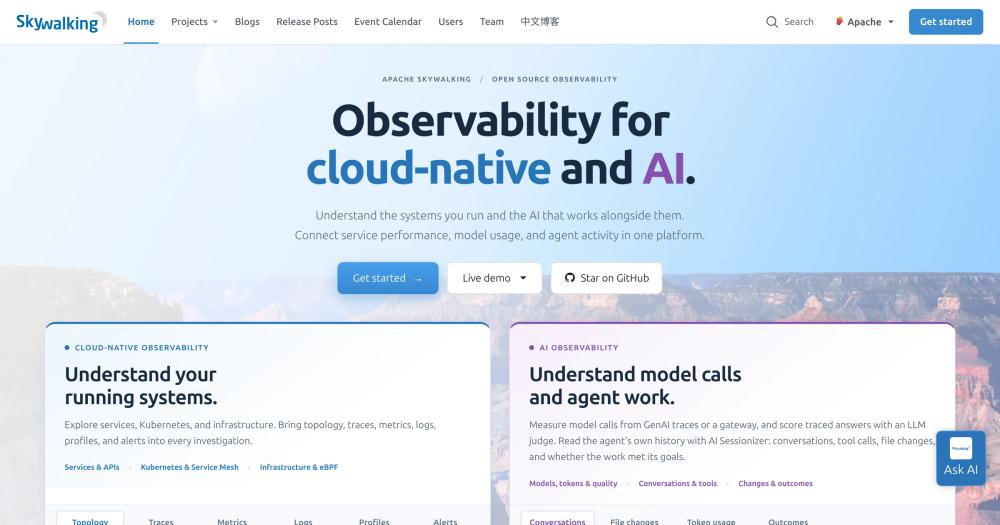
Monitor distributed systems, cloud-native infrastructure, and AI agents with traces, metrics, logs, profiling, and topology maps.

Visit websiteGitHub25K starsDeploy on Hostinger
image of Apache SkyWalking
TL;DR

Apache SkyWalking is an APM and observability platform for cloud-native microservices, Kubernetes, and AI agent monitoring. It replaces paid tools like Datadog and Dynatrace with a fully self-hosted, Apache-2.0 licensed system covering distributed tracing, metrics, logs, profiling, and AI session replay. Best for platform teams and AI engineers who need full-stack telemetry without per-host vendor pricing.

Read the full breakdownHide the full breakdownWho it is for, how it works, trade-offs, the quick start and the FAQ
who it's for

Who Apache SkyWalking is for#

Platform engineers monitoring Kubernetes microservices

SkyWalking maps service dependencies automatically and provides end-to-end traces without manually correlating logs across services. The Rover eBPF agent adds kernel-level profiling for CPU and network performance without modifying service code, covering the gap between application and infrastructure monitoring.

Skip if:

If your team has no in-house platform engineering capacity to manage a Java-based APM backend, a managed SaaS like Datadog or New Relic will have lower operational overhead, though at higher subscription cost.

AI engineering teams tracing model calls and agent sessions

AI Sessionizer replays Claude Code, Kiro, and LangChain agent conversations alongside token usage, tool calls, and file changes. GenAI traces measure per-model-call latency and an LLM judge scores answer quality, all in the same platform as cloud-native infrastructure monitoring.

Skip if:

If you only need model call latency and token counts with no interest in correlating AI activity to infrastructure metrics, a lightweight LLM observability tool focused solely on AI will have a simpler setup.

Teams migrating off Datadog or New Relic

Services already instrumented with OpenTelemetry SDKs can redirect OTLP data to SkyWalking with minimal changes. SkyWalking converts OTLP traces to service metrics and topology maps, covering the main APM use cases without reinstrumenting every service.

Skip if:

If your team relies on Datadog's integrated security monitoring, synthetic testing, or CI visibility, SkyWalking does not cover those use cases out of the box and a migration would leave those gaps unfilled.

the problem

The problem it solves#

Running distributed systems on Kubernetes means a single user request can touch dozens of services, pods, and infrastructure components. When something slows down or breaks, finding which hop introduced the latency or the error without purpose-built tooling means manually correlating logs across services, which does not scale.

Paid observability platforms solve this but charge per host, per log ingested, or per span indexed, with costs that grow in proportion to the system being monitored. Teams that run large Kubernetes clusters or high-throughput services often face four- to five-figure monthly bills for observability alone. SkyWalking offers the same distributed tracing, topology mapping, and alerting in a system you deploy and run yourself, with no per-unit pricing.

how Apache SkyWalking solves it

How it solves it#

Distributed Tracing with Service Topology

End-to-end tracing follows requests across every service in a distributed system, building topology maps that show dependencies, call rates, and error rates. Agents cover Java, .NET Core, Node.js, Go, Python, PHP, Lua, Rust, and C++; OpenTelemetry OTLP instrumentation works alongside native agents for the same metrics and topology.

AI Agent Monitoring via AI Sessionizer

AI Sessionizer replays conversations from Claude Code, Kiro, and LangChain/LangGraph agents alongside their token usage, tool calls, file changes, and outcome judgments. GenAI traces measure individual model calls and an LLM judge scores answer quality, giving teams full visibility from infrastructure to AI outputs.

eBPF Profiling with Rover Agent

The Rover agent uses eBPF to profile Kubernetes deployments and diagnose CPU and network performance without modifying application code. It monitors Istio and Envoy service meshes, including Istio Ambient, providing kernel-level observability for teams that cannot or do not want to instrument every service.

OpenTelemetry and Multi-Ecosystem Integration

SkyWalking accepts data from OpenTelemetry, Prometheus, Zipkin, Zabbix, Fluentd, and Telegraf through the same metrics pipeline, normalizing formats so existing telemetry infrastructure does not need to be replaced. OTLP traces are converted into service metrics and topology maps automatically.

BanyanDB Native Observability Database

BanyanDB is SkyWalking's purpose-built storage backend for observability data, designed to ingest, analyze, and store telemetry. A single SkyWalking cluster can handle over 100 billion telemetry events, based on published capacity figures from the project. Created in 2022, BanyanDB replaces the need for external storage backends in full-stack deployments.

ML-Based Alerting and Metric Baselines

Machine learning identifies patterns in observability data to automatically calculate metric baselines for intelligent alerting. HTTP URI patterns are recognized automatically, reducing the manual configuration needed to set meaningful alert thresholds as services evolve and traffic patterns shift.

strengths · trade-offs

Strengths and trade-offs#

Strengths

  • Apache-2.0 License with No Vendor FeesApache-2.0 permits commercial use, modification, and distribution without any licensing fees. Teams running large Kubernetes clusters avoid the per-host, per-log, or per-span pricing of Datadog, Dynatrace, or New Relic, where costs scale with the size of the system being monitored.
  • Full-Stack Observability Including AI WorkloadsSkyWalking covers the same observability pillars as paid APM platforms: distributed tracing, infrastructure metrics, log management, profiling, and alerting. Adding AI agent monitoring in the same system means teams do not need separate tooling for LLM workloads alongside their cloud-native infrastructure.
  • Ten-Plus Years in Production, 1,040 ContributorsThe project has been in active production use since 2015 and counts over 1,040 contributors. With 25,000 GitHub stars and 22 open issues at the time of writing, the codebase is actively maintained and widely deployed in production environments across hundreds of companies and organizations.
  • OpenTelemetry-Native Without Lock-InServices instrumented with OpenTelemetry SDKs work with SkyWalking without additional changes. Teams migrating off a commercial APM can point existing OTLP collection at a SkyWalking backend rather than a vendor-managed one, keeping instrumentation changes minimal and reversible.

Trade-offs

  • -Java Backend Requires Operational InvestmentSkyWalking runs as a Java-based backend cluster, which introduces JVM tuning, storage management for BanyanDB, and ongoing operational work. Teams without in-house platform engineering capacity may find the initial setup and ongoing tuning more demanding than a managed SaaS APM tool.
  • -Full-Platform Configuration Has a Learning CurveSkyWalking has many configurable components: agents, the OAP server, BanyanDB, Horizon UI, and optional Grafana integration. Setting up a production-grade deployment that covers all telemetry types requires reading the official documentation and understanding the data flow between components.
versus alternatives

Apache SkyWalking vs alternatives#

Apache SkyWalking vs Datadog

Both cover distributed tracing, infrastructure metrics, log management, and alerting for cloud-native systems. The fundamental difference is deployment model: SkyWalking is self-hosted under Apache-2.0, while Datadog is a managed platform with per-host and per-log-ingest pricing.

FeatureApache SkyWalkingDatadog
LicenseApache-2.0Proprietary
Self-hostingYesNo
AI agent monitoringYes (AI Sessionizer)Limited
PricingInfrastructure cost onlyPer-host/per-log

SkyWalking is the stronger choice when costs scale with cluster size and per-host or per-log billing would become prohibitive. Datadog is worth considering when you need its integrated security monitoring, synthetic testing, or CI visibility, and your team prefers a fully managed service over running a backend APM cluster.

Apache SkyWalking vs New Relic

New Relic and SkyWalking cover the same observability pillars. SkyWalking runs on your infrastructure under Apache-2.0; New Relic is a managed SaaS with per-data-ingest pricing. Teams already on OpenTelemetry can redirect OTLP data to SkyWalking without reinstrumenting services.

FeatureApache SkyWalkingNew Relic
LicenseApache-2.0Proprietary
Self-hostingYesNo
OpenTelemetryNative OTLPSupported
AI observabilityGenAI traces, AI SessionizerLimited
PricingInfrastructure cost onlyPer GB ingested

New Relic is the better fit when you need synthetic monitors, full-stack observability with minimal configuration, or your team cannot take on the operational work of running a backend APM cluster.

Apache SkyWalking vs Dynatrace

Both target enterprise observability for cloud-native and Kubernetes environments. Dynatrace's OneAgent handles auto-instrumentation at the host level; SkyWalking uses per-language agents or OpenTelemetry. Both support service mesh monitoring and eBPF-level profiling.

FeatureApache SkyWalkingDynatrace
LicenseApache-2.0Proprietary
Self-hostingYesManaged/on-prem options
eBPF profilingYes (Rover)Yes (OneAgent)
AI-driven baselinesYesYes (Davis AI)
PricingInfrastructure cost onlyPer host unit

Dynatrace is a better fit when you need AI-driven root cause analysis (Davis AI), no-touch auto-instrumentation across a large estate, or enterprise support contracts. SkyWalking requires more manual configuration but provides full data ownership and no per-host licensing.

install · quick start

Quick start#

bash
Self-hosting Apache SkyWalking uses Docker with the official OAP server and Horizon UI images.

```bash
docker run -d --name skywalking-oap -p 11800:11800 -p 12800:12800 apache/skywalking-oap-server:latest
docker run -d --name skywalking-ui -p 8080:8080 --link skywalking-oap -e SW_OAP_ADDRESS=http://skywalking-oap:12800 apache/skywalking-ui:latest
```
tech stack · detected from GitHub

What it's built on#

Languages
Java
Frameworks
Flask
frequently asked

FAQ#

Does Apache SkyWalking support OpenTelemetry instrumentation?

Yes. SkyWalking accepts OTLP traces, metrics, and logs natively, so services instrumented with OpenTelemetry SDKs work without additional agents. SkyWalking converts OTLP traces into its topology and service metrics format, giving teams the same dependency maps and dashboards they would get from native agents. Both instrumentation paths produce the same topology and metrics output.

What is AI Sessionizer and which AI agents does it support?

AI Sessionizer is a component that collects conversation history from AI coding agents and replays it alongside token usage, tool calls, file changes, and outcome judgments. It currently supports Claude Code, Kiro, and LangChain/LangGraph agents. Conversations and their metrics reach SkyWalking over OTLP. The outcome judgment feature uses an LLM judge to assess whether the agent's work met its stated goals.

What database does SkyWalking use to store telemetry data?

SkyWalking ships with BanyanDB, a purpose-built observability database created by the project in 2022 to ingest, analyze, and store telemetry at scale. The platform also supports Elasticsearch and other compatible backends, giving teams the option to use existing storage infrastructure rather than adopting BanyanDB alongside a new deployment.

Is Apache SkyWalking free for commercial use?

Yes. SkyWalking is licensed under Apache-2.0, which permits commercial use, modification, and distribution without licensing fees. There are no per-host, per-log, or per-span charges, and there is no commercial tier that restricts what the open source version can do. The only costs are the infrastructure you choose to run it on.

How does SkyWalking compare to Datadog and New Relic in feature coverage?

SkyWalking and Datadog/New Relic cover similar ground: distributed tracing, infrastructure metrics, log management, profiling, and alerting. The main difference is deployment model and cost structure. SkyWalking runs on your infrastructure under Apache-2.0 at no per-unit cost, while Datadog and New Relic are managed platforms with subscription pricing that scales with usage. SkyWalking adds AI agent monitoring that neither managed platform covers fully; Datadog adds integrated security monitoring and synthetic testing that SkyWalking does not.

also worth a look

Similar open-source tools#

Checkmk

Alternative toDatadog

Hybrid IT monitoring with auto-discovery and 2,000+ integrations.

  • 2,643 GitHub stars
  • GPL-2.0Licence GPL-2.0

Uptrace

Alternative toDatadog

Self-hosted APM for distributed traces, metrics, and logs.

  • 4,311 GitHub stars
  • AGPL-3.0Licence AGPL-3.0

ClickStack

Alternative toDatadog

Self-hosted observability stack on ClickHouse with session replay

  • 10,031 GitHub stars
  • MITLicence MIT

Prometheus

Alternative toDatadog

Time series monitoring with a dimensional model and PromQL query language.

  • 67,616 GitHub stars
  • Apache-2.0Licence Apache-2.0

ClawTrace

Alternative toLangSmith

Visualize agent execution trees and track token costs per step

  • 47 GitHub stars
  • Apache-2.0Licence Apache-2.0

Stakpak

Alternative toDatadog

Open source agent that automates app deployment and monitoring

  • 1,855 GitHub stars
  • Apache-2.0Licence Apache-2.0
by category

Open source tools in these categories#

188

Security & Monitoring

REA (Reverse Engineer Anything), RustDesk, Sherlock
129

DevOps & CI/CD

Nvm, Uptime Kuma, Netdata
625

Developer Tools

Skills for Real Engineers, REA (Reverse Engineer Anything), superpowers
Hostinger

Self-host Apache SkyWalking on a Hostinger VPS

Keep it running 24/7, even when your laptop is off. A Hostinger VPS gives it a server of its own.

  1. 01

    Choose a plan

    Starts from $6.49/mo

  2. 02

    Apply

    Extra 10% off yearly plans

  3. 03

    Install Apache SkyWalking

    On a server that stays on

  4. 04

    Start building

    Focus on the app, not the server

Deploy on Hostinger

Sponsors

Inbox Zero

Alternative toSuperhuman

AI email assistant that drafts replies and clears your inbox

  • 12,987 GitHub stars
  • AGPL-3.0Licence AGPL-3.0
  • #Email

rakazo

Alternative toGrok Bot

AI teammates you own: your keys, your model, your machine.

  • 7,869 GitHub stars
  • Apache-2.0Licence Apache-2.0
  • #AI Agents

SnitchFeed

Live monitoring on LinkedIn, X, Reddit & more. Agentic social listening for startups.

Marketing & Growth

Advertise your product

New open source projects by email

The projects we add and every new guide. Free, unsubscribe any time.

Find open source alternatives to paid software

/
  • Claude Code to OpenCode
  • Jira to Windshift
  • Notion to AppFlowy
  • Slack to Mattermost
  • Linear to GitLab
  • Wispr Flow to Handy
  • Arc to Zen Browser
  • CapCut to Concat
  • Grok Bot to rakazo
  • Superhuman to Inbox Zero
  • Airtable to AITable
  • Muse to OpenClaw
  • Railway to Coolify
  • GitHub Copilot to Cline
  • Datadog to Netdata
  • Confluence to Wiki.js
  • Discord to Fluxer
  • Microsoft Teams to Rocket.Chat
  • 1Password to KeePassXC
  • Firebase to Supabase
  • Pinecone to Qdrant
  • Zapier to n8n
  • Devin AI to OpenHands
  • Asana to Leantime