Open Source Alternatives
  • Alternatives
  • Categories
    Categories by size1,302 projects
    • Developer Tools673
    • AI & Machine Learning549
    • Business & Productivity311
    • Web Development219
    • Security & Monitoring198
    • Communication & Collaboration168
    • IT Management165
    • Design & Creative145
    • LLMOps & AI Tooling142
    • DevOps & CI/CD141
    Browse all 21 categoriesCloud & Hosting, Product & Project Management and 9 more
  • Blog
  • Advertise
SearchNotion, Slack, password manager.../
Submit
Open Source Alternatives
  • Alternatives
    • Developer Tools673
    • AI & Machine Learning549
    • Business & Productivity311
    • Web Development219
    • Security & Monitoring198
    • Communication & Collaboration168
    • Browse all 21 categories
  • Blog
  • Advertise
Submit your project

New open source projects by email

The projects we add and every new guide. Free, unsubscribe any time.

Open Source Alternatives LogoOpen Source Alternatives

Handpicked Open Source Alternatives to Paid Softwares

Add Open Source Alternatives as a preferred source on Google

Product

  • Categories
  • Tag
  • Advertise

Resources

  • Blog
  • Collection
  • Submit

Company

  • Privacy Policy
  • Terms of Service
  • Refund Policy
  • Sitemap

Alternatives

  • Claude Code
  • Jira
  • Notion
  • Slack
  • Linear
  • Wispr Flow
  • All alternatives
© 2026 Open Source Alternatives. All rights reserved.
Open SourceAlternatives
Home/Categories/Developer Tools/Aws Emulator
icon of Aws Emulator

Aws Emulator

Open source alternative to LocalStack Enterprise

  • 9.1K stars
  • CC0-1.0
  • Active this week
  • Last commit today

Last verified Nov 18, 2026

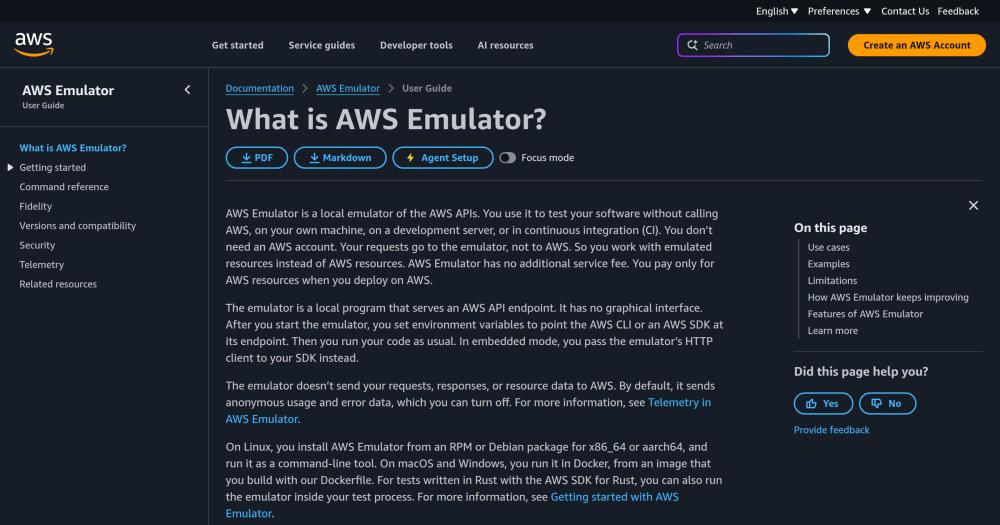
Run AWS API tests locally without an AWS account; point any AWS SDK or CLI at the emulator to get matching validation and error behavior.

Visit websiteGitHub9.1K starsDeploy on Hostinger
Image for Aws Emulator
TL;DR

Aws Emulator is a local emulator of the AWS APIs, built by Amazon and released under CC0, that lets you run integration tests against emulated AWS services without an account or network connection. It replaces commercial alternatives like LocalStack Enterprise for teams that need reliable API emulation in local development and CI/CD without a managed service fee. The emulator keeps all resources in memory, works with any AWS SDK or CLI through environment variable configuration, and includes an embedded mode for in-process Rust tests. Best for backend engineers and CI pipelines that need AWS integration tests to run offline at zero additional cost.

Read the full breakdownHide the full breakdownWho it is for, how it works, trade-offs, the quick start and the FAQ
who it's for

Who Aws Emulator is for#

Backend engineers writing AWS integration tests

Run integration tests against emulated S3, DynamoDB, SQS, and other services on your machine without an AWS account. Set environment variables to point the AWS SDK at the local endpoint, run your existing test suite, and catch API-shape errors and cross-service issues before they reach staging.

Skip if:

Your tests require accurate IAM policy evaluation or behavior that varies by AWS region. The emulator does not enforce IAM and verifies behavior only against us-west-2.

CI/CD pipelines running offline integration tests

Add the emulator to a CI container and run your AWS integration tests with no AWS credentials and no outbound calls. Each test run gets a fresh emulator with clean in-memory state, making test results deterministic and removing the risk of test pollution from shared AWS test accounts.

Skip if:

Your pipeline already tests against a live AWS test account and your team is satisfied with the cost and reliability of that approach.

Teams prototyping AWS-backed apps with AI coding agents

Install the aws-emulator skill in an AI coding agent using the AWS CLI, then let the agent build and interact with AWS-dependent applications locally before any deployment. The agent can set up the emulator, run your code against it, and iterate on the design without touching AWS resources.

Skip if:

Your prototyping workflow does not use an AI coding agent or the aws-agent-toolkit CLI. The skill-based setup requires AWS CLI 2.35.0 or later.

Engineers learning AWS APIs before going live

Create and query S3 buckets, DynamoDB tables, and other services locally without an AWS account. The emulator returns the same validation errors AWS returns, including error codes and message text, so the API patterns you learn on the emulator transfer directly to production.

Skip if:

You need to test behavior that varies across AWS regions or verify service quotas. The emulator uses a single-region, single-account context and has no quota enforcement.

the problem

The problem it solves#

Testing code that calls AWS services requires either an AWS account with live resources, or mocking the AWS SDK. Live accounts incur costs and require network access, making integration tests slow and unreliable in CI environments. SDK mocks only test your own code's behavior, not the actual responses, error shapes, and validation logic AWS applies. A test that passes against a mock may fail against the real API when field names, error codes, or cross-service behavior differ.

The gap is widest in continuous integration, where AWS credentials may not be available, and in local development, where spinning up a real DynamoDB table or S3 bucket for every test run adds friction and unpredictable cost. Teams work around this with brittle per-service fake implementations, shared test accounts with credential management overhead, or by skipping integration tests entirely and catching AWS-specific bugs only after deployment.

how Aws Emulator solves it

How it solves it#

SDK and CLI endpoint redirection

Point any AWS SDK or CLI at the emulator by setting environment variables, with no code changes needed. Your requests go to the local endpoint instead of AWS, and you get back the same response shapes and validation errors. Works with every AWS SDK that supports endpoint overrides.

Embedded mode for Rust tests

For tests written in Rust with the AWS SDK for Rust, the emulator runs in-process, one isolated instance per test. You pass the emulator's HTTP client directly to the SDK client, with no endpoint URL, certificate, or environment variable setup required. Each test gets a clean state automatically.

AI-maintained service coverage

The service implementations are maintained by AI agents and updated multiple times a day. Each service is a separate Rust crate compiled from a Smithy model that drives the wire protocol, so API shapes stay accurate as AWS adds and changes endpoints. Fidelity scores are published with each release on the GitHub releases page.

Per-test clean state

The emulator keeps all resources in memory and clears them when it stops. Starting the emulator fresh for each test run guarantees isolation. You can also set --idle-timeout to stop it automatically after a period of inactivity, keeping CI environments clean without manual teardown.

Controllable telemetry

Telemetry is on by default, sending anonymous usage and error data to AWS with no personal or request data included. You can disable it with the --telemetry off flag, an environment variable (EMULATOR_TELEMETRY=off), a config file (~/.aws/emulator/config.toml), or the embedded API when building the emulator into a tool.

strengths · trade-offs

Strengths and trade-offs#

Strengths

  • Zero additional cost with CC0 licenseAWS Emulator is released under CC0, the public domain dedication, which waives all copyright restrictions. Anyone can run it, modify it, and use it commercially with no attribution required. You pay nothing for the emulator itself, and no service fees accrue until you deploy to actual AWS.
  • Maintained by the cloud providerAWS Emulator is built and maintained by Amazon, the same team that builds and runs the services it emulates. API shapes, error codes, and validation rules come from the same engineers who write the production implementations, reducing the risk of emulation drift over time.
  • Continuous AI-driven updatesAI agents update the service implementations multiple times a day, tracking AWS API changes without waiting for a release cycle. The fidelity scores published with each release on the GitHub releases page give you a concrete measure of how closely each service matches AWS at that version.
  • No data leaves your machineRequests, responses, and resource data never reach AWS. The emulator runs entirely locally, making it safe for air-gapped environments and codebases that handle sensitive data. Anonymous telemetry is the only outbound traffic, and it can be disabled with one flag or environment variable.

Trade-offs

  • -IAM policies are not evaluatedThe emulator does not evaluate AWS Identity and Access Management policies or resource-based policies the way AWS does. Requests succeed or fail based on API syntax and service logic, not permission checks. Do not use it to test whether your IAM setup blocks or allows specific operations.
  • -Single region and account scopeThe emulator accepts any region and account ID in a request but does not keep resources separate by region or account. For tests that need to verify cross-region or multi-account isolation, you need to run a separate emulator instance per region, each on its own port.
  • -In-memory state clears on restartAll resources the emulator creates are held in memory and deleted when the process stops. You cannot persist emulated infrastructure across runs. For tests that rely on pre-existing state, that state must be created fresh at the start of every test session.
  • -Fidelity varies by serviceHow closely each service matches AWS depends on the service and the specific feature. Some services are fully emulated; others have documented gaps tracked in the repository's issues/ directory. Check the fidelity scores published with each release before assuming a specific API operation will behave identically to AWS.
versus alternatives

Aws Emulator vs alternatives#

AWS Emulator vs LocalStack Enterprise

Both tools emulate AWS APIs locally for development and testing, but they come from different origins and serve different workflows.

FeatureAWS EmulatorLocalStack Enterprise
LicenseCC0 (public domain)Proprietary
Self-hostingYes (Linux package, Docker)Yes (with paid tier)
IAM policy simulationNoYes
Web UI / consoleNoYes
Team collaborationNoYes
PricingFreePaid subscription
Maintained byAmazon (AWS team)Third party

AWS Emulator is built and maintained by Amazon, the same team that builds the production AWS services. Validation logic, error codes, and API shapes come directly from the source. It has no service fee and is released under CC0. Its scope is narrower than LocalStack Enterprise, with no IAM simulation, no web UI, and no team collaboration features. For teams whose main need is offline API emulation in CI and local development, AWS Emulator covers that use case at zero cost.

LocalStack Enterprise is a commercial platform built by a third party that has been operating in this space for several years. It adds IAM policy simulation, a visual web console for browsing emulated resources, team-level features, and broader community documentation. Teams that need those capabilities, or that are already invested in LocalStack's tooling ecosystem, will find LocalStack Enterprise worth the subscription cost. The trade-off is a paid license and a dependency on a third-party managed service rather than the cloud provider's own tooling.

For most teams writing integration tests or running CI pipelines, AWS Emulator is the first tool to try given its zero cost and official provenance. LocalStack Enterprise makes sense when IAM testing, the web console, or team collaboration features are requirements.

install · quick start

Quick start#

bash
Download AWS Emulator for Linux as an RPM or Debian package from GitHub Releases: https://github.com/aws/aws-emulator/releases/latest
tech stack · detected from GitHub

What it's built on#

Languages
Rust
frequently asked

FAQ#

Does AWS Emulator match AWS exactly?

Not exactly. How closely the emulator matches AWS varies by service and feature. The fidelity scores published with each release on the GitHub releases page show which operations are fully emulated and which have documented gaps. Individual gaps are tracked in the repository's issues/ directory under issues/things-that-do-not-work/. The emulator is verified against us-west-2 only; regional differences in service availability are not reflected.

Can I use AWS Emulator to test IAM permissions?

No. The emulator does not evaluate IAM or resource-based policies the way AWS does. Requests that would fail due to insufficient permissions in AWS may succeed in the emulator. Use it to test your application code's AWS API calls, not to verify that your permission setup is correct.

How do I point my AWS SDK at the emulator?

Set the endpoint URL environment variable for your SDK to the emulator's local address. The emulator serves HTTPS on 127.0.0.1:9297 when started from source; the exact port depends on how you launch it. After setting the environment variable, your existing code calls the emulator with no code changes. The official AWS Emulator User Guide covers setup instructions for each SDK.

Is AWS Emulator free to use, including for commercial projects?

Yes. AWS Emulator is released under CC0, the public domain dedication. Amazon has waived all copyright and related rights worldwide, so you can run it, modify it, and use it commercially with no attribution required. No trademark or patent rights are granted by the CC0 waiver. You cannot use the AWS name or logo in ways that imply Amazon endorsement, and no Amazon patent rights are transferred.

Does AWS Emulator work on macOS and Windows?

On macOS and Windows, you run AWS Emulator in Docker using the official Dockerfile from the repository. On Linux, you install it directly from an RPM or Debian package for x86_64 or aarch64. For Rust projects, embedded mode is supported on Linux only when building from source; most other users install a prebuilt package or use Docker.

also worth a look

Similar open-source tools#

Spinifex

Alternative toAWS

Run AWS workloads on your own hardware, free and open-source.

  • 422 GitHub stars
  • AGPL-3.0Licence AGPL-3.0

Aspire

InDeveloper Tools

Code-first distributed app orchestration with built-in observability.

  • 6,434 GitHub stars
  • MITLicence MIT

Alchemy

Alternative toPulumi Cloud

Type-safe cloud infrastructure and app logic in one TypeScript program

  • 1,972 GitHub stars
  • Apache-2.0Licence Apache-2.0

FckSignups

InCustomer Support

Open-source tools that work instantly, no signup required

  • 4,588 GitHub stars
  • GPL-3.0Licence GPL-3.0

Dbos Transact Java

Alternative toTemporal Cloud

Postgres-native durable workflows for Java, no orchestrator required.

  • 248 GitHub stars
  • MITLicence MIT

Arcane

Alternative toPortainer Business

Docker management UI with remote agents and container auto-updates.

  • 9,332 GitHub stars
  • BSD-3-ClauseLicence BSD-3-Clause
by category

Open source tools in these categories#

673

Developer Tools

REA (Reverse Engineer Anything), Skills for Real Engineers, superpowers
135

Cloud & Hosting

dify, RuView, OmniRoute
93

Backend Development

graphify, dify, Rust
141

DevOps & CI/CD

Nvm, Uptime Kuma, Netdata
Hostinger

Self-host Aws Emulator on a Hostinger VPS

Keep it running 24/7, even when your laptop is off. A Hostinger VPS gives it a server of its own.

  1. 01

    Choose a plan

    Starts from $6.49/mo

  2. 02

    Apply

    Extra 10% off yearly plans

  3. 03

    Install Aws Emulator

    On a server that stays on

  4. 04

    Start building

    Focus on the app, not the server

Deploy on Hostinger

Sponsors

Inbox Zero

Alternative toSuperhuman

AI email assistant that drafts replies and clears your inbox

  • 13,058 GitHub stars
  • AGPL-3.0Licence AGPL-3.0
  • #Email

rakazo

Alternative toGrok Bot

AI teammates you own: your keys, your model, your machine.

  • 8,913 GitHub stars
  • Apache-2.0Licence Apache-2.0
  • #AI Agents

SnitchFeed

Live monitoring on LinkedIn, X, Reddit & more. Agentic social listening for startups.

Marketing & Growth

Advertise your product

New open source projects by email

The projects we add and every new guide. Free, unsubscribe any time.

Find open source alternatives to paid software

/
  • Claude Code to OpenCode
  • Jira to Windshift
  • Notion to AppFlowy
  • Slack to Mattermost
  • Linear to GitLab
  • Wispr Flow to Handy
  • Arc to Zen Browser
  • CapCut to Concat
  • Grok Bot to rakazo
  • Superhuman to Inbox Zero
  • Discord to Stoat
  • Airtable to AITable
  • Datadog to SigNoz
  • Muse to OpenClaw
  • Railway to Coolify
  • GitHub Copilot to Cline
  • Confluence to Wiki.js
  • Microsoft Teams to Rocket.Chat
  • 1Password to KeePassXC
  • Firebase to Supabase
  • Pinecone to Qdrant
  • Zapier to n8n
  • Devin AI to OpenHands
  • Asana to Leantime