Open Source Alternatives
  • Alternatives
  • Categories
    Categories by size1,235 projects
    • Developer Tools635
    • AI & Machine Learning530
    • Business & Productivity298
    • Web Development217
    • Security & Monitoring191
    • Communication & Collaboration167
    • IT Management158
    • LLMOps & AI Tooling135
    • DevOps & CI/CD132
    • Cloud & Hosting131
    Browse all 21 categoriesDesign & Creative, Product & Project Management and 9 more
  • Blog
  • Advertise
SearchNotion, Slack, password manager.../
Submit
Open Source Alternatives
  • Alternatives
    • Developer Tools635
    • AI & Machine Learning530
    • Business & Productivity298
    • Web Development217
    • Security & Monitoring191
    • Communication & Collaboration167
    • Browse all 21 categories
  • Blog
  • Advertise
Submit your project

New open source projects by email

The projects we add and every new guide. Free, unsubscribe any time.

Open Source Alternatives LogoOpen Source Alternatives

Handpicked Open Source Alternatives to Paid Softwares

Add Open Source Alternatives as a preferred source on Google

Product

  • Categories
  • Tag
  • Advertise

Resources

  • Blog
  • Collection
  • Submit

Company

  • Privacy Policy
  • Terms of Service
  • Refund Policy
  • Sitemap

Alternatives

  • Claude Code
  • Jira
  • Notion
  • Slack
  • Linear
  • Wispr Flow
  • All alternatives
© 2026 Open Source Alternatives. All rights reserved.
Open SourceAlternatives
Home/Categories/AI & Machine Learning/Extremely Autonomous Agents
icon of Extremely Autonomous Agents

Extremely Autonomous Agents

Open source alternative to Relevance AI and CrewAI

  • 1 stars
  • AGPL-3.0
  • Active this week
  • Last commit today

Last verified Nov 13, 2026

Run a self-hosted fleet of autonomous AI agents, each with its own job, tools, and schedule, on the AI you already have.

Visit websiteGitHub1 starsDeploy on Hostinger
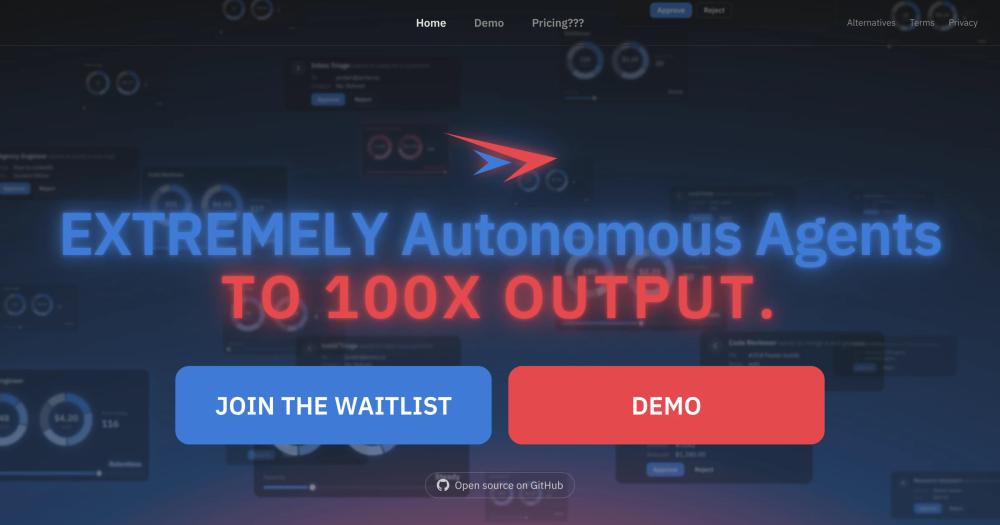
image of Extremely Autonomous Agents
TL;DR

Extremely Autonomous Agents is a free, AGPL-3.0-licensed desktop app launching 1 December 2026 that runs a fleet of autonomous AI agents on your own computer. It replaces managed agent platforms like Relevance AI and CrewAI by keeping agents local and running on the AI you already have (a Claude, ChatGPT, or Copilot plan; API keys from Anthropic, OpenAI, Google, or others; or local models via Ollama), with no additional charge per run for self-hosters. Best for small business operators who need scheduled background agents across sales, marketing, and support without paying managed-service fees on top of their existing AI subscriptions.

Read the full breakdownHide the full breakdownWho it is for, how it works, trade-offs, the quick start and the FAQ
who it's for

Who Extremely Autonomous Agents is for#

Small business operators running scheduled outreach or support agents

Set up an Outreach agent with the customer contacts it needs, configure each tool at the approval level that fits (logged for research, awaiting approval for anything sent externally), and let it run on a schedule. The Agency Engineer builds any missing CRM or email connection when asked, and the Agency Doctor keeps the agent running cleanly.

Skip if:

Running the app today requires cloning the repository and starting Node services manually. Wait for the 1 December 2026 release build if terminal setup is not an option, or use the hosted managed plan from the makers.

Developers integrating MCP-native agents into AI workflows

Because the agency speaks MCP natively, it plugs into Claude Desktop, Cursor, and VS Code as a tool server. Developers building AI-assisted workflows can delegate persistent background tasks (research, monitoring, outreach) to the agency and query or approve actions from their existing editor without switching contexts.

Skip if:

If your workflow is single-shot or synchronous, a direct API call or a simpler script is faster. Extremely Autonomous Agents is built for persistent scheduled agents, not one-off queries that return immediately.

Teams running AI agents on a private or local LLM

Any OpenAI-compatible endpoint works as an agent model, so a team running LM Studio, vLLM, or a private Azure OpenAI deployment can configure agents on their own models without sending data to a cloud provider. The fallback chain (up to three models per agent) keeps the fleet running if one endpoint goes down.

Skip if:

If your agents require specific capabilities only available from a major provider's proprietary API (fine-tuned models, multimodal actions beyond standard text), you will need to wire those endpoints separately. The integration supports standard OpenAI-compatible text endpoints.

the problem

The problem it solves#

Running AI agents for real business work is expensive if you rely on managed platforms. Commercial services add their own monthly fees on top of the AI you are already paying for, and they route your business data through shared cloud infrastructure where you do not control what gets stored or for how long. Teams running outreach, support triaging, or internal research through a managed agent service end up paying twice: once for the underlying model and once for the agent layer.

The deeper problem is coordination. Getting persistent scheduled agents to actually run across sales, marketing, support, and engineering requires stitching together a scheduler, an AI API, a workflow engine, and an approval layer. When one piece breaks, debugging is fragmented. Teams end up spending more time maintaining the automation than the automation saves them.

how Extremely Autonomous Agents solves it

How it solves it#

BYO AI: subscriptions, API keys, or local models

Agents connect to the AI you already have: a ChatGPT, Claude, or Copilot subscription; an API key from Anthropic, OpenAI, Google, OpenRouter, xAI, Mistral, DeepSeek, Groq, or any OpenAI-compatible endpoint (Azure OpenAI, Together, Fireworks, LM Studio, vLLM); or a local model through Ollama. Each agent holds up to three models and falls back to the next if one fails, so a quota hit or outage does not stop the fleet.

Per-tool approval levels

Every tool an agent uses has a configurable level: silent (runs without telling you), logged (runs and records what it did), or awaiting approval (waits for a human to confirm before acting). Anything that reaches outside the business (an email, a post, a payment) starts on approval by default. You change levels at any time without restarting the agent.

Agency Engineer: self-extending tool connections

When an agent needs a capability it does not have, it files a request. The built-in Agency Engineer finds or builds the connection (HTTP, MCP, or a sandboxed code plugin) and tests it with your keys before asking you to approve giving it to the agents that need it. New plugins are reviewed by an independent check before they reach agents.

Agency Doctor: automated fleet health checks

A built-in health monitor runs every couple of hours and scans the whole fleet for things nobody asks about: loops, busywork, the same error repeating. When it finds a problem, it gets the agent fixed rather than waiting for a human to notice. The check covers every agent in the fleet, not just the ones that have recently errored.

MCP integration with Claude Desktop, Cursor, and VS Code

Talk to your agency from Claude Desktop, Cursor, VS Code, Claude Code, or any app that speaks MCP. You can query what a sales agent did today, approve a pending email, or give the research agent a new job from your editor. Settings > Connectors wires up Claude Desktop or Cursor in one click; anywhere else takes `npx -y @extremely-agency/mcp`.

Multi-user organizations with an encrypted relay

Create an organization, invite members by email, and host the agency on one computer. Members connect from their own devices through an end-to-end encrypted relay. For teams that prefer fully on-premise setup, local accounts work without the relay, so no external backend is required.

strengths · trade-offs

Strengths and trade-offs#

Strengths

  • Zero per-run cost on self-hosted deploymentsBecause agents run locally on your own AI subscriptions or API keys, there is no additional charge per task or agent run. You pay whatever your LLM provider charges for tokens; the agent layer is free for self-hosters under AGPL-3.0. Managed platforms add their own layer on top of the same underlying model costs.
  • Business data stays on your machineThe agency server runs on your own computer. Business data, customer contacts, and internal docs fed to agents do not leave your infrastructure unless an agent explicitly sends them somewhere you approve. The approval gate on outbound actions (email, posts, payments) is on by default, so nothing goes external without your sign-off.
  • Any OpenAI-compatible endpoint works as an agent modelTeams running LM Studio, vLLM, a private Azure OpenAI deployment, or any other OpenAI-compatible endpoint can configure agents on their own models without exposing data to a cloud LLM provider. The fallback chain (up to three models per agent) keeps the fleet running if one endpoint goes down or hits a rate limit.
  • Agent configuration in plain text filesEach agent is defined by three files: CHARTER.md, TOOLS.yaml, and KPI.yaml. These are version-controllable, diff-able, and readable without any proprietary tooling. Ready-made agent packs for sales, marketing, support, finance, and engineering are available to add without writing from scratch.

Trade-offs

  • -No packaged installer until 1 December 2026As of November 2026, the desktop app has not yet launched. Running it requires Node 24, cloning the repository, and starting the agency server and desktop app manually in separate terminals. Users uncomfortable with running Node services from a terminal should wait for the December 1 release build or try the browser demo at extremely.agency/demo.
  • -24 open issues on a three-week-old repositoryThe repository opened 27 October 2026 and already has 24 open issues as of 13 November 2026. This is a high ratio for a project less than three weeks old, indicating active development alongside open bug reports and feature requests. The team is committing actively, but the codebase has not reached a stable release.
  • -AGPL-3.0 restricts running a modified version as a serviceAGPL-3.0 is permissive for self-hosting and internal team use at no cost. The restriction applies if you run a modified version as a managed service for others outside your organization: in that case you must publish your source changes under the same license. Teams wanting to build a hosted offering on top of this codebase need a commercial license from the makers or must publish their modifications.
versus alternatives

Extremely Autonomous Agents vs alternatives#

Extremely Autonomous Agents vs Relevance AI

Relevance AI is a managed cloud platform where technical teams build and deploy AI agents for business work. Extremely Autonomous Agents runs the same kind of fleet on your own computer. The choice comes down to data location and pricing model.

FeatureExtremely Autonomous AgentsRelevance AI
LicenseAGPL-3.0Paid platform
DeploymentRuns on your computerManaged cloud
Data locationStays on your machineThird-party infrastructure
AI modelYour subscriptions, keys, or local modelsManaged model providers
PricingFree (self-hosted)Subscription
SetupNode 24 and source checkoutWeb-based

Extremely Autonomous Agents is the better choice when your business data must stay off third-party infrastructure, when you want to use existing AI subscriptions rather than paying an additional managed-service fee, or when you want agents running on a private or local model. Relevance AI is the better choice for teams that need a polished web interface with no local infrastructure requirements and are comfortable with a managed service handling their agent compute.

Extremely Autonomous Agents vs CrewAI

CrewAI is an enterprise platform and framework for developers building multi-agent systems with defined roles, tasks, and tools. Extremely Autonomous Agents ships as a desktop application with a visual interface, approval workflows, and a built-in scheduler, aiming at operators who want agents running out of the box rather than a framework to build orchestration code on top of.

FeatureExtremely Autonomous AgentsCrewAI
LicenseAGPL-3.0Enterprise platform (paid)
DeploymentSelf-hosted desktop appManaged cloud
AI modelYour own subscriptions, keys, or OllamaManaged integrations
Data locationStays on your computerCloud infrastructure
ConfigurationPlain text filesCode-defined agents
Target userOperators, small teamsDevelopers, enterprise teams

Extremely Autonomous Agents is the better choice for small teams and operators who want scheduled agents without writing orchestration code and who want to bring their own AI without added platform fees. CrewAI is the better choice for engineering teams that need code-level control over multi-agent orchestration and want enterprise support options.


install · quick start

Quick start#

bash
Install the agency from source with Node 24; start the server and the desktop app each in their own terminal.

```bash
git clone https://github.com/maxkxd/extremely-autonomous-agents
cd extremely-autonomous-agents/apps/server && npm install && npm run dev
```
tech stack · detected from GitHub

What it's built on#

Languages
JavaScriptTypeScript
Frameworks
ElectronReact
Databases
PostgreSQL
Tooling
esbuild
frequently asked

FAQ#

Does it require an API key, or can I use my ChatGPT or Claude subscription?

No API key is required if you have a ChatGPT, Claude, or Copilot plan. The app supports subscription-based plans from those providers as well as API keys from Anthropic, OpenAI, Google, OpenRouter, xAI, Mistral, DeepSeek, Groq, and any OpenAI-compatible endpoint. Local models through Ollama also work. Each agent can use up to three models and falls back to the next if one is unavailable.

Is there a hosted option, or does it only run on my own computer?

Both. The self-hosted path runs the agency on your computer and is free under AGPL-3.0. The makers offer a managed hosted plan at $16.58 per month (billed $199 per year), where they run the agency for you so your computer does not need to stay on. Your API keys and data stay encrypted on the managed plan.

When is the downloadable app available?

The packaged desktop app for Windows and Mac is scheduled to launch on 1 December 2026. Until then, running it requires Node 24 and starting the server and frontend from the repository. A live demo at extremely.agency/demo lets you try the full app with sample agents in a browser without installing anything.

What does AGPL-3.0 mean for running this for my own business?

AGPL-3.0 is permissive for internal use. You can run the app unmodified or modified on your own computer or server for your own business at no cost, and share it with your team. The restriction applies when you run a modified version as a service for others outside your organization: in that case you must publish your source code changes under the same license. Running it internally for your own team has no such requirement.

Can multiple people in a team use the same agency?

Yes. Create an organization in the app, invite members by email, and host the agency on one computer. Members connect from their own devices through an end-to-end encrypted relay. For teams that prefer a fully on-premise setup with no external relay, local accounts work, but all members must be able to reach the host machine on their network.

also worth a look

Similar open-source tools#

LobeHub

Alternative toRelevance AI

AI agent team operator with IM gateway and persistent memory.

  • 84,888 GitHub stars
  • CustomLicence Apache-2.0 with LobeHub Community License additional terms

Langflow

Alternative toRelevance AI

Visual AI workflow builder that deploys as an API or MCP server.

  • 156,573 GitHub stars
  • MITLicence MIT

agentswarms

Alternative toCrewAI

Self-hosted AI agents, swarms, RAG, and BI in one platform

  • 298 GitHub stars
  • CustomLicence Elastic License 2.0 (ELv2)

dify

Alternative toRelevance AI

Visual AI workflow builder with RAG, agents, and self-hosting

  • 160,957 GitHub stars
  • CustomLicence Apache-2.0 with additional terms

OpenBot

Alternative toGrok Bot

AI coworkers you can trust with real work

  • 11,400 GitHub stars
  • MITLicence MIT

OpenCompany

Alternative toMicrosoft Copilot Studio

Self-hosted AI agent canvas for every business function

  • 1,082 GitHub stars
  • MITLicence MIT
by category

Open source tools in these categories#

530

AI & Machine Learning

freeCodeCamp, REA (Reverse Engineer Anything), OpenClaw
298

Business & Productivity

OpenClaw, Excalidraw, RustDesk
135

LLMOps & AI Tooling

Hermes Agent, OpenCode, MarkItDown
Hostinger

Self-host Extremely Autonomous Agents on a Hostinger VPS

Keep it running 24/7, even when your laptop is off. A Hostinger VPS gives it a server of its own.

  1. 01

    Choose a plan

    Starts from $6.49/mo

  2. 02

    Apply

    Extra 10% off yearly plans

  3. 03

    Install Extremely Autonomous Agents

    On a server that stays on

  4. 04

    Start building

    Focus on the app, not the server

Deploy on Hostinger

Sponsors

Inbox Zero

Alternative toSuperhuman

AI email assistant that drafts replies and clears your inbox

  • 12,987 GitHub stars
  • AGPL-3.0Licence AGPL-3.0
  • #Email

rakazo

Alternative toGrok Bot

AI teammates you own: your keys, your model, your machine.

  • 7,869 GitHub stars
  • Apache-2.0Licence Apache-2.0
  • #AI Agents

SnitchFeed

Live monitoring on LinkedIn, X, Reddit & more. Agentic social listening for startups.

Marketing & Growth

Advertise your product

New open source projects by email

The projects we add and every new guide. Free, unsubscribe any time.

Find open source alternatives to paid software

/
  • Claude Code to OpenCode
  • Jira to Windshift
  • Notion to AppFlowy
  • Slack to Mattermost
  • Linear to GitLab
  • Wispr Flow to Handy
  • Arc to Zen Browser
  • CapCut to Concat
  • Grok Bot to rakazo
  • Superhuman to Inbox Zero
  • Discord to Stoat
  • Airtable to AITable
  • Datadog to SigNoz
  • Muse to OpenClaw
  • Railway to Coolify
  • GitHub Copilot to Cline
  • Confluence to Wiki.js
  • Microsoft Teams to Rocket.Chat
  • 1Password to KeePassXC
  • Firebase to Supabase
  • Pinecone to Qdrant
  • Zapier to n8n
  • Devin AI to OpenHands
  • Asana to Leantime