Open Source Alternatives
  • Alternatives
  • Categories
    Categories by size1,066 projects
    • Developer Tools540
    • AI & Machine Learning468
    • Business & Productivity250
    • Web Development205
    • Security & Monitoring162
    • Communication & Collaboration144
    • IT Management140
    • Cloud & Hosting123
    • LLMOps & AI Tooling122
    • Data & Analytics115
    Browse all 21 categoriesProduct & Project Management, Design & Creative and 9 more
  • Blog
  • Advertise
SearchNotion, Slack, password manager.../
Submit
Open Source Alternatives
  • Alternatives
    • Developer Tools540
    • AI & Machine Learning468
    • Business & Productivity250
    • Web Development205
    • Security & Monitoring162
    • Communication & Collaboration144
    • Browse all 21 categories
  • Blog
  • Advertise
Submit your project

New open source projects by email

The projects we add and every new guide. Free, unsubscribe any time.

Open Source Alternatives LogoOpen Source Alternatives

Handpicked Open Source Alternatives to Paid Softwares

Product

  • Categories
  • Tag
  • Advertise

Resources

  • Blog
  • Collection
  • Submit

Company

  • Privacy Policy
  • Terms of Service
  • Refund Policy
  • Sitemap

Alternatives

  • Claude Code
  • Jira
  • Notion
  • Slack
  • Linear
  • Wispr Flow
  • All alternatives
© 2026 Open Source Alternatives. All rights reserved.
Open SourceAlternatives
Home/Categories/Customer Support/Freescout
icon of Freescout

Freescout

Open source alternative to Help Scout, Zendesk, Freshdesk and Front

  • 4.6K stars
  • AGPL-3.0
  • Active this week
  • Last commit today

Last verified Nov 5, 2026

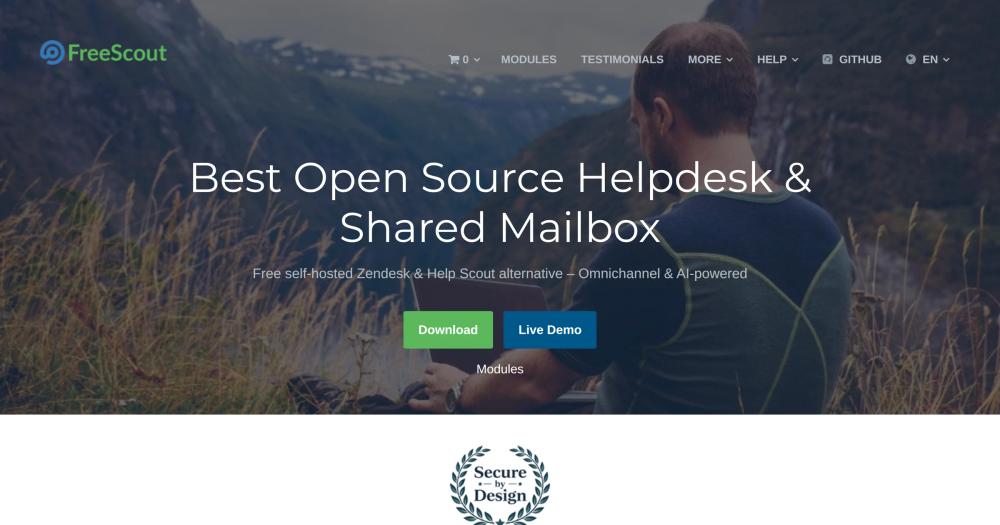
Manage customer support tickets and shared inboxes in a self-hosted help desk built on PHP and Laravel, with unlimited agents and no per-seat pricing.

Visit websiteGitHub4.6K starsDeploy on Hostinger
image of Freescout
TL;DR

Freescout is a self-hosted PHP help desk and shared inbox that replaces Help Scout and Zendesk for teams that need unlimited agents without per-seat pricing. It runs on any server with PHP and MySQL, supports email, WhatsApp, Telegram, Facebook, and live chat in one queue, and ships with a web-based installer and updater. AGPL-3.0 licensed. Best for small to mid-size support teams managing multiple mailboxes who need a real ticketing system without a subscription fee.

Read the full breakdownHide the full breakdownWho it is for, how it works, trade-offs and the FAQ
who it's for

Who Freescout is for#

Small teams leaving Help Scout or Zendesk over per-seat costs

FreeScout covers email ticketing, assignment, internal notes, collision detection, and notifications, which are the core features most small support teams use daily on Help Scout or Zendesk. Moving to a self-hosted FreeScout eliminates the per-seat bill while keeping the same workflow.

Skip if:

Skip if your team is not comfortable managing a PHP/MySQL server or paying a managed hosting provider. The savings only materialize if you can handle uptime and updates.

Agencies managing support for multiple clients

Separate mailboxes let agencies run distinct support queues per client from a single FreeScout installation, with agents assigned to specific mailboxes. Clients never see each other's tickets. The unlimited agent model means adding a client account does not trigger a new seat charge.

Skip if:

Skip if each client requires complete data isolation in separate databases or separate deployments. FreeScout's mailbox separation is logical, not physical.

Teams running omnichannel support across email and messaging

The module system adds WhatsApp, Telegram, Facebook, Slack, and Live Chat alongside standard email into the same ticket queue. Agents work from one inbox regardless of channel. This suits teams where customers contact support through multiple channels and agents need context across all of them.

Skip if:

Skip if you need native integrations to CRMs or billing systems out of the box. FreeScout connects via Zapier and Make, but deep CRM sync requires a module or custom work.

Privacy-conscious businesses keeping data on their own infrastructure

Every ticket, customer email, and agent note stays on the server you control. FreeScout makes no outbound connections to external services unless you install a module that does. For businesses with legal, regulatory, or customer commitments about where support data is stored, that is the simplest architecture.

Skip if:

Skip if data residency requirements mandate a certified provider (SOC 2, HIPAA, ISO 27001). FreeScout carries no compliance certifications; you are responsible for your own infrastructure's compliance.

the problem

The problem it solves#

Help desk software charges per agent. As a team grows, the per-seat model means the monthly bill rises with every new support rep added, with no flat-rate option on tools like Help Scout or Zendesk's standard tiers. Teams that want to give everyone on staff access to the support queue face a direct tradeoff between headcount and software cost.

The practical result is that many teams keep support inboxes small, hand off to a shared Gmail account, or accept feature-stripped free tiers that lack assignment, collision detection, or proper reporting. Email threads get lost. Two agents reply to the same customer. Internal notes pile up in a separate chat tool. The workflow breaks down in ways that affect customer experience before the team is large enough to justify a paid seat for everyone involved.

how Freescout solves it

How it solves it#

Omnichannel inbox

Centralizes customer conversations from email (SMTP, IMAP, POP3), WhatsApp, Telegram, Facebook, Slack, and Live Chat into one queue. Agents see all channels in the same interface without switching between apps. Channel integrations come through FreeScout's module system, which also supports Microsoft Office 365 and Google Workspace OAuth authentication.

Unlimited agents, tickets, and mailboxes

No seat limits on agents, no caps on tickets or mailboxes. The entirety of FreeScout's functionality is available to every agent, including assignment, internal notes, collision detection, and notifications. Teams commonly run multiple mailboxes per installation to separate support queues by product, department, or client.

Module system for extended functionality

Official and community modules add capabilities beyond the core: WhatsApp, Telegram, Live Chat, S3 storage, Zapier, Make (Integromat), and more. The module system means the core stays lightweight while teams add only what they need. A developer community maintains a range of community modules alongside the official set.

AI-powered reply drafting

An AI integration module enables reply drafting with AI assistance from within the conversation view. The feature is modular, so teams that prefer not to use it can skip the module entirely. This keeps the core help desk install light for teams that do not need AI-assisted drafting.

Progressive Web App with push notifications

FreeScout's Progressive Web App installs from the browser on iOS, Android, macOS, and desktop. It supports Web Push notifications, so agents receive alerts for new conversations and assignments without needing a native app. Native Android and iOS apps are also available for agents who prefer them.

Web-based installer and updater

FreeScout includes a browser-based installer that handles database setup and initial configuration, and a web updater for applying new versions without shell access. This makes FreeScout accessible on shared hosting plans where SSH is unavailable, since it only requires PHP and MySQL running on a standard web host.

strengths · trade-offs

Strengths and trade-offs#

Strengths

  • No per-agent pricing: flat infrastructure costCommercial help desks charge per seat; FreeScout has no seat limit. Every agent gets full access at no incremental cost, so the software bill stays flat as the team grows. The only costs are infrastructure and, optionally, a managed hosting fee.
  • Runs on shared hosting with no minimum resourcesFreeScout is a pure PHP/MySQL application with no minimum CPU or RAM requirements. Per the README, it runs on shared hosting plans, not just VPS or cloud servers. That makes it accessible to smaller teams and agencies with existing hosting infrastructure who cannot justify a dedicated server.
  • Actively maintained with a low open issue countThe repository had 4,639 stars at time of research, with the last commit on 2026-11-04. The open issue count was 17, excluding pull requests. For a PHP help desk with 743 forks, a 17-issue backlog indicates an actively maintained codebase.
  • AGPL-3.0 permits free internal commercial useAGPL-3.0 permits running FreeScout internally for any commercial purpose at no cost, including handling customer support for a commercial product. The restriction applies only when distributing a modified version as a hosted service to others: they must release source changes. Internal use has no such restriction.

Trade-offs

  • -AGPL-3.0 blocks resale as a managed serviceIf you plan to offer FreeScout as a hosted help desk service to paying customers, the AGPL-3.0 license requires publishing your source modifications. Managed service providers and SaaS companies reselling a hosted FreeScout instance cannot do so as a closed proprietary offering. Teams running it internally for their own customer support are not affected.
  • -PHP web server setup requiredFreeScout requires Nginx or Apache, PHP 7.4-8.x, and MySQL 5.0+, MariaDB, or PostgreSQL. That is straightforward for teams with PHP hosting experience or a panel like cPanel, but it adds setup work for teams whose infrastructure runs Node.js or Python stacks. Docker images are available, but initial configuration still requires understanding the PHP web stack.
  • -No managed SaaS option from the projectFreeScout has no managed cloud tier from the project itself. Teams that want a fully managed support inbox with no infrastructure responsibility will need to use a third-party managed host like Pikapods or Cloudron, or run it on a VPS they maintain themselves. Uptime, backups, and updates are the team's responsibility.
versus alternatives

Freescout vs alternatives#

FreeScout vs Help Scout

FreeScout and Help Scout both center on shared email inboxes for support teams. Help Scout is a managed SaaS service with per-seat pricing; FreeScout is self-hosted with no seat limits.

FeatureFreeScoutHelp Scout
LicenseAGPL-3.0Proprietary
HostingSelf-hostedSaaS only
PricingFree (server costs only)Per-seat subscription
Agent limitsUnlimitedPer plan
OmnichannelYes, via modulesLimited
Mobile appsNative + PWAYes

FreeScout is the better choice when per-agent pricing is a barrier to giving every support rep an account, when data privacy requires keeping tickets on your own server, or when you need omnichannel channels beyond email without add-on fees. Help Scout is worth considering when you need a zero-maintenance inbox with no server to manage and strong third-party CRM integrations available out of the box.

FreeScout vs Zendesk

Zendesk is an enterprise support ticket system with per-seat pricing and a large integration ecosystem. FreeScout covers the email ticketing workflow that most small and mid-size teams use, without Zendesk's pricing complexity or enterprise feature overhead.

FeatureFreeScoutZendesk
LicenseAGPL-3.0Proprietary
HostingSelf-hostedSaaS only
PricingFree (server costs only)Per-seat subscription
Agent limitsUnlimitedPer plan
OmnichannelYes, via modulesYes
Compliance certificationsNoneSOC 2, HIPAA (higher tiers)

FreeScout is the better fit for teams that want a full ticketing system without Zendesk's enterprise pricing. Zendesk is worth considering when you need enterprise compliance certifications (SOC 2, HIPAA), deep CRM automation, or Zendesk's AI features, and the per-seat cost fits your team's budget.

tech stack · detected from GitHub

What it's built on#

Languages
PHP
Frameworks
Laravel
frequently asked

FAQ#

Is FreeScout free to use?

Yes. FreeScout is AGPL-3.0 licensed and free to self-host with no agent limits or feature paywalls. You pay only for the server you run it on. Managed hosting through providers like Pikapods or Cloudron adds a small hosting fee, but the software itself is free. The AGPL-3.0 license permits internal commercial use without restriction.

What server do I need to run FreeScout?

Any server or shared hosting plan with Nginx or Apache, PHP 7.4-8.x, and MySQL 5.0+, MariaDB 5.0+, or PostgreSQL. FreeScout has no minimum CPU or RAM requirements, so it runs on even modest shared hosting. A web-based installer handles initial configuration, and a web updater applies future releases without shell access.

Can I migrate from Zendesk or Help Scout to FreeScout?

FreeScout's website lists a migration tool at freescout.net/migrate that imports from other help desks. The specifics of supported formats and ticket history import depend on the migration tool, so check the documentation for your current platform before committing to the move.

Does FreeScout support email through Office 365 or Google Workspace?

Yes. FreeScout supports modern OAuth authentication for both Microsoft Office 365 and Google Workspace, in addition to standard SMTP, IMAP, and POP3 connections. OAuth is the recommended path for accounts where basic authentication has been disabled by the email provider.

Are there mobile apps for FreeScout agents?

Yes. FreeScout has native Android and iOS apps, and a Progressive Web App that installs from the browser on any device with Web Push notification support. Both the mobile apps and the PWA support the same functionality and modules as the web version.

also worth a look

Similar open-source tools#

UVdesk

Alternative toZendesk

Helpdesk and ticketing on PHP/Symfony with workflow automation

  • 19,594 GitHub stars
  • OSL-3.0Licence OSL-3.0

Chatwoot

Alternative toZendesk

Self-hosted customer support platform with live chat and AI

  • 38,732 GitHub stars
  • MITLicence MIT

UnInbox

Alternative toFront

Open source collaborative email with shared team inboxes

  • 1,758 GitHub stars
  • AGPL-3.0Licence AGPL-3.0

Vela

Alternative toGoogle Maps

OpenStreetMap and Google data, no account, no Play Services

  • 2,396 GitHub stars
  • GPL-3.0Licence GPL-3.0

FckSignups

InCustomer Support

Open-source tools that work instantly, no signup required

  • 4,539 GitHub stars
  • GPL-3.0Licence GPL-3.0

go-whatsapp-web-multidevice

Alternative toTwilio

Self-hosted WhatsApp REST API with multi-account and webhook support

  • 4,987 GitHub stars
  • MITLicence MIT
by category

Open source tools in these categories#

31

Customer Support

agency-agents, iptv, Twenty
144

Communication & Collaboration

freeCodeCamp, iptv, Excalidraw
Hostinger

Self-host Freescout on a Hostinger VPS

Keep it running 24/7, even when your laptop is off. A Hostinger VPS gives it a server of its own.

  1. 01

    Choose a plan

    Starts from $6.49/mo

  2. 02

    Apply

    Extra 10% off yearly plans

  3. 03

    Install Freescout

    On a server that stays on

  4. 04

    Start building

    Focus on the app, not the server

Deploy on Hostinger

Sponsors

Inbox Zero

Alternative toSuperhuman

AI email assistant that drafts replies and clears your inbox

  • 12,889 GitHub stars
  • AGPL-3.0Licence AGPL-3.0
  • #Email

rakazo

Alternative toGrok Bot

AI teammates you own: your keys, your model, your machine.

  • 6,568 GitHub stars
  • Apache-2.0Licence Apache-2.0
  • #AI Agents

SnitchFeed

Live monitoring on LinkedIn, X, Reddit & more. Agentic social listening for startups.

Marketing & Growth

Advertise your product

New open source projects by email

The projects we add and every new guide. Free, unsubscribe any time.

Find open source alternatives to paid software

/
  • Claude Code to OpenCode
  • Jira to Windshift
  • Notion to AppFlowy
  • Slack to Mattermost
  • Linear to GitLab
  • Wispr Flow to Handy
  • Arc to Zen Browser
  • CapCut to Concat
  • Grok Bot to rakazo
  • Superhuman to Inbox Zero
  • Airtable to AITable
  • Muse to OpenClaw
  • Railway to Coolify
  • GitHub Copilot to Cline
  • Datadog to Netdata
  • Confluence to Wiki.js
  • Microsoft Teams to Rocket.Chat
  • Pinecone to Qdrant
  • Zapier to n8n
  • 1Password to KeePassXC
  • Devin AI to OpenHands
  • Firebase to Supabase
  • Contentful to Strapi
  • Adobe Premiere Pro to Shotcut