

Who FunClip is for#
Content creators clipping Chinese-language video highlights
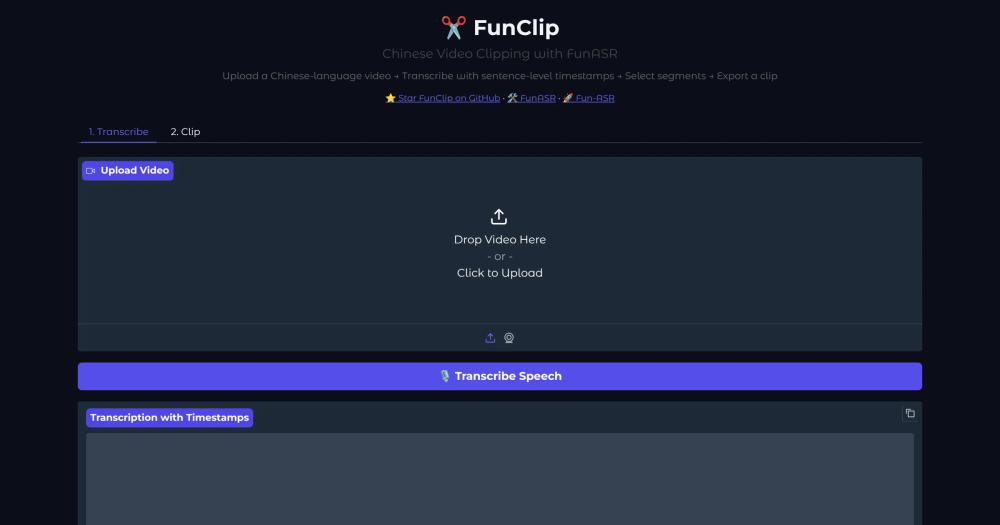
Upload a long interview, conference talk, or podcast episode, run ASR, then select the specific sentences you want to keep. FunClip generates the clipped video and its SRT file in one step, without needing a separate editing tool for basic cuts.
Skip if:
If your source video is primarily English and you need the highest possible ASR accuracy, a Whisper-based tool may produce better transcripts for the clipping step.
Researchers and journalists handling sensitive footage
All processing runs locally with no external API calls for the core ASR and clipping workflow. Footage from interviews, legal proceedings, or proprietary corporate content stays on your machine throughout the entire process.
Skip if:
Skip FunClip if you need cloud collaboration on transcripts, where multiple editors review and annotate the same video remotely in a shared workspace.
Developers building multilingual video processing pipelines
FunClip's command-line interface supports scripted recognition and clipping as separate stages, making it composable with other Python tooling. The Gradio service can also run on a dedicated server and be accessed via browser over a LAN using the listen flag.
Skip if:
If you need real-time streaming transcription rather than file-based batch processing, FunClip is not designed for that use case.
Teams using LLM-driven video summarization
FunClip passes the full SRT subtitle file to a connected LLM (Qwen, GPT, or MiniMax M2.7) and uses the model's output to automatically select and clip the most relevant segments. This eliminates manual segment selection for long recordings where you want an AI-generated highlight reel.
Skip if:
LLM-assisted clipping requires an API key for the chosen LLM provider. If you need a fully offline pipeline with no external API calls, use standard transcript-based clipping instead.
The problem it solves#
Cloud transcription and clipping tools bill by the minute and require uploading footage to third-party servers. For teams handling confidential interviews, research sessions, or sensitive video content, that data exposure is a real problem. Services like Trint and Taption charge subscription fees that compound quickly for anyone transcribing more than a few hours per month.
Manual clipping without transcription is slow: you watch the video, mark in and out points, export, and repeat for every segment. When the footage is in a language with limited tooling, or when you need to clip a specific speaker rather than a specific time range, the problem gets worse. Most paid tools offer no speaker-based clipping at all.
How it solves it#
FunASR Paraformer Speech Recognition
Uses Alibaba's Paraformer-Large model, one of the highest-accuracy open-source Chinese ASR models with over 13 million downloads on Modelscope. Produces sentence-level timestamps that feed directly into the clipping workflow, so the text you select maps precisely to the video segment.
Speaker Diarization and Speaker-Based Clipping
Integrates the CAM++ speaker recognition model to identify individual speakers in the video. Once the transcript is labeled by speaker ID, you can clip all segments from a specific speaker (for example, 'spk0') or combine multiple speakers into a single export.
LLM-Assisted Smart Clipping
Connects to large language models including the Qwen and GPT series and MiniMax M2.7 to automatically select the most relevant segments from the transcript. You provide a prompt; FunClip passes the SRT subtitles to the LLM, which returns timestamps for the clip. The 'AI Clip' button applies those timestamps directly.
SRT Subtitle Generation
Automatically generates two SRT files on each clip: the full-video subtitle file and a targeted subtitle file for the clipped segment. Optional ffmpeg and ImageMagick dependencies let you burn subtitles directly into the exported video.
Multilingual and Multi-Model Support
Supports Chinese (default Paraformer), English (Paraformer English model), and multilingual audio including Japanese and 7 Chinese dialect groups via Fun-ASR-Nano. SenseVoice adds emotion recognition and audio event detection on top of standard speech-to-text output.
Hotword Customization
Uses SeACo-Paraformer to accept user-specified hotwords during ASR, which improves accuracy on entity names, brand names, and technical terms that general models frequently misrecognize. Hotwords are set before recognition and apply to the full transcript.
Strengths and trade-offs#
Strengths
- Fully local processing with no data uploadVideo files are processed entirely on the local machine. No footage is sent to external servers, which matters for interviews, research footage, or any content that cannot leave a controlled environment. Unlike Trint or Taption, there is no cloud storage dependency and no account required.
- MIT license with no usage restrictionsThe source code is MIT licensed, meaning you can run it commercially, modify it, and integrate it into larger pipelines without licensing fees. The bundled Paraformer-Large and CAM++ model weights use Apache 2.0; check the applicable model page before redistribution.
- Active development with versioned releasesVersion 2.1.1 shipped in August 2026, with code pushed as recently as August 3, 2026. The 2.1.0 release introduced a formal versioned release track with checksum-protected archives for stable rollbacks. The project has 6,141 stars and 736 forks on GitHub.
- Text-based and speaker-based clipping in one toolMost transcription tools let you select time ranges. FunClip lets you select by the actual recognized text or by speaker ID, which is faster for long interviews or multi-speaker recordings where you want a specific person's segments without scrubbing through timecode.
Trade-offs
- -Local machine must handle ASR model inferenceRunning Paraformer-Large locally requires enough CPU or GPU memory to load a full ASR model. Lightweight edge machines will be slow. Fun-ASR-Nano is available for smaller hardware but does not provide character-level timestamps, which limits precise text-based clipping.
- -Python environment setup requiredInstallation requires cloning the repository, installing Python dependencies from requirements.txt, and optionally installing ffmpeg and ImageMagick for subtitle burn-in. There is no one-click installer or Docker image in the official instructions. Users unfamiliar with Python environments will need to follow the setup steps carefully.
- -Primary ASR strength is Chinese, not EnglishThe default Paraformer-Large model is trained for Chinese ASR. English is supported via a separate model flag and Fun-ASR-Nano extends to Japanese and dialect groups, but English accuracy does not match specialized English ASR models like Whisper large-v3 for non-Chinese content.
FunClip vs alternatives#
FunClip vs Trint
Trint is a cloud-based transcription and collaborative editing platform. FunClip is a local, open-source alternative that runs entirely on your own hardware with no footage upload.
| Feature | FunClip | Trint |
|---|---|---|
| License | MIT | Proprietary |
| Hosting | Self-hosted, local | Cloud only |
| Pricing | Free (self-hosted) | Subscription |
| Chinese ASR | Paraformer-Large (high accuracy) | General multilingual |
| Speaker diarization | Yes (CAM++ model) | Yes |
| LLM-assisted clipping | Yes | No |
| Offline processing | Yes | No |
FunClip is the stronger choice when your footage cannot leave your own machine, when you process significant volumes of Chinese-language video, or when per-minute cloud billing is a concern. Trint is worth considering when you need collaborative editing where multiple team members review and annotate transcripts in a shared browser-based workspace with a polished editor and no local setup.
FunClip vs Taption
Taption is a cloud transcription service with Chinese language support and video subtitle tools. FunClip runs locally and covers the same core workflow: speech-to-text, subtitle generation, and segment selection.
| Feature | FunClip | Taption |
|---|---|---|
| License | MIT | Proprietary |
| Hosting | Self-hosted | Cloud |
| Pricing | Free | Subscription |
| Offline processing | Yes | No |
| Hotword customization | Yes (SeACo-Paraformer) | Limited |
| LLM clipping | Yes | No |
FunClip's offline processing and hotword customization are advantages over Taption for users handling sensitive content or needing to tune ASR accuracy for specific domain vocabulary. Taption offers a more polished collaborative editing experience and requires no local setup, which suits teams that prefer a managed browser tool.
FunClip vs Exemplary AI
Exemplary AI is an AI-powered video processing service with transcription, clipping, and content repurposing features. FunClip focuses narrowly on transcription-driven clipping with speaker diarization.
| Feature | FunClip | Exemplary AI |
|---|---|---|
| License | MIT | Proprietary |
| Hosting | Self-hosted | Cloud |
| Pricing | Free | Subscription |
| Speaker-based clipping | Yes | Limited |
| Data stays local | Yes | No |
| Content repurposing | No | Yes |
Exemplary AI offers broader content repurposing features beyond clipping, such as generating clips for multiple social formats in one step. FunClip is the better choice when local data control is the priority or when you specifically need speaker-based segment selection rather than format-based repurposing.
Quick start#
Install FunClip by cloning the repository and installing Python dependencies.
```bash
git clone https://github.com/modelscope/FunClip.git
cd FunClip
pip install -r ./requirements.txt
python funclip/launch.py
```What it's built on#
- Languages
- Python
FAQ#
Is FunClip free to use?
Yes. FunClip's source code is MIT licensed and free to run on your own hardware. There are no per-minute fees or subscription tiers. Model weights (Paraformer-Large, SeACo-Paraformer, CAM++) are available under Apache 2.0. Running it locally costs only your own compute.
Does FunClip work with English video?
Yes, with caveats. Pass -l en to load the Paraformer English model, or use Fun-ASR-Nano for multilingual input including English, Japanese, and Chinese dialect groups. For text-based clipping specifically, use Paraformer rather than Fun-ASR-Nano, since the current Nano checkpoint does not provide reliable character-level timestamps.
Can I run FunClip on a server and access it remotely?
Yes. Start the Gradio service with --listen to bind all network interfaces for LAN access. Add --share to create a public Gradio tunnel for access from outside the local network. Without the share flag, the service stays private to your local network.
What video file formats does FunClip support?
FunClip processes video files through ffmpeg, which handles most common formats including MP4, MKV, MOV, and AVI. The core transcription step works on the audio extracted from the video file. Subtitle burn-in into the output video requires both ffmpeg and ImageMagick.
How does FunClip compare to Whisper-based transcription tools?
FunClip uses the FunASR Paraformer models rather than Whisper. Paraformer-Large is one of the highest-accuracy Chinese ASR models available, with over 13 million downloads on Modelscope. It also integrates speaker diarization and hotword customization that Whisper does not provide natively. Whisper generally performs better on English and many non-Chinese languages.
Similar open-source tools#

FckSignups
Open-source tools that work instantly, no signup required

stremio-web
Open source web UI for media streaming, powered by community addons.

fmt
Fast, type-safe C++ formatting that replaces printf and iostreams

agentic-inbox
Self-hosted email client with AI agent on Cloudflare Workers

OpenCompany
Self-hosted AI agent canvas for every business function

dograh
Open source voice agent builder with telephony and BYOK AI support