Open Source Alternatives
  • Alternatives
  • Categories
    Categories by size1,102 projects
    • Developer Tools555
    • AI & Machine Learning470
    • Business & Productivity268
    • Web Development208
    • Security & Monitoring171
    • Communication & Collaboration153
    • IT Management145
    • Cloud & Hosting127
    • LLMOps & AI Tooling122
    • Data & Analytics118
    Browse all 21 categoriesProduct & Project Management, DevOps & CI/CD and 9 more
  • Blog
  • Advertise
SearchNotion, Slack, password manager.../
Submit
Open Source Alternatives
  • Alternatives
    • Developer Tools555
    • AI & Machine Learning470
    • Business & Productivity268
    • Web Development208
    • Security & Monitoring171
    • Communication & Collaboration153
    • Browse all 21 categories
  • Blog
  • Advertise
Submit your project

New open source projects by email

The projects we add and every new guide. Free, unsubscribe any time.

Open Source Alternatives LogoOpen Source Alternatives

Handpicked Open Source Alternatives to Paid Softwares

Product

  • Categories
  • Tag
  • Advertise

Resources

  • Blog
  • Collection
  • Submit

Company

  • Privacy Policy
  • Terms of Service
  • Refund Policy
  • Sitemap

Alternatives

  • Claude Code
  • Jira
  • Notion
  • Slack
  • Linear
  • Wispr Flow
  • All alternatives
© 2026 Open Source Alternatives. All rights reserved.
Open SourceAlternatives
Home/Categories/Data & Analytics/Gramps Web
icon of Gramps Web

Gramps Web

Open source alternative to Ancestry, MyHeritage and Family Tree Maker

  • 1.8K stars
  • AGPL-3.0
  • Active this week
  • Last commit today

Last verified Nov 5, 2026

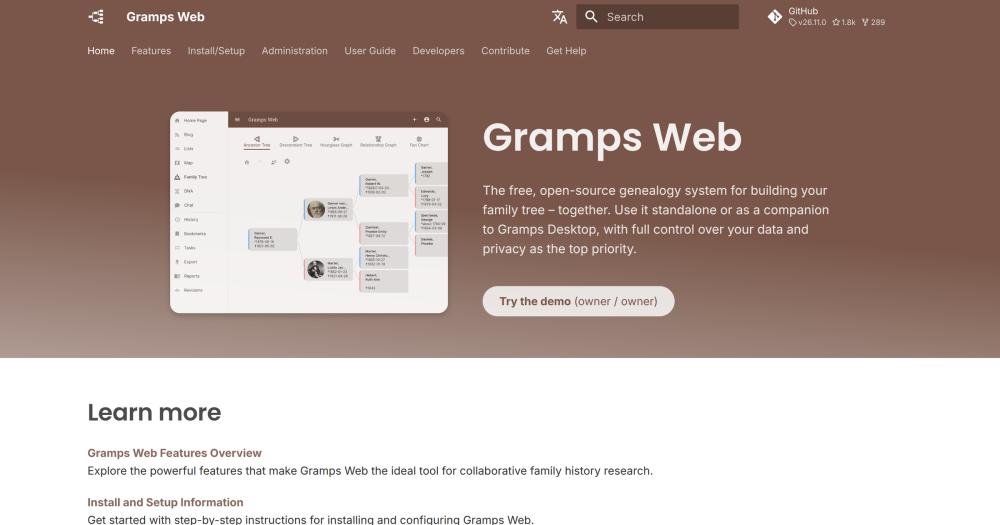
Manage your family tree and genealogy research in a self-hosted web app with collaborative editing, privacy controls, and bidirectional Gramps Desktop sync.

Visit websiteGitHub1.8K starsDeploy on Hostinger
Image for Gramps Web
TL;DR

Gramps Web is a self-hosted, AGPL-3.0 licensed web application for collaborative genealogy, designed as a companion to the Gramps Desktop application with bidirectional database sync. It replaces paid genealogy platforms like Ancestry and MyHeritage for families who want their research data on their own server without a subscription fee. Best for genealogists with existing Gramps databases, families collaborating on multi-generational research, and privacy-conscious researchers who want to keep sensitive family data off third-party servers.

Read the full breakdownHide the full breakdownWho it is for, how it works, trade-offs and the FAQ
who it's for

Who Gramps Web is for#

Genealogists with Existing Gramps Desktop Databases

Researchers who have built up a Gramps Desktop database over years can share it with family by running Gramps Web on a home server or VPS. The bidirectional sync means the existing research workflow does not change, and family members can browse and contribute without installing desktop software.

Skip if:

Users migrating from Ancestry or another commercial platform will need to export their data to GEDCOM first, since Gramps Web does not have direct import paths from commercial platforms. Some media files and source attachments may not transfer cleanly through GEDCOM export.

Families Collaborating on Multi-Generational Research

Multiple family members across different locations can contribute to the same genealogy database in real-time through the web interface. Role-based permissions let the primary researcher control who can edit records versus who can only browse the family tree.

Skip if:

Families who need automated record matching, DNA analysis tools, or access to digitized record databases as part of active research will not find those capabilities in Gramps Web and may need a commercial service for discovery work alongside it.

Privacy-Conscious Researchers Keeping Data Off Third-Party Servers

Genealogy databases often contain sensitive information about living relatives: birth dates, addresses, and family relationships. Gramps Web keeps that data on infrastructure the researcher controls, not on a third-party platform subject to that platform's privacy policies and practices.

Skip if:

Researchers who prioritize ease of use and built-in record access over data location will get more value from Ancestry or MyHeritage than from setting up and maintaining a self-hosted instance.

the problem

The problem it solves#

Most families documenting genealogy end up on commercial platforms like Ancestry or MyHeritage. These services host your data on their servers, control access through paid accounts, and may change terms or pricing over time. For families doing multi-decade research, dependence on a commercial service raises concerns about long-term access, data portability, and privacy for living relatives whose information ends up in the database.

The harder challenge is sharing. Collaborating on a commercial genealogy platform typically requires every contributor to have their own paid account. Researchers who want to keep sensitive family data away from third-party servers have limited options within the commercial genealogy ecosystem without returning to unshared local files.

how Gramps Web solves it

How it solves it#

Bidirectional Gramps Desktop Sync

Data changes made in Gramps Web sync to Gramps Desktop, and changes in Gramps Desktop sync back to the web app. Genealogists who do primary research locally can share results with family members browsing the web interface without manually exporting and re-importing GEDCOM files.

Interactive Family Tree Visualizations

Renders ancestor, descendant, fan, and hourglass charts from the genealogy database. All chart types are interactive and browsable from any web-enabled device, so family members do not need to install desktop software to explore the family tree visually.

Collaborative Multi-User Editing

Multiple users can browse and edit the family tree simultaneously via the web interface. The demo deployment shows four access levels (owner, editor, contributor, member), giving administrators control over who can edit records versus who can only view the database.

Mapping with Historical Overlays

Places in the genealogy database can be visualized on interactive maps, with support for custom historical map overlays. This lets researchers view migration patterns and place relationships across time periods, not just on a modern base map.

Integrated Research Blog

Research findings can be documented in a built-in blog stored directly in the Gramps database. Posts support images and narrative text, keeping source analysis and storytelling alongside the structured genealogy data rather than in a separate notes system.

Advanced Search Across All Record Types

Searches all record types in the genealogy database with support for wildcards and logical operators. The search covers people, places, sources, and media, letting researchers find records by partial information rather than requiring exact name or date matches.

strengths · trade-offs

Strengths and trade-offs#

Strengths

  • Full Data Ownership Under AGPL-3.0The database lives on your server and you retain full control over backups, exports, and sharing. AGPL-3.0 licensing means the source code is auditable and you are not dependent on a commercial provider keeping the service operational or affordable.
  • No Subscription Fees for Self-Hosted DeploymentUnlike paid genealogy services, Gramps Web is free to run on your own hardware. The only costs are your server infrastructure, and the AGPL-3.0 license places no per-seat or usage fees on families running their own instance.
  • Companion to the Leading Open Source Desktop AppThe README describes Gramps Desktop as the leading open source genealogy desktop application. Gramps Web is built to extend it to the web, making the combination the most complete open source genealogy setup available. Existing Gramps Desktop databases import directly.
  • Active Development: 1,803 Stars and Recent CommitsWith 1,803 GitHub stars, 289 forks, and a last commit in November 2026, Gramps Web has an active development community. The project participates in Hacktoberfest and publishes a development board showing prioritized feature work and ongoing contributions.
  • Support for 40 or More LanguagesGramps Web ships with internationalization support covering 40 or more languages across the full interface. This makes it usable by families whose genealogy research spans multiple countries and languages, without requiring custom configuration.

Trade-offs

  • -No Built-In Record Libraries or Hint EngineGramps Web is a database and collaboration layer, not a subscription genealogy research service. It does not include the record libraries, census indexes, or automated hint engines that Ancestry and MyHeritage provide. Researchers who rely on those resources for active discovery will still need a separate commercial subscription.
  • -Docker Deployment Requires Some Technical SetupInstalling Gramps Web requires running Docker containers for both the web frontend and the backend API. This is straightforward for someone with server administration experience but requires following the official documentation carefully. Families without Docker knowledge will need to invest time in learning container basics or find technical assistance.
  • -Frontend and Backend Are Separate ComponentsThe web frontend and the server-side API are maintained in separate GitHub repositories, each with its own issue tracker. The 56 open issues tracked against the frontend repository do not capture issues in the gramps-web-api backend. Troubleshooting a problem may require checking both repositories.
versus alternatives

Gramps Web vs alternatives#

Gramps Web vs Ancestry

Ancestry is a commercial genealogy service with one of the largest digitized record libraries available. The comparison with Gramps Web comes down to data ownership and cost versus record access and guided research hints.

FeatureGramps WebAncestry
LicenseAGPL-3.0Proprietary
Data hostingYour serverAncestry's servers
SubscriptionNoneRequired
Built-in record librariesNoYes
Collaborative editingYesLimited
Data exportFull GEDCOMLimited

Gramps Web is the better choice when data ownership, privacy, and long-term cost matter more than access to Ancestry's record databases. Ancestry is the stronger choice when automated hints, census records, and immigration indexes are the primary tools for active genealogy research.

Gramps Web vs MyHeritage

MyHeritage combines a cloud genealogy service with DNA testing and automated record matching. Like Ancestry, it is a commercial service where the data lives on the platform's servers and access is gated behind a paid account.

FeatureGramps WebMyHeritage
LicenseAGPL-3.0Proprietary
Data hostingYour serverMyHeritage's servers
SubscriptionNoneRequired for most features
DNA toolsNoYes
Collaborative accessYesLimited
Data portabilityFull GEDCOMStandard GEDCOM

Gramps Web is the better fit for researchers who have compiled their family history and want to share it privately without ongoing fees. MyHeritage is the stronger option when DNA matching and global record discovery are active parts of the research workflow.

Gramps Web vs Family Tree Maker

Family Tree Maker is proprietary desktop genealogy software that includes a sync feature for Ancestry.com accounts. Unlike Ancestry and MyHeritage, it is a desktop application rather than a cloud service, which makes the comparison with Gramps Web different in character.

FeatureGramps WebFamily Tree Maker
LicenseAGPL-3.0Proprietary
DeploymentSelf-hosted web appDesktop (Windows/Mac)
Multi-user accessYesNo
Ancestry.com syncNoYes
AccessAny browserDesktop only
CostFree (self-hosted)Paid

Gramps Web is the better choice for collaborative work where multiple people need access from different devices or locations. Family Tree Maker is the better fit for a single researcher who wants deep Ancestry.com integration and a traditional desktop application interface without a web-based setup.

tech stack · detected from GitHub

What it's built on#

Languages
JavaScriptTypeScript
Tooling
Rollup
frequently asked

FAQ#

Is Gramps Web the same as Gramps Desktop?

No. Gramps Desktop is a standalone desktop application for genealogy research. Gramps Web is a separate web application that uses the same Gramps database format and syncs with Gramps Desktop bidirectionally. You can run Gramps Web without Gramps Desktop, but it is designed to complement it for families who want web-based access alongside a local desktop workflow.

Can I import my family tree from Ancestry or MyHeritage into Gramps Web?

Yes, via GEDCOM export. Both Ancestry and MyHeritage support GEDCOM export; download the file from the commercial platform and import it into the Gramps database that Gramps Web uses. Some data may not transfer cleanly through GEDCOM, including media files and source citations stored in platform-specific formats, so plan to review the import manually after bringing the data over.

Does Gramps Web provide access to genealogy record libraries like Ancestry?

No. Gramps Web is a database and collaboration layer, not a genealogy record service. It does not include access to census records, immigration indexes, or automated hint engines. Users who rely on those records for active research will still need subscriptions to commercial services alongside Gramps Web.

How complex is the self-hosted setup for Gramps Web?

Gramps Web runs as Docker containers: one for the web frontend and one for the backend API. Someone familiar with Docker and basic server configuration can follow the official documentation at grampsweb.org and have an instance running. Users without Docker experience will need to learn container basics; a one-click managed hosting path is not documented in the README.

What does the AGPL-3.0 license mean for a family running Gramps Web?

AGPL-3.0 allows you to run Gramps Web on your own server for personal, family, or internal organizational use at no cost. The license requires that if you distribute a modified version as a network service to others outside your organization, you release the source changes. Standard self-hosting for a family does not trigger this requirement.

also worth a look

Similar open-source tools#

Whatsapp Backup Tools

Alternative toiMyfone ChatsBack

Archive and browse WhatsApp backups locally

  • 215 GitHub stars
  • GPL-3.0Licence GPL-3.0

FckSignups

InCustomer Support

Open-source tools that work instantly, no signup required

  • 4,539 GitHub stars
  • GPL-3.0Licence GPL-3.0

Inbox Zero

Featured

Alternative toSuperhuman

AI email assistant that drafts replies and clears your inbox

  • 12,889 GitHub stars
  • AGPL-3.0Licence AGPL-3.0

Buzz

Featured

Alternative toSlack

Self-hosted team chat where people and AI agents work together

  • 36,728 GitHub stars
  • Apache-2.0Licence Apache-2.0

Castopod

Alternative toBuzzsprout

Self-hosted podcast hosting with fediverse social and IABv2 analytics

  • 879 GitHub stars
  • AGPL-3.0Licence AGPL-3.0

Once Campfire

Alternative toSlack

Group chat on your own server, MIT-licensed, no recurring fees.

  • 4,814 GitHub stars
  • MITLicence MIT
by category

Open source tools in these categories#

118

Data & Analytics

Firecrawl, ragflow, Worldmonitor
153

Communication & Collaboration

freeCodeCamp, iptv, Excalidraw
Hostinger

Self-host Gramps Web on a Hostinger VPS

Keep it running 24/7, even when your laptop is off. A Hostinger VPS gives it a server of its own.

  1. 01

    Choose a plan

    Starts from $6.49/mo

  2. 02

    Apply

    Extra 10% off yearly plans

  3. 03

    Install Gramps Web

    On a server that stays on

  4. 04

    Start building

    Focus on the app, not the server

Deploy on Hostinger

Sponsors

Inbox Zero

Alternative toSuperhuman

AI email assistant that drafts replies and clears your inbox

  • 12,889 GitHub stars
  • AGPL-3.0Licence AGPL-3.0
  • #Email

rakazo

Alternative toGrok Bot

AI teammates you own: your keys, your model, your machine.

  • 7,028 GitHub stars
  • Apache-2.0Licence Apache-2.0
  • #AI Agents

SnitchFeed

Live monitoring on LinkedIn, X, Reddit & more. Agentic social listening for startups.

Marketing & Growth

Advertise your product

New open source projects by email

The projects we add and every new guide. Free, unsubscribe any time.

Find open source alternatives to paid software

/
  • Claude Code to OpenCode
  • Jira to Windshift
  • Notion to AppFlowy
  • Slack to Mattermost
  • Linear to GitLab
  • Wispr Flow to Handy
  • Arc to Zen Browser
  • CapCut to Concat
  • Grok Bot to rakazo
  • Superhuman to Inbox Zero
  • Airtable to AITable
  • Muse to OpenClaw
  • Railway to Coolify
  • GitHub Copilot to Cline
  • Datadog to Netdata
  • Confluence to Wiki.js
  • Microsoft Teams to Rocket.Chat
  • Firebase to Supabase
  • Pinecone to Qdrant
  • Zapier to n8n
  • 1Password to KeePassXC
  • Devin AI to OpenHands
  • Asana to Leantime
  • Contentful to Strapi