Open Source Alternatives
  • Alternatives
  • Categories
    Categories by size1,010 projects
    • Developer Tools517
    • AI & Machine Learning446
    • Business & Productivity232
    • Web Development203
    • Security & Monitoring150
    • Communication & Collaboration138
    • IT Management135
    • Cloud & Hosting119
    • LLMOps & AI Tooling116
    • Data & Analytics110
    Browse all 21 categoriesProduct & Project Management, Design & Creative and 9 more
  • Blog
  • Advertise
SearchNotion, Slack, password manager.../
Submit
Open Source Alternatives
  • Alternatives
    • Developer Tools517
    • AI & Machine Learning446
    • Business & Productivity232
    • Web Development203
    • Security & Monitoring150
    • Communication & Collaboration138
    • Browse all 21 categories
  • Blog
  • Advertise
Submit your project

New open source projects by email

The projects we add and every new guide. Free, unsubscribe any time.

Open Source Alternatives LogoOpen Source Alternatives

Handpicked Open Source Alternatives to Paid Softwares

Product

  • Categories
  • Tag
  • Advertise

Resources

  • Blog
  • Collection
  • Submit

Company

  • Privacy Policy
  • Terms of Service
  • Refund Policy
  • Sitemap

Alternatives

  • Claude Code
  • Jira
  • Notion
  • Slack
  • Linear
  • Wispr Flow
  • All alternatives
© 2026 Open Source Alternatives. All rights reserved.
Open SourceAlternatives
Home/Categories/Communication & Collaboration/Omicron
icon of Omicron

Omicron

Open source alternative to Ghost

  • 26 stars
  • AGPL-3.0
  • Active this week
  • Last commit today

Last verified Oct 31, 2026

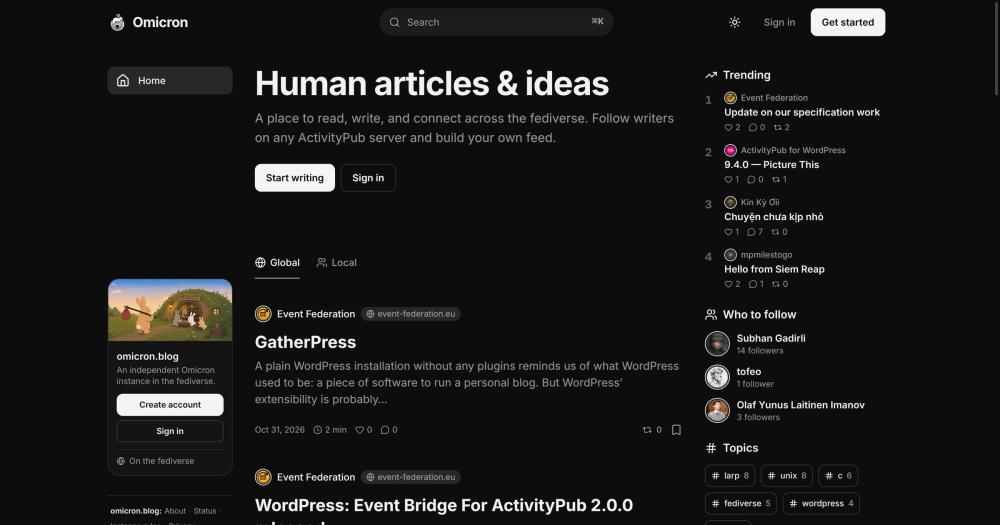
Host a federated blog on the fediverse with full ActivityPub support, a Tiptap editor, and one-command Docker deployment. AGPL-3.0 licensed.

Visit websiteGitHub26 starsDeploy on Hostinger
image of Omicron
TL;DR

Omicron is a self-hostable federated blogging platform that turns your server into an ActivityPub node on the fediverse. It replaces Ghost Pro and similar paid blogging services for writers who want fediverse federation and full data ownership without monthly platform fees. Runs on Docker in one command under an AGPL-3.0 license, with a Tiptap editor, content import from Medium and Substack, and an open client API.

Read the full breakdownHide the full breakdownWho it is for, how it works, trade-offs, the quick start and the FAQ
who it's for

Who Omicron is for#

Writers moving from Substack or Medium who want fediverse presence

Writers leaving Substack or Medium who want their posts to appear in Mastodon feeds and other fediverse timelines benefit from Omicron's built-in ActivityPub federation. Each post federates automatically, and the import tool handles bringing existing content over from those platforms.

Skip if:

If you need subscriber email newsletters, paid member tiers, or a polished analytics dashboard, Omicron does not ship those features yet. A hosted platform like Ghost Pro or Substack covers that workflow today.

Self-hosters building a personal publishing infrastructure

Omicron runs the full blog stack on your own server or VPS with Docker Compose. Automatic TLS setup, self-contained secrets generation, and built-in backup support via restic make it a credible choice for technically comfortable users who want to own their data and infrastructure.

Skip if:

If Docker and basic server administration are unfamiliar, the setup process requires working knowledge of domain DNS and Linux. A managed hosted service is a lower-friction starting point.

Developers building ActivityPub-connected apps

Omicron exposes an open client API with OAuth/PKCE scoped access, allowing external apps to publish, read, and interact with the same APIs as the official clients. The webhook endpoint accepts Markdown posts from any external CMS or static-site pipeline, with title, slug, tags, and upsert semantics.

Skip if:

If you only need ActivityPub outbox federation without a user-facing blog interface, a lighter ActivityPub library may be a simpler fit.

the problem

The problem it solves#

Hosted blogging platforms tie your content, your audience, and your distribution to their infrastructure. Ghost Pro, Substack, and Medium grow expensive as readership scales, and switching platforms means rebuilding your audience from scratch on a new URL.

For writers who want to reach readers across the fediverse, conventional blogging platforms require maintaining a separate social media presence to drive traffic. The pain of migration also compounds vendor dependence. Exporting posts is usually possible, but subscriber lists, SEO history, and social connections typically stay behind when you move.

how Omicron solves it

How it solves it#

ActivityPub Federation

Every Omicron account is an ActivityPub actor with its own @user@your-domain address. Readers on any fediverse server, including Mastodon, Pixelfed, and Misskey, can follow your blog without creating an account on your instance. Follows and posts propagate across the fediverse automatically.

One-Command Docker Deployment

The installer pulls the full stack (Deno backend, SvelteKit frontend, PostgreSQL, Redis, Caddy) with one curl command. Secrets and the database password are generated automatically on first boot. There is nothing to configure before the setup wizard appears at localhost.

Tiptap Editor with Full Markdown Support

Posts are written in a block-style Tiptap editor with full Markdown support. The editor provides a distraction-free writing experience. Draft saving, tags, and a custom slug are available from the same writing interface.

Content Import and Export

Writers can import posts from Medium, Substack, WordPress WXR, or RSS exports from other tools. Full export of posts, drafts, and local images is available from Settings under Content, so moving to or from Omicron does not strand your writing history.

Open Client API with OAuth/PKCE

External apps register with the instance and use scoped OAuth authorization to read, write, and interact via the same APIs as the official clients. Developers can also publish directly via a webhook endpoint by POSTing Markdown with a title, slug, and tags.

strengths · trade-offs

Strengths and trade-offs#

Strengths

  • Fediverse reach without a separate social accountEvery account federates over ActivityPub from the moment the instance starts. Writers get a fediverse address that works across Mastodon and the wider fediverse without any plugin or additional configuration.
  • Single-command install with automatic TLSThe curl-based installer fetches the stack, generates secrets, starts the database, and completes auto-migration before showing the setup wizard. Caddy handles Let's Encrypt certificate issuance automatically when you point a domain at the server.
  • Content portability with no proprietary formatOmicron imports from Medium, Substack, and WordPress WXR exports, and allows full export of posts, drafts, and local images from settings. There is no proprietary storage format that would complicate a future migration to another tool.
  • AGPL-3.0: free to run, fork-friendlyThe project is licensed under AGPL-3.0. Anyone can run it on their own infrastructure at no cost, including for business or team use. If you run a modified version as a public-facing network service, the license requires making your changes available, which keeps contributions flowing back to the project.

Trade-offs

  • -Early-stage project with a small communityOmicron was created in June 2026 and has 26 GitHub stars and 3 forks as of October 2026. The contributor community is still small and the long-term maintenance commitment is unproven for a production blogging deployment. Teams with low tolerance for early-stage software risk should evaluate self-hosted Ghost or a hosted service instead.
  • -No member subscriptions or newsletter deliveryGhost Pro and similar commercial platforms include subscriber management, email newsletter delivery, and paid-member gating out of the box. Omicron does not ship these commerce features. Writers who need a paywall or newsletter pipeline will need to combine it with a separate email service.
  • -Multi-component stack requires server familiarityThe full stack runs Deno, PostgreSQL, Redis, SvelteKit, and Caddy together. The installer abstracts the initial setup, but debugging or scaling individual components requires familiarity with each layer. A single-binary or managed hosting option is not available.
versus alternatives

Omicron vs alternatives#

Omicron vs Ghost

Ghost is the primary paid platform in the blogging space, with both a self-hosted open source version (MIT licensed) and a hosted subscription service, Ghost Pro. Omicron targets the same writer audience but builds ActivityPub federation into the core product from the start.

FeatureOmicronGhost Pro
LicenseAGPL-3.0Proprietary (hosted)
Self-hostingYes, Docker ComposeNo
Member subscriptionsNoYes
Newsletter deliveryNoYes
InstallOne-command scriptHosted service

Omicron is the better fit for writers whose primary goal is fediverse presence. Every account is an ActivityPub actor from the moment the instance starts, so readers on Mastodon, Pixelfed, and other ActivityPub servers can follow posts directly without creating an account on your instance. Writers moving from Medium or Substack can import existing posts during setup.

Ghost Pro is the stronger choice when you need subscriber management and email newsletter delivery. Ghost's membership system handles paid-member tiers, free subscriber lists, and direct email delivery to inboxes, a feature set Omicron does not currently offer. Ghost also has a self-hosted open source edition (MIT licensed) with a wider theme and integration ecosystem and a longer track record, making it the lower-risk pick for content businesses that depend on subscriber revenue today.


install · quick start

Quick start#

bash
Self-hosting Omicron uses Docker Compose with Caddy for automatic HTTPS.

```bash
curl -fsSL https://raw.githubusercontent.com/the-jk-labs/omicron/main/install.sh | sh
```
tech stack · detected from GitHub

What it's built on#

Languages
TypeScript
Frameworks
ReactSvelte
Cache
Redis
frequently asked

FAQ#

Is Omicron free to use?

Yes. Omicron is AGPL-3.0 licensed and free to run on your own server. There is no managed cloud version, so the only cost is your own server or VPS hosting. The AGPL requires sharing source changes if you run a modified version as a public-facing network service, but using the unmodified version has no such requirement.

Can Mastodon users follow an Omicron blog?

Yes. Every Omicron user account is an ActivityPub actor with an address like @user@your-domain. Anyone on Mastodon or another ActivityPub-compatible server can follow that address and see new posts in their home feed without creating an account on your Omicron instance.

How does Omicron compare to self-hosted Ghost?

Omicron adds native ActivityPub federation that self-hosted Ghost does not ship as a core feature. Ghost's open source version has a more mature membership and newsletter system. Omicron is the better choice if fediverse integration is the priority; self-hosted Ghost is the stronger choice if you need subscriber management and email delivery today.

What does the AGPL-3.0 license mean for running my own blog?

The AGPL-3.0 lets you run Omicron on your own infrastructure, including for a business or team, at no cost. If you deploy a modified version as a public-facing service, the license requires making those source modifications publicly available. Running the unmodified version has no such requirement, and the app surfaces a built-in source link to satisfy AGPL section 13.

How do I import my existing blog posts into Omicron?

Omicron supports importing from Medium, Substack, WordPress WXR export files, and RSS exports. The import option is in the Settings panel of your Omicron instance. Exporting posts, drafts, and local images is available from Settings under Content.

also worth a look

Similar open-source tools#

Forem

Alternative toHashnode

Community publishing and discussion tool that powers DEV Community.

  • 22,813 GitHub stars
  • AGPL-3.0Licence AGPL-3.0

supertonic

Alternative toElevenLabs

Instantly convert text to speech with customizable options

  • 13,772 GitHub stars
  • MITLicence MIT

Inbox Zero

Featured

Alternative toSuperhuman

AI email assistant that drafts replies and clears your inbox

  • 12,855 GitHub stars
  • AGPL-3.0Licence AGPL-3.0

Buzz

Featured

Alternative toSlack

Self-hosted team chat where people and AI agents work together

  • 36,552 GitHub stars
  • Apache-2.0Licence Apache-2.0

TwinDesk

Alternative toSynergy

One mouse and keyboard for Mac, Windows, Linux and Android. No cloud.

  • 2,443 GitHub stars
  • GPL-3.0Licence GPL-3.0

Alexandrie

Alternative toNotion

Self-hosted knowledge base with offline sync, Kanban, and OIDC/SSO

  • 3,518 GitHub stars
  • MITLicence MIT
by category

Open source tools in these categories#

138

Communication & Collaboration

freeCodeCamp, iptv, Excalidraw
39

Web & App Development

Flutter, Rust, Nvm
Hostinger

Self-host Omicron on a Hostinger VPS

Keep it running 24/7, even when your laptop is off. A Hostinger VPS gives it a server of its own.

  1. 01

    Choose a plan

    Starts from $6.49/mo

  2. 02

    Apply

    Extra 10% off yearly plans

  3. 03

    Install Omicron

    On a server that stays on

  4. 04

    Start building

    Focus on the app, not the server

Deploy on Hostinger

Sponsors

Inbox Zero

Alternative toSuperhuman

AI email assistant that drafts replies and clears your inbox

  • 12,855 GitHub stars
  • AGPL-3.0Licence AGPL-3.0
  • #Email

rakazo

Alternative toGrok Bot

AI teammates you own: your keys, your model, your machine.

  • 6,242 GitHub stars
  • Apache-2.0Licence Apache-2.0
  • #AI Agents

SnitchFeed

Live monitoring on LinkedIn, X, Reddit & more. Agentic social listening for startups.

Marketing & Growth

Advertise your product

New open source projects by email

The projects we add and every new guide. Free, unsubscribe any time.

Find open source alternatives to paid software

/
  • Claude Code to OpenCode
  • Jira to Windshift
  • Notion to AppFlowy
  • Slack to Mattermost
  • Linear to GitLab
  • Wispr Flow to Handy
  • Arc to Zen Browser
  • CapCut to Concat
  • Grok Bot to rakazo
  • Superhuman to Inbox Zero
  • Airtable to AITable
  • Muse to OpenClaw
  • Railway to Coolify
  • GitHub Copilot to Cline
  • Datadog to Netdata
  • Microsoft Teams to Rocket.Chat
  • Confluence to Docmost
  • Pinecone to Qdrant
  • Zapier to n8n
  • Devin AI to OpenHands
  • Firebase to Supabase
  • 1Password to KeePassXC
  • Contentful to Strapi
  • Adobe Premiere Pro to Shotcut