

Who PageIndex is for#
Finance teams analyzing filings
Use PageIndex when answers must trace back through long reports and benchmark documents where section context matters.
Skip if:
Skip if your content corpus is short, simple, and works well with standard vector search.
Enterprise search teams testing RAG accuracy
Use PageIndex to compare reasoning-based retrieval against vector chunking for contracts, policies, and technical manuals.
Skip if:
Skip if you need mature managed enterprise search connectors first.
The problem it solves#
Traditional RAG can retrieve text that is semantically similar but not actually relevant to the user's question. Long financial reports, contracts, and technical documents often require section-aware reasoning, source traceability, and context beyond isolated chunks.
How it solves it#
Vectorless retrieval
PageIndex uses document structure and LLM reasoning instead of requiring vector databases and chunk similarity as the primary retrieval layer.
Tree index over documents
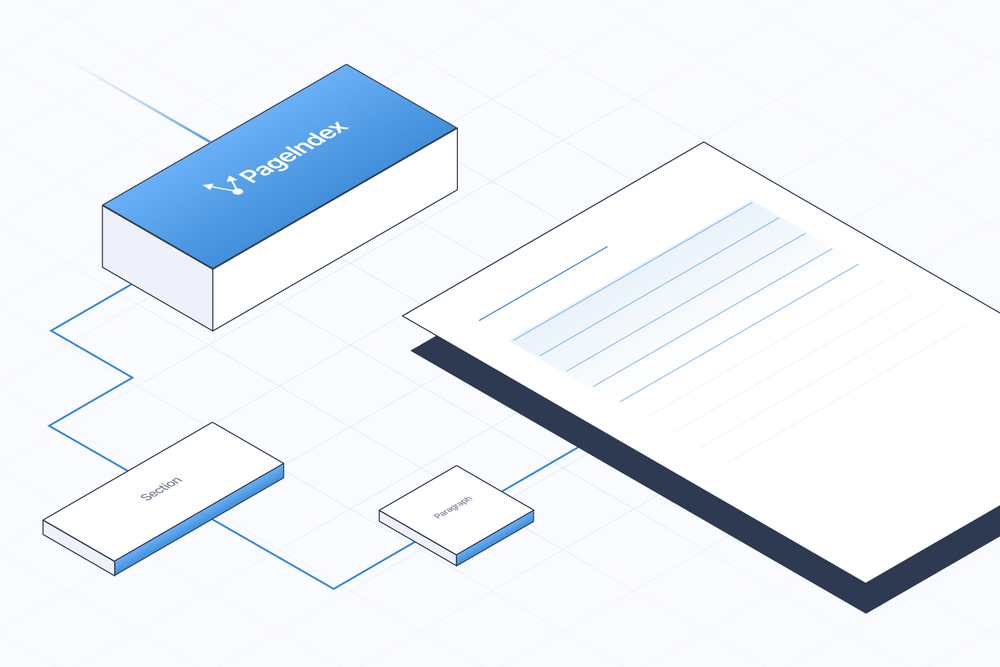
The README describes a table-of-contents tree structure that lets an LLM search sections in a way closer to how a human expert navigates a long document.
Traceable document answers
PageIndex emphasizes explainability and section references, helping users verify where an answer came from before acting on it.
Strengths and trade-offs#
Strengths
- Strong for long professional documentsThe design targets cases where relevance depends on document structure, domain context, and multi-step reasoning rather than nearest-neighbor similarity alone.
- MIT-licensed frameworkThe repository is MIT licensed, which supports experimentation and commercial evaluation of the retrieval approach.
Trade-offs
- -Newer and narrower than vector databasesPageIndex is aimed at reasoning-based document retrieval. Teams still need to validate latency, cost, model dependence, and ecosystem fit before replacing established vector search.
PageIndex vs alternatives#
PageIndex vs vector database RAG
PageIndex is better when long-document answers need reasoning over document structure and traceable section references. Vector databases are still better when teams need mature high-scale embedding search, broad integrations, and predictable nearest-neighbor retrieval over many short chunks.
What it's built on#
- Languages
- Python
FAQ#
What is PageIndex?
PageIndex is a vectorless, reasoning-based RAG framework for retrieving answers from long documents.
Does PageIndex require a vector database?
No. The README positions PageIndex around document structure and reasoning rather than vector database retrieval.
What documents is PageIndex best for?
PageIndex is best for long professional documents where source traceability, section context, and reasoning matter.
Similar open-source tools#

FckSignups
Open-source tools that work instantly, no signup required

supervision
Python toolkit for computer vision detection, tracking, and annotation

fmt
Fast, type-safe C++ formatting that replaces printf and iostreams

dograh
Open source voice agent builder with telephony and BYOK AI support

tradingview-mcp
MCP bridge for AI-assisted TradingView chart analysis

escrcpy
Graphical Android device mirroring and control with scrcpy