Open Source Alternatives
  • Alternatives
  • Categories
    Categories by size1,093 projects
    • Developer Tools550
    • AI & Machine Learning470
    • Business & Productivity263
    • Web Development206
    • Security & Monitoring169
    • Communication & Collaboration151
    • IT Management144
    • Cloud & Hosting127
    • LLMOps & AI Tooling122
    • Data & Analytics117
    Browse all 21 categoriesProduct & Project Management, DevOps & CI/CD and 9 more
  • Blog
  • Advertise
SearchNotion, Slack, password manager.../
Submit
Open Source Alternatives
  • Alternatives
    • Developer Tools550
    • AI & Machine Learning470
    • Business & Productivity263
    • Web Development206
    • Security & Monitoring169
    • Communication & Collaboration151
    • Browse all 21 categories
  • Blog
  • Advertise
Submit your project

New open source projects by email

The projects we add and every new guide. Free, unsubscribe any time.

Open Source Alternatives LogoOpen Source Alternatives

Handpicked Open Source Alternatives to Paid Softwares

Product

  • Categories
  • Tag
  • Advertise

Resources

  • Blog
  • Collection
  • Submit

Company

  • Privacy Policy
  • Terms of Service
  • Refund Policy
  • Sitemap

Alternatives

  • Claude Code
  • Jira
  • Notion
  • Slack
  • Linear
  • Wispr Flow
  • All alternatives
© 2026 Open Source Alternatives. All rights reserved.
Open SourceAlternatives
Home/Categories/Communication & Collaboration/Rallly
icon of Rallly

Rallly

Open source alternative to Doodle

  • 5.3K stars
  • AGPL-3.0
  • Active this week
  • Last commit today

Last verified Nov 5, 2026

Create group scheduling polls in seconds, share a link, and let participants vote with no account needed. Self-hosted via Docker under AGPL-3.0.

Visit websiteGitHub5.3K starsDeploy on Hostinger
image of Rallly
TL;DR

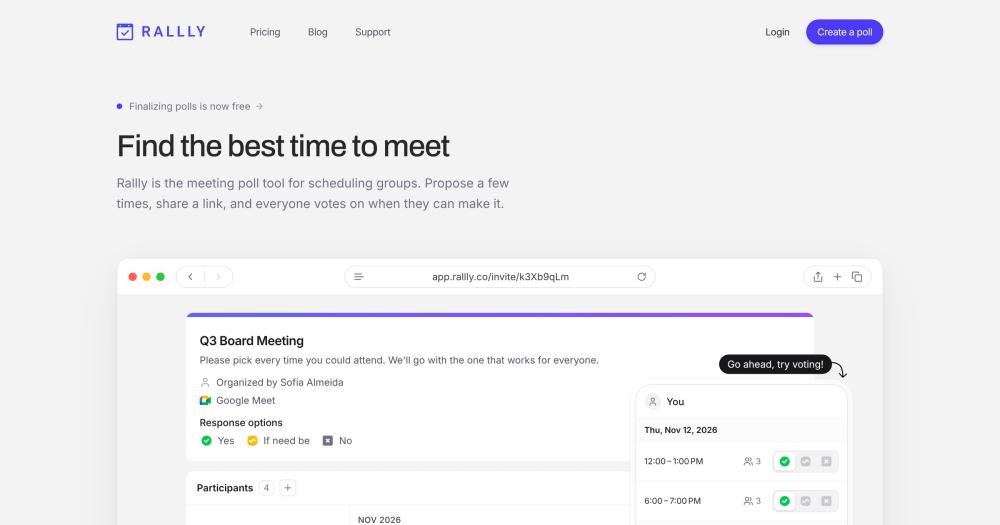
Rallly is an open-source group scheduling tool for finding the best meeting time without back-and-forth emails. It replaces paid polling services like Doodle with a self-hosted approach. Create a poll with proposed time slots, share the link, and let participants vote with no account needed. AGPL-3.0 licensed and deployable via Docker; best for teams, project managers, and executive assistants who need to coordinate schedules across time zones without per-user licensing costs.

Read the full breakdownHide the full breakdownWho it is for, how it works, trade-offs, the quick start and the FAQ
who it's for

Who Rallly is for#

Project managers coordinating cross-team meetings

Creates a poll with candidate times, shares it across departments or external stakeholders, and finalizes the slot once votes are in. The availability grid shows the best option without counting manually, and the finalize step sends calendar invites to everyone.

Skip if:

If your calendar system already has built-in group scheduling and all participants share the same platform (Google Calendar 'Find a time', for example), a dedicated poll tool adds a step without enough benefit.

Executive assistants scheduling meetings with external guests

Sends a link to external participants who do not have or want to create an account on a scheduling service. Participants vote in one click; times display in each person's local time zone automatically, so there is no back-and-forth over time zone math.

Skip if:

If the meeting is a one-on-one and the other person uses a self-service booking link, that is faster than a poll.

Teams with data privacy requirements

Self-hosts Rallly on company infrastructure so scheduling data, participant names, and meeting topics never leave the internal network. AGPL-3.0 licensing covers internal commercial use with no additional cost.

Skip if:

If your compliance review requires OSI-approved licenses only, verify AGPL-3.0 meets your requirements before deploying, as the self-hosted AGPL version is distinct from the hosted Pro tier.

Open source communities organizing contributor calls

Creates polls for contributors across dozens of time zones without requiring anyone to sign up. The 10+ language support means the voting interface can match participants' preferred language.

Skip if:

If the community is small enough that a single organizer can check availability directly (fewer than five people), a poll adds unnecessary overhead.

the problem

The problem it solves#

Coordinating a meeting across four or more people quickly turns into a scheduling problem. Reply-all email threads asking for availability grow unwieldy, later responses overwrite the earlier picture, and the organizer has to reconcile everything manually. Calendar invite chains assume every participant shares the same calendar system.

The practical result is repeated rounds of messaging and friction when someone says the agreed slot no longer works. Teams often fall back to free-text spreadsheets or availability surveys, then start the loop over when a response comes in late. Hosted scheduling services store scheduling data on third-party infrastructure and add costs at higher usage tiers, which matters for teams with privacy requirements or tight budgets.

how Rallly solves it

How it solves it#

No-login voting for participants

Participants open the shared poll link and vote without creating an account. All three response options (yes, if-need-be, no) are available from the link alone. This matters for external collaborators or large groups where requiring sign-up would reduce response rates.

Automatic time zone conversion

Each participant sees proposed times in their own local time zone, detected automatically from their device. Organizers enter times once in their own time zone; Rallly handles the conversion for every participant. This removes a common failure mode in international scheduling where one side does the math wrong.

Visual availability grid

Responses render as a grid showing who is available, who can attend if needed, and who cannot make each slot. The best option is visible at a glance without counting responses manually or exporting to a spreadsheet.

Poll finalization with calendar invites

Once the organizer selects the winning slot, Rallly finalizes the poll and sends email notifications to all participants with a calendar invite. This closes the loop in one action, with no separate step of sending individual calendar invitations.

Comments on polls

Participants and the organizer can leave comments directly on the poll. Discussion about the meeting stays in one place instead of continuing across separate email threads, which helps when participants want to flag conflicts or propose alternatives.

10+ languages via community translation

The voting interface is translated into more than ten languages through Crowdin. International teams can vote in their native language, which reduces friction for non-English speakers in distributed groups.

strengths · trade-offs

Strengths and trade-offs#

Strengths

  • Free self-hosting under AGPL-3.0The self-hosted version is AGPL-3.0 licensed and costs nothing beyond your server. You can run unlimited polls with any number of participants, with no per-user pricing or usage caps. This makes it practical for teams that run many scheduling polls across the year.
  • No participant accounts requiredParticipants vote with no sign-up at all. External collaborators, clients, and large groups can respond without creating yet another account. This is a meaningful differentiator over tools that require all participants to authenticate before voting.
  • Scheduling data stays on your infrastructureWith self-hosting, polling data, participant names, and meeting topics never leave your server. For teams that handle sensitive meeting topics or operate under data residency requirements, this is a property that the hosted Doodle and similar commercial platforms cannot match.
  • Active maintenance since 2015The repository has been under continuous development for over a decade, with 5,337 GitHub stars, 589 forks, and only 3 open issues. The most recent push was November 2026. Longevity and a low open issue count indicate a stable tool, not an abandoned side project.

Trade-offs

  • -PostgreSQL required for self-hostingSelf-hosting needs a PostgreSQL database alongside the Docker container. If your server setup does not already include a managed database, this adds provisioning and maintenance overhead. The hosted version at rallly.co removes this requirement but stores scheduling data on third-party infrastructure.
  • -No native calendar sync in self-hosted modeRallly finalizes meetings by sending email notifications with calendar invites, but it does not sync directly with Google Calendar or Outlook in the self-hosted configuration. Teams that want organizers to book the confirmed slot directly from their calendar app need a different tool or additional configuration.
versus alternatives

Rallly vs alternatives#

Rallly vs Doodle

Both tools solve the same core problem: finding a meeting time that works for a group without round-trip emails. Doodle is the dominant commercial option in this space; Rallly is the main open source alternative with a self-hosting path.

FeatureRalllyDoodle
LicenseAGPL-3.0Proprietary
Self-hostingYes (Docker + PostgreSQL)No
No-login votingYesYes
Time zone handlingAutomatic per participantAutomatic
PricingFree self-hosted; hosted free and Pro tiersFree tier; paid plans for advanced features
Custom brandingRallly Pro or self-hosted configPaid plans
Languages10+ community-translatedMultiple

Rallly is the better choice when you want to self-host scheduling data, run unlimited polls without advertising, or avoid per-user licensing costs. Its AGPL-3.0 license covers internal commercial use on a self-hosted instance. The three-step poll flow and no-login voting are functionally equivalent to Doodle's core offering, and the automatic time zone conversion matches what Doodle provides.

Doodle is worth considering when you need calendar integration managed for you without server administration, or when your team already relies on Doodle's paid integrations. Teams that prefer not to run their own infrastructure can also use the hosted version at rallly.co, which offers a Pro tier with custom branding and other features.

install · quick start

Quick start#

bash
Self-host Rallly with Docker; full setup and configuration are documented at support.rallly.co/self-hosting.
```bash
docker pull lukevella/rallly
```
tech stack · detected from GitHub

What it's built on#

Languages
JavaScriptTypeScript
Frameworks
Next.jsReactTailwind CSS
Databases
PostgreSQL
Infrastructure
AWS
Tooling
Turborepo
frequently asked

FAQ#

Does Rallly work across different time zones?

Yes. Rallly detects each participant's local time zone automatically and displays proposed times in that zone. Organizers enter times once in their own time zone and do not need to list separate times for different regions. The conversion happens per participant, so international groups see the correct local times without any manual adjustment.

Can I self-host Rallly for free?

Yes. Rallly is AGPL-3.0 licensed and ships as a Docker image you can run on your own server at no licensing cost. The self-hosted setup requires a PostgreSQL database and configuration via environment variables. Full documentation is at support.rallly.co/self-hosting. You can run unlimited polls with any number of participants on a self-hosted instance.

Do participants need a Rallly account to vote?

No. Participants open the shared link and vote without signing up. Creating a free account is optional and lets you manage your polls from any device and receive notifications when participants respond. The no-account path covers the full voting experience.

What is Rallly Pro?

Rallly Pro is a paid subscription on the hosted version at rallly.co. It adds custom branding on polls, removal of Rallly attribution, and indefinitely stored polls (free-plan polls are automatically deleted after inactivity). The Pro tier applies to the hosted service only. The self-hosted version under AGPL-3.0 includes all features without a Pro subscription.

Is Rallly still actively maintained?

Yes. The repository at github.com/lukevella/rallly was most recently pushed to on November 4, 2026, and has 5,337 GitHub stars with only 3 open issues. It has been under active development since 2015.

also worth a look

Similar open-source tools#

Inbox Zero

Featured

Alternative toSuperhuman

AI email assistant that drafts replies and clears your inbox

  • 12,889 GitHub stars
  • AGPL-3.0Licence AGPL-3.0

Once Campfire

Alternative toSlack

Group chat on your own server, MIT-licensed, no recurring fees.

  • 4,814 GitHub stars
  • MITLicence MIT

DokuWiki

Alternative toConfluence

PHP wiki engine with file storage, ACLs, and 1200+ plugins.

  • 4,737 GitHub stars
  • GPL-2.0Licence GPL-2.0

SilverBullet

Alternative toObsidian

Programmable markdown wiki with Lua scripting and live queries

  • 6,457 GitHub stars
  • MITLicence MIT

Miniflux

Alternative toFeedly

Self-hosted feed reader with tracker removal and 25+ integrations.

  • 9,890 GitHub stars
  • Apache-2.0Licence Apache-2.0

Seafile

Alternative toGoogle Drive

Self-hosted file sync with client-side encryption for teams.

  • 15,424 GitHub stars
  • CustomLicence GPL-2.0 with OpenSSL exception
by category

Open source tools in these categories#

151

Communication & Collaboration

freeCodeCamp, iptv, Excalidraw
263

Business & Productivity

OpenClaw, Excalidraw, RustDesk
Hostinger

Self-host Rallly on a Hostinger VPS

Keep it running 24/7, even when your laptop is off. A Hostinger VPS gives it a server of its own.

  1. 01

    Choose a plan

    Starts from $6.49/mo

  2. 02

    Apply

    Extra 10% off yearly plans

  3. 03

    Install Rallly

    On a server that stays on

  4. 04

    Start building

    Focus on the app, not the server

Deploy on Hostinger

Sponsors

Inbox Zero

Alternative toSuperhuman

AI email assistant that drafts replies and clears your inbox

  • 12,889 GitHub stars
  • AGPL-3.0Licence AGPL-3.0
  • #Email

rakazo

Alternative toGrok Bot

AI teammates you own: your keys, your model, your machine.

  • 7,028 GitHub stars
  • Apache-2.0Licence Apache-2.0
  • #AI Agents

SnitchFeed

Live monitoring on LinkedIn, X, Reddit & more. Agentic social listening for startups.

Marketing & Growth

Advertise your product

New open source projects by email

The projects we add and every new guide. Free, unsubscribe any time.

Find open source alternatives to paid software

/
  • Claude Code to OpenCode
  • Jira to Windshift
  • Notion to AppFlowy
  • Slack to Mattermost
  • Linear to GitLab
  • Wispr Flow to Handy
  • Arc to Zen Browser
  • CapCut to Concat
  • Grok Bot to rakazo
  • Superhuman to Inbox Zero
  • Airtable to AITable
  • Muse to OpenClaw
  • Railway to Coolify
  • GitHub Copilot to Cline
  • Datadog to Netdata
  • Confluence to Wiki.js
  • Microsoft Teams to Rocket.Chat
  • Firebase to Supabase
  • Pinecone to Qdrant
  • Zapier to n8n
  • 1Password to KeePassXC
  • Devin AI to OpenHands
  • Asana to Leantime
  • Contentful to Strapi