Open Source Alternatives
  • Alternatives
  • Categories
    Categories by size1,108 projects
    • Developer Tools558
    • AI & Machine Learning472
    • Business & Productivity271
    • Web Development208
    • Security & Monitoring171
    • Communication & Collaboration153
    • IT Management145
    • Cloud & Hosting127
    • LLMOps & AI Tooling123
    • Data & Analytics118
    Browse all 21 categoriesProduct & Project Management, DevOps & CI/CD and 9 more
  • Blog
  • Advertise
SearchNotion, Slack, password manager.../
Submit
Open Source Alternatives
  • Alternatives
    • Developer Tools558
    • AI & Machine Learning472
    • Business & Productivity271
    • Web Development208
    • Security & Monitoring171
    • Communication & Collaboration153
    • Browse all 21 categories
  • Blog
  • Advertise
Submit your project

New open source projects by email

The projects we add and every new guide. Free, unsubscribe any time.

Open Source Alternatives LogoOpen Source Alternatives

Handpicked Open Source Alternatives to Paid Softwares

Product

  • Categories
  • Tag
  • Advertise

Resources

  • Blog
  • Collection
  • Submit

Company

  • Privacy Policy
  • Terms of Service
  • Refund Policy
  • Sitemap

Alternatives

  • Claude Code
  • Jira
  • Notion
  • Slack
  • Linear
  • Wispr Flow
  • All alternatives
© 2026 Open Source Alternatives. All rights reserved.
Open SourceAlternatives
Home/Categories/Marketing & Growth/Shlink
icon of Shlink

Shlink

Open source alternative to Bitly, Short.io, Rebrandly and Cuttly

  • 5.4K stars
  • MIT
  • Active this week
  • Last commit 2 days ago

Last verified Nov 3, 2026

Manage custom-domain short links on your own infrastructure with a REST API, CLI, and visit analytics stored in your own database.

Visit websiteGitHub5.4K starsDeploy on Hostinger
image of Shlink
TL;DR

Shlink is a self-hosted PHP URL shortener that serves short links from any domain you control and stores all redirect and visit data locally. It replaces paid URL shortening services like Bitly and Rebrandly, offering a REST API, a CLI, and anonymized visit analytics without sending click data to third-party servers. Licensed under MIT, it deploys via Docker or a pre-built dist file on PHP 8.4+, and supports MySQL, MariaDB, PostgreSQL, Microsoft SQL Server, and SQLite. Best for developers and marketing teams who need custom-domain short links with full analytics and no per-link or per-domain pricing.

Read the full breakdownHide the full breakdownWho it is for, how it works, trade-offs, the quick start and the FAQ
who it's for

Who Shlink is for#

Developers building API-driven link management

Shlink's REST API covers link creation, management, and visit analytics programmatically. Any application that needs to create or track short URLs as part of a larger workflow (email sending systems, marketing automation, or analytics pipelines) can call the Shlink API without a GUI dependency.

Skip if:

Your link management is manual rather than programmatic. For small-scale personal shortening with no API integration needs, the full Shlink setup (server, database, PHP or Docker) is more infrastructure than the use case requires.

Marketing teams running campaigns under a custom domain

Shlink serves short links from your own domain so campaign URLs carry your brand. Visit analytics include geolocation and referrer data, covering the core needs of campaign tracking without a third-party subscription or per-click cost.

Skip if:

Your team has no server to maintain and needs zero-infrastructure shortening. A managed service like Bitly or Short.io is the simpler path when server administration is not an option.

DevOps teams building an internal link shortener

Internal teams frequently need short links for documentation, internal communications, or tooling references. Shlink works as a lightweight internal URL service with a web client and REST API, without sending internal link usage data to an external vendor.

Skip if:

Your organization restricts adding new internal services without a lengthy approval process. An approved SaaS shortener is the lower-maintenance path when that overhead applies.

Teams migrating from Bitly for cost or privacy reasons

Shlink covers the core Bitly use cases: custom domains, link analytics, and programmatic creation through a REST API. Teams concerned about Bitly pricing changes or data policies can run Shlink on a VPS and use shlink-web-client for the same day-to-day management workflows.

Skip if:

You need Bitly's specific ecosystem integrations without building API bridges. Shlink requires custom integration work for platforms that offer native Bitly connectors.

the problem

The problem it solves#

Commercial URL shorteners charge monthly fees that scale with the number of links, clicks, or custom domains. Bitly's free tier limits link history and strips analytics depth; Short.io and Rebrandly charge per domain on paid plans. Beyond cost, every redirect passes through the vendor's servers, meaning the click data belongs to them and not you. If a vendor changes pricing, removes a tier, or shuts down, your short links either break or migrate at cost.

Teams running link shortening for marketing campaigns, internal tooling, or API-driven workflows often hit these limits: analytics depth locked behind an enterprise tier, API rate limits requiring a paid upgrade, or branded domains costing extra per month. The historical workaround has been to build a custom shortener, which adds engineering maintenance that most teams would rather skip.

how Shlink solves it

How it solves it#

REST API with API key authentication

The REST API exposes every link management operation as an HTTP endpoint, covering link creation, updates, deletion, and visit queries by date range, country, or referrer. API keys authenticate all requests and are generated from the CLI. A public interactive sandbox at api-spec.shlink.io documents every endpoint with request and response examples.

CLI for server-side administration

The command line interface (`bin/cli`) covers all link operations and handles tasks the REST API does not expose, specifically API key creation and rotation. Each command accepts `--help` for full usage. API key management is CLI-only by design, keeping credential operations off the network layer.

Progressive web app interface

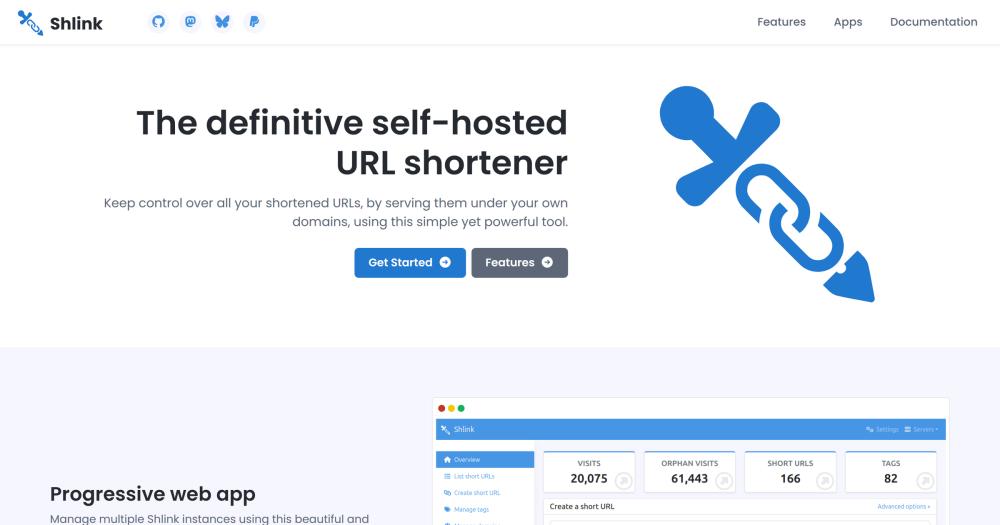
The companion shlink-web-client connects to any Shlink installation through the REST API. It is available as a hosted service at app.shlink.io or as a self-hosted container. One instance of the web app can manage multiple Shlink backends from the same browser session, with no duplicate installs required.

Anonymized visit analytics with geolocation

Every click on a short URL generates a visit record with geolocation data (using the included MaxMind GeoLite2 dataset), referrer, and device metadata. Analytics are stored in your own database; no visit data leaves your infrastructure. The GeoLite2 dataset is bundled with Shlink, so geolocation requires no external API call.

Multiple database backends

Shlink supports MySQL, MariaDB, PostgreSQL, Microsoft SQL Server, and SQLite. The installer script configures the database connection and runs initial schema migrations. The required PDO extension variant (pdo_mysql, pdo_pgsql, pdo_sqlsrv, or pdo_sqlite) must match the chosen database.

Custom slug and auto-generated short codes

Short URLs can use a system-generated unique code or a custom human-readable slug you specify. This covers both programmatic bulk shortening with auto codes and branded campaign links with custom slugs, from the same REST API endpoint, without separate configuration.

strengths · trade-offs

Strengths and trade-offs#

Strengths

  • MIT license with no per-link or per-domain feesShlink is MIT licensed, permitting commercial use, modification, and redistribution with no restrictions. Unlike Bitly and Short.io, there is no per-domain charge or tiered analytics pricing. You pay a fixed monthly infrastructure cost for the server, regardless of link count or traffic volume.
  • API-first design for integrationThe primary interface is a REST API, not a web UI, making it straightforward to integrate with marketing automation systems, CI/CD pipelines, or any application that needs to create or query short URLs programmatically. The API covers all link operations; the CLI handles the administrative layer on top.
  • Full data ownershipClick data, geolocation records, and link inventories live in your own database. No redirect event leaves your infrastructure, which matters for teams with privacy requirements, data residency rules, or compliance constraints that prohibit sending traffic data to third-party services.
  • Decade of active maintenanceShlink has been actively maintained since its first release in 2016, with its most recent code push in November 2026. The project has accumulated over 5,400 GitHub stars and maintains only 18 open issues. Releases are automated through GitHub Actions CI with published dist files for each supported PHP version.

Trade-offs

  • -PHP prerequisites for bare-metal deploymentInstalling Shlink without Docker requires PHP 8.4 or 8.5 with specific extensions: json, curl, pdo, intl, gd, and either gmp or bcmath. RabbitMQ integration additionally requires the sockets and bcmath extensions. Teams without an existing PHP environment will need to use the Docker image or a managed PHP hosting provider.
  • -CLI-only API key managementAPI keys can only be generated and revoked from the command line interface on the server. There is no web UI or REST endpoint for key management. Teams without direct server CLI access need to plan how they will generate and rotate keys before deploying, since the web client depends on a valid key to connect.
versus alternatives

Shlink vs alternatives#

Shlink vs Bitly

Bitly is the most widely deployed commercial URL shortener. The core overlap is custom-domain short links with click analytics. Bitly stores all redirect traffic on its servers and provides analytics through its dashboard; Shlink stores everything locally.

FeatureShlinkBitly
LicenseMIT (self-hosted)Proprietary
Self-hostingYesNo
Custom domainsYesPaid plans only
Visit analyticsIncludedTiered by plan
REST APIYesPaid plans only
PricingInfrastructure costFree to $199/month (annual billing; source: bitly.com/pages/pricing)

Shlink is the better choice when data ownership matters: every click event stays on your server and you pay a fixed infrastructure cost with no per-click or per-domain fees. Bitly is worth considering when you need a managed, zero-infrastructure shortener with an extensive ecosystem of native integrations; its connector library covers many platforms without custom API work.

Shlink vs Short.io

Short.io focuses on branded links with multi-domain support and team access controls. Both tools support multiple custom domains; Shlink runs the whole stack on your server.

FeatureShlinkShort.io
LicenseMIT (self-hosted)Proprietary
Self-hostingYesNo
Multi-domainYesYes
Team accessAPI keysUser accounts with roles
AnalyticsLocal databaseManaged
PricingInfrastructure costFree to $148/month (source: short.io/pricing)

Shlink is the better fit when privacy requirements or compliance rules prevent sending redirect data to third-party servers. Short.io is the simpler option when you need built-in team user management with roles and permissions, since Shlink's access model is API key-based with no native role system.

Shlink vs Rebrandly

Rebrandly is positioned for branded link management in marketing teams. Shlink covers the same core use case at a different cost and control model.

FeatureShlinkRebrandly
LicenseMIT (self-hosted)Proprietary
Self-hostingYesNo
Custom domainsYesYes
Click analyticsYesYes (tiered)
REST APIYesYes
PricingInfrastructure costFree to $149/month (source: rebrandly.com/pricing)

Shlink is the better choice for teams that want to run link shortening as an internal service with no recurring SaaS cost and full data portability. Rebrandly is worth considering when your team needs its UTM parameter management tools and built-in link organization features (tags, workspaces) without building those workflows on top of a REST API.

install · quick start

Quick start#

bash
Download a pre-built dist file (one per supported PHP version) from GitHub Releases: https://github.com/shlinkio/shlink/releases/latest
tech stack · detected from GitHub

What it's built on#

Languages
PHP
Frameworks
LaminasMezzio
frequently asked

FAQ#

What databases does Shlink support?

Shlink supports MySQL, MariaDB, PostgreSQL, Microsoft SQL Server, and SQLite. You configure the database during initial setup through the installer script (vendor/bin/shlink-installer install). The installer creates the schema and sets up the database connection; subsequent schema migrations run automatically on upgrade.

Can I use Shlink without running my own server?

Shlink requires a PHP 8.4+ server or Docker container to run its backend. There is no managed cloud hosting for Shlink itself. The companion web app shlink-web-client is available as a hosted service at app.shlink.io, but that is only the management interface: it still connects to your self-hosted Shlink backend via the REST API and cannot operate without one.

How do I manage short links without using the CLI every time?

Shlink provides a REST API for all link operations, plus a progressive web app called shlink-web-client. The web app is available at app.shlink.io or can be self-hosted. It connects to your Shlink instance through the API and provides a visual interface for creating, editing, and viewing analytics on short links. One instance can manage multiple Shlink backends.

Is Shlink free for commercial use?

Yes. Shlink is MIT licensed, which permits commercial use, modification, and distribution with no restrictions. You pay only for the server infrastructure you run it on. There is no per-link, per-domain, or per-visit fee.

What visit data does Shlink collect and where is it stored?

Shlink records anonymized visit data for each short URL click: geolocation (via the included MaxMind GeoLite2 dataset), referrer, and device metadata. This data is stored in your own database and never leaves your server. The GeoLite2 dataset is bundled with Shlink and used for IP-to-location lookups without calling an external service at click time.

also worth a look

Similar open-source tools#

Kutt

Alternative toBitly

Self-hosted URL shortener with analytics and custom domains

  • 11,189 GitHub stars
  • MITLicence MIT

FckSignups

InCustomer Support

Open-source tools that work instantly, no signup required

  • 4,539 GitHub stars
  • GPL-3.0Licence GPL-3.0

Fastapi

Alternative toAWS API Gateway

High-performance Python API framework with auto OpenAPI documentation

  • 104,391 GitHub stars
  • MITLicence MIT

fmt

InCustomer Support

Fast, type-safe C++ formatting that replaces printf and iostreams

  • 25,907 GitHub stars
  • MITLicence MIT

Soketi

Alternative toPusher

Self-hosted Pusher-compatible WebSocket server, open source

  • 5,635 GitHub stars
  • AGPL-3.0Licence AGPL-3.0

Sylius

Alternative toShopify

Headless Symfony commerce for complex B2B and B2C stores

  • 8,563 GitHub stars
  • MITLicence MIT
by category

Open source tools in these categories#

70

Marketing & Growth

agency-agents, MoneyPrinterTurbo, MiroFish
80

Backend Development

dify, graphify, Rust
87

APIs & Integration

n8n, Firecrawl, iptv
208

Web Development

freeCodeCamp, Skills for Real Engineers, superpowers
Hostinger

Self-host Shlink on a Hostinger VPS

Keep it running 24/7, even when your laptop is off. A Hostinger VPS gives it a server of its own.

  1. 01

    Choose a plan

    Starts from $6.49/mo

  2. 02

    Apply

    Extra 10% off yearly plans

  3. 03

    Install Shlink

    On a server that stays on

  4. 04

    Start building

    Focus on the app, not the server

Deploy on Hostinger

Sponsors

Inbox Zero

Alternative toSuperhuman

AI email assistant that drafts replies and clears your inbox

  • 12,889 GitHub stars
  • AGPL-3.0Licence AGPL-3.0
  • #Email

rakazo

Alternative toGrok Bot

AI teammates you own: your keys, your model, your machine.

  • 7,028 GitHub stars
  • Apache-2.0Licence Apache-2.0
  • #AI Agents

SnitchFeed

Live monitoring on LinkedIn, X, Reddit & more. Agentic social listening for startups.

Marketing & Growth

Advertise your product

New open source projects by email

The projects we add and every new guide. Free, unsubscribe any time.

Find open source alternatives to paid software

/
  • Claude Code to OpenCode
  • Jira to Windshift
  • Notion to AppFlowy
  • Slack to Mattermost
  • Linear to GitLab
  • Wispr Flow to Handy
  • Arc to Zen Browser
  • CapCut to Concat
  • Grok Bot to rakazo
  • Superhuman to Inbox Zero
  • Airtable to AITable
  • Muse to OpenClaw
  • Railway to Coolify
  • GitHub Copilot to Cline
  • Datadog to Netdata
  • Confluence to Wiki.js
  • Microsoft Teams to Rocket.Chat
  • Firebase to Supabase
  • Pinecone to Qdrant
  • Zapier to n8n
  • 1Password to KeePassXC
  • Devin AI to OpenHands
  • Asana to Leantime
  • Contentful to Strapi