Open Source Alternatives
  • Alternatives
  • Categories
    Categories by size1,324 projects
    • Developer Tools680
    • AI & Machine Learning550
    • Business & Productivity326
    • Web Development219
    • Security & Monitoring200
    • Communication & Collaboration171
    • IT Management166
    • Design & Creative148
    • DevOps & CI/CD143
    • LLMOps & AI Tooling142
    Browse all 21 categoriesCloud & Hosting, Product & Project Management and 9 more
  • Blog
  • Advertise
SearchNotion, Slack, password manager.../
Submit
Open Source Alternatives
  • Alternatives
    • Developer Tools680
    • AI & Machine Learning550
    • Business & Productivity326
    • Web Development219
    • Security & Monitoring200
    • Communication & Collaboration171
    • Browse all 21 categories
  • Blog
  • Advertise
Submit your project

New open source projects by email

The projects we add and every new guide. Free, unsubscribe any time.

Open Source Alternatives LogoOpen Source Alternatives

Handpicked Open Source Alternatives to Paid Softwares

Add Open Source Alternatives as a preferred source on Google

Product

  • Categories
  • Tag
  • Advertise

Resources

  • Blog
  • Collection
  • Submit

Company

  • Privacy Policy
  • Terms of Service
  • Refund Policy
  • Sitemap

Alternatives

  • Claude Code
  • Jira
  • Notion
  • Slack
  • Linear
  • Wispr Flow
  • All alternatives
© 2026 Open Source Alternatives. All rights reserved.
Open SourceAlternatives
Home/Categories/Design & Creative/ultrafast
icon of Ultrafast

ultrafast

Open source alternative to Remotion, Shotstack, Creatomate and JSON2Video

  • 0 stars
  • Apache-2.0
  • Active this week
  • Last commit today

Last verified Nov 22, 2026

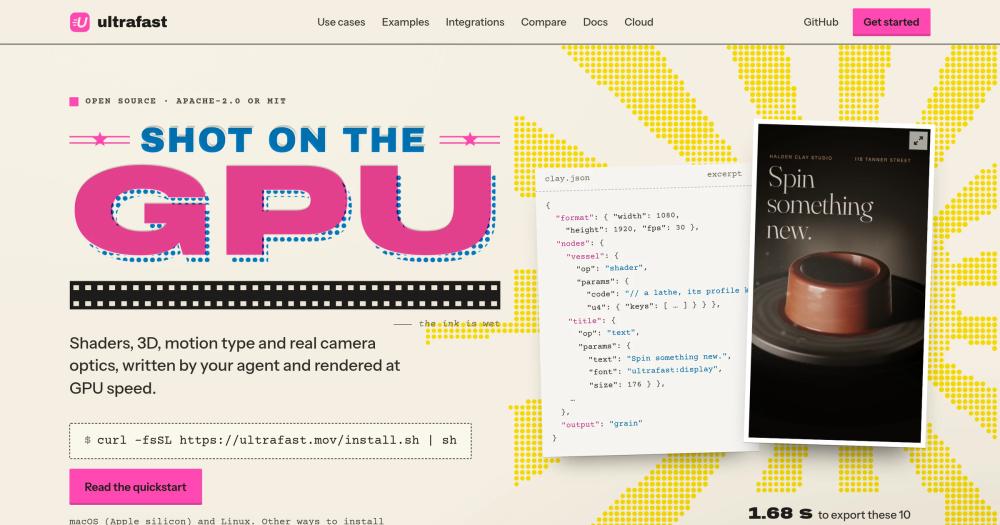
Render GPU-accelerated video from a JSON document for AI agents, without a browser process; Apache-2.0 or MIT, runs on Metal and Vulkan.

Visit websiteGitHub0 stars
image of Ultrafast
TL;DR

ultrafast is a GPU-accelerated video engine for AI coding agents, licensed Apache-2.0 or MIT. A video is a JSON document of composited nodes (3D, type, shapes, footage, shaders, effects); ultrafast compiles it to GPU kernels and renders at hundreds of frames per second using Metal on macOS (Apple silicon) or Vulkan on Linux. It replaces cloud video APIs like Shotstack and Creatomate, and exports the same 10-second video in under a second where Remotion takes two to seven seconds at its fastest. A built-in `uf review` command reads every frame for WCAG 2.3.1 compliance, contrast, and readability. Free for commercial use at any scale, self-hosted on your GPU, with a 20-tool MCP server for Claude Code, Codex, Cursor, and Gemini CLI.

Read the full breakdownHide the full breakdownWho it is for, how it works, trade-offs, the quick start and the FAQ
who it's for

Who ultrafast is for#

AI pipeline developers generating video at scale

ultrafast's SDK (`pip install ultrafastmov`, `npm i ultrafastmov`) and framework starters plug into existing agent pipelines on Vercel AI SDK, OpenAI Agents SDK, LangGraph, and Mastra. The agent writes the JSON document; ultrafast exports the MP4 on the same machine or on a `uf serve` instance. Good for personalization at scale: one document template, per-customer data merged in.

Skip if:

Your pipeline runs in CPU-only or cloud-native environments where you cannot attach a GPU. ultrafast Cloud, which removes that requirement, is on the waitlist but not yet open.

Developers working with Claude Code, Codex, Cursor, or Gemini CLI

`uf mcp` connects to any of those agents in one command. The agent discovers 20 MCP tools covering document creation, frame inspection, export, and review. The quickest path: tell the agent to visit ultrafast.mov and make something, and it reads the docs and writes the first video itself.

Skip if:

Your coding agent is not among Claude Code, Codex, Cursor, or Gemini CLI, and you are not ready to configure a custom MCP client. ChatGPT and the Claude connector are coming soon but not yet available.

Teams automating video production with a self-hosted API

ultrafast replaces cloud video APIs (Shotstack, Creatomate, JSON2Video) with a self-hosted HTTP API via `uf serve` that costs nothing per render, gives agents a review step, and runs on your infrastructure. The JSON document format is close enough to Creatomate's template structure that most pipelines can migrate without a full rewrite.

Skip if:

Your team has no GPU to run the render service, and ultrafast Cloud (waitlist) has not opened yet. Shotstack or Creatomate remain the hosted option in that case.

Motion graphics and data-visualization teams integrating AI

ultrafast handles 3D (glTF, bevelled type, camera optics, IBL, depth of field), animated vector shapes, Lottie files, word-timed captions, and data-driven charts in one render pass. The example library covers launch films, data stories, loops, and documentary cuts, each with the JSON document that produced it.

Skip if:

Your work requires Remotion's embeddable React player, real-time collaborative editing, or HeyGen's avatar and voice features, which ultrafast does not include.

the problem

The problem it solves#

Programmatic video for AI agents is slow and token-heavy. The dominant approach runs each frame through headless Chrome. The agent writes a React project or HTML, the renderer launches a browser, screenshots every frame, and assembles the MP4. Exporting a 10-second video takes two to seven seconds with Remotion at its fastest settings, and writing it requires close to 1,900 agent tokens.

Cloud video APIs (Shotstack, Creatomate, JSON2Video) avoid the browser but send every render to a third-party server, charge per minute or per render, and give agents no way to inspect the output before the export completes. The result is slow iteration loops, high token overhead, and no built-in review step.

how ultrafast solves it

How it solves it#

GPU rendering without a browser

ultrafast compiles the JSON video document to GPU kernels and draws every frame on the GPU with Metal (macOS Apple silicon) or Vulkan (Linux, Windows via WSL2). No browser process, no screenshot capture, no readback: on one RTX 5090, three 10-second videos export in 0.85 to 0.98 s end to end, where Remotion takes 2.25 to 6.69 s at its fastest settings.

One JSON document per video

A video is a stack of nodes in a single JSON file: footage, shapes, text, 3D, shaders, effects. The agent writes the document; ultrafast compiles it once and renders every frame. Any agent that can write JSON can produce video without learning a framework or component model.

Built-in frame review for agents

`uf review` reads every frame and reports what a person would catch: text clipped off the edge, contrast below 3:1, font size below 24 px, text on screen too briefly, and seizure-risk flashing (WCAG 2.3.1). The agent fixes the document and re-runs. A 300-frame teaser reads in 4.7 s.

3D and 2D in one render pass

One engine renders 3D models (glTF, primitives, bevelled type), vector shapes, animated text, charts, Lottie animations, and footage in the same frame. Camera moves, depth of field, image-based lighting, and refractive glass are document properties. No Blender or After Effects required.

MCP server with 20 tools

`uf mcp` starts a local MCP server with 20 tools covering document creation, frame inspection, export, and review. It connects to Claude Code, Codex, Cursor, and Gemini CLI without configuration, and the same server is exposable remotely via `uf serve`.

SDK and framework starters

Python (`pip install ultrafastmov`), Node.js (`npm i ultrafastmov`), and framework starters for Vercel AI SDK, OpenAI Agents SDK, LangGraph, and Mastra let agents embed rendering directly in existing pipelines without the CLI.

strengths · trade-offs

Strengths and trade-offs#

Strengths

  • Faster exports than browser-based renderersOn one RTX 5090, three 10-second videos at 1080p export in 0.85 to 0.98 s end-to-end. At their fastest settings, Remotion takes 2.25 to 6.69 s and HyperFrames takes 3.31 to 4.46 s for the same videos. The speed advantage comes from skipping the browser process entirely and encoding directly to hardware.
  • Fewer agent tokens per videoWriting the same 10-second 1080x1920 short, an agent uses 1,234 tokens with ultrafast (o200k_base tokenizer) versus 1,868 for Remotion and 1,680 for HyperFrames. The difference is the format: one JSON document instead of a React project or HTML and CSS.
  • Apache-2.0 or MIT, free at any scaleThe engine is dual-licensed Apache-2.0 or MIT, free for commercial use at any volume, with no per-render fees and no company license required. Remotion's source-available license requires a paid seat for teams of four or more; Shotstack charges 5 to 20 cents per rendered minute.
  • Built-in agent review loop`uf review` checks every frame against WCAG 2.3.1 and common readability standards without manual inspection. This closes a loop that Remotion and cloud APIs leave open: agents iterate on the document, not on the pixels, and converge on a clean export before it goes to a human.

Trade-offs

  • -Requires a local GPUultrafast renders on the GPU: a Mac with Apple silicon, or a computer with a Vulkan GPU on Linux or Windows via WSL2. CPU-only or cloud-native environments cannot run it today. ultrafast Cloud, which provides hosted rendering with no local GPU, is on the waitlist but not yet available.
  • -Windows via WSL2 onlyNative Windows binaries are not available. Windows users run ultrafast inside WSL2 with a Vulkan GPU; the official docs cover the setup. Teams with strict Windows-native deployment requirements will need to wait for a native build or for ultrafast Cloud to open.
  • -No web player or avatar supportultrafast does not include an embeddable web player (like Remotion's) or AI avatar and voice synthesis (available through HeyGen). Workflows that depend on those features should use Remotion or HyperFrames instead.
  • -Very new projectThe repository was created on November 21, 2026, and has zero stars and zero open issues as of that date. The API surface, MCP tool definitions, and document schema may change before a stable release. Early adopters should expect breaking changes in the initial period.
versus alternatives

ultrafast vs alternatives#

ultrafast vs Remotion

Both tools generate video programmatically, but they render differently. Remotion draws each frame in headless Chrome using React components; ultrafast draws directly on the GPU with Metal or Vulkan and produces no browser process. On one RTX 5090, three 10-second 1080p videos export in 0.85 to 0.98 s with ultrafast; at Remotion's fastest settings the same videos take 2.25 to 6.69 s. An agent writing the same 10-second short uses 1,234 tokens with ultrafast versus 1,868 with Remotion (measured 2026-11-22; tokenizer: o200k_base).

ultrafastRemotion
RenderingGPU (Metal or Vulkan)Headless Chrome
LicenseApache-2.0 or MITSource-available; companies of 4+ need a paid license
Agent tokens (10 s short)1,2341,868
Export time (10 s, RTX 5090)0.85-0.98 s2.25-6.69 s (fastest)
Frame reviewBuilt in (uf review)None
Web playerNoYes

ultrafast is the stronger choice when render speed, token budget, or licensing cost matters. Pick Remotion when your team builds video as React components, needs the embeddable web player, or depends on Remotion's existing plugin ecosystem.

ultrafast vs Shotstack

Shotstack is a proprietary cloud-only video editing API billed at 5 to 20 cents per rendered minute with no self-hosting option. ultrafast runs on your GPU, costs nothing per render, and gives agents a local review step. The JSON template structures are similar enough for most pipelines to migrate without a full rewrite; the key difference is running the render service yourself rather than posting to a cloud endpoint.

Shotstack is worth considering if you have no GPU and ultrafast Cloud (waitlist only) has not opened yet, or if you need Shotstack's native stock footage and audio integrations.

ultrafast vs Creatomate

Creatomate is a JSON-driven video and image generation API for automated content workflows, available only as a hosted service. ultrafast covers the same JSON-to-MP4 use case with self-hosted rendering, no per-render fees, and built-in frame review. The describe-then-render model is similar; the schemas differ, so migrating a pipeline requires rewriting the template format.

Creatomate remains a reasonable option for teams that have no GPU and need a managed API today; ultrafast Cloud, the hosted GPU path, is on the waitlist.


install · quick start

Quick start#

bash
Install ultrafast on macOS (Apple silicon) or Linux with the one-line script, Homebrew, or Docker.

```bash
curl -fsSL https://ultrafast.mov/install.sh | sh
brew install ultrafastmov/tap/ultrafast
docker run --gpus all ghcr.io/ultrafastmov/ultrafast:latest info
```
tech stack · detected from GitHub

What it's built on#

Languages
JavaScriptPythonRustTypeScript
frequently asked

FAQ#

Does ultrafast require a GPU?

Yes, for self-hosted use: a Mac with Apple silicon, or a computer with a Vulkan GPU on Linux or Windows via WSL2. ultrafast Cloud, which renders on hosted GPUs with no local GPU required, is coming soon; join the waitlist at ultrafast.mov/cloud. Cold first runs take roughly 2.5 s while the GPU warms up; subsequent warm runs export a 10-second video in under a second on modern hardware.

Is ultrafast free for commercial use?

Yes. The engine is dual-licensed Apache-2.0 or MIT, free to use commercially at any volume and any scale, with no per-render fees and no company license required. The upcoming ultrafast Cloud will have its own pricing, announced before it opens.

How does ultrafast compare to Remotion?

Both generate video from code, but differently. Remotion draws frames in headless Chrome using React components; ultrafast draws on the GPU with Metal or Vulkan. The same 10-second video exports in 0.85 to 0.98 s with ultrafast versus 2.25 to 6.69 s with Remotion at its fastest settings, and an agent writes 1,234 tokens for the ultrafast version versus 1,868 for Remotion (measured 2026-11-22; tokenizer: o200k_base). Remotion has an embeddable web player and a larger ecosystem; ultrafast is faster and fully open source under Apache-2.0 or MIT, while Remotion's source-available license requires a paid company license for teams of four or more.

Which agents and coding tools does ultrafast support today?

Claude Code, Codex, Cursor, and Gemini CLI are available today via uf mcp. Cursor, Claude Desktop, and other MCP clients take the config manually with {"command": "uf", "args": ["mcp"]}. The ChatGPT app and the Claude connector (for the web and mobile Claude) are coming soon. SDK support exists for Python, Node.js, and framework starters for Vercel AI SDK, OpenAI Agents SDK, LangGraph, and Mastra.

Can ultrafast edit existing video footage?

Yes. ultrafast can cut, trim, speed-ramp, reframe, grade, key, and caption existing video files, mix in audio, and add titles, logos, and charts. The examples include documentary cuts from NASA footage with word-by-word captions and grade adjustments. On Linux, ffmpeg is required for exports; espeak-ng and tesseract are needed for the voiceover and ocr ops.

also worth a look

Similar open-source tools#

Openfilm

Alternative toRemotion

AI video agent for coding agents, with a local editor and no account.

  • 8,842 GitHub stars
  • MITLicence MIT

hyperframes

Alternative toRemotion

Turn HTML and CSS into rendered MP4 videos, built for AI agents.

  • 87,245 GitHub stars
  • Apache-2.0Licence Apache-2.0

Ffmpeg Skill

Alternative toRendi

FFmpeg skill for coding agents: 42 tools, MCP server, local-first

  • 8,403 GitHub stars
  • MITLicence MIT

Rea Video

Alternative toTwelve Labs

Video reverse-engineering CLI that runs inside AI coding assistants.

  • 11,099 GitHub stars
  • Apache-2.0Licence Apache-2.0

Brag

InDesign & Creative

Agent skill that turns any project into a launch video in one command

  • 22,036 GitHub stars
  • MITLicence MIT

Awwwards-mcp

Alternative toLazyweb

MCP server for Awwwards design inspiration, no API key required.

  • 880 GitHub stars
  • MITLicence MIT
by category

Open source tools in these categories#

149

Design & Creative

ComfyUI, Excalidraw, Godot Engine
551

AI & Machine Learning

REA (Reverse Engineer Anything), freeCodeCamp, OpenClaw
681

Developer Tools

Skills for Real Engineers, REA (Reverse Engineer Anything), superpowers

Sponsors

SnitchFeed

Live monitoring on LinkedIn, X, Reddit & more. Agentic social listening for startups.

Marketing & Growth

Windshift

Alternative toJira

Self-hosted work management for teams leaving Jira

  • 460 GitHub stars
  • AGPL-3.0Licence AGPL-3.0

Nuphos

Alternative toConductor

Agent workspace for teams running Claude Code or Codex

  • 707 GitHub stars
  • Apache-2.0Licence Apache-2.0
  • #AI Agents
Advertise your product

New open source projects by email

The projects we add and every new guide. Free, unsubscribe any time.

Find open source alternatives to paid software

/
  • Claude Code to OpenCode
  • Jira to Windshift
  • Notion to AppFlowy
  • Slack to Mattermost
  • Linear to GitLab
  • Wispr Flow to Handy
  • Arc to Zen Browser
  • CapCut to Concat
  • Grok Bot to rakazo
  • Superhuman to Inbox Zero
  • Discord to Stoat
  • Airtable to AITable
  • Datadog to SigNoz
  • Muse to OpenClaw
  • Railway to Coolify
  • GitHub Copilot to Cline
  • Confluence to Wiki.js
  • Microsoft Teams to Rocket.Chat
  • Zapier to n8n
  • 1Password to KeePassXC
  • Pinecone to Qdrant
  • Contentful to Strapi
  • Devin AI to OpenHands
  • Firebase to Supabase