Open Source Alternatives
  • Alternatives
  • Categories
    Categories by size1,127 projects
    • Developer Tools571
    • AI & Machine Learning487
    • Business & Productivity275
    • Web Development209
    • Security & Monitoring173
    • Communication & Collaboration154
    • IT Management146
    • Cloud & Hosting128
    • LLMOps & AI Tooling126
    • DevOps & CI/CD119
    Browse all 21 categoriesProduct & Project Management, Data & Analytics and 9 more
  • Blog
  • Advertise
SearchNotion, Slack, password manager.../
Submit
Open Source Alternatives
  • Alternatives
    • Developer Tools571
    • AI & Machine Learning487
    • Business & Productivity275
    • Web Development209
    • Security & Monitoring173
    • Communication & Collaboration154
    • Browse all 21 categories
  • Blog
  • Advertise
Submit your project

New open source projects by email

The projects we add and every new guide. Free, unsubscribe any time.

Open Source Alternatives LogoOpen Source Alternatives

Handpicked Open Source Alternatives to Paid Softwares

Product

  • Categories
  • Tag
  • Advertise

Resources

  • Blog
  • Collection
  • Submit

Company

  • Privacy Policy
  • Terms of Service
  • Refund Policy
  • Sitemap

Alternatives

  • Claude Code
  • Jira
  • Notion
  • Slack
  • Linear
  • Wispr Flow
  • All alternatives
© 2026 Open Source Alternatives. All rights reserved.
Open SourceAlternatives
Home/Categories/Developer Tools/Orchestrator
icon of Agent Orchestrator

Orchestrator

Open source alternative to Conductor

  • 14.1K stars
  • Apache-2.0
  • Active this week
  • Last commit today

Last verified Nov 5, 2026

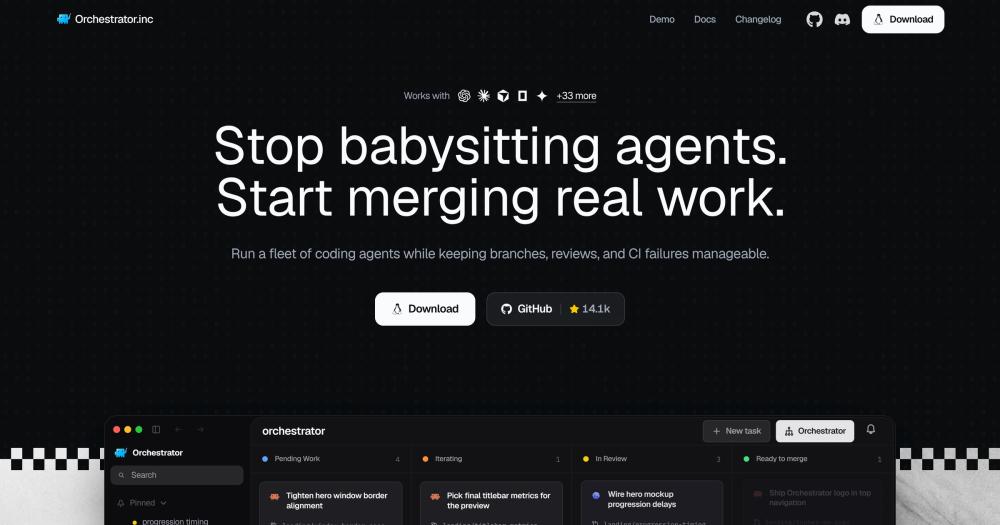
Orchestrate a fleet of coding agents in parallel, each in its own Git worktree, from a desktop workspace for macOS, Windows, and Linux.

Visit websiteGitHub14.1K stars
image of Agent Orchestrator
TL;DR

Orchestrator is a desktop workspace for running a fleet of coding agents in parallel, with each worker in its own Git worktree so branches never collide. It is free and open source (Apache-2.0) for local use, and an alternative to paid agent-orchestration tools. A kanban board tracks every session by live status, CI failures route back to the agent that owns the branch, and review comments return to the session that wrote the code. Available on macOS, Windows, and Linux, with a companion app for iPhone and Android.

Read the full breakdownHide the full breakdownWho it is for, how it works, trade-offs, the quick start and the FAQ
who it's for

Who Orchestrator is for#

Solo developers parallelizing large feature builds

Orchestrator handles the branching and merging overhead when a feature needs multiple parallel tracks. The main agent breaks the work into pieces, workers run in separate worktrees, and failed CI routes to the right session without manual triage. No context switching between multiple terminal tabs.

Skip if:

Your tasks are sequential rather than parallel, or you typically run one agent at a time. Orchestrator adds overhead (the daemon, the board, the worktree setup) that only pays off when parallel agent work is the norm.

Engineering teams with mixed agent setups on shared repos

Orchestrator's review routing sends review comments back to the session that wrote the code, so the author agent can respond rather than the developer having to relay context. Teams using a mix of agents (some members on Claude Code, others on Cursor) can standardize on one board.

Skip if:

Your team has a review and CI process that agents already plug into directly. Orchestrator wraps that process; if the existing workflow already works, adding a board layer may not add value.

Developers who want agents running while the laptop is closed

The Starter and Pro cloud plans run workers in hosted environments, so tasks continue after the laptop closes. Pair with the mobile app and you get push notifications when an agent needs input, then reply from your phone.

Skip if:

Your agents need persistent access to local files, local databases, or development hardware that is not reachable from a hosted workspace. Cloud workers run in hosted environments and cannot access resources only available on your machine.

Claude Code and Codex users managing multiple parallel sessions

Orchestrator wraps Claude Code and Codex in a GUI that adds worktrees, a kanban board, and PR routing without changing how those agents work. If you currently open multiple Claude Code terminal sessions in separate worktrees and manually track their PRs, Orchestrator replaces that manual coordination with a single board.

Skip if:

You prefer working directly in the CLI without a GUI layer. Orchestrator adds a desktop app to your workflow; developers who live in the terminal may find the overhead unnecessary.

the problem

The problem it solves#

Running multiple coding agents in parallel creates a coordination problem that individual agents cannot handle alone. Each agent works in isolation: it does not know that another session on the same repository just changed a file it depends on, that a CI check just failed on a branch it did not write, or that a reviewer left a comment that belongs to a different session. The result is constant context switching. You pull up each agent in turn to check status, copy error output from a CI notification into the right chat, relay reviewer comments to the right session, and manually track which branches are ahead, behind, or waiting.

The overhead compounds when agents run in parallel on the same codebase. Git worktree conflicts, stale branches, and duplicate work on overlapping files are hard to catch until a merge fails. Without something tracking each session's PR lifecycle and routing feedback automatically, the number of agents you can run effectively is limited not by compute but by how many browser tabs you can keep open.

how Orchestrator solves it

How it solves it#

Main Agent Orchestration

Tell a project's main agent what to build. It plans the work, creates a worker for each piece in its own Git worktree, and returns to you only when something needs a decision. Workers can use Claude Code, Codex, Cursor, Aider, or any of the 35+ supported agents.

Status-Derived Kanban Board

Every worker session appears on a kanban board with lanes driven by live data: the agent's current action, its pull request on GitHub, CI check results, and pending reviews. Lane placement is automatic; there is no status field to update.

Automatic CI and Review Routing

When a CI check fails, Orchestrator sends the failing check name, the error log, and a link to the run to the agent that owns that branch. Reviewer comments go back to the same session that wrote the code, with the full review thread attached.

35+ Coding Agent Support

Pick the agent and model for each individual task. Work with it in Orchestrator's structured chat timeline, or open its native terminal UI in the same worktree. Supported agents include Claude Code, Codex, Cursor, Aider, GitHub Copilot, Grok, Kimi, Cline, Goose, Devin, and more.

Mobile Companion App

Pair the free iPhone, iPad, or Android app with your desktop by scanning a QR code. Get a push notification when an agent asks a question or needs approval, reply in chat, start a new task, or check a pull request from anywhere on your home network or through the managed HTTPS tunnel.

Cloud Agents (Starter and Pro)

Run worker sessions in hosted workspaces (Starter: 2 at once, 8 sessions, 20 hours/week at $20/month; Pro: 10 at once, 25 sessions, 80 hours/week at $40/month) so tasks keep running after the laptop closes. Cloud workers run in instant VMs or Coder dev workspaces; the local desktop app monitors them like any other session.

strengths · trade-offs

Strengths and trade-offs#

Strengths

  • Apache-2.0 license, free for local use with your own API keysThe local path is fully free and open source. Download the installer, point it at a repository, and run as many parallel sessions as your machine handles. Your API keys go directly to the agent providers; no data passes through Orchestrator's infrastructure for local sessions.
  • 14,100 stars and active development since February 2026The repository reached 14,100 stars and 1,900 forks in roughly nine months (created February 13, 2026, with the last commit on November 5, 2026). Active commits and an active Discord community mean issues and feature requests get picked up at a rate that matters for a workflow-critical tool.
  • 35+ agent integrations on one board, mixing agents per taskSupports over 35 coding agents including Claude Code, Codex, Cursor, Aider, GitHub Copilot, Grok, Kimi, Cline, Goose, and Devin. Each task can use a different agent and model, so you can mix high-reasoning agents for complex pieces with faster agents for boilerplate, all tracked on the same board.
  • PR lifecycle handled end-to-end, without manual relayFrom branch creation through CI checks, review comment routing, and merge, Orchestrator passes feedback to the right session automatically. Failed checks go to the owning agent with the error log; reviewer comments go back to the session that wrote the code. No copy-pasting error output between browser tabs.

Trade-offs

  • -432 open issues as of November 2026The repository had 432 open issues on November 5, 2026, which is high for a tool that has been public since February. For a workflow tool handling multiple active branches simultaneously, bugs in routing logic or PR status detection can interrupt a session at a critical point.
  • -Desktop app only; no headless or server deployment mode documentedOrchestrator runs as a desktop application. The daemon runs locally (or in cloud workspaces for Starter/Pro sessions), but there is no documented headless path for running the orchestrator in a CI environment or on a remote server without a desktop session.
  • -Cloud agents require a paid planKeeping agents running after the laptop closes requires the Starter ($20/month) or Pro ($40/month) plan. Local use is free and covers the full board, CI routing, and PR lifecycle features, but async or overnight work depends on the paid cloud tier.
versus alternatives

Orchestrator vs alternatives#

Orchestrator vs Conductor

Conductor is a paid commercial platform for running multiple coding agents in parallel. Conductor shuts down on November 20, 2026, and is not a viable option for new projects.

Orchestrator provides the same multi-agent coordination under an open source Apache-2.0 license at no cost for local use. No cloud account is required for the core feature set. Where Conductor ran agent sessions in its hosted infrastructure, Orchestrator runs on your machine with your own API keys by default, and adds optional cloud sessions at $20/month (Starter) or $40/month (Pro) for work that should continue after the laptop closes.

FeatureOrchestratorConductor
LicenseApache-2.0Proprietary
Local deploymentYes, no account neededNo
Cloud agentsStarter ($20/mo), Pro ($40/mo)Subscription only
Supported agents35+ (Claude Code, Codex, Cursor, Aider, more)Proprietary selection
Mobile appFree (iOS and Android)Not available
Project statusActive, 14k+ stars on GitHubShutting down 2026-11-20

For teams currently using Conductor, the shutdown date leaves a narrow window. Orchestrator's core concepts (parallel agent sessions, kanban tracking, PR routing) cover the same workflow, with the addition of an open source license and optional self-hosted local operation.


install · quick start

Quick start#

bash
Download the signed installer (macOS, Windows, or Linux) from GitHub Releases: https://github.com/OrchestratorInc/agent-orchestrator/releases/latest
tech stack · detected from GitHub

What it's built on#

Languages
GoJavaScriptTypeScript
Frameworks
ElectronReact
frequently asked

FAQ#

Is Orchestrator free to use?

The local version is free and open source under Apache-2.0. Download the installer for macOS, Windows, or Linux, use your own API keys, and run as many sessions as your machine handles with no account or subscription required. Cloud agents, which keep workers running after your laptop closes, require the Starter plan at $20/month or Pro at $40/month. Enterprise plans are available for larger teams.

Which coding agents does Orchestrator support?

Orchestrator supports over 35 agents including Claude Code, Codex, Cursor, Aider, GitHub Copilot, Grok, Kimi, Cline, Goose, and Devin. Each task can use a different agent and model. The agent setup guides at docs.orchestrator.inc list the current matrix of which agents support worker, chat, and reviewer modes, since support varies by agent.

How does Orchestrator route CI failures back to the correct agent?

Orchestrator monitors every pull request it opens. When a CI check fails, it sends the check name, the error output, and a link to the failing run to the worker that owns that branch. The agent sees the failure in context and can push a fix immediately. Review comments work the same way: they return to the session that wrote the code, with the full review thread attached.

Does Orchestrator require a server or cloud account to run?

No server or cloud account is required for local use. The installer includes the daemon; the desktop app starts it for you. The optional Starter and Pro plans add hosted worker environments, but the full local feature set, including the board, CI routing, PR review, and mobile pairing, works with no cloud account.

How is Orchestrator different from running coding agents manually in separate terminals?

Running agents manually means managing multiple terminal sessions, tracking which branch each agent is on, copying CI failure output into the right chat, and relaying reviewer comments yourself. Orchestrator automates the routing: failed CI checks go to the owning agent, review comments return to the session that wrote the code, and the kanban board shows live status across all sessions from one place.

Looking for more

Other ways to replace Conductor#

paperclip

Featuredfor Conductor

Self-hosted AI agent management with org charts and budgets

111,113 GitHub starsVisit

Orca

#1 in the Conductor guide

Drop-in Conductor replacement with 27 or more agents on macOS, Windows, and Linux under MIT

115,397 GitHub stars

T3 Code

#2 in the Conductor guide

MIT-licensed control plane for 6 or more agents with mobile and web clients and a large community

46,806 GitHub stars

Paseo

#3 in the Conductor guide

Daemon-based architecture for agents running on a VM or Docker host with full mobile parity

23,074 GitHub stars
All 39 Conductor alternatives12 open source Conductor alternatives, ranked
by category

Open source tools in these categories#

571

Developer Tools

REA (Reverse Engineer Anything), Skills for Real Engineers, superpowers
487

AI & Machine Learning

freeCodeCamp, REA (Reverse Engineer Anything), OpenClaw
119

DevOps & CI/CD

Nvm, Uptime Kuma, Netdata

Sponsors

Inbox Zero

Alternative toSuperhuman

AI email assistant that drafts replies and clears your inbox

  • 12,915 GitHub stars
  • AGPL-3.0Licence AGPL-3.0
  • #Email

rakazo

Alternative toGrok Bot

AI teammates you own: your keys, your model, your machine.

  • 7,028 GitHub stars
  • Apache-2.0Licence Apache-2.0
  • #AI Agents

SnitchFeed

Live monitoring on LinkedIn, X, Reddit & more. Agentic social listening for startups.

Marketing & Growth

Advertise your product

New open source projects by email

The projects we add and every new guide. Free, unsubscribe any time.

Find open source alternatives to paid software

/
  • Claude Code to OpenCode
  • Jira to Windshift
  • Notion to AppFlowy
  • Slack to Mattermost
  • Linear to GitLab
  • Wispr Flow to Handy
  • Arc to Zen Browser
  • CapCut to Concat
  • Grok Bot to rakazo
  • Superhuman to Inbox Zero
  • Airtable to AITable
  • Muse to OpenClaw
  • Railway to Coolify
  • GitHub Copilot to Cline
  • Datadog to Netdata
  • Confluence to Wiki.js
  • Microsoft Teams to Rocket.Chat
  • Firebase to Supabase
  • Pinecone to Qdrant
  • Zapier to n8n
  • 1Password to KeePassXC
  • Devin AI to OpenHands
  • Asana to Leantime
  • Contentful to Strapi