Open Source Alternatives
  • Alternatives
  • Categories
    Categories by size1,136 projects
    • Developer Tools580
    • AI & Machine Learning495
    • Business & Productivity275
    • Web Development209
    • Security & Monitoring173
    • Communication & Collaboration154
    • IT Management146
    • Cloud & Hosting128
    • LLMOps & AI Tooling128
    • Product & Project Management121
    Browse all 21 categoriesDevOps & CI/CD, Data & Analytics and 9 more
  • Blog
  • Advertise
SearchNotion, Slack, password manager.../
Submit
Open Source Alternatives
  • Alternatives
    • Developer Tools580
    • AI & Machine Learning495
    • Business & Productivity275
    • Web Development209
    • Security & Monitoring173
    • Communication & Collaboration154
    • Browse all 21 categories
  • Blog
  • Advertise
Submit your project

New open source projects by email

The projects we add and every new guide. Free, unsubscribe any time.

Open Source Alternatives LogoOpen Source Alternatives

Handpicked Open Source Alternatives to Paid Softwares

Product

  • Categories
  • Tag
  • Advertise

Resources

  • Blog
  • Collection
  • Submit

Company

  • Privacy Policy
  • Terms of Service
  • Refund Policy
  • Sitemap

Alternatives

  • Claude Code
  • Jira
  • Notion
  • Slack
  • Linear
  • Wispr Flow
  • All alternatives
© 2026 Open Source Alternatives. All rights reserved.
Open SourceAlternatives
Home/Categories/Developer Tools/Agentbox
icon of Agentbox

Agentbox

Open source alternative to Conductor

  • 351 stars
  • GPL-3.0
  • Active this week
  • Last commit today

Last verified Nov 5, 2026

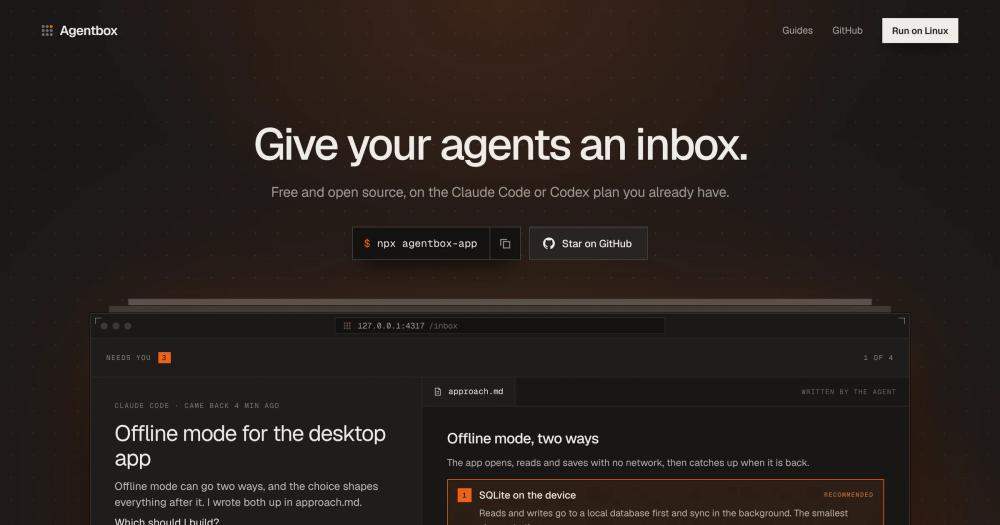
Run Claude Code and Codex agents in parallel with a shared inbox, each isolated in its own git worktree. Free, GPL-3.0, Mac and Linux.

Visit websiteGitHub351 stars
image of Agentbox
TL;DR

Agentbox is a desktop application for running Claude Code and Codex agents in parallel, each in its own git worktree, with an inbox-style interface so you only respond when one needs you. It replaces the tab-per-agent workflow that commercial agent management tools charge for, running entirely on the Claude Code or Codex subscription you already have. GPL-3.0, free, available as a signed Mac app and as an `npx` command for browsers and Linux. Best for developers filing tasks in bulk who want to review results rather than watch agents run.

Read the full breakdownHide the full breakdownWho it is for, how it works, trade-offs, the quick start and the FAQ
who it's for

Who Agentbox is for#

Solo developers parallelizing code tasks

File ten tasks at once (dependency updates, failing tests, documentation gaps) and step away. Agentbox queues them, runs them in priority order across your session slots, and delivers inbox cards when each one finishes. The inbox pattern prevents context-switching between terminals while agents run.

Skip if:

You are running one or two agents at a time and prefer live interaction with each one. The inbox adds overhead when you have fewer tasks than session slots and want to watch agents reason through the problem.

Developers exploring architecture options before building

Ask agents for multiple design options before any code is written. The README describes a workflow where agents return designs drawn in your actual app before the implementation begins. Pick one option and that branch gets built, avoiding an early commitment to a direction that turns out to be wrong.

Skip if:

You need to watch agents reason step by step through the problem in real time. Agentbox is built for review-at-the-end workflows, not live observation.

Teams running parallel sprints on the same codebase

Each team member can file tasks against a shared codebase without coordinating which files each agent should touch: worktree isolation handles that. The priority queue ensures the highest-priority items start first even when the team files tasks simultaneously.

Skip if:

Your team is on Windows. The `npx agentbox-app` browser path works on Windows but requires Node 22.18 and does not include the signed Mac app experience.

the problem

The problem it solves#

Today you manage coding agents in terminal windows and chat windows, and the number you can run is bounded by how many windows you can track at once. Each agent demands attention while it works, then goes quiet when it finishes, with no signal telling you it is done. Five agents might feel manageable; twenty becomes a constant context-switching burden.

The deeper problem is coordination. Without per-agent isolation, two agents editing the same file at once produce conflicts that need manual resolution. Without a priority system, urgent work can wait behind lower-priority tasks that happened to start first. Teams running multiple agents today typically manage this through separate terminals, manual file discipline, and re-queuing blocked work by hand.

how Agentbox solves it

How it solves it#

Inbox view for parallel agents

Each agent gets a row that only surfaces when it needs attention. While an agent is working, its row stays out of the inbox. When it finishes or gets stuck, its card appears with a two-line summary of what it did and what it needs. A hundred agents working in parallel is as quiet as one.

Git worktree isolation per task

Every agent runs in its own git worktree and on its own branch. No two agents touch the same files, so work from one task never conflicts with another in progress. The worktree is created before the agent starts and exists only for that task.

Keyboard-first review

Keys J and K navigate the inbox, E approves the agent's recommendation, R opens a reply, and 1, 2, 3 pick a numbered option the agent offered. The command palette at Cmd+K or Ctrl+K covers every other action. Each card closes on a keypress and the next card loads immediately.

Priority queue with project-level ordering

Tag tasks Urgent, High, Medium or Low, and order projects by dragging them once. Agentbox combines tag and project rank to decide which agents start first when session slots are limited and which card surfaces first in the inbox. Only your tags count: an agent cannot promote its own work.

No new subscription required

Agentbox drives Claude Code and Codex using the credentials already installed on your machine. There is no Agentbox server, no sign-up, and no additional fee. On first launch, the app finds the agents you have set up and walks you through connecting them.

strengths · trade-offs

Strengths and trade-offs#

Strengths

  • No cloud account or extra subscriptionAgentbox runs entirely on the Claude Code or Codex account you already have. No Agentbox server, no new sign-up, and no fee for the manager layer on top of the agents. The app is free to download; the `npx` path is free to run.
  • GPL-3.0: fork it, modify it, run itThe codebase is GPL-3.0 and on GitHub. You can modify agent behavior by editing the prompts in the `briefs/` directory the README describes, then run your modified version. Source builds carry no telemetry: the PostHog key is only baked into released builds.
  • Worktree isolation prevents merge conflictsEvery agent starts in its own git worktree and branch. Two agents can work on the same codebase simultaneously without touching each other's files. The worktree is created before the agent starts, so conflicts do not arise mid-run.
  • Keyboard review scales to dozens of tasksApproving a finished task is one keypress. The card closes and the next one loads. Reviewing twenty finished tasks takes roughly the same time as reviewing one because there is no terminal-switching, no log-scrolling, and no hunting for the right window.

Trade-offs

  • -macOS is the primary platformThe signed installer is Mac-only. Linux and other OS users run Agentbox through `npx agentbox-app`, which requires Node 22.18 or newer. The terminal feature on Linux also needs `make` and a C++ compiler; without them the terminal is omitted but the app runs otherwise. There is no Windows installer.
  • -Requires Claude Code or Codex installedAgentbox orchestrates agents but does not include them. You need a working Claude Code or Codex install and an active subscription before anything runs. Teams that have not set up either agent first have a prerequisite to handle.
  • -Early-stage projectThe repo launched in September 2026. At 351 stars and 6 open issues, it is under active development. The core inbox and worktree flow is working, but users running it at large scale or with unusual project structures may encounter edge cases not yet addressed.
versus alternatives

Agentbox vs alternatives#

Agentbox vs Conductor

Agentbox and Conductor both address the problem of managing multiple coding agents at once. Conductor is shutting down on November 20, 2026. Agentbox is the actively maintained GPL-3.0 alternative for teams and developers who need a parallel-agent workflow that continues beyond that date.

FeatureAgentboxConductor
LicenseGPL-3.0Proprietary
CostFreePaid
HostingLocal, no server requiredManaged cloud
Agent supportClaude Code, CodexClaude Code
PlatformmacOS app; Linux/browser via npxWeb app
StatusActiveEnding November 20, 2026

Agentbox runs entirely on your machine against the credentials you already have. There is no cloud account for the management layer, no additional subscription, and no outbound connection beyond what Claude Code or Codex themselves make. Each agent task runs in an isolated git worktree, which prevents file conflicts between parallel agents automatically.

Agentbox is designed for the pattern of filing many tasks and reviewing results later. If your workflow relies on live, interactive sessions with a single agent at a time, the inbox approach adds overhead that may not suit that style.

install · quick start

Quick start#

bash
Install Agentbox on any OS with one setup command (requires Node 22.18); or download the signed Mac app from GitHub Releases: https://github.com/savannahfeder/agentbox/releases/latest

```bash
npx agentbox-app
```
tech stack · detected from GitHub

What it's built on#

Languages
JavaScriptTypeScript
Frameworks
ElectronReact
Infrastructure
AWS
frequently asked

FAQ#

Does Agentbox require a separate subscription?

No. Agentbox drives Claude Code and Codex using the subscription you already have. The app itself is free and GPL-3.0. You need a working Claude Code or Codex install and an active Anthropic or OpenAI subscription, but there is no Agentbox account or additional monthly fee.

Does Agentbox run on Linux or Windows?

Linux is supported via npx agentbox-app, which starts the app in your browser listening only on localhost. It requires Node 22.18 or newer. The terminal feature also needs make and a C++ compiler (on Debian or Ubuntu: sudo apt install build-essential); everything else works without them. There is no Windows installer; the npx path runs on Windows as well.

What data does Agentbox send?

Released builds (the Mac app and npx agentbox-app) send anonymized usage counts to PostHog: 19 event types covering actions like opening the app, writing a task, and an agent finishing. No file contents, prompts, or paths are included. Turn it off in Settings under "Counts and crash reports", or add "diagnostics": false to zero.config.json. Source builds from the repo have no PostHog key and send nothing at all.

Can I build Agentbox from source?

Yes. Clone the repo and run npm install && npm start. Node 22.18 or newer is required. On Linux, the terminal feature needs make and a C++ compiler; without them the terminal is omitted but everything else works. The README documents how to open the app as a fresh user via npm run fresh for testing without touching your own projects.

Can Agentbox work with projects that are not git repositories?

No. Each agent task runs in its own git worktree, so the project you connect to Agentbox must be a git repository. It does not need to be pushed to a remote: a local git init is enough. Projects configured as personalProducts in zero.config.json are handled differently and use a single persistent session rather than per-task worktrees.

Looking for more

Other ways to replace Conductor#

paperclip

Featuredfor Conductor

Self-hosted AI agent management with org charts and budgets

111,113 GitHub starsVisit

Orca

#1 in the Conductor guide

Drop-in Conductor replacement with 27 or more agents on macOS, Windows, and Linux under MIT

115,397 GitHub stars

T3 Code

#2 in the Conductor guide

MIT-licensed control plane for 6 or more agents with mobile and web clients and a large community

46,806 GitHub stars

Paseo

#3 in the Conductor guide

Daemon-based architecture for agents running on a VM or Docker host with full mobile parity

23,074 GitHub stars
All 49 Conductor alternatives12 open source Conductor alternatives, ranked
by category

Open source tools in these categories#

581

Developer Tools

REA (Reverse Engineer Anything), Skills for Real Engineers, superpowers
496

AI & Machine Learning

freeCodeCamp, REA (Reverse Engineer Anything), OpenClaw
121

Product & Project Management

agency-agents, freeCodeCamp, Gstack

Sponsors

Inbox Zero

Alternative toSuperhuman

AI email assistant that drafts replies and clears your inbox

  • 12,915 GitHub stars
  • AGPL-3.0Licence AGPL-3.0
  • #Email

rakazo

Alternative toGrok Bot

AI teammates you own: your keys, your model, your machine.

  • 7,028 GitHub stars
  • Apache-2.0Licence Apache-2.0
  • #AI Agents

SnitchFeed

Live monitoring on LinkedIn, X, Reddit & more. Agentic social listening for startups.

Marketing & Growth

Advertise your product

New open source projects by email

The projects we add and every new guide. Free, unsubscribe any time.

Find open source alternatives to paid software

/
  • Claude Code to OpenCode
  • Jira to Windshift
  • Notion to AppFlowy
  • Slack to Mattermost
  • Linear to GitLab
  • Wispr Flow to Handy
  • Arc to Zen Browser
  • CapCut to Concat
  • Grok Bot to rakazo
  • Superhuman to Inbox Zero
  • Airtable to AITable
  • Muse to OpenClaw
  • Railway to Coolify
  • GitHub Copilot to Cline
  • Datadog to Netdata
  • Confluence to Wiki.js
  • Microsoft Teams to Rocket.Chat
  • Firebase to Supabase
  • Pinecone to Qdrant
  • Zapier to n8n
  • 1Password to KeePassXC
  • Devin AI to OpenHands
  • Asana to Leantime
  • Contentful to Strapi