Open Source Alternatives
  • Alternatives
  • Categories
    Categories by size1,127 projects
    • Developer Tools571
    • AI & Machine Learning487
    • Business & Productivity275
    • Web Development209
    • Security & Monitoring173
    • Communication & Collaboration154
    • IT Management146
    • Cloud & Hosting128
    • LLMOps & AI Tooling126
    • DevOps & CI/CD119
    Browse all 21 categoriesProduct & Project Management, Data & Analytics and 9 more
  • Blog
  • Advertise
SearchNotion, Slack, password manager.../
Submit
Open Source Alternatives
  • Alternatives
    • Developer Tools571
    • AI & Machine Learning487
    • Business & Productivity275
    • Web Development209
    • Security & Monitoring173
    • Communication & Collaboration154
    • Browse all 21 categories
  • Blog
  • Advertise
Submit your project

New open source projects by email

The projects we add and every new guide. Free, unsubscribe any time.

Open Source Alternatives LogoOpen Source Alternatives

Handpicked Open Source Alternatives to Paid Softwares

Product

  • Categories
  • Tag
  • Advertise

Resources

  • Blog
  • Collection
  • Submit

Company

  • Privacy Policy
  • Terms of Service
  • Refund Policy
  • Sitemap

Alternatives

  • Claude Code
  • Jira
  • Notion
  • Slack
  • Linear
  • Wispr Flow
  • All alternatives
© 2026 Open Source Alternatives. All rights reserved.
Open SourceAlternatives
Home/Categories/Developer Tools/bb
icon of Bb

bb

Open source alternative to Conductor and Factory.ai

  • 4.9K stars
  • MIT
  • Active this week
  • Last commit today

Last verified Nov 5, 2026

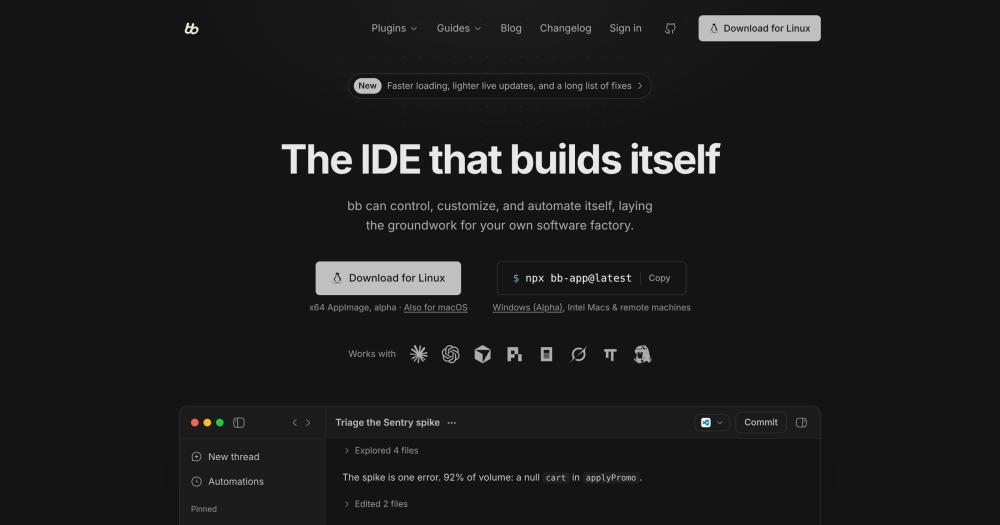
Orchestrate multiple coding agents in parallel, each in its own git worktree, using a local-first MIT-licensed agentic IDE.

Visit websiteGitHub4.9K stars
image of Bb
TL;DR

bb is a local-first, MIT-licensed agentic IDE that orchestrates Claude Code, Codex, Cursor, Pi, OpenCode, Grok, and other AI coding agents in parallel, each in its own git worktree thread. It is an open source alternative to paid orchestration tools like Factory.ai, letting you coordinate the agents you already use on your existing provider subscriptions. bb itself adds no per-seat fee: each agent bills through its own provider directly. Best for teams and individuals who want to run multiple AI coding agents on the same codebase simultaneously without file conflicts.

Read the full breakdownHide the full breakdownWho it is for, how it works, trade-offs, the quick start and the FAQ
who it's for

Who bb is for#

Development teams running concurrent agent tasks

A team can dispatch a Sentry triage to Claude Code, a module TypeScript port to Codex, and a release notes draft to Pi, all simultaneously, each in its own worktree thread. bb keeps the working trees separate so the team sees each job's status and output without manually managing branch conflicts.

Skip if:

Skip bb if your team runs one agent at a time and has no need for parallel worktree isolation. Sequential single-agent workflows gain nothing from bb's orchestration layer and add unnecessary setup complexity.

Individual developers building a customized AI workbench

bb's plugin system lets you add integrations with a prompt: a Linear panel, a custom agent skill, or a Slack trigger. The result is a personalized workbench that reflects your actual workflow. Because it is MIT-licensed, you can fork it and ship a custom build to your whole team.

Skip if:

Skip bb if you are satisfied with a single agent and have no interest in building or installing custom plugins. The added complexity of bb's orchestration layer is unnecessary for single-agent, single-task work.

Teams automating recurring engineering tasks via CLI or HTTP

The bb CLI and HTTP API let any external program spawn a thread: a nightly changelog generator triggered by a cron job, a CI bot that opens a triage thread on a test failure, or a Slack command that kicks off a code review. Each thread runs in the bb sidebar so engineers can follow or steer the work.

Skip if:

Skip bb if your automation use case is a one-off or low-frequency script with no need for human oversight. bb's orchestration layer adds infrastructure worth maintaining only when agent work runs regularly.

the problem

The problem it solves#

AI coding agents are most valuable when they can work in parallel on a codebase, but most setups serialize that work. When two agents edit the same files simultaneously, the results conflict and require manual resolution. Teams end up running agents one at a time, losing the parallelism that makes agent-assisted development faster.

The friction comes from coordination overhead. Teams must decide which agent runs next, switch context between threads, and stitch together outputs from separate sessions that did not share a working tree. Some paid orchestration services handle this, but they run agents on remote servers under the vendor's billing model, with no local access to the agent context from your own machine.

how bb solves it

How it solves it#

Git worktree isolation per agent thread

Each agent runs in its own git worktree, so five agents can work in parallel on the same repository without file conflicts. Work runs in threads you can follow live, steer at any point, or hand off to another agent. This is the core architectural choice that makes parallel agent work reliable rather than collision-prone.

Support for Claude Code, Codex, Cursor, Pi, OpenCode, Grok, omp, and Hermes

bb supports eight named agent integrations: Claude Code, Codex, Cursor, Pi, OpenCode, Grok, omp, and Hermes. Each runs on your own provider subscription, billed directly by that provider. You can dispatch the same task to different agents, or have one agent spawn and manage another inside bb.

Plugin system built on the same extension tools users have

Almost anything in bb can be changed with a single prompt. The GitHub integration, agent memory, scheduled jobs, and remote access are all plugins built with the same extension mechanism available to any bb user. A new Linear panel can be added by describing it: bb builds the plugin, registers the panel and CLI command, and the agents can use it immediately.

CLI and HTTP API for external automation

The same CLI the agents use is open to any program you write: a shell script, a cron job, or a bot in Telegram, Signal, or Slack. Each can spawn a thread that appears in the bb sidebar. The HTTP API provides the same access over the network, so external systems can trigger and monitor agent work without manual intervention.

Runs on your machine on existing provider subscriptions

bb runs local-first. It uses the provider subscriptions you already pay for, billed by those providers, not bb. There is no per-seat fee from bb itself. The macOS desktop app (Apple Silicon) is the recommended path; a Linux AppImage and Windows installer are in alpha, with npx available on all platforms.

strengths · trade-offs

Strengths and trade-offs#

Strengths

  • MIT license with no bb billingbb is MIT-licensed end to end. Fork the repo, customize the agents, tools, and UI, and deploy it across your whole organization. You run it on your existing Claude Code, Codex, or Cursor subscriptions; bb itself adds no per-seat or usage fee. Unlike proprietary orchestration services, there is no vendor to negotiate with for custom deployment terms.
  • Provider subscriptions stay with the providerEach agent runs on your own provider subscription and is billed by that provider directly. If you already pay for Claude Code or Codex, bb does not add another billing relationship. This also means you get the full model capabilities from each provider rather than a managed-tier API with usage caps set by a third party.
  • Every interface surface is a first-class access pointbb treats the desktop app, web app, CLI, and HTTP API as equal entry points. A shell script, a cron job, or an external bot can spawn a thread the same way the desktop UI can. This means agent work integrates with existing build systems and notification pipelines without special adapters or vendor approval.

Trade-offs

  • -Early-stage with 642 open issuesbb is in active development, created in February 2026. The core architecture is stable, but the README notes that workflows and surfaces are still evolving. With 642 open issues on GitHub, users should expect incomplete features, API changes, and rough edges in areas outside the core agent dispatch and worktree flow.
  • -macOS Apple Silicon is the only fully stable desktop targetThe signed desktop app runs on macOS Apple Silicon. The Linux AppImage and Windows installer are labeled alpha in the README, with the note to 'expect problems.' Intel Mac users are directed to the npx path instead. Teams running Windows or Linux as their primary development environment should test the npx route and check issue reports before committing bb to production agent workflows.
  • -Requires pre-authenticated provider CLIs before usebb uses the provider CLI you already have authenticated. Setting up Claude Code, Codex, or Cursor credentials is a prerequisite before those agents can be dispatched. This is not especially difficult, but bb is not a zero-step install for someone who has never configured any AI coding agent. First-time setup requires working through each provider's own authentication flow.
versus alternatives

bb vs alternatives#

bb vs Factory.ai

Both bb and Factory.ai address the problem of running AI coding agents at scale, but they take opposite approaches to infrastructure. bb runs local-first on your own machine, using the agent subscriptions you already pay for. Factory.ai is a managed service where agents run on Factory's servers and billing goes through Factory.

FeaturebbFactory.ai
LicenseMITProprietary
InfrastructureLocal, on your machineManaged by Factory.ai
Agent billingYour provider subscriptionFactory.ai billing
Supported agentsClaude Code, Codex, Cursor, Pi, OpenCode, Grok, omp, HermesFactory-managed agents
PluginsUser-extensibleVendor-defined

bb is the better choice when data privacy matters (your code stays on your machine), when you already have provider subscriptions you want to keep, or when you need to extend the orchestration layer with custom integrations. Factory.ai is the better choice when your team wants a fully managed service with no local infrastructure to maintain and is willing to work within the agent and billing model Factory provides.

bb vs Conductor

Conductor was the leading paid orchestration service in this category. Conductor stops working on November 20, 2026.

Teams currently on Conductor who need to migrate before that date should evaluate bb alongside Factory.ai. bb runs locally on existing provider subscriptions; Factory.ai is a managed alternative. Neither reproduces Conductor's exact feature set, so testing against your actual workflows before the deadline is worth the effort.

install · quick start

Quick start#

bash
Install bb via npx on any platform; macOS Apple Silicon users can download the signed desktop app from GitHub Releases: https://github.com/get-bb/bb/releases/latest

```bash
npx bb-app@latest
```
tech stack · detected from GitHub

What it's built on#

Languages
JavaScriptTypeScript
Frameworks
React
Tooling
esbuild
frequently asked

FAQ#

Does bb replace Claude Code, Codex, or Cursor?

No. bb coordinates those agents rather than replacing them. Claude Code, Codex, Cursor, Pi, OpenCode, Grok, omp, and Hermes all run inside bb, each in their own thread. bb is the orchestration layer; the agents do the actual coding work on your provider subscriptions.

Is bb free to use?

Yes. bb is MIT-licensed and free to run. You need existing subscriptions to the AI coding agents you want to use (Claude Code, Codex, Cursor, etc.), billed by those providers directly. bb itself adds no licensing fee. Download the desktop app from GitHub Releases or install via npx.

What platforms does bb support?

The macOS desktop app (Apple Silicon) is fully supported. Linux (x64 AppImage) and Windows (x64 installer) are in alpha as of November 2026, with the README noting to 'expect problems.' Intel Mac users and anyone on a non-Apple-Silicon machine can run bb via npx bb-app@latest on any platform that has Node.js.

How does bb handle billing across multiple AI agents?

bb does not bill for agent usage. Each agent runs on your own provider subscription and is billed by that provider directly. If you use Claude Code, Anthropic bills you. If you use Codex, OpenAI bills you. bb connects them into one orchestration interface without adding its own usage charges.

Can I build custom integrations with bb?

Yes. bb has a plugin system where almost any integration can be added with a prompt. The website shows an example of building a Linear panel: describe the integration, bb builds the plugin, registers the panel and CLI command, and the agents can use it immediately. The GitHub integration, agent memory, scheduled jobs, and remote access are all built as plugins using the same mechanism.

Looking for more

Other ways to replace Conductor and Factory.ai#

paperclip

Featuredfor Conductor

Self-hosted AI agent management with org charts and budgets

111,113 GitHub starsVisit

Orca

#1 in the Conductor guide

Drop-in Conductor replacement with 27 or more agents on macOS, Windows, and Linux under MIT

115,397 GitHub stars

T3 Code

#2 in the Conductor guide

MIT-licensed control plane for 6 or more agents with mobile and web clients and a large community

46,806 GitHub stars

Paseo

#3 in the Conductor guide

Daemon-based architecture for agents running on a VM or Docker host with full mobile parity

23,074 GitHub stars
All 39 Conductor alternatives12 open source Conductor alternatives, ranked
by category

Open source tools in these categories#

571

Developer Tools

REA (Reverse Engineer Anything), Skills for Real Engineers, superpowers
487

AI & Machine Learning

freeCodeCamp, REA (Reverse Engineer Anything), OpenClaw
126

LLMOps & AI Tooling

Hermes Agent, OpenCode, MarkItDown

Sponsors

Inbox Zero

Alternative toSuperhuman

AI email assistant that drafts replies and clears your inbox

  • 12,915 GitHub stars
  • AGPL-3.0Licence AGPL-3.0
  • #Email

rakazo

Alternative toGrok Bot

AI teammates you own: your keys, your model, your machine.

  • 7,028 GitHub stars
  • Apache-2.0Licence Apache-2.0
  • #AI Agents

SnitchFeed

Live monitoring on LinkedIn, X, Reddit & more. Agentic social listening for startups.

Marketing & Growth

Advertise your product

New open source projects by email

The projects we add and every new guide. Free, unsubscribe any time.

Find open source alternatives to paid software

/
  • Claude Code to OpenCode
  • Jira to Windshift
  • Notion to AppFlowy
  • Slack to Mattermost
  • Linear to GitLab
  • Wispr Flow to Handy
  • Arc to Zen Browser
  • CapCut to Concat
  • Grok Bot to rakazo
  • Superhuman to Inbox Zero
  • Airtable to AITable
  • Muse to OpenClaw
  • Railway to Coolify
  • GitHub Copilot to Cline
  • Datadog to Netdata
  • Confluence to Wiki.js
  • Microsoft Teams to Rocket.Chat
  • Firebase to Supabase
  • Pinecone to Qdrant
  • Zapier to n8n
  • 1Password to KeePassXC
  • Devin AI to OpenHands
  • Asana to Leantime
  • Contentful to Strapi