Open Source Alternatives
  • Alternatives
  • Categories
    Categories by size1,173 projects
    • Developer Tools603
    • AI & Machine Learning510
    • Business & Productivity281
    • Web Development213
    • Security & Monitoring175
    • Communication & Collaboration158
    • IT Management149
    • LLMOps & AI Tooling130
    • Cloud & Hosting129
    • Product & Project Management125
    Browse all 21 categoriesDesign & Creative, DevOps & CI/CD and 9 more
  • Blog
  • Advertise
SearchNotion, Slack, password manager.../
Submit
Open Source Alternatives
  • Alternatives
    • Developer Tools603
    • AI & Machine Learning510
    • Business & Productivity281
    • Web Development213
    • Security & Monitoring175
    • Communication & Collaboration158
    • Browse all 21 categories
  • Blog
  • Advertise
Submit your project

New open source projects by email

The projects we add and every new guide. Free, unsubscribe any time.

Open Source Alternatives LogoOpen Source Alternatives

Handpicked Open Source Alternatives to Paid Softwares

Add Open Source Alternatives as a preferred source on Google

Product

  • Categories
  • Tag
  • Advertise

Resources

  • Blog
  • Collection
  • Submit

Company

  • Privacy Policy
  • Terms of Service
  • Refund Policy
  • Sitemap

Alternatives

  • Claude Code
  • Jira
  • Notion
  • Slack
  • Linear
  • Wispr Flow
  • All alternatives
© 2026 Open Source Alternatives. All rights reserved.
Open SourceAlternatives
Home/Categories/AI & Machine Learning/Billion Context
icon of Billion Context

Billion Context

Open source alternative to Compresr

  • 4.6K stars
  • MIT with attribution requirement
  • Active this week
  • Last commit today

Last verified Nov 8, 2026

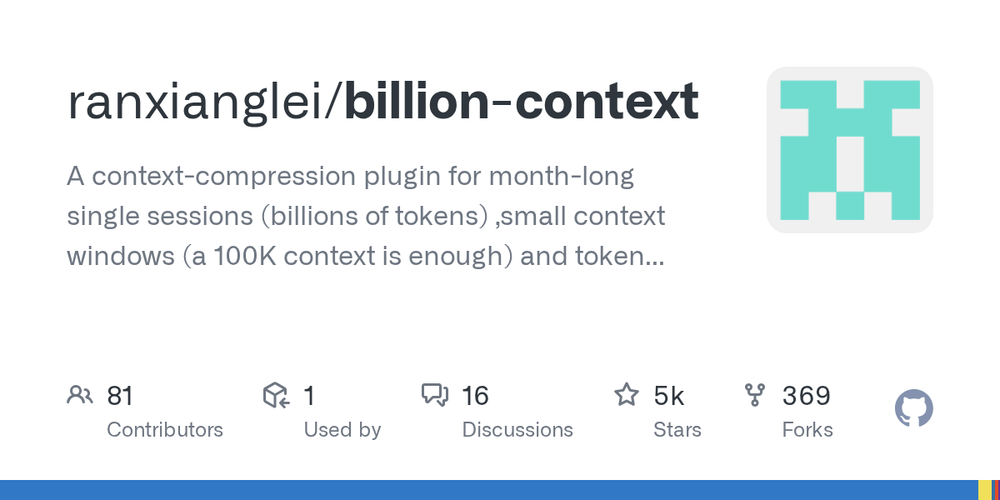
Run a context-compression proxy between any AI coding agent and its model API, cutting token costs up to 5x and enabling month-long sessions.

Visit websiteGitHub4.6K stars
image of Billion Context
TL;DR

Billion Context is a context-compression proxy for AI coding agents that sits between any agent and its model API, using an acp-kernel engine to compress consumed conversation history into reversible summaries. It replaces commercial context-management services like Compresr, cutting token costs by up to 5x while enabling month-long coding sessions without hitting context windows. The license is MIT with an attribution requirement; self-hosting requires only an npm install. Best for developers running long AI coding sessions who want lower API costs and more reliable multi-hour or multi-day agent runs.

Read the full breakdownHide the full breakdownWho it is for, how it works, trade-offs, the quick start and the FAQ
who it's for

Who Billion Context is for#

Developers running multi-hour AI coding sessions

billion-context keeps a session alive across days of work without breaking context. If you regularly hit the edge of your model's context window on complex refactors, long debugging sessions, or large codebases, the proxy keeps the conversation coherent without requiring a manual restart.

Skip if:

Your sessions are short and self-contained (under an hour per task). billion-context's value is for extended runs where context accumulates; for short sessions, the overhead of a local proxy exceeds the benefit.

Teams with high monthly model API costs

At 5x fewer tokens for the same session quality, teams paying several hundred dollars per month on API fees for coding agents can cut those costs significantly. The npm install and local proxy are free; the savings come entirely from reduced token usage on the model API you are calling.

Skip if:

Your team is on a fixed-price or unlimited plan for your model API. If token volume is not what drives your costs, the compression benefit does not translate to a cost saving.

Agent pipeline developers building long-horizon tasks

For agentic pipelines where a single task may involve hundreds of tool calls and thousands of messages, billion-context prevents the pipeline from stopping at a context boundary mid-task. The proxy is transparent to the agent; no code changes are needed in the pipeline itself.

Skip if:

Your pipeline already manages context windows programmatically and reinitializes agents between subtasks. billion-context is most useful for single-session continuity, not for distributed multi-agent systems where context is managed at a higher level.

the problem

The problem it solves#

Long AI coding sessions hit a wall. Each model charges per token, and context windows run out. Once the window overflows the session breaks or degrades badly, forcing the user to start fresh and reload all the accumulated project context. Teams running intensive agent sessions routinely pay hundreds of dollars in API fees for a single complex task, with no guarantee the session survives long enough to complete it.

Existing options leave gaps. Provider-side summarization is opaque, non-reversible, and often drops critical details. RAG approaches require extra infrastructure and return imprecise context. Truncation just cuts history. None of them let the agent decide what to retain with full fidelity.

how Billion Context solves it

How it solves it#

Transparent proxy for any AI coding agent

Intercepts and rewrites Anthropic and OpenAI API streams, so billion-context works with any client that calls those APIs: Claude Code, Codex, OpenCode, aider, Gemini CLI, and 20+ others. No model switching, no API key changes, no prompt engineering.

Model-driven incremental compression

Compression is not a hard truncation. The proxy injects four context-management tools into the conversation; the model calls `compress` itself as context grows, folding a message range into a detailed summary. Ranges can be decompressed on demand when exact details matter again, and `search_context` does keyword search across compressed and visible messages.

Prefix-cache compatibility

Compression keeps the cache prefix intact. A healthy session maintains a 95-97% prefix-cache hit rate, and the compression process itself costs under 2% of that. Prefix-cache misses are a primary cost amplifier in long agent sessions; preserving the prefix is what makes the token savings add up.

Three integration modes

Install as a native plugin inside a supported agent client (Claude Code, OpenCode, pi, dsh, kimi, hermes, zcode), use the `bili <client>` launcher to start both proxy and agent together, or point the client's baseURL at the `/bili/` URL prefix. All three routes land in the same compression pipeline.

Independent third-party benchmark results

Third-party 1,500-item benchmarks rank billion-context first on ContextBench (0.3097 Utilized F1, 58.3% lower cost than full context), 16.6% higher recall than the best RAG approach on LongMemEval-S (79.20% vs 62.60%), and 100% survival on the 1.48M-token MemoryAgentBench task where full context fails all 199/199 runs.

strengths · trade-offs

Strengths and trade-offs#

Strengths

  • No per-token fees for the proxy layerUnlike Compresr and similar commercial context-compression services that charge usage-based fees for their APIs, billion-context runs locally at no marginal cost. The proxy is a local process; your costs reduce to your own server costs and the actual model API calls, which are smaller because of the compression.
  • Agent compatibility across 20+ clientsThe proxy handles both Anthropic and OpenAI wire formats, which covers the vast majority of AI coding agents in active use. Dedicated launchers, native plugins, and cert-MITM modes expand coverage to closed-binary clients (GitHub Copilot CLI, Amp, Kiro) that have no plugin seam.
  • Reversible, model-guided compressionUnlike hard truncation or opaque provider summarization, billion-context lets the model decide what to compress and fold it into a summary that the model can decompress later when exact details are needed. This preserves context fidelity better than losing it outright.
  • Documented production-scale resultsThe project publishes a research paper documenting 4.5 months of production use: 174,327 model calls, 18.76B cumulative input tokens, zero context-window violations on 204,800-token models, and marathon sessions of 8,584 to 12,049 calls. This is documented longitudinal operation, not a lab benchmark.

Trade-offs

  • -MIT license with mandatory attribution for user-facing productsMIT with an added attribution clause: use, modify, deploy, and self-host for any purpose including commercial. Products or services with a user-facing surface must display visible credit on the home page, docs, or About/Credits page stating the product uses billion-context with a link to the repository. Server-side or embedded use with no user-facing surface needs only a notice in shipped documentation. Reselling it as a managed service is not permitted.
  • -495 open issues for a project that opened in August 2026The repo reached 4,625 stars quickly after opening in August 2026. With 495 open issues, bug reports and edge cases are actively accumulating. The project shows recent pushes, but users running production workloads should expect rough edges in client integrations and test their specific agent client before committing.
  • -Cert-MITM mode requires trusting a local CAFor closed-binary agent clients with no plugin seam, billion-context uses certificate-based MITM proxying. This requires installing a local CA certificate, which some security policies prohibit in team or enterprise environments. Clients with native plugin support (Claude Code, OpenCode, pi, dsh, kimi, hermes, zcode) avoid this requirement entirely.
versus alternatives

Billion Context vs alternatives#

Billion Context vs Compresr

Compresr is a commercial context-compression API for LLM pipelines with usage-based pricing. It is designed as a managed service you call from your own code, abstracting the compression logic into a hosted API endpoint.

Billion Context takes a different approach: it is a local proxy you install once that sits between your agent client and the model API, with no changes to your calling code. You point your agent's base URL at the proxy; it handles compression transparently.

Price model

Compresr charges per use of its compression API. Billion Context is free to run; there is no per-call fee for the proxy layer itself. Your costs are only the reduced number of tokens sent to the actual model API, which is where the savings come from.

Self-hosting and code access

Billion Context runs entirely on your machine or server. You can inspect the compression code, modify the acp-kernel behavior, and update without waiting for a vendor. Compresr is a hosted service with no access to the compression implementation.

Integration surface

Compresr integrates at the code level: your application calls its API. Billion Context integrates at the network level: the proxy intercepts and rewrites model API traffic. This means billion-context works with any existing agent client without code changes, while Compresr requires explicit integration work in your application or pipeline.

When Compresr fits better

Compresr is simpler to integrate for teams that already have application-level code calling LLM APIs and want a drop-in compression middleware. It requires no local proxy management and no network interception.

When Billion Context fits better

Billion Context is better suited for individual developers or teams using off-the-shelf AI coding agents (Claude Code, Codex, OpenCode, aider) where there is no application-level code to modify. It is free to run and open source, with detailed benchmark results published in the project's research paper.

install · quick start

Quick start#

bash
Install billion-context globally with npm to get the `bili` command for the context-compression proxy.

```bash
npm install -g billion-context --prefix=~/.local
```
tech stack · detected from GitHub

What it's built on#

Languages
JavaScriptTypeScript
Databases
MySQL
Tooling
esbuild
frequently asked

FAQ#

Does billion-context work with Claude Code?

Yes. Run bili plugin install claude for a native integration that manages its own settings block and session-owned proxy, or use bili claude as a launcher that starts both the proxy and Claude Code together. The native mode is documented in the README as issue #964.

What does the attribution requirement in the license mean for self-hosters?

billion-context uses an MIT license with an added attribution clause. You may use, modify, deploy, and self-host it for any purpose including commercial and team use. If you use it in a product or service with a user-facing surface (a web app, desktop tool, or anything a user interacts with), you must display a visible credit on the home page, documentation, or an About/Credits page stating the product uses billion-context and linking to the GitHub repository. Server-side or embedded use with no user-facing surface satisfies the requirement by carrying the notice in shipped documentation only.

How does billion-context compare to built-in model context summarization?

Provider-side context summarization is opaque and non-reversible; once the provider summarizes history, the original is gone and you cannot restore it. billion-context keeps summaries as explicit, decompressible ranges: the model can call decompress to restore a range if exact details are needed again. It also exposes search_context for keyword search across both compressed and visible history, and acp_status for a context-usage overview.

What is the expected prefix-cache hit rate during a session?

A healthy session maintains a 95-97% prefix-cache hit rate, with compression overhead itself under 2% of that. If the rate drops, the README documents the typical causes in order: upstream cache TTL expiry, a model switch mid-session, a billion-context bug, or unknown causes. Cache health is visible during a session via the /acp and /acp-cache commands.

Does billion-context support OpenAI-compatible APIs beyond the official OpenAI endpoint?

Yes. The proxy rewrites both Anthropic and OpenAI wire format streams. Any model API that uses either format is supported: Anthropic-compatible, OpenAI-compatible, and local models served with an OpenAI-compatible endpoint. The client table in the README lists certified integrations; for clients using other formats, the launcher or URL prefix route applies.

also worth a look

Similar open-source tools#

Hermes Agent

Featured

Alternative toGrok Bot

Self-hosted AI agent: persistent memory, multi-channel chat, model choice.

  • 260,560 GitHub stars
  • MITLicence MIT

Hive

Alternative toConductor

AI coding agent orchestrator for isolated parallel worktrees

  • 474 GitHub stars
  • MITLicence MIT

Alethe

Alternative toConductor

Multi-agent coding workspace with real PTYs and MCP management

  • 1,118 GitHub stars
  • AGPL-3.0Licence AGPL-3.0

Maestro

Alternative toConductor

Desktop orchestrator for parallel AI coding agent fleets

  • 3,540 GitHub stars
  • AGPL-3.0Licence AGPL-3.0

bb

Alternative toConductor

Multi-agent IDE coordinating Claude Code, Codex, Cursor, and more.

  • 4,896 GitHub stars
  • MITLicence MIT

Routerly

Alternative toPortkey

Self-hosted LLM gateway with 11 routing policies and no database.

  • 107 GitHub stars
  • AGPL-3.0Licence AGPL-3.0
by category

Open source tools in these categories#

510

AI & Machine Learning

freeCodeCamp, REA (Reverse Engineer Anything), OpenClaw
130

LLMOps & AI Tooling

Hermes Agent, OpenCode, MarkItDown
603

Developer Tools

REA (Reverse Engineer Anything), Skills for Real Engineers, superpowers

Sponsors

Inbox Zero

Alternative toSuperhuman

AI email assistant that drafts replies and clears your inbox

  • 12,915 GitHub stars
  • AGPL-3.0Licence AGPL-3.0
  • #Email

rakazo

Alternative toGrok Bot

AI teammates you own: your keys, your model, your machine.

  • 7,028 GitHub stars
  • Apache-2.0Licence Apache-2.0
  • #AI Agents

SnitchFeed

Live monitoring on LinkedIn, X, Reddit & more. Agentic social listening for startups.

Marketing & Growth

Advertise your product

New open source projects by email

The projects we add and every new guide. Free, unsubscribe any time.

Find open source alternatives to paid software

/
  • Claude Code to OpenCode
  • Jira to Windshift
  • Notion to AppFlowy
  • Slack to Mattermost
  • Linear to GitLab
  • Wispr Flow to Handy
  • Arc to Zen Browser
  • CapCut to Concat
  • Grok Bot to rakazo
  • Superhuman to Inbox Zero
  • Airtable to AITable
  • Muse to OpenClaw
  • Railway to Coolify
  • GitHub Copilot to Cline
  • Datadog to Netdata
  • Confluence to Wiki.js
  • Microsoft Teams to Rocket.Chat
  • Firebase to Supabase
  • Pinecone to Qdrant
  • Zapier to n8n
  • 1Password to KeePassXC
  • Devin AI to OpenHands
  • Asana to Leantime
  • Contentful to Strapi
  • Claude Code to OpenCode
  • Jira to Windshift
  • Notion to AppFlowy
  • Slack to Mattermost
  • Linear to GitLab
  • Wispr Flow to Handy
  • Arc to Zen Browser
  • CapCut to Concat
  • Grok Bot to rakazo
  • Superhuman to Inbox Zero
  • Airtable to AITable
  • Muse to OpenClaw
  • Railway to Coolify
  • GitHub Copilot to Cline
  • Datadog to Netdata
  • Confluence to Wiki.js
  • Microsoft Teams to Rocket.Chat
  • Firebase to Supabase
  • Pinecone to Qdrant
  • Zapier to n8n
  • 1Password to KeePassXC
  • Devin AI to OpenHands
  • Asana to Leantime
  • Contentful to Strapi