Open Source Alternatives
  • Alternatives
  • Categories
    Categories by size1,139 projects
    • Developer Tools583
    • AI & Machine Learning498
    • Business & Productivity275
    • Web Development209
    • Security & Monitoring173
    • Communication & Collaboration154
    • IT Management146
    • Cloud & Hosting128
    • LLMOps & AI Tooling128
    • Product & Project Management122
    Browse all 21 categoriesDevOps & CI/CD, Data & Analytics and 9 more
  • Blog
  • Advertise
SearchNotion, Slack, password manager.../
Submit
Open Source Alternatives
  • Alternatives
    • Developer Tools583
    • AI & Machine Learning498
    • Business & Productivity275
    • Web Development209
    • Security & Monitoring173
    • Communication & Collaboration154
    • Browse all 21 categories
  • Blog
  • Advertise
Submit your project

New open source projects by email

The projects we add and every new guide. Free, unsubscribe any time.

Open Source Alternatives LogoOpen Source Alternatives

Handpicked Open Source Alternatives to Paid Softwares

Product

  • Categories
  • Tag
  • Advertise

Resources

  • Blog
  • Collection
  • Submit

Company

  • Privacy Policy
  • Terms of Service
  • Refund Policy
  • Sitemap

Alternatives

  • Claude Code
  • Jira
  • Notion
  • Slack
  • Linear
  • Wispr Flow
  • All alternatives
© 2026 Open Source Alternatives. All rights reserved.
Open SourceAlternatives
Home/Categories/Developer Tools/Diri
icon of Diri

Diri

Open source alternative to Conductor

  • 484 stars
  • AGPL-3.0
  • Active this week
  • Last commit today

Last verified Nov 5, 2026

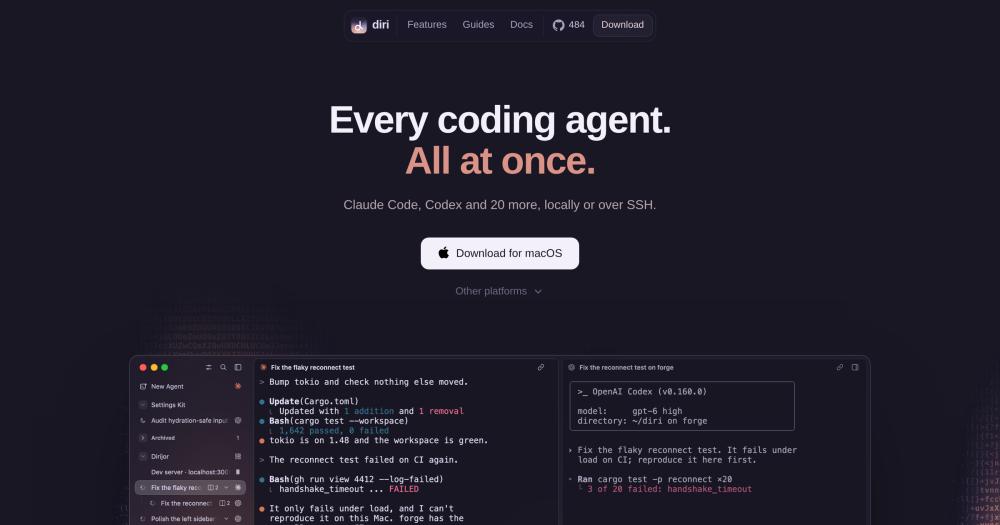
Orchestrate Claude Code, Codex, and 20+ coding agents in parallel on macOS, locally or over SSH, with no account required.

Visit websiteGitHub484 stars
image of Diri
TL;DR

Diri is a native macOS app that orchestrates multiple coding agents in parallel, letting one developer keep track of dozens of running sessions at once. It is free and open source under AGPL-3.0, running on the user's own machines with no Diri account and no hosted relay. Each agent gets its own terminal session and git worktree; a built-in MCP server lets agents spawn and coordinate other agents. Best for developers already using Claude Code, Codex, or Cursor who want to parallelize work across features and branches.

Read the full breakdownHide the full breakdownWho it is for, how it works, trade-offs, the quick start and the FAQ
who it's for

Who Diri is for#

Developers parallelizing feature work across branches

A developer assigns five features to five agents, each in its own worktree and branch. The sidebar shows which agents are waiting for input and which have finished. At the end of a work session, the developer reviews diffs and commits them from within Diri without switching to a separate terminal.

Skip if:

You are running a single agent at a time on straightforward tasks. The overhead of managing multiple worktrees and sessions pays off at three or more parallel tasks, not for one-off work.

Teams automating overnight coding and test runs

Scheduled runs and Mac-wake support let a developer queue agents to start before work hours. An agent can run tests, open pull requests, or prepare a morning summary while the developer is away. SSH support means these can run on a build server rather than a personal Mac.

Skip if:

Your team already runs CI in the cloud on every commit and does not need local agent coordination. Diri handles local or SSH agent execution, not integration with remote CI runners.

Developers building agent-to-agent workflows

Diri's built-in MCP server lets one agent prompt another. A lead agent can break a plan into tasks, spawn a worker agent per task, collect the results, and produce a summary. Any to-do item can also start an agent directly. This is the starting point for multi-step automated development without custom orchestration code.

Skip if:

You need a persistent server-side orchestrator accessible to external systems. Diri orchestrates agents on a local Mac or SSH hosts; it does not run as a background service with a stable network address.

Open source developers auditing AI-generated changes

Diri shows diffs, a commit interface, and pull request checks beside the agent session that produced the code. A developer reviews every change in context before committing, with the full terminal session available for reference. Worktree-per-agent isolation means changes from different agents do not mix.

Skip if:

You want agents to commit and push autonomously without review. Diri places the developer in the review loop and is not designed for fully autonomous commit workflows.

the problem

The problem it solves#

Running one AI coding agent is straightforward. Running ten or twenty at once means tracking which session is blocked, which has finished, and which needs a decision, across separate terminal windows with no shared status view. Developers miss agent prompts waiting for input and lose track of which changes belong to which task.

The git problem compounds this. Parallel agents writing to the same working tree produce conflicts that are hard to untangle. Without per-agent branch and worktree isolation, running agents in parallel creates more cleanup work than it saves.

how Diri solves it

How it solves it#

Agent-to-agent coordination via MCP

Diri includes a built-in MCP server that lets any running agent spawn other agents, hand them tasks, wait for their output, and collect their results. A developer can describe the job in plain English starting with "Use diri to..." and the agent handles delegation to other agents on the same Mac or on any SSH host.

Git worktree per agent

Every agent session in Diri can get its own git worktree and branch, so agents working on different features or fixes never write to the same working tree. Changes stay isolated until the developer reviews and merges them. The diff, stage, and commit interface is beside the session that produced the code.

Scheduled runs with Mac wake

Runs can be set for specific times or recurring patterns, and Diri can wake the Mac to execute them. A developer sets agents to start at 7 AM on weekdays before sitting down, or schedules a one-time run for later in the day. Scheduling works without leaving a terminal open.

SSH agent sessions with no remote install

Diri connects to SSH hosts and runs agents on them with no additional software installed on the remote machine. The developer picks a host in the app, and agents run there using their existing SSH credentials, extending the full multi-agent workflow to build servers or remote development environments.

Sessions that survive closing the app

Each agent runs in its own terminal process, independent of the Diri app window. Closing Diri leaves all agents running; reopening it shows each session where it was left. Restarting the Mac stops agent processes, but Claude Code, Codex, and most other agents support resuming the same conversation after restart.

22 agent definitions included out of the box

Diri ships with definitions for 22 agents: Claude Code, Codex, Cursor, Gemini, OpenCode, Pi, Copilot, Kimi, and more. Any terminal-based coding agent can be added by writing a short JSON manifest file without modifying the app. Claude Code and Codex receive the deepest status display and conversation-resume integration.

strengths · trade-offs

Strengths and trade-offs#

Strengths

  • AGPL-3.0, free, no Diri account requiredDiri is free under AGPL-3.0 with no subscription and no per-seat fee. There is no Diri account and no hosted relay. Developers pay only for the AI APIs they already use through their own Claude, ChatGPT, or other accounts. The source is on GitHub at cristicretu/diri.
  • Native Rust with no browser engine overheadDiri is built in native Rust using GPUI. The app runs no embedded browser engine. The README describes it as a native app designed to manage dozens of concurrent sessions, which keeps resource usage bounded by what the agents themselves consume rather than by framework overhead.
  • Code and prompts stay on the user's machinesAgents run on the user's Mac or on SSH hosts the user controls. The app records crash and performance diagnostics only, never terminal contents or prompts, and that sharing can be turned off in settings. For teams with confidential codebases, this is a meaningful distinction from cloud-hosted orchestration services.
  • Per-agent browser for live testingEach agent session in Diri gets its own browser instance for testing what it built. Computer use lets agents interact with Mac apps in the background while the developer's cursor stays on their normal work. This closes the loop between code generation and functional testing without manual handoff to a separate browser session.

Trade-offs

  • -macOS 15 required; Linux is in betaThe primary supported platform is macOS 15 or newer on Apple silicon and Intel. Linux support exists in beta for x86_64 Ubuntu 22.04 and 24.04 (X11 or Wayland, Vulkan 1.3), but Linux packages are not included in every release. Windows support is in progress but not yet available.
  • -Project is about three months old with 14 open issuesDiri was created in August 2026 and had 14 open issues as of November 2026. The project is active (last pushed November 2026, 484 stars) but is early-stage software. Features listed as upcoming in the roadmap, including notes and Windows support, are not yet complete, and some behaviors may change between releases.
  • -AGPL-3.0 restricts reselling as a hosted serviceAGPL-3.0 requires making source code available to users of a network-served version. Running Diri on your own machines for internal team development does not trigger this requirement. The restriction applies when offering Diri as a hosted managed service to external users; in that case, the source must be provided under the same license.
versus alternatives

Diri vs alternatives#

Diri vs Conductor

Diri and Conductor overlap on the same use case: a dedicated interface for running multiple coding agents in parallel, with session management and change review in one place. Conductor is a paid, proprietary tool; Diri is free and open source under AGPL-3.0.

Conductor stops working on November 20, 2026. Developers currently using Conductor to coordinate their coding agents will need a replacement before that date.

FeatureDiriConductor
LicenseAGPL-3.0Proprietary
PriceFreePaid
StatusActive, open sourceEnds November 20, 2026
DeploymentLocal or SSH, no accountManaged service

Diri handles the core orchestration workflow: a session-status sidebar, diff review beside each agent session, and git worktree isolation per agent to keep parallel work from colliding. It extends this with agent-to-agent coordination through a built-in MCP server, SSH support for running agents on remote machines without additional server software, and scheduled runs with Mac-wake capability.

For developers migrating from Conductor, Diri covers the same parallel-agent management use case with no subscription required, running entirely on the developer's own machines.


install · quick start

Quick start#

bash
Install Diri on macOS using the Homebrew cask.

```bash
brew install --cask diri
```
tech stack · detected from GitHub

What it's built on#

Languages
JavaScriptRustSwift
frequently asked

FAQ#

Is Diri free to use?

Yes. Diri is free and open source under AGPL-3.0. There is no Diri subscription, no per-seat fee, and no account required. You pay only for the AI APIs you use directly, through your own Claude, ChatGPT, or other accounts.

Which coding agents does Diri support?

Diri ships with definitions for 22 agents: Claude Code, Codex, Cursor, Gemini, OpenCode, Pi, Copilot, Kimi, and more. Any terminal-based coding agent can be added by writing a short JSON manifest file. Claude Code and Codex receive the deepest status display and conversation-resume integration.

What happens if I close Diri while agents are running?

Agents keep running. Each session runs in its own process, independent of the Diri app window. Reopen Diri and every session is where you left it. Restarting your Mac stops the agent processes, but Claude Code, Codex, and most other agents support resuming the same conversation when you restart.

Can agents on different machines coordinate with each other?

Yes. Agents started in Diri can spawn other agents on the same Mac or on any SSH host you have added. The built-in MCP server handles the coordination: one agent can hand a task to another, wait for it, and collect the result. You trigger this with a plain English prompt starting with "Use diri to...".

What platforms does Diri run on?

macOS 15 or newer on Apple silicon and Intel is the primary supported platform. Linux support is in beta for x86_64 Ubuntu 22.04 and 24.04 (X11 or Wayland, Vulkan 1.3). Linux packages are not included in every release. Windows support is in progress. See the Linux installation guide for packages, source builds, and current limitations.

Looking for more

Other ways to replace Conductor#

paperclip

Featuredfor Conductor

Self-hosted AI agent management with org charts and budgets

111,113 GitHub starsVisit

Orca

#1 in the Conductor guide

Drop-in Conductor replacement with 27 or more agents on macOS, Windows, and Linux under MIT

115,397 GitHub stars

T3 Code

#2 in the Conductor guide

MIT-licensed control plane for 6 or more agents with mobile and web clients and a large community

46,806 GitHub stars

Paseo

#3 in the Conductor guide

Daemon-based architecture for agents running on a VM or Docker host with full mobile parity

23,074 GitHub stars
All 52 Conductor alternatives12 open source Conductor alternatives, ranked
by category

Open source tools in these categories#

584

Developer Tools

REA (Reverse Engineer Anything), Skills for Real Engineers, superpowers
499

AI & Machine Learning

freeCodeCamp, REA (Reverse Engineer Anything), OpenClaw

Sponsors

Inbox Zero

Alternative toSuperhuman

AI email assistant that drafts replies and clears your inbox

  • 12,915 GitHub stars
  • AGPL-3.0Licence AGPL-3.0
  • #Email

rakazo

Alternative toGrok Bot

AI teammates you own: your keys, your model, your machine.

  • 7,028 GitHub stars
  • Apache-2.0Licence Apache-2.0
  • #AI Agents

SnitchFeed

Live monitoring on LinkedIn, X, Reddit & more. Agentic social listening for startups.

Marketing & Growth

Advertise your product

New open source projects by email

The projects we add and every new guide. Free, unsubscribe any time.

Find open source alternatives to paid software

/
  • Claude Code to OpenCode
  • Jira to Windshift
  • Notion to AppFlowy
  • Slack to Mattermost
  • Linear to GitLab
  • Wispr Flow to Handy
  • Arc to Zen Browser
  • CapCut to Concat
  • Grok Bot to rakazo
  • Superhuman to Inbox Zero
  • Airtable to AITable
  • Muse to OpenClaw
  • Railway to Coolify
  • GitHub Copilot to Cline
  • Datadog to Netdata
  • Confluence to Wiki.js
  • Microsoft Teams to Rocket.Chat
  • Firebase to Supabase
  • Pinecone to Qdrant
  • Zapier to n8n
  • 1Password to KeePassXC
  • Devin AI to OpenHands
  • Asana to Leantime
  • Contentful to Strapi