Open Source Alternatives
  • Alternatives
  • Categories
    Categories by size1,047 projects
    • Developer Tools533
    • AI & Machine Learning461
    • Business & Productivity244
    • Web Development204
    • Security & Monitoring157
    • Communication & Collaboration141
    • IT Management139
    • Cloud & Hosting122
    • LLMOps & AI Tooling121
    • Data & Analytics113
    Browse all 21 categoriesDesign & Creative, Product & Project Management and 9 more
  • Blog
  • Advertise
SearchNotion, Slack, password manager.../
Submit
Open Source Alternatives
  • Alternatives
    • Developer Tools533
    • AI & Machine Learning461
    • Business & Productivity244
    • Web Development204
    • Security & Monitoring157
    • Communication & Collaboration141
    • Browse all 21 categories
  • Blog
  • Advertise
Submit your project

New open source projects by email

The projects we add and every new guide. Free, unsubscribe any time.

Open Source Alternatives LogoOpen Source Alternatives

Handpicked Open Source Alternatives to Paid Softwares

Product

  • Categories
  • Tag
  • Advertise

Resources

  • Blog
  • Collection
  • Submit

Company

  • Privacy Policy
  • Terms of Service
  • Refund Policy
  • Sitemap

Alternatives

  • Claude Code
  • Jira
  • Notion
  • Slack
  • Linear
  • Wispr Flow
  • All alternatives
© 2026 Open Source Alternatives. All rights reserved.
Open SourceAlternatives
Home/Categories/Developer Tools/Emdash
icon of Emdash

Emdash

Open source alternative to Conductor

  • 6.2K stars
  • Apache-2.0
  • Active this week
  • Last commit 2 days ago

Last verified Nov 4, 2026

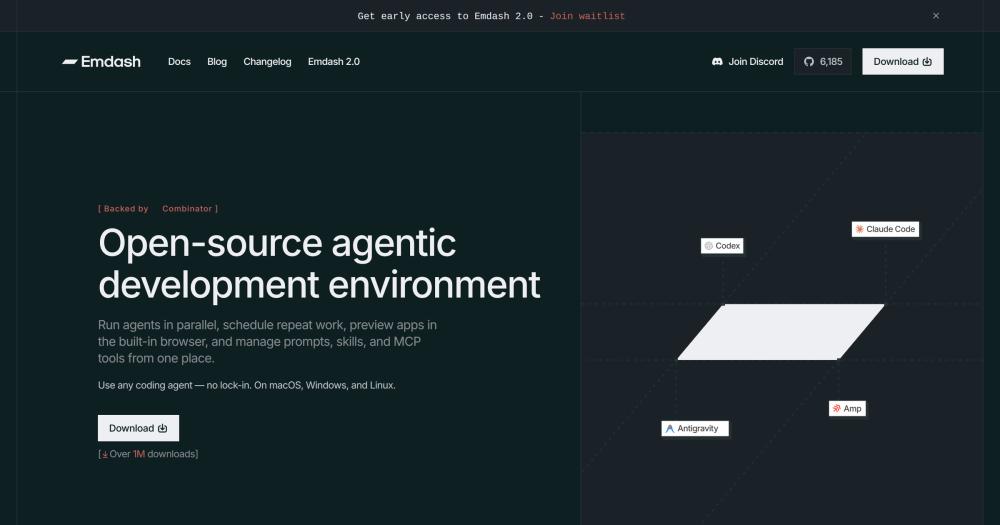
Run multiple AI coding agents in parallel across isolated Git worktrees, with unified diff review, scheduling, and SSH remote machine support.

Visit websiteGitHub6.2K stars
image of Emdash
TL;DR

Emdash is a free, open-source desktop app for running AI coding agents in parallel across isolated Git worktrees. It replaces the serial run-wait-review cycle that slows agent-assisted development, letting you work on multiple branches simultaneously and review the diffs from one place. Licensed under Apache-2.0 and available for macOS, Windows, and Linux, it supports over 25 agent providers with no lock-in. Best for developers and teams already using CLI agents who want to run several tasks at once without manually managing multiple terminal sessions.

Read the full breakdownHide the full breakdownWho it is for, how it works, trade-offs, the quick start and the FAQ
who it's for

Who Emdash is for#

Developers running multiple agent tasks on a single codebase

Run separate agents for a bug fix, a refactor, and a dependency update at the same time, each in its own worktree. Review the three diffs side by side and merge the ones that pass.

Skip if:

If you are running agents sequentially on purpose (for example, chaining output of one agent as input to the next), Emdash's parallel worktree model does not map to that workflow directly.

Teams automating recurring engineering maintenance

Schedule weekly bug sweeps, pre-release checks, or dependency audits as recurring agent jobs. Each run executes in an isolated context, logs results, and shows pass or fail without manual intervention.

Skip if:

If your recurring jobs need to interact with a CI/CD pipeline's build artifacts directly, you will need additional tooling beyond Emdash's scheduling.

Individual developers tracking tickets from multiple projects

Connect Linear, Jira, GitHub, and other trackers to pull issues directly into agent sessions. Each issue becomes a task with full context, running in its own worktree. No copy-pasting from tracker to terminal.

Skip if:

Teams requiring shared visibility into all agent runs across multiple engineers will need to coordinate via the shared Git repository since each developer runs their own Emdash instance.

Engineers working on remote or cloud machines

Connect over SSH to a dev server, cloud VM, or GPU box and run the same parallel agent workflow remotely. Credentials are stored in the OS keychain and SSH certificates held by the agent are supported.

Skip if:

If your remote machine does not have the required agent CLIs installed, you will need to set them up there first. Emdash can install supported agents but requires an internet connection on the remote host.

the problem

The problem it solves#

Running AI coding agents one at a time creates a bottleneck that scales poorly with the volume of agent-ready tasks. A developer using Claude Code or Codex typically opens a terminal, starts a task, waits for the agent to finish, reviews the output, and then moves to the next one. When the backlog has ten tickets and each agent run takes five minutes, most of that time is dead time.

The problem compounds for teams. Each engineer working separately means no shared view of what agents are doing across branches, no way to quickly review several agents' diffs in parallel, and no easy path to recurring automated jobs. Teams end up copy-pasting issue text into separate terminal sessions and tracking progress in side notes, which removes most of the productivity benefit that parallel agent execution could provide.

how Emdash solves it

How it solves it#

Parallel agents in isolated Git worktrees

Each task runs in its own Git worktree and branch, so multiple agents can work on separate features simultaneously without file conflicts. Each worktree keeps its own branch, terminal history, conversation, and review state together.

Provider-agnostic agent support

Works with over 25 agent CLIs including Claude Code, Codex, Cursor, Amp, OpenCode, and Devin. Emdash detects installed providers automatically and manages install state, hooks, and provider settings without manual configuration.

Issue tracker integration

Pull tasks directly from Linear, GitHub, Jira, GitLab, Asana, Featurebase, Monday.com, Forgejo, Plain, or YouTrack. The agent receives the full issue context rather than a copy-pasted summary.

Review, commit, and CI from one place

Inspect diffs, create pull requests, check CI status, and merge without switching to another tool. The review panel covers all active worktrees in one view.

Remote SSH execution

Connect to remote machines over SSH or SFTP and run the same parallel workflow on a dev server, cloud VM, or GPU box. Supports SSH agent, key, and password authentication, with credentials stored in the OS keychain.

Recurring agent automations

Schedule recurring jobs such as weekly bug sweeps, release prep, or automated reviews on a cron-like schedule. Each automation runs in its own isolated context and logs pass or fail results.

strengths · trade-offs

Strengths and trade-offs#

Strengths

  • Apache-2.0 license with local-first dataThe Apache-2.0 license lets you use, modify, and distribute Emdash commercially with no restrictions. App state is stored in a local SQLite database; your code and conversations are never sent to Emdash servers. Telemetry is optional and can be disabled in Settings.
  • No agent lock-inSupports over 25 agent CLIs. You can mix providers per task or switch providers without changing your workflow. Unlike tools tied to a single model vendor, Emdash keeps the choice with you.
  • Active development and large communityOver 6,000 GitHub stars and 1 million downloads since launch in August 2025, with the last push in November 2026. Backed by Y Combinator W26. The team ships updates frequently, with recent additions including remote SSH, scheduling, and an in-app browser.
  • Worktree isolation prevents merge conflictsEach agent works in a separate Git worktree and branch from the start, so parallel runs never step on each other. When you are done reviewing, you merge what works and discard the rest.

Trade-offs

  • -Desktop app only, no web or server deployment modeEmdash is a desktop application for macOS, Windows, and Linux. There is no web-based interface or self-hosted server edition. Teams requiring a centralized server deployment or browser-only access to the orchestration layer will need a different approach.
  • -Agent API key costs are separateEmdash is free, but you still pay for the underlying agent API calls (OpenAI, Anthropic, etc.) separately. High-volume parallel runs can generate significant API costs depending on the providers and models in use.
  • -No shared multi-user coordination viewEach developer runs their own Emdash instance. There is no server-side mode where a team shares a single Emdash deployment, tracks each other's agent runs in real time, or coordinates from a central dashboard. Teams coordinate through Git and the shared repository instead.
versus alternatives

Emdash vs alternatives#

Emdash vs Conductor

Emdash and Conductor share the same core idea: run AI coding agents in parallel across isolated Git worktrees. The key differences are platform availability, licensing, and product status. Conductor is a macOS desktop app with an optional hosted cloud add-on (Conductor Cloud); Emdash is open source (Apache-2.0) and runs on macOS, Windows, and Linux. Conductor is winding down: as of November 4, 2026, no new sign-ups or downloads are accepted; Conductor Cloud shuts down on November 20, 2026; and the full product, including local Conductor, will wind down in early 2027.

FeatureEmdashConductor
LicenseApache-2.0Proprietary
DeploymentLocal desktop app or remote SSHLocal macOS desktop app, optional cloud add-on
Agent support25+ CLI providersSelect providers
Self-hostingYes (local or SSH)Yes (local macOS)
PricingFreeNo new sign-ups; free for existing users since Nov 4, 2026
PlatformsmacOS, Windows, LinuxmacOS only
StatusActive, open sourceNo new users; winding down in early 2027

For developers who were using Conductor and need to migrate, Emdash is the natural path: the same parallel worktree model, without the macOS restriction, and with an active open source community backing continued development. For anyone evaluating tools now, Conductor is not available to new users.

install · quick start

Quick start#

bash
Install on macOS via Homebrew, or download a signed installer for Windows and Linux from GitHub Releases.
```bash
brew install --cask emdash
```
tech stack · detected from GitHub

What it's built on#

Languages
TypeScript
Frameworks
ElectronReact
Infrastructure
Docker
frequently asked

FAQ#

Is Emdash free to use?

Yes. Emdash is free and open source under the Apache-2.0 license. There is no subscription, no per-seat fee, and no usage limit from Emdash itself. You pay only for the underlying AI provider API calls, which are billed directly by the provider.

Which AI coding agents does Emdash support?

Emdash supports over 25 agent CLIs, including Claude Code, Codex, Cursor, Amp, OpenCode, Devin, Qwen Code, Droid, and GitHub Copilot. It detects installed providers automatically. You can use different agents on different tasks in the same session.

Is my code sent to Emdash's servers?

No. Emdash is local-first. App state is stored in a SQLite database on your machine. Emdash does not send your code or agent conversations to its servers. The agent CLIs you use may send code to their own providers depending on the provider's data handling policy.

What is a Git worktree and why does Emdash use them?

A Git worktree is a linked working directory that shares a repository's history but has its own branch and file state. Emdash creates one worktree per agent task so that parallel agents work on separate branches simultaneously without file conflicts. When a task finishes, you review its diff and decide whether to merge or discard.

Does Emdash work on Windows and Linux?

Yes. Emdash is available for macOS (Apple Silicon and Intel), Windows (installer and portable executable), and Linux (AppImage, .deb, and .rpm packages for x64 and ARM64). See the GitHub Releases page for all current builds: https://github.com/generalaction/emdash/releases/latest

also worth a look

Similar open-source tools#

paperclip

Featured

Alternative toGrok Bot

Self-hosted AI agent management with org charts and budgets

  • 109,899 GitHub stars
  • MITLicence MIT

Muxin

Alternative toRoyal TSX

One app for all your machines, AI agent sessions, desktops, and MCP.

  • 383 GitHub stars
  • Apache-2.0Licence Apache-2.0

Freebuff

Alternative toCursor

Free AI coding agent with five tools across desktop, CLI, and cloud

  • 13,934 GitHub stars
  • Apache-2.0Licence Apache-2.0

Happy

Alternative toConductor

Open source AI coding orchestrator for Claude, Codex, Grok, Gemini.

  • 24,474 GitHub stars
  • MITLicence MIT

Zeroshot

Alternative toConductor

Enforced QA workflow engine for coding agents, MIT licensed

  • 2,096 GitHub stars
  • MITLicence MIT

Caprock

Alternative toConductor

Track coding agent sessions with cost, plan limits, and PR pipeline

  • 41 GitHub stars
  • Apache-2.0Licence Apache-2.0
by category

Open source tools in these categories#

533

Developer Tools

REA (Reverse Engineer Anything), Skills for Real Engineers, superpowers
461

AI & Machine Learning

freeCodeCamp, REA (Reverse Engineer Anything), OpenClaw
121

LLMOps & AI Tooling

Hermes Agent, OpenCode, MarkItDown

Sponsors

Inbox Zero

Alternative toSuperhuman

AI email assistant that drafts replies and clears your inbox

  • 12,889 GitHub stars
  • AGPL-3.0Licence AGPL-3.0
  • #Email

rakazo

Alternative toGrok Bot

AI teammates you own: your keys, your model, your machine.

  • 6,568 GitHub stars
  • Apache-2.0Licence Apache-2.0
  • #AI Agents

SnitchFeed

Live monitoring on LinkedIn, X, Reddit & more. Agentic social listening for startups.

Marketing & Growth

Advertise your product

New open source projects by email

The projects we add and every new guide. Free, unsubscribe any time.

Find open source alternatives to paid software

/
  • Claude Code to OpenCode
  • Jira to Windshift
  • Notion to AppFlowy
  • Slack to Mattermost
  • Linear to GitLab
  • Wispr Flow to Handy
  • Arc to Zen Browser
  • CapCut to Concat
  • Grok Bot to rakazo
  • Superhuman to Inbox Zero
  • Airtable to AITable
  • Muse to OpenClaw
  • Railway to Coolify
  • GitHub Copilot to Cline
  • Datadog to Netdata
  • Microsoft Teams to Rocket.Chat
  • Confluence to Docmost
  • Pinecone to Qdrant
  • Zapier to n8n
  • Devin AI to OpenHands
  • Firebase to Supabase
  • 1Password to KeePassXC
  • Contentful to Strapi
  • Adobe Premiere Pro to Shotcut