Open Source Alternatives
  • Alternatives
  • Categories
    Categories by size1,127 projects
    • Developer Tools571
    • AI & Machine Learning487
    • Business & Productivity275
    • Web Development209
    • Security & Monitoring173
    • Communication & Collaboration154
    • IT Management146
    • Cloud & Hosting128
    • LLMOps & AI Tooling126
    • DevOps & CI/CD119
    Browse all 21 categoriesProduct & Project Management, Data & Analytics and 9 more
  • Blog
  • Advertise
SearchNotion, Slack, password manager.../
Submit
Open Source Alternatives
  • Alternatives
    • Developer Tools571
    • AI & Machine Learning487
    • Business & Productivity275
    • Web Development209
    • Security & Monitoring173
    • Communication & Collaboration154
    • Browse all 21 categories
  • Blog
  • Advertise
Submit your project

New open source projects by email

The projects we add and every new guide. Free, unsubscribe any time.

Open Source Alternatives LogoOpen Source Alternatives

Handpicked Open Source Alternatives to Paid Softwares

Product

  • Categories
  • Tag
  • Advertise

Resources

  • Blog
  • Collection
  • Submit

Company

  • Privacy Policy
  • Terms of Service
  • Refund Policy
  • Sitemap

Alternatives

  • Claude Code
  • Jira
  • Notion
  • Slack
  • Linear
  • Wispr Flow
  • All alternatives
© 2026 Open Source Alternatives. All rights reserved.
Open SourceAlternatives
Home/Categories/AI & Machine Learning/Kandev
icon of Kandev

Kandev

Open source alternative to Conductor

  • 1.1K stars
  • AGPL-3.0
  • Active this week
  • Last commit today

Last verified Nov 5, 2026

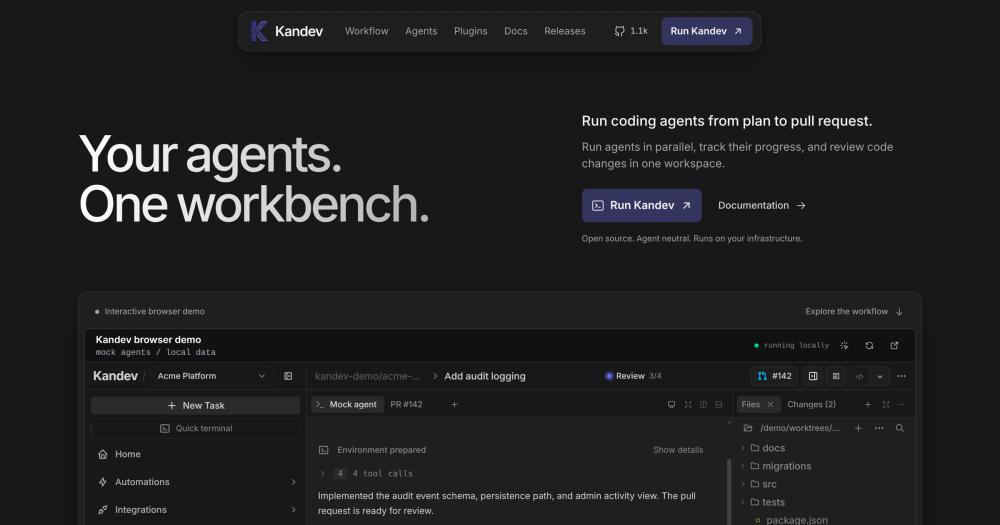
Orchestrate multiple coding agents from plan to pull request with parallel worktrees, human-gated reviews, and no vendor lock-in.

Visit websiteGitHub1.1K starsDeploy on Hostinger
image of Kandev
TL;DR

Kandev is an open source AI kanban board and development workbench for running coding agents in parallel with isolated git worktrees and human-gated code review. It replaces paid commercial agentic platforms with a self-hosted, multi-provider workspace that keeps tasks, plans, agent sessions, and diffs together in one place. Licensed under AGPL-3.0, Kandev runs as a native Go binary via Homebrew, npx, or Docker with no telemetry. Best for developers and teams who run multiple agents simultaneously and need a reviewable, structured workflow rather than untracked CLI sessions.

Read the full breakdownHide the full breakdownWho it is for, how it works, trade-offs, the quick start and the FAQ
who it's for

Who Kandev is for#

Development teams running multiple coding agents in parallel

Teams with two or more developers each running their own agent sessions benefit from Kandev's shared kanban board, isolated worktrees, and centralized review queue. The plan-to-PR workflow keeps every task's context visible to the whole team, not just the person who started it.

Skip if:

Your team runs only one agent session at a time and reviews code directly in GitHub. The overhead of a separate workbench does not pay off at that scale.

Solo developers who want structured, reviewable agent workflows

Kandev's human-gated model lets solo developers define planning and review gates before changes merge, reducing the risk of accepting an agent's output without inspection. Session management and diff review remove the need to track what an agent did from terminal history.

Skip if:

You prefer quick, ad-hoc agent sessions without task-tracking overhead. Terminal agents with direct commit access are simpler when you review every change yourself in real time.

Teams migrating off a commercial agentic platform

Organizations that relied on paid agentic platforms for multi-agent orchestration can self-host Kandev as a replacement. It covers parallel execution, review gates, MCP integration, and PR creation on your own infrastructure with no per-seat pricing.

Skip if:

Your organization needs a fully managed, vendor-supported platform with an enterprise SLA. Kandev is community-supported and self-hosted; there is no enterprise support tier.

Engineers running agents on remote or cloud infrastructure

Kandev's executor model supports SSH, Docker, Kubernetes, and Sprites cloud environments, letting you run compute-heavy agent sessions on a remote server while managing tasks from a laptop or phone. Executor profiles store credentials and settings for each environment.

Skip if:

Your agents run only on your local machine and you have no need for remote or container execution. The standard npx install handles local-only use without the extra configuration.

the problem

The problem it solves#

Running AI coding agents on a real codebase means context switching between terminal sessions, manually tracking what each agent was asked to do, and reviewing diffs in a separate git interface once the agent finishes. When you run more than one agent at a time, concurrent changes to the same files create conflicts, and the work of organizing what each agent should do next falls entirely on the developer.

The review challenge runs deeper still. Agents can produce large diffs across many files, but there is no place to annotate specific lines, compare the before and after, and decide what merges before moving to the next task. Without a structured workspace, teams either slow down to review carefully in their editor or accept the risk of shipping changes they did not fully inspect.

how Kandev solves it

How it solves it#

Parallel agent execution with isolated worktrees

Each task gets its own git worktree, so multiple agents can work on the same repository at the same time without file conflicts. The kanban board tracks each task's status, plan, and agent session independently. Executors can be mixed across tasks: one on local, another in Docker, another via SSH.

Multi-provider agent support

Supports over 20 coding agent CLIs via ACP (Agent Client Protocol) and CLI passthrough mode, including Claude Code, Codex, GitHub Copilot, Gemini CLI, Amp, Cursor, Devin, Qwen, OpenCode, and Auggie. Teams can mix providers across workflow steps, assigning different models to plan, implement, and review stages.

Integrated diff review workspace

After an agent finishes, review the diff in the same workspace without switching to a separate git tool. The plan, agent conversation, and code changes stay together on each task card. Leave feedback on specific changes, ask the agent to revise, and approve before the work moves forward.

Workflow automation and sub-tasks

Trigger agent tasks from schedules, webhooks, or external MCP calls. Multi-step workflows can assign different agents per step. Agents can spawn sub-tasks to split work that grows beyond a single session, producing multiple PRs from the same starting point. Workflow definitions export and import as portable YAML.

Flexible executors

Run agents as local processes, inside Docker containers, on remote servers via SSH, in Kubernetes pods, or in Sprites cloud environments. Executor profiles store environment variables, credentials, and prepare scripts for reuse. Teams can assign private executor ownership to restrict compute access.

Plugin system and integrations

Install community plugins for Slack, Bitbucket, YouTrack, Redmine, and Forgejo from the plugin marketplace. Built-in integrations cover GitHub, GitLab, Jira, Linear, Sentry, and Azure DevOps for ticket import, PR linking, and review activity in the kanban board.

strengths · trade-offs

Strengths and trade-offs#

Strengths

  • No telemetry and full infrastructure ownershipThe Go binary runs on your infrastructure without sending usage data to external services. Code, agent conversations, and task history stay on your machines. The AGPL-3.0 license means the source is inspectable and modifiable under those terms. No cloud account, no API keys to Kandev, and no seat pricing.
  • Agent-neutral design across 20+ providersKandev connects to over 20 coding agent CLIs through ACP without being tied to any one provider's API or pricing. Teams can switch providers, mix models across workflow steps, or add a new agent without changing their task setup. Terminal-based agents without ACP support run in CLI passthrough mode inside a PTY terminal.
  • Server-first architecture with remote accessThe application runs as a server you can access from any device. Agents can run on remote machines over SSH, Docker, or Kubernetes while you manage tasks from a laptop or phone using Tailscale, a Cloudflare Tunnel, or a local network. This separates the control plane from the execution environment.
  • Active development since January 2026Kandev launched in January 2026 and reached 1,063 GitHub stars with 84 contributors and 4,318 commits to the default branch over its first 52 weeks. The project integrates new agent CLIs and executor types as they become available, with 176 forks indicating active community adoption.

Trade-offs

  • -114 open issues on a young projectWith 114 open issues and a project history starting in January 2026, Kandev is under active development and some workflows may change between releases. Teams depending on specific features or integrations should track the issue tracker and release notes before upgrading.
  • -AGPL-3.0 restricts managed service redistributionRunning Kandev internally for your own development workflow is permitted under AGPL-3.0, including internal commercial and team use. Organizations that intend to offer Kandev as a managed or hosted service to others must comply with AGPL-3.0's source-disclosure obligations for that service. Teams with strict open source license policies should review this before adopting.
  • -No managed cloud optionKandev has no hosted SaaS tier. Operations, updates, and backups fall on the team running it. While the Homebrew and npx installs are fast, teams using Docker, Kubernetes, or remote SSH executors need infrastructure know-how. There is no vendor support contract or enterprise SLA.
versus alternatives

Kandev vs alternatives#

Kandev vs Conductor

Conductor is a commercial platform for agentic development workflows that stops working on 2026-11-20.

Kandev covers the same parallel-agent orchestration use case with an AGPL-3.0 license, self-hosted infrastructure, and no telemetry. Teams migrating off Conductor before its end of life will find that Kandev's core workflow (plan, run agents in parallel, review diffs, open PRs) maps closely to what Conductor offered.

FeatureKandevConductor
LicenseAGPL-3.0Proprietary
Self-hostingYesNo
Parallel agent executionYes (isolated worktrees)Yes
Multi-provider agents20+ CLIs via ACPLimited
Human review gatesPlan, review, approvalPlan, review, approval
Plugin systemCommunity marketplaceProprietary
MCP server supportYesYes
CostFree (self-hosted)Paid subscription

Kandev's self-hosted model keeps code and agent conversations on your infrastructure with no vendor dependency and no seat pricing. The agent-neutral design connects any supported CLI without a provider relationship.

Teams that need a managed, vendor-supported platform with an enterprise SLA should note that Kandev is a community-supported project; operations, updates, and issue resolution fall on the team running it.

install · quick start

Quick start#

bash
Install Kandev with Homebrew on macOS or Linux, or run it without a full install using npx.

```bash
brew install kdlbs/kandev/kandev
kandev
```
tech stack · detected from GitHub

What it's built on#

Languages
GoJavaScriptTypeScript
Frameworks
Next.jsReact
frequently asked

FAQ#

What coding agents does Kandev support?

Kandev supports over 20 coding agent CLIs, including Claude Code, Codex, GitHub Copilot, Gemini CLI, Amp, Cursor, Devin, Qwen, OpenCode, Auggie, Kilocode, and AWS Kiro. Most integrations communicate via ACP (Agent Client Protocol). Any terminal-based agent CLI can also run in passthrough mode inside a PTY terminal, even without ACP support. See the GitHub README for the full agent table and install commands.

Is Kandev free to use?

Yes. Kandev is AGPL-3.0 licensed and free to run on your own infrastructure. There is no paid tier, no seat pricing, and no telemetry. The license permits internal commercial and team use. Organizations that intend to offer Kandev as a managed or hosted service to others must comply with AGPL-3.0's source-disclosure obligations for that service.

Does Kandev work on Windows?

Yes. Kandev supports macOS, Linux, and Windows (native or WSL). Install via Scoop on Windows by adding the kandev bucket first: scoop bucket add kandev https://github.com/kdlbs/scoop-kandev then scoop install kandev. On any platform with Node.js 7 or later, npx kandev@latest also works without a package manager install. The Homebrew tap is for macOS and Linux.

Where does Kandev store tasks and agent conversations?

Kandev stores worktrees and its SQLite database in ~/.kandev by default. All data stays on the machine where Kandev runs. No usage data, task content, or agent conversations are sent to external services. You can configure a different storage path through environment settings.

How do I connect Kandev to GitHub or Jira?

GitHub and GitLab connect directly for repository access, PR linking, and review activity. Jira, Linear, Sentry, and Azure DevOps connect through built-in integrations to pull tickets into the kanban board. Bitbucket is available through a community plugin from the plugin marketplace. Connect integrations from the Settings panel after installation.

Looking for more

Other ways to replace Conductor#

paperclip

Featuredfor Conductor

Self-hosted AI agent management with org charts and budgets

111,113 GitHub starsVisit

Orca

#1 in the Conductor guide

Drop-in Conductor replacement with 27 or more agents on macOS, Windows, and Linux under MIT

115,397 GitHub stars

T3 Code

#2 in the Conductor guide

MIT-licensed control plane for 6 or more agents with mobile and web clients and a large community

46,806 GitHub stars

Paseo

#3 in the Conductor guide

Daemon-based architecture for agents running on a VM or Docker host with full mobile parity

23,074 GitHub stars
All 39 Conductor alternatives12 open source Conductor alternatives, ranked
by category

Open source tools in these categories#

487

AI & Machine Learning

freeCodeCamp, REA (Reverse Engineer Anything), OpenClaw
571

Developer Tools

REA (Reverse Engineer Anything), Skills for Real Engineers, superpowers
119

Product & Project Management

agency-agents, freeCodeCamp, Gstack
119

DevOps & CI/CD

Nvm, Uptime Kuma, Netdata
Hostinger

Self-host Kandev on a Hostinger VPS

Keep it running 24/7, even when your laptop is off. A Hostinger VPS gives it a server of its own.

  1. 01

    Choose a plan

    Starts from $6.49/mo

  2. 02

    Apply

    Extra 10% off yearly plans

  3. 03

    Install Kandev

    On a server that stays on

  4. 04

    Start building

    Focus on the app, not the server

Deploy on Hostinger

Sponsors

Inbox Zero

Alternative toSuperhuman

AI email assistant that drafts replies and clears your inbox

  • 12,915 GitHub stars
  • AGPL-3.0Licence AGPL-3.0
  • #Email

rakazo

Alternative toGrok Bot

AI teammates you own: your keys, your model, your machine.

  • 7,028 GitHub stars
  • Apache-2.0Licence Apache-2.0
  • #AI Agents

SnitchFeed

Live monitoring on LinkedIn, X, Reddit & more. Agentic social listening for startups.

Marketing & Growth

Advertise your product

New open source projects by email

The projects we add and every new guide. Free, unsubscribe any time.

Find open source alternatives to paid software

/
  • Claude Code to OpenCode
  • Jira to Windshift
  • Notion to AppFlowy
  • Slack to Mattermost
  • Linear to GitLab
  • Wispr Flow to Handy
  • Arc to Zen Browser
  • CapCut to Concat
  • Grok Bot to rakazo
  • Superhuman to Inbox Zero
  • Airtable to AITable
  • Muse to OpenClaw
  • Railway to Coolify
  • GitHub Copilot to Cline
  • Datadog to Netdata
  • Confluence to Wiki.js
  • Microsoft Teams to Rocket.Chat
  • Firebase to Supabase
  • Pinecone to Qdrant
  • Zapier to n8n
  • 1Password to KeePassXC
  • Devin AI to OpenHands
  • Asana to Leantime
  • Contentful to Strapi