Open Source Alternatives
  • Alternatives
  • Categories
    Categories by size1,108 projects
    • Developer Tools558
    • AI & Machine Learning472
    • Business & Productivity271
    • Web Development208
    • Security & Monitoring171
    • Communication & Collaboration153
    • IT Management145
    • Cloud & Hosting127
    • LLMOps & AI Tooling123
    • Data & Analytics118
    Browse all 21 categoriesProduct & Project Management, DevOps & CI/CD and 9 more
  • Blog
  • Advertise
SearchNotion, Slack, password manager.../
Submit
Open Source Alternatives
  • Alternatives
    • Developer Tools558
    • AI & Machine Learning472
    • Business & Productivity271
    • Web Development208
    • Security & Monitoring171
    • Communication & Collaboration153
    • Browse all 21 categories
  • Blog
  • Advertise
Submit your project

New open source projects by email

The projects we add and every new guide. Free, unsubscribe any time.

Open Source Alternatives LogoOpen Source Alternatives

Handpicked Open Source Alternatives to Paid Softwares

Product

  • Categories
  • Tag
  • Advertise

Resources

  • Blog
  • Collection
  • Submit

Company

  • Privacy Policy
  • Terms of Service
  • Refund Policy
  • Sitemap

Alternatives

  • Claude Code
  • Jira
  • Notion
  • Slack
  • Linear
  • Wispr Flow
  • All alternatives
© 2026 Open Source Alternatives. All rights reserved.
Open SourceAlternatives
Home/Categories/Business & Productivity/Readeck
icon of Readeck

Readeck

Open source alternative to Readwise Reader, Instapaper, Pocket, Raindrop.io and Matter

  • 1.2K stars
  • AGPL-3.0
  • Active this month
  • Last commit 12 days ago

Last verified Nov 5, 2026

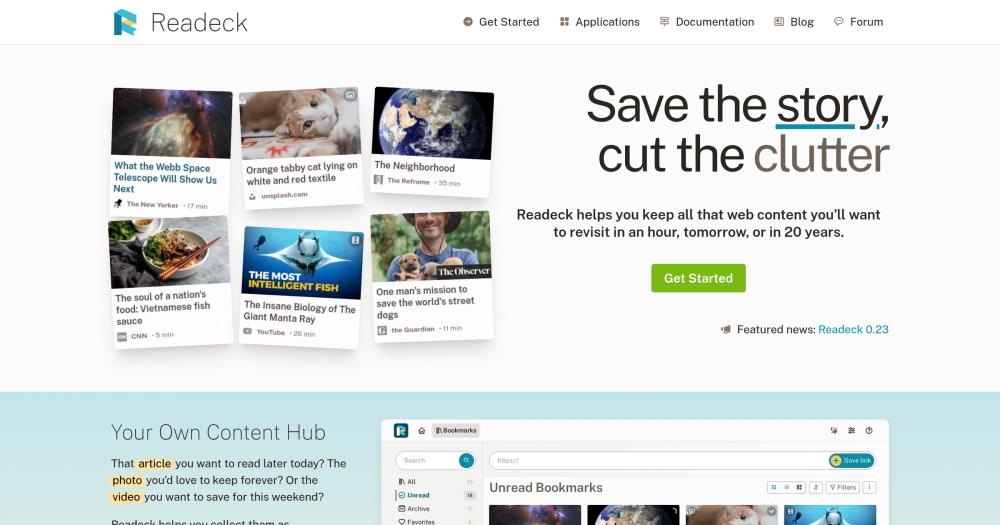
Run a self-hosted read-later app that archives web pages, images, and videos locally with full-text search, EPUB export, and no cloud dependency.

Visit websiteCodeberg1.2K starsDeploy on Hostinger
image of Readeck
TL;DR

Readeck is a self-hosted read-later app that archives web pages, images, and video references in a local ZIP file so saved content is always accessible, even after the original page disappears. It replaces paid tools like Readwise Reader, Raindrop.io, and Instapaper, with no subscription fee and full data ownership. Licensed AGPL-3.0, it runs on Docker or as a single binary with SQLite. Best for privacy-aware readers and researchers who want a permanent personal content archive with full-text search and EPUB export for e-readers.

Read the full breakdownHide the full breakdownWho it is for, how it works, trade-offs, the quick start and the FAQ
who it's for

Who Readeck is for#

Researchers archiving web sources for long-term reference

Researchers saving academic articles, blog posts, and reports need archives that survive link rot. Readeck stores the full page text and images at save time, so a source is accessible indefinitely. Full-text search across all archived content makes it easy to find a specific passage later.

Skip if:

You need to collaborate on a shared reading list with colleagues; Readeck does not have shared collections between multiple users.

E-reader users collecting long-form articles

Readers who prefer consuming articles on a Kindle or Kobo can export any saved article to EPUB, or browse the OPDS catalog directly from the e-reader. Articles saved during the week can be exported as a single collection book for a weekend reading session.

Skip if:

You want automatic daily article delivery to your e-reader without manual export steps; dedicated newsletter-to-e-reader services handle that specific workflow more directly.

Privacy-focused individuals replacing cloud bookmarking services

Cloud read-later services like Instapaper and Raindrop.io store your reading list on their servers and can analyze reading habits. Readeck keeps everything on your own server, with no outbound requests from your browser when reading saved content.

Skip if:

You are not comfortable managing a Linux server or container host. The setup requires basic server knowledge, and there is no cloud-hosted option.

Developers adding read-later to a self-hosted stack

Developers who already self-host other services can add Readeck as a single Docker container. The API supports mobile sync and browser extensions. The SQLite-backed setup requires no separate database server.

Skip if:

Your read-later collection is small and you have no other self-hosted infrastructure. At that scale, the operational overhead is not worth the privacy benefit.

the problem

The problem it solves#

Web pages disappear. The article you saved three years ago may 404 today, or the images may be gone even if the text remains. Services like Pocket handled this for millions of readers, but Pocket ended on 2025-07-08, leaving users without their archives. Subscription-based read-later tools charge per month whether you read frequently or not, and your data lives on their servers, inaccessible if you cancel or if the company folds.

The deeper problem is permanence. A bookmark is a pointer; it breaks. A cloud archive is safer than a bookmark, but it still requires the service to stay alive and you to keep paying. When the service ends or raises prices, your reading history goes with it. Readers who treat saved articles as a long-term personal knowledge base need a durable archive that they own, stored where they control it, with no dependency on a third party's uptime or pricing decisions.

how Readeck solves it

How it solves it#

Full content archiving in an immutable ZIP file

When you save a URL, Readeck fetches the page text and all images and stores them in a single immutable ZIP file on your server. No external requests leave your browser when reading saved content: everything is served from your instance. Articles remain readable even after the original page is taken down, changed, or moved behind a paywall.

Full-text search across archived content

Search runs over the archived text of every saved page, not just titles and labels. Find a half-remembered phrase from an article you saved months ago without knowing the title or source. Labels, favorites, and domain filters narrow results further.

E-Book export and OPDS catalog

Export any saved article as an EPUB for reading on a Kindle or Kobo, or export an entire collection into one book. The OPDS catalog endpoint makes Readeck's library directly accessible from compatible e-readers, so you can browse and download articles without visiting the web interface.

One-click browser extensions for Firefox and Chrome

Save any page from your browser in one click without copying and pasting the URL. Extensions are available for Mozilla Firefox (via addons.mozilla.org) and Google Chrome (via the Chrome Web Store).

Highlights and annotations on saved articles

Mark up important passages in any saved article with highlights and add your own notes to them. Annotations are stored with the bookmark and are searchable alongside the article text.

Collections from saved search queries

Any search query can be saved as a named collection, giving you a persistent view of all bookmarks matching that query as new content is added. Useful for tracking all bookmarks from a specific site or with a specific label combination.

strengths · trade-offs

Strengths and trade-offs#

Strengths

  • No external requests from the browser when readingAfter a page is saved, Readeck serves the archived HTML, images, and assets directly from your instance. When you read a saved article, your browser makes zero requests to the original site or any third-party CDN. This is a privacy guarantee most cloud read-later services cannot offer.
  • Single binary or Docker container, SQLite includedReadeck ships as a precompiled binary and as a container image. No runtime dependencies, no separate background processes, no Postgres required by default: SQLite handles most installs. The whole server is one process.
  • AGPL-3.0 with no paid tier or usage capsThe full feature set is available under AGPL-3.0 for free, with no usage caps, no pro tier, and no telemetry sent home. You run the complete product on your own infrastructure.
  • Go-based server with fast response timesThe server is written in Go and renders pages server-side with Stimulus and Turbo. There is no heavy SPA JavaScript bundle to load on the client. Response times stay fast even on modest hardware.

Trade-offs

  • -209 open issues on CodebergAs of November 2026, the project has 209 open issues. The project is actively maintained with a last push in October 2026, but a large open issue count suggests feature requests and edge cases are accumulating faster than they close.
  • -Videos are not archived locallyReadeck detects video pages and handles them differently from articles, but it does not store video files locally. The README states that videos are the one exception to its full local archiving. For use cases that require offline video access, Readeck is not the right tool.
  • -Requires a self-hosted server to runReadeck has no cloud-hosted option. You need a Linux server, VPS, or home server running continuously for the mobile apps and browser extensions to sync. Users who want a managed service with no server to maintain will find commercial tools like Readwise Reader easier to start.
versus alternatives

Readeck vs alternatives#

Readeck vs Readwise Reader

Readwise Reader is the dominant paid read-later tool for people who highlight and annotate. Readeck and Readwise Reader overlap on article archiving, full-text search, and highlights; they diverge on deployment model and pricing.

FeatureReadeckReadwise Reader
LicenseAGPL-3.0Proprietary
Self-hostingYes (required)No
PricingFree$7.99/mo (Reader only, billed yearly; readwise.io/pricing, Nov 2026)
HighlightsYesYes
AI summarizationNoYes
E-book exportYes (EPUB)No
Mobile appYesYes

Readeck is the better choice for readers who want complete data ownership, no subscription fee, and EPUB export for e-readers. Readwise Reader is worth considering when you need its AI-powered summarization, cross-device sync without a server, or its highlight export integrations with Obsidian and Notion.

Readeck vs Raindrop.io

Raindrop.io is a bookmark manager with a hosted web and mobile experience. Its focus is organizing links with tags and collections rather than archiving full page content for offline reading.

FeatureReadeckRaindrop.io
LicenseAGPL-3.0Proprietary
Self-hostingYesNo
Full page archivingYesPaid plan only
Full-text searchYesYes
EPUB exportYesNo
PricingFreeFree / Pro $30.48/year billed annually (raindrop.io/pro/buy, Nov 2026)

Readeck gives full page archiving to every install at no cost, which Raindrop.io restricts to its paid Pro plan. For offline reading and long-term archival, Readeck is the stronger choice. Raindrop.io is better when you need a polished cross-device bookmark manager with shared collections and collaborative features.

Readeck vs Instapaper and Matter

Instapaper and Matter are cloud-based read-later services with polished mobile apps. Readeck is the right choice when data ownership and local archiving matter more than a managed experience. Instapaper remains a good option for users who want a simple app with direct Kindle send integration and no server to manage. Matter is worth keeping for users who rely on its social reading features and annotation sharing with other readers.

Note on Pocket

Pocket ended its service on 2025-07-08 and is no longer available.

install · quick start

Quick start#

bash
Self-host Readeck using Docker with a persistent data volume.

```bash
docker run --rm -ti -p 8000:8000 -v readeck-data:/readeck codeberg.org/readeck/readeck:latest
```
tech stack · detected from GitHub

What it's built on#

Languages
GoJavaScriptPythonTypeScript
frequently asked

FAQ#

How do I install Readeck?

Readeck can be installed via Docker or as a precompiled binary. For Docker, run: docker run --rm -ti -p 8000:8000 -v readeck-data:/readeck codeberg.org/readeck/readeck:latest. For a binary install, download the file for your operating system from the releases page on Codeberg, make it executable, and run it with the serve argument. The server starts on port 8000 by default.

Does Readeck save videos?

Readeck detects video pages and handles them differently from articles, but it does not download and store video files locally. The README notes that videos are the one exception to its full local archiving. For articles, images, and static pages, everything is saved locally to your server.

Can I access Readeck from my phone?

Yes. Readeck has dedicated smartphone applications that sync your bookmark collection from your self-hosted instance. Browser extensions for Firefox and Chrome are also available for saving pages from desktop browsers.

What is the license for Readeck?

Readeck is licensed under AGPL-3.0. You can run it privately or commercially for internal use at no cost. If you distribute a modified version or run a modified version as a network service accessible to others, you must release your source modifications under the same license.

How is Readeck different from Pocket?

Pocket ended its service on 2025-07-08 and is no longer available. Readeck is a self-hosted alternative: you run it on your own server, your data stays on your infrastructure, and there is no subscription fee. Readeck also archives images alongside article text at save time, which Pocket's reader view did not always do.
also worth a look

Similar open-source tools#

Linkding

Alternative toRaindrop.io

Bookmark manager with tags, archiving, and browser extensions

  • 11,384 GitHub stars
  • MITLicence MIT

Linkwarden

Alternative toRaindrop.io

Self-hosted bookmark manager with archiving and team collaboration

  • 20,312 GitHub stars
  • AGPL-3.0Licence AGPL-3.0

Arcmark

Alternative toAnybox

Native macOS bookmark manager with browser integration

  • 494 GitHub stars
  • MITLicence MIT

CleanYourTV

Featured

Alternative toATV Launcher Pro

Debloat any Android or Google TV over Wi-Fi and get an Apple TV-style home.

  • 51,495 GitHub stars
  • MIT LicenseLicence MIT License

OpenClaw

Featured

Alternative toMuse

Self-hosted AI assistant for WhatsApp, Telegram, and more

  • 393,917 GitHub stars
  • MITLicence MIT

Inbox Zero

Featured

Alternative toSuperhuman

AI email assistant that drafts replies and clears your inbox

  • 12,889 GitHub stars
  • AGPL-3.0Licence AGPL-3.0
by category

Open source tools in these categories#

271

Business & Productivity

OpenClaw, Excalidraw, RustDesk
Hostinger

Self-host Readeck on a Hostinger VPS

Keep it running 24/7, even when your laptop is off. A Hostinger VPS gives it a server of its own.

  1. 01

    Choose a plan

    Starts from $6.49/mo

  2. 02

    Apply

    Extra 10% off yearly plans

  3. 03

    Install Readeck

    On a server that stays on

  4. 04

    Start building

    Focus on the app, not the server

Deploy on Hostinger

Sponsors

Inbox Zero

Alternative toSuperhuman

AI email assistant that drafts replies and clears your inbox

  • 12,889 GitHub stars
  • AGPL-3.0Licence AGPL-3.0
  • #Email

rakazo

Alternative toGrok Bot

AI teammates you own: your keys, your model, your machine.

  • 7,028 GitHub stars
  • Apache-2.0Licence Apache-2.0
  • #AI Agents

SnitchFeed

Live monitoring on LinkedIn, X, Reddit & more. Agentic social listening for startups.

Marketing & Growth

Advertise your product

New open source projects by email

The projects we add and every new guide. Free, unsubscribe any time.

Find open source alternatives to paid software

/
  • Claude Code to OpenCode
  • Jira to Windshift
  • Notion to AppFlowy
  • Slack to Mattermost
  • Linear to GitLab
  • Wispr Flow to Handy
  • Arc to Zen Browser
  • CapCut to Concat
  • Grok Bot to rakazo
  • Superhuman to Inbox Zero
  • Airtable to AITable
  • Muse to OpenClaw
  • Railway to Coolify
  • GitHub Copilot to Cline
  • Datadog to Netdata
  • Confluence to Wiki.js
  • Microsoft Teams to Rocket.Chat
  • Firebase to Supabase
  • Pinecone to Qdrant
  • Zapier to n8n
  • 1Password to KeePassXC
  • Devin AI to OpenHands
  • Asana to Leantime
  • Contentful to Strapi