Open Source Alternatives
  • Alternatives
  • Categories
    Categories by size1,283 projects
    • Developer Tools660
    • AI & Machine Learning543
    • Business & Productivity307
    • Web Development219
    • Security & Monitoring198
    • Communication & Collaboration168
    • IT Management164
    • Design & Creative142
    • LLMOps & AI Tooling140
    • DevOps & CI/CD137
    Browse all 21 categoriesCloud & Hosting, Product & Project Management and 9 more
  • Blog
  • Advertise
SearchNotion, Slack, password manager.../
Submit
Open Source Alternatives
  • Alternatives
    • Developer Tools660
    • AI & Machine Learning543
    • Business & Productivity307
    • Web Development219
    • Security & Monitoring198
    • Communication & Collaboration168
    • Browse all 21 categories
  • Blog
  • Advertise
Submit your project

New open source projects by email

The projects we add and every new guide. Free, unsubscribe any time.

Open Source Alternatives LogoOpen Source Alternatives

Handpicked Open Source Alternatives to Paid Softwares

Add Open Source Alternatives as a preferred source on Google

Product

  • Categories
  • Tag
  • Advertise

Resources

  • Blog
  • Collection
  • Submit

Company

  • Privacy Policy
  • Terms of Service
  • Refund Policy
  • Sitemap

Alternatives

  • Claude Code
  • Jira
  • Notion
  • Slack
  • Linear
  • Wispr Flow
  • All alternatives
© 2026 Open Source Alternatives. All rights reserved.
Open SourceAlternatives
Home/Categories/Web Development/Svelte
icon of Svelte

Svelte

  • 89K stars
  • MIT
  • Active this week
  • Last commit today

Last verified Nov 17, 2026

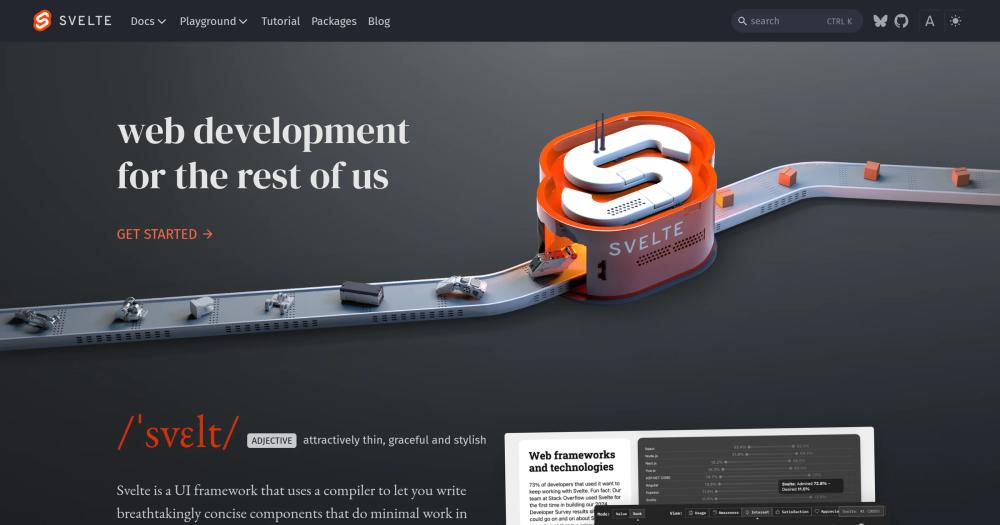
Build web applications with a compiler that converts declarative components into efficient vanilla JavaScript, with no runtime overhead.

Visit websiteGitHub89K stars
Image for Svelte
TL;DR

Svelte is a compiler for building web interfaces. It converts declarative component files into vanilla JavaScript at build time, producing output that surgically updates the DOM with no framework runtime overhead. MIT-licensed and community-maintained, the project has over 89,000 GitHub stars and receives active development. For teams building performance-sensitive web projects, Svelte removes the gap between component authoring and what the browser executes.

Read the full breakdownHide the full breakdownWho it is for, how it works, trade-offs and the FAQ
who it's for

Who Svelte is for#

Performance-critical web projects

Teams building public-facing pages where initial load time and JavaScript bundle size affect user experience will find Svelte's zero-runtime output a direct fit. Smaller bundles translate to faster time-to-interactive for every visitor.

Skip if:

Your team is already committed to a framework with a mature third-party component library ecosystem and migrating would outweigh performance gains.

Developer-owned web applications

Engineering teams that want full control over their markup, component behavior, and output code, rather than committing to a visual builder or managed platform, can use Svelte to build and self-host their own applications.

Skip if:

Non-technical contributors need to edit and publish web content without touching code; a CMS with a visual editing interface will serve that workflow better.

the problem

The problem it solves#

Most JavaScript web frameworks deliver a client-side runtime to the browser alongside application code. That runtime initializes on page load, tracks application state, and executes on every state change throughout the page lifecycle. For developers building public-facing websites where initial load performance and JavaScript weight matter, this runtime cost is a real challenge: it adds to what the browser must download, parse, and execute before anything becomes interactive. Teams wanting component-based development without that overhead have historically faced a trade-off between authoring productivity and delivery cost.

how Svelte solves it

How it solves it#

Compiler-Based Architecture

Svelte is a compiler, not a browser-side runtime library. It reads declarative component files during the build step and emits the JavaScript the browser will run. No framework code travels to the user's device alongside the application.

No Runtime Overhead

Conventional frameworks ship abstractions that run on every page load. Svelte moves all of that work to compile time. The output is vanilla JavaScript with no framework present in the browser's execution environment.

Surgical DOM Updates

The compiled output updates only the specific DOM nodes that need to change in response to state changes. This tight, generated update path reflects what the project describes as code that "surgically updates the DOM."

MIT License

Svelte is released under the MIT license. This permits use in commercial and non-commercial projects, modification, and redistribution with no restrictions beyond attribution.

Active Open Source Project

The Svelte repository has over 89,000 GitHub stars and 6,000 forks. The project receives ongoing commits from a volunteer contributor community, with the most recent code push in November 2026.

strengths · trade-offs

Strengths and trade-offs#

Strengths

  • Zero framework weight in productionEvery byte of JavaScript shipped to the browser is application code produced by the compiler, not framework infrastructure. Teams building pages with strict performance budgets benefit directly from this output model.
  • Unrestricted MIT licenseThe MIT license places no constraints on commercial use, modification, or deployment. Organizations running Svelte-built properties internally or as services owe no licensing fees and face no source disclosure obligations.

Trade-offs

  • -1,000 open issuesThe GitHub repository carried 1,000 open issues at time of research. For a widely used framework, this count includes edge cases, feature requests, and compatibility reports across diverse environments, and some issues may stay open for extended periods.
  • -Volunteer-driven development paceSvelte's development is carried entirely by volunteers, funded through Open Collective donations. Roadmap progress and release frequency depend on contributor availability rather than a dedicated engineering organization.
versus alternatives

Svelte vs alternatives#

Svelte vs Webflow

Webflow is a paid commercial platform for building and hosting websites through a visual editor. Subscriptions are charged per site for publishing and hosting rights, and the product targets designers and marketing teams who want to build pages without writing code. Svelte is a code-level compiler for developers: it produces standard JavaScript from component files and the developer hosts that output on any web infrastructure they choose.

The practical difference is ownership. Webflow's paid tier ties site publishing to a subscription; moving off the platform requires redesigning in a new tool. Svelte output is portable standard web files. Teams that prioritize code ownership and flexibility over visual editing will favor Svelte; teams where non-technical contributors own the content and design workflow may find Webflow's managed environment the more productive choice.

Svelte vs Framer

Framer is a commercial web design and publishing tool with AI-assisted layout features and subscription-based hosting. Like Webflow, it targets the design end of web production rather than the engineering end, and charges for hosting and publishing rights. Svelte sits at the other end of that spectrum: it is a build tool for engineers writing application code.

Teams choosing between the two are really choosing between workflows. Framer's commercial platform provides a managed environment with minimal setup overhead for design-led teams. Svelte provides a compiler and no managed environment, putting hosting, tooling, and infrastructure choices in the developer's hands. There is no subscription cost, and nothing in Svelte's MIT license restricts self-hosted deployment.

tech stack · detected from GitHub

What it's built on#

Languages
JavaScriptTypeScript
Frameworks
Svelte
Tooling
esbuildRollup
frequently asked

FAQ#

Is Svelte free and open source?

Yes. Svelte is released under the MIT license, which permits use in commercial and non-commercial projects, modification, and redistribution without restriction. No subscription or licensing fee applies to any use of the framework.

How does Svelte's compiler approach differ from runtime frameworks?

Runtime frameworks ship a JavaScript library to the browser that runs alongside your application code on every page load. Svelte processes component files at build time and outputs vanilla JavaScript the browser runs directly. No framework is present in the browser's execution environment; the compiler's output is the entire application code, and it updates the DOM surgically in response to state changes.

What is the size of the Svelte community?

The Svelte GitHub repository has over 89,000 stars and more than 6,000 forks. The project maintains a Discord community at svelte.dev/chat and receives financial support through Open Collective. It has been under active development since 2016.

How many open issues does Svelte have?

The repository carried 1,000 open issues at the time this information was gathered, based on GitHub's issue search API excluding pull requests. For a widely used framework, this count includes feature requests, bug reports across diverse environments, and documentation gaps alongside active bug work.

How is Svelte funded and maintained?

Svelte is maintained by volunteers. Its README states that "ongoing development is made possible entirely by fantastic volunteers." Financial support comes through Open Collective, where donations cover development-related expenses such as hosting costs. If sufficient donations are received, funds may also support development more directly.

also worth a look

Similar open-source tools#

Ant Design Vue

Alternative toKendo UI for Vue

Vue component library for enterprise apps, based on Ant Design.

  • 21,716 GitHub stars
  • MITLicence MIT

Angular

InWeb Development

TypeScript web framework with signals, SSR, and first-party modules

  • 101,490 GitHub stars
  • MITLicence MIT

Opensource UI

Alternative toTailwind UI

200+ copy-paste React and Next.js components, MIT licensed, no package

  • 847 GitHub stars
  • MITLicence MIT

Rust

InWeb Development

Systems language with memory safety and no garbage collector.

  • 121,906 GitHub stars
  • Apache-2.0Licence Apache-2.0

Spacebin

Alternative toPastebin.com

Self-hosted pastebin with encrypted pastes and syntax highlighting.

  • 158 GitHub stars
  • Apache-2.0Licence Apache-2.0

Phonedriver

Alternative toBrowserStack

MCP server for AI agents to control Android and iOS devices

  • 148 GitHub stars
  • AGPL-3.0Licence AGPL-3.0
by category

Open source tools in these categories#

219

Web Development

freeCodeCamp, Skills for Real Engineers, superpowers
660

Developer Tools

REA (Reverse Engineer Anything), Skills for Real Engineers, superpowers
51

Web & App Development

Flutter, Rust, Angular

Sponsors

Inbox Zero

Alternative toSuperhuman

AI email assistant that drafts replies and clears your inbox

  • 13,025 GitHub stars
  • AGPL-3.0Licence AGPL-3.0
  • #Email

rakazo

Alternative toGrok Bot

AI teammates you own: your keys, your model, your machine.

  • 8,291 GitHub stars
  • Apache-2.0Licence Apache-2.0
  • #AI Agents

SnitchFeed

Live monitoring on LinkedIn, X, Reddit & more. Agentic social listening for startups.

Marketing & Growth

Advertise your product

New open source projects by email

The projects we add and every new guide. Free, unsubscribe any time.

Find open source alternatives to paid software

/
  • Claude Code to OpenCode
  • Jira to Windshift
  • Notion to AppFlowy
  • Slack to Mattermost
  • Linear to GitLab
  • Wispr Flow to Handy
  • Arc to Zen Browser
  • CapCut to Concat
  • Grok Bot to rakazo
  • Superhuman to Inbox Zero
  • Discord to Stoat
  • Airtable to AITable
  • Datadog to SigNoz
  • Muse to OpenClaw
  • Railway to Coolify
  • GitHub Copilot to Cline
  • Confluence to Wiki.js
  • Microsoft Teams to Rocket.Chat
  • 1Password to KeePassXC
  • Firebase to Supabase
  • Pinecone to Qdrant
  • Zapier to n8n
  • Devin AI to OpenHands
  • Asana to Leantime