Open Source Alternatives
  • Alternatives
  • Categories
    Categories by size1,138 projects
    • Developer Tools582
    • AI & Machine Learning497
    • Business & Productivity275
    • Web Development209
    • Security & Monitoring173
    • Communication & Collaboration154
    • IT Management146
    • Cloud & Hosting128
    • LLMOps & AI Tooling128
    • Product & Project Management121
    Browse all 21 categoriesDevOps & CI/CD, Data & Analytics and 9 more
  • Blog
  • Advertise
SearchNotion, Slack, password manager.../
Submit
Open Source Alternatives
  • Alternatives
    • Developer Tools582
    • AI & Machine Learning497
    • Business & Productivity275
    • Web Development209
    • Security & Monitoring173
    • Communication & Collaboration154
    • Browse all 21 categories
  • Blog
  • Advertise
Submit your project

New open source projects by email

The projects we add and every new guide. Free, unsubscribe any time.

Open Source Alternatives LogoOpen Source Alternatives

Handpicked Open Source Alternatives to Paid Softwares

Product

  • Categories
  • Tag
  • Advertise

Resources

  • Blog
  • Collection
  • Submit

Company

  • Privacy Policy
  • Terms of Service
  • Refund Policy
  • Sitemap

Alternatives

  • Claude Code
  • Jira
  • Notion
  • Slack
  • Linear
  • Wispr Flow
  • All alternatives
© 2026 Open Source Alternatives. All rights reserved.
Open SourceAlternatives
Home/Categories/Developer Tools/Termic
icon of Termic

Termic

Open source alternative to Conductor and Baton

  • 326 stars
  • AGPL-3.0
  • Active this week
  • Last commit today

Last verified Nov 5, 2026

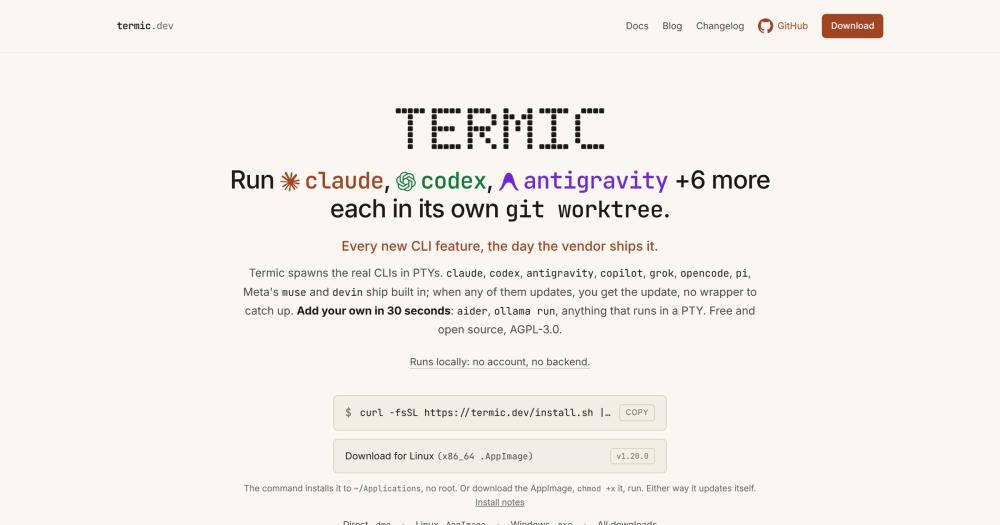
Run AI coding CLIs in parallel git worktrees on a local desktop app; no SDK middleman, no per-token billing, on your existing plan.

Visit websiteGitHub326 stars
image of Termic
TL;DR

Termic is a free, AGPL-3.0 desktop app that runs claude, codex, Antigravity, Grok, Copilot, and other AI coding CLIs in parallel, each in its own git worktree. It replaces Conductor and similar paid agent runners by spawning the real CLI binaries rather than vendor SDKs, keeping inference on a developer's existing Pro or Max subscription. Available on macOS, Linux, and Windows, with no backend and no account required.

Read the full breakdownHide the full breakdownWho it is for, how it works, trade-offs, the quick start and the FAQ
who it's for

Who Termic is for#

Developers running parallel Claude Code sessions

Open four claude tabs, each in its own worktree, and work on separate features or bug fixes simultaneously. The broadcast command and work-done notifications reduce the overhead of monitoring multiple agent sessions.

Skip if:

You only ever run one agent at a time, or you prefer managing worktrees manually from the terminal with git worktree add.

Teams looking for a Conductor alternative

Conductor stops working on 2026-11-20. Termic covers the same core workflow (parallel agents in worktrees, work-done detection, diff review) with an AGPL-3.0 license, local execution, and support for Codex, Antigravity, and custom CLI agents beyond Claude.

Skip if:

Your team depends on Conductor's cloud-hosted session storage or managed remote execution. Termic runs locally and does not replicate those features.

Developers who want an isolated sandbox per agent

Enable the per-task macOS Seatbelt cage to let an agent run with --dangerously-skip-permissions without exposing ~/.ssh, ~/.aws, ~/.gnupg, or Keychains. The in-process network proxy limits outbound connections to per-CLI vendor APIs, GitHub, and package registries by default.

Skip if:

You are on Linux or Windows: the Seatbelt cage is macOS-only. Docker mode is the isolation alternative on those platforms.

Engineers comparing model outputs on the same problem

Fire one prompt at claude, codex, and agy simultaneously using broadcast or agent races, each in its own worktree. Compare their diffs when they finish and adopt the winner, all from one app.

Skip if:

You only use one AI coding CLI. The parallel-agent value is specific to developers with subscriptions to more than one provider.

the problem

The problem it solves#

Running multiple AI coding agents in parallel against the same codebase creates three concrete problems: file conflicts when two agents edit the same path, billing surprises when a third-party orchestrator routes through the vendor SDK rather than the interactive CLI, and no reliable signal for when an agent actually finishes a turn.

The billing problem is specific to the Anthropic ecosystem since June 2026, when Agent SDK usage moved to a separate credit pool from the interactive Claude CLI. Any orchestrator that calls the SDK silently bills against that pool, while a developer who opens claude in a terminal does not. The file-conflict problem is common to every multi-agent workflow: without worktree isolation, two agents writing to the same project produce merge conflicts and lost work.

how Termic solves it

How it solves it#

Parallel worktrees per task

Each task creates a git worktree under ~/termic/tasks/<project>/<name>/, so multiple agents work on separate on-disk copies of the same repository without file conflicts. You can run N agents against the same branch across tabs, attach to repo root for one-off questions, or duplicate a worktree to spin up a parallel attempt from the same commit.

Interactive CLI path, not SDK

Termic spawns the real claude, codex, agy, copilot, and grok binaries in PTYs. Because it launches the interactive CLI rather than the vendor SDK, inference rides on your existing Pro or Max subscription rather than the separate Agent SDK credit meter Anthropic introduced in June 2026. No per-token markup is added.

macOS Seatbelt sandbox per task

An optional per-task cage pairs macOS Seatbelt (filesystem default-deny) with an in-process HTTPS CONNECT proxy (hostname allowlist). ~/.ssh, ~/.aws, ~/.gnupg, and browser profiles are blocked by default. The proxy restricts outbound network to per-CLI vendor APIs plus GitHub and package registries; add your own hosts per project. No daemon to install.

Broadcast and agent races

Shift+Cmd+B sends one prompt to every agent in a task simultaneously. For races, each agent gets its own fresh worktree and you compare their diffs N-up when they finish, then adopt the winner. These features make multi-agent code review and architectural exploration practical without switching between terminal windows.

Spotlight: live worktree sync to main checkout

Spotlight mirrors one task's changes (committed, uncommitted, and untracked) into the main checkout as a detached HEAD in real time, so your editor, dev server, and browser see the agent's work without you switching branches. It never commits to your branch; disabling it cleanly restores the checkout.

Bring your own agent in 30 seconds

The agent registry in Settings is editable. Claude, Codex, Antigravity, Copilot, Grok, opencode, pi, Muse Code, and Devin ship as built-ins. Add aider, an ollama model, or any PTY-compatible tool in roughly 30 seconds by filling in the launch command.

strengths · trade-offs

Strengths and trade-offs#

Strengths

  • No SDK middleman means no extra billingBy spawning the interactive CLI rather than the Agent SDK, Termic stays on your existing Claude Pro or Max subscription. The June 2026 Anthropic credit change made SDK-based tools charge from a separate credit pool; Termic's interactive path is unaffected by that change and adds no per-token markup.
  • Local-only, no account, AGPL-3.0Termic runs entirely on your machine with no backend server and no account. Prompts go xterm to PTY to CLI to wherever the CLI sends them; Termic does not read or forward them. The AGPL-3.0 license means the source is auditable and any fork or derivative stays open, which prevents the tool from quietly going proprietary.
  • Tauri 2 desktop build: ~10 MBThe app uses a Tauri 2 Rust backend and a WKWebView frontend, producing an ~10 MB bundle. Electron typically runs ~120 MB. For teams running many Termic instances or on constrained machines, the size difference is practical, not cosmetic.
  • Reliable work-done notificationThe work-done indicator combines per-CLI title classification (Claude spinner and similar patterns) with OSC 9;4 signals, gated by byte-quiet and content-hash checks, rather than an idle timer. Desktop notifications fire only when an agent actually finishes a turn, so you are not checking tabs constantly or missing a completed run.

Trade-offs

  • -macOS Seatbelt sandbox is macOS-onlyThe per-task filesystem and network cage relies on macOS Seatbelt, which does not exist on Linux or Windows. On those platforms the equivalent is Docker mode, which provides container-based isolation with a stronger filesystem boundary but does not restrict network egress the way the CONNECT proxy does on macOS. Linux users also lose the sandbox toggle on the task shield icon.
  • -Windows support is experimentalThe Windows installer is not code-signed yet, so SmartScreen asks for confirmation on first launch. Windows support is documented as experimental and not yet used as a daily driver by the maintainer. The macOS Seatbelt sandbox does not exist on Windows; Docker mode is the available isolation path there.
  • -AGPL-3.0 share-alike applies to forks and hosted derivativesTermic is free to run, modify, and use internally for any purpose, including commercial team use. The AGPL-3.0 share-alike clause requires that anyone who distributes a modified version, or runs a modified version as a hosted service accessible to others, must release those modifications under AGPL-3.0. Using Termic to run your own coding agents on your own machine is not affected by this clause.
versus alternatives

Termic vs alternatives#

Termic vs Conductor

Conductor is a commercial agent orchestrator that runs Claude in parallel worktrees with a checkpoint-commit approach. Conductor stops working on 2026-11-20.

FeatureTermicConductor
LicenseAGPL-3.0Proprietary
PlatformsmacOS, Linux, WindowsmacOS only
AgentsClaude, Codex, Antigravity, Grok, Copilot, customClaude only
DeploymentLocal desktop app, no backendCloud-backed sessions
SandboxmacOS Seatbelt + network proxyNone documented
CostFreePaid

Termic spawns the interactive CLI rather than the Agent SDK, which keeps usage on a developer's existing Pro or Max subscription. Conductor's checkpoint approach commits to your branch; Termic's Spotlight feature syncs changes to the main checkout as a detached HEAD and leaves no commits behind.

Termic vs Baton

Baton is a commercial tool for orchestrating AI coding agents with a managed cloud backend. Termic runs entirely locally with no account or backend server, so there is no service to authenticate with and no data leaving the machine.

FeatureTermicBaton
LicenseAGPL-3.0Proprietary
DeploymentLocal desktop appCloud-managed
Agent typesMultiple CLI agentsCloud-orchestrated
Offline useYesNo

Termic is the better choice when data privacy, local execution, or CLI flexibility is a requirement. Baton is worth considering when managed cloud orchestration, team-level session sharing, or a hosted environment is a requirement that cannot be met with a local desktop tool.

install · quick start

Quick start#

bash
Install on macOS via Homebrew; on Linux, the install script downloads the signed AppImage.

```bash
# macOS
brew install --cask simion/termic/termic

# Linux
curl -fsSL https://termic.dev/install.sh | sh
```
tech stack · detected from GitHub

What it's built on#

Languages
JavaScriptRustTypeScript
Frameworks
React
frequently asked

FAQ#

Does Termic use my Claude Pro or Max plan, or does it charge separately?

Termic spawns the interactive claude CLI, the same binary as running claude in a terminal. Anthropic's June 2026 Agent SDK credit change moved the SDK and claude -p onto a separate credit pool; the interactive CLI stays on regular Pro or Max usage limits. Termic adds no markup and routes no inference through its own backend.

Is Termic free and open source?

Yes. Termic is AGPL-3.0, free to use, and free to build from source. The AGPL means any fork or derivative must also remain open source under AGPL-3.0. The source is on GitHub at github.com/simion/termic. The app itself costs nothing; you pay only for whatever CLI subscriptions you already use.

Does Termic see my prompts or read my code?

No. Termic is a local app with no backend. Prompts travel from the terminal emulator through a PTY to the CLI binary to wherever the CLI sends them; Termic does not read or forward them. A debug log in the system temp directory is available but off by default. Because the app is fully open source, you can read exactly what it does and build it yourself to verify.

What is the macOS sandbox and when should I enable it?

The per-task sandbox combines macOS Seatbelt (default-deny filesystem) with an in-process HTTPS CONNECT proxy (hostname allowlist). It blocks the agent from reading ~/.ssh, ~/.aws, ~/.gnupg, Keychains, browser profiles, and personal folders. Network is restricted to per-CLI vendor APIs, GitHub, and package registries by default. Enable it for any task where you want to run with --dangerously-skip-permissions without full system exposure. The sandbox is pinned at task creation and cannot be changed on a live task.

Does Termic work on Linux and Windows?

Yes, with caveats. Linux ships as a signed x86_64 AppImage; the in-app updater works the same as on macOS. Windows 11 x64 ships as an experimental per-user installer that is not yet code-signed, so SmartScreen asks once on first launch. The macOS Seatbelt sandbox does not exist on Linux or Windows; Docker mode is the isolation alternative. The rest of the feature set, including worktrees, parallel tabs, diff view, and broadcast, works the same on all three platforms.

Looking for more

Other ways to replace Conductor and Baton#

paperclip

Featuredfor Conductor

Self-hosted AI agent management with org charts and budgets

111,113 GitHub starsVisit

Orca

#1 in the Conductor guide

Drop-in Conductor replacement with 27 or more agents on macOS, Windows, and Linux under MIT

115,397 GitHub stars

T3 Code

#2 in the Conductor guide

MIT-licensed control plane for 6 or more agents with mobile and web clients and a large community

46,806 GitHub stars

Paseo

#3 in the Conductor guide

Daemon-based architecture for agents running on a VM or Docker host with full mobile parity

23,074 GitHub stars
All 50 Conductor alternatives12 open source Conductor alternatives, ranked
by category

Open source tools in these categories#

582

Developer Tools

REA (Reverse Engineer Anything), Skills for Real Engineers, superpowers
497

AI & Machine Learning

freeCodeCamp, REA (Reverse Engineer Anything), OpenClaw

Sponsors

Inbox Zero

Alternative toSuperhuman

AI email assistant that drafts replies and clears your inbox

  • 12,915 GitHub stars
  • AGPL-3.0Licence AGPL-3.0
  • #Email

rakazo

Alternative toGrok Bot

AI teammates you own: your keys, your model, your machine.

  • 7,028 GitHub stars
  • Apache-2.0Licence Apache-2.0
  • #AI Agents

SnitchFeed

Live monitoring on LinkedIn, X, Reddit & more. Agentic social listening for startups.

Marketing & Growth

Advertise your product

New open source projects by email

The projects we add and every new guide. Free, unsubscribe any time.

Find open source alternatives to paid software

/
  • Claude Code to OpenCode
  • Jira to Windshift
  • Notion to AppFlowy
  • Slack to Mattermost
  • Linear to GitLab
  • Wispr Flow to Handy
  • Arc to Zen Browser
  • CapCut to Concat
  • Grok Bot to rakazo
  • Superhuman to Inbox Zero
  • Airtable to AITable
  • Muse to OpenClaw
  • Railway to Coolify
  • GitHub Copilot to Cline
  • Datadog to Netdata
  • Confluence to Wiki.js
  • Microsoft Teams to Rocket.Chat
  • Firebase to Supabase
  • Pinecone to Qdrant
  • Zapier to n8n
  • 1Password to KeePassXC
  • Devin AI to OpenHands
  • Asana to Leantime
  • Contentful to Strapi