Open Source Alternatives
  • Alternatives
  • Categories
    Categories by size1,107 projects
    • Developer Tools557
    • AI & Machine Learning472
    • Business & Productivity270
    • Web Development208
    • Security & Monitoring171
    • Communication & Collaboration153
    • IT Management145
    • Cloud & Hosting127
    • LLMOps & AI Tooling123
    • Data & Analytics118
    Browse all 21 categoriesProduct & Project Management, DevOps & CI/CD and 9 more
  • Blog
  • Advertise
SearchNotion, Slack, password manager.../
Submit
Open Source Alternatives
  • Alternatives
    • Developer Tools557
    • AI & Machine Learning472
    • Business & Productivity270
    • Web Development208
    • Security & Monitoring171
    • Communication & Collaboration153
    • Browse all 21 categories
  • Blog
  • Advertise
Submit your project

New open source projects by email

The projects we add and every new guide. Free, unsubscribe any time.

Open Source Alternatives LogoOpen Source Alternatives

Handpicked Open Source Alternatives to Paid Softwares

Product

  • Categories
  • Tag
  • Advertise

Resources

  • Blog
  • Collection
  • Submit

Company

  • Privacy Policy
  • Terms of Service
  • Refund Policy
  • Sitemap

Alternatives

  • Claude Code
  • Jira
  • Notion
  • Slack
  • Linear
  • Wispr Flow
  • All alternatives
© 2026 Open Source Alternatives. All rights reserved.
Open SourceAlternatives
Home/Categories/Marketing & Growth/useSend
icon of useSend

useSend

Open source alternative to Resend, SendGrid, Postmark, Mailgun and Amazon SES

  • 4.8K stars
  • AGPL-3.0
  • Active this week
  • Last commit 4 days ago

Last verified Nov 5, 2026

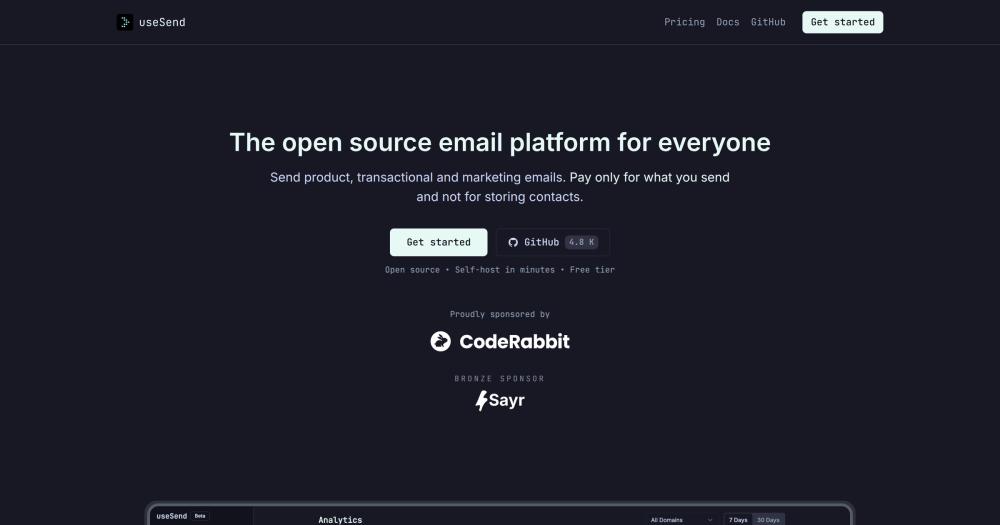
Host transactional and marketing emails from your own infrastructure, backed by Amazon SES, with a visual editor, delivery analytics, and typed SDKs.

Visit websiteGitHub4.8K starsDeploy on Hostinger
image of useSend
TL;DR

useSend is an open source email platform for transactional and marketing sends, built on Amazon SES under the hood. It replaces paid commercial email services like Resend, SendGrid, and Postmark for teams who want to own their email infrastructure. Licensed under AGPL-3.0 and deployed via Docker, useSend adds a dashboard, visual campaign editor, delivery analytics, contact management, and typed SDKs on top of SES. Best for developers and product teams who want to control their email stack without per-contact storage fees.

Read the full breakdownHide the full breakdownWho it is for, how it works, trade-offs, the quick start and the FAQ
who it's for

Who useSend is for#

Developer teams sending transactional emails from SaaS apps

useSend's REST API and typed SDKs (TypeScript, Python, Go) cover the standard transactional email flow: account verifications, password resets, and event notifications. The SMTP relay also works for apps that already send via SMTP without an API integration.

Skip if:

Your app sends very high volumes and needs deliverability consulting, IP warming support, or dedicated IPs out of the box. Commercial transactional email services include those features; useSend's deliverability depends on your own Amazon SES reputation, which you need to build and maintain.

Newsletter teams migrating away from per-contact pricing

useSend supports contact lists and the visual campaign editor needed for newsletters. Teams like Papermark (30,000+ subscribers) have used it in production. The free cloud tier covers up to 3,000 sends per month; heavier senders benefit most from the self-hosted path where send costs are only SES rates.

Skip if:

Your team needs an extensive automation and workflow builder with conditionals, A/B testing, and deep CRM integrations. useSend covers basic campaign sending and contact management; it does not currently offer full marketing automation.

Infrastructure teams adding a dashboard layer on top of Amazon SES

Teams already on AWS who need delivery analytics, contact management, and an API layer on top of SES without building those themselves. useSend adds the full sending stack while keeping SES as the actual delivery mechanism, with no additional per-contact fees on top of SES costs.

Skip if:

You have no existing AWS footprint and are starting from scratch. Setting up an AWS account, verifying SES domains, and managing DMARC/SPF records takes additional work before useSend's features are accessible.

the problem

The problem it solves#

Most commercial email platforms charge per contact stored, not just per email sent. As a subscriber list grows, the monthly bill scales with it even when send volume stays flat. Teams running newsletters or product updates on tools like Resend, Mailgun, or Postmark also face vendor lock-in: their sending history, suppression lists, contact data, and templates live on the provider's infrastructure. If pricing changes or a plan is discontinued, there is no self-hosted path out.

For developers who already have AWS credentials, Amazon SES itself is inexpensive but bare: it offers delivery but no dashboard, no campaign editor, no analytics, and no contact management. Building those layers on top of SES takes time and ongoing maintenance. useSend was built to fill that gap, giving teams the full sending stack with SES handling delivery.

how useSend solves it

How it solves it#

Real-Time Delivery Analytics

Tracks deliveries, opens, clicks, bounces, and unsubscribes in real time through a searchable log. Filter by domain, status, or API key and export results. Campaign performance is visible per send, making it straightforward to identify deliverability issues or top-performing campaigns.

Visual Marketing Email Editor

Design campaigns with a Notion-like WYSIWYG editor that works in major email clients. Reuse templates and brand styles, and personalize content with variables. The editor is built on tiptap and jsx-email and is published as a separate open source package at usesend/useSend.

Contact Management with Suppression List

Manage contacts, lists, and consent in one place. Import and export contacts, track per-list subscription status, and automatically update contacts from bounces and complaints. The suppression list is auto-populated from bounces and complaints and is manageable via import, export, or API.

Drop-In SMTP Relay

Provides a drop-in SMTP relay that works with any app or framework without requiring API integration. Documented specifically for use with services like Supabase that need an outgoing SMTP endpoint. Existing apps that already send via SMTP can point to useSend with no code changes.

Typed SDKs for TypeScript, Python, and Go

Official SDKs are available for TypeScript, Python, and Go. Each wraps the REST API for sending emails with typed request and response objects. Authentication uses a Bearer API key prefixed with 'us_', and the base URL is app.usesend.com.

Schedule API and Webhook Support

The Schedule API allows delayed or time-specific email sends. Webhooks let your application react to delivery events (delivered, bounced, opened, clicked) in real time. Both features are marked as implemented in the README feature checklist alongside transactional mail and SMTP.

strengths · trade-offs

Strengths and trade-offs#

Strengths

  • No per-contact storage feesuseSend's pricing charges only for emails sent, not for how many contacts you store. The free cloud tier allows up to 3,000 email sends per month. This contrasts with paid platforms like Mailgun and Resend that charge contact-based monthly fees even when send volume is low.
  • Amazon SES delivery at SES ratesuseSend routes sends through Amazon SES, the same infrastructure many paid email APIs use internally. Self-hosters pay SES directly at SES pricing rather than a marked-up commercial rate. Teams already on AWS keep everything within one provider and can use existing SES domain verifications.
  • Active project with 4,700+ GitHub starsCreated in March 2024, the repository had 4,783 stars and 446 forks as of November 2026, with the last push on October 31, 2026. The project participates in Hacktoberfest to attract contributors. Community adoption includes teams at Coolify, Papermark, and doras.to.

Trade-offs

  • -Requires Postgres, Redis, and AWS credentials to self-hostThe Docker deployment requires a Postgres database, Redis for queuing, and Amazon SES credentials including AWS account setup and domain verification. This is not a zero-dependencies install. Teams without existing AWS infrastructure need to configure SES before useSend's features are accessible.
  • -Inbound email not yet supportedThe README's feature checklist marks inbound email as planned but not yet implemented. Teams that need to receive and parse inbound mail cannot use useSend for that use case today.
  • -Beta status: API surfaces may changeThe README notes the project is currently in beta. Under active development since 2024, some configuration formats and API details may change between releases. Teams running useSend in production should track release notes.
versus alternatives

useSend vs alternatives#

useSend vs Resend

Both provide developer-focused email APIs for transactional sends, but their ownership and pricing models differ. Resend is a managed proprietary service; useSend is self-hostable and AGPL-3.0 licensed.

FeatureuseSendResend
LicenseAGPL-3.0Proprietary
Self-hostingYesNo
Contact storage feeNoneYes (contact-based plans)
Marketing email editorVisual WYSIWYGBroadcasts (WYSIWYG editor)
SMTP relayYesYes
Pricing modelPay-per-send via SESPlan-based

useSend is the stronger choice when you want to self-host your email stack, avoid per-contact storage fees, and need both transactional and marketing emails from one deployment. Resend is worth considering if you want a polished managed service with strong deliverability out of the box and no infrastructure to maintain.

useSend vs SendGrid

SendGrid covers transactional email, marketing campaigns, and analytics at large scale. useSend covers the same surface area for smaller to mid-sized teams with the advantage of full infrastructure ownership.

FeatureuseSendSendGrid
LicenseAGPL-3.0Proprietary
Self-hostingYesNo
Marketing emailVisual editorDrag-and-drop editor
Developer SDKsTypeScript, Python, GoMultiple languages
PricingPay-per-send via SESContact-based plans

Teams running transactional emails and newsletters at startup or SMB scale will find useSend adequate with significantly lower costs when self-hosted. SendGrid remains the better fit when you need enterprise-level deliverability, dedicated IP warming, and 24/7 support SLAs.

useSend vs Postmark

Postmark focuses on transactional email speed and deliverability with no marketing campaign feature. useSend covers both transactional and marketing sends; Postmark does not include a campaign editor or contact list management. useSend's self-hosted path costs less for teams with existing AWS accounts. Postmark is the better choice when fast transactional delivery, a polished inbox preview tool, and a fully managed service are your primary concerns.

install · quick start

Quick start#

bash
Self-host useSend using Docker; images are published to DockerHub and GitHub Container Registry, and a Railway template is available for one-click deploy.

```bash
docker pull usesend/usesend
```
tech stack · detected from GitHub

What it's built on#

Languages
JavaScriptPythonTypeScript
Frameworks
Next.jsReact
Infrastructure
AWS
Cache
Redis
frequently asked

FAQ#

Does useSend require Amazon SES to operate?

Yes. useSend uses Amazon SES as its delivery layer, so you need an AWS account with SES enabled. The self-hosted path also requires Postgres, Redis, and your SES credentials as environment variables. The cloud-hosted tier manages SES credentials on your behalf.

What is the useSend free tier?

The cloud-hosted free tier allows up to 3,000 email sends per month, up to 100 per day, one contact book, one domain, and one team member. Self-hosted deployments have no built-in send limits beyond what your Amazon SES account allows.

Is useSend AGPL-3.0 licensed? Can I use it commercially?

Yes, useSend is licensed under AGPL-3.0. You can run it on your own infrastructure for internal or commercial use. The AGPL copyleft provision applies if you distribute a modified version as a network service to others: in that case, you must publish your modifications. Running it internally for your own team does not trigger this requirement.

Can useSend handle both transactional and marketing emails?

Yes. useSend supports both use cases from one installation. Transactional emails are sent via the REST API or SMTP relay. Marketing emails are built with the visual campaign editor and scheduled or sent to contact lists. On the cloud tier, transactional emails cost $0.0004 each and marketing emails cost $0.001 each.

Does useSend support inbound email?

Not yet. The README marks inbound email as a planned but not yet implemented feature. As of October 2026, useSend handles outbound sending only. Teams that need inbound email parsing should evaluate other tools for that specific need.

also worth a look

Similar open-source tools#

Plunk

Alternative toSendGrid

Transactional email, campaigns, and automations on one contact list.

  • 5,576 GitHub stars
  • AGPL-3.0Licence AGPL-3.0

FckSignups

InCustomer Support

Open-source tools that work instantly, no signup required

  • 4,539 GitHub stars
  • GPL-3.0Licence GPL-3.0

OpenClix

Alternative toBraze

Open source mobile retention and engagement automation

  • 39 GitHub stars
  • MITLicence MIT

Agent Reach

Featured

Alternative toFirecrawl

Give any AI agent internet access, free and local

  • 108,787 GitHub stars
  • MITLicence MIT

Shlink

Alternative toBitly

Self-hosted URL shortener with REST API, CLI, and visit analytics

  • 5,402 GitHub stars
  • MITLicence MIT

LibreTranslate

Alternative toDeepL Pro

Self-hosted, offline-capable machine translation API.

  • 17,276 GitHub stars
  • AGPL-3.0Licence AGPL-3.0
by category

Open source tools in these categories#

70

Marketing & Growth

agency-agents, MoneyPrinterTurbo, MiroFish
87

APIs & Integration

n8n, Firecrawl, iptv
558

Developer Tools

REA (Reverse Engineer Anything), Skills for Real Engineers, superpowers
Hostinger

Self-host useSend on a Hostinger VPS

Keep it running 24/7, even when your laptop is off. A Hostinger VPS gives it a server of its own.

  1. 01

    Choose a plan

    Starts from $6.49/mo

  2. 02

    Apply

    Extra 10% off yearly plans

  3. 03

    Install useSend

    On a server that stays on

  4. 04

    Start building

    Focus on the app, not the server

Deploy on Hostinger

Sponsors

Inbox Zero

Alternative toSuperhuman

AI email assistant that drafts replies and clears your inbox

  • 12,889 GitHub stars
  • AGPL-3.0Licence AGPL-3.0
  • #Email

rakazo

Alternative toGrok Bot

AI teammates you own: your keys, your model, your machine.

  • 7,028 GitHub stars
  • Apache-2.0Licence Apache-2.0
  • #AI Agents

SnitchFeed

Live monitoring on LinkedIn, X, Reddit & more. Agentic social listening for startups.

Marketing & Growth

Advertise your product

New open source projects by email

The projects we add and every new guide. Free, unsubscribe any time.

Find open source alternatives to paid software

/
  • Claude Code to OpenCode
  • Jira to Windshift
  • Notion to AppFlowy
  • Slack to Mattermost
  • Linear to GitLab
  • Wispr Flow to Handy
  • Arc to Zen Browser
  • CapCut to Concat
  • Grok Bot to rakazo
  • Superhuman to Inbox Zero
  • Airtable to AITable
  • Muse to OpenClaw
  • Railway to Coolify
  • GitHub Copilot to Cline
  • Datadog to Netdata
  • Confluence to Wiki.js
  • Microsoft Teams to Rocket.Chat
  • Firebase to Supabase
  • Pinecone to Qdrant
  • Zapier to n8n
  • 1Password to KeePassXC
  • Devin AI to OpenHands
  • Asana to Leantime
  • Contentful to Strapi